Mount Iwato
The Book of Five RingsMount Iwato is the setting in which Miyamoto Musashi announces the purpose and circumstances of his book, joining a precise moment of composition to acts of homage and prayer. The mountain frames The Book of Five Rings as a work written by an experienced warrior who seeks to explain strategy through a Way aligned with nature.
Setting and Composition
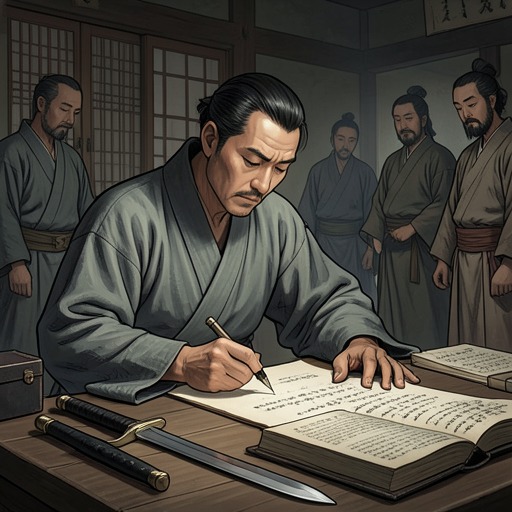
In the first ten days of the tenth month of 1645, in the twentieth year of the Kan’ei era, Musashi says he has climbed Mount Iwato in Higo Province, on Kyushu. He is sixty years old. From the mountain he pays homage to heaven, prays to Kwannon, and kneels before Buddha. These details locate the book’s opening in a specific landscape and moment, while presenting its author not only as a strategist but as someone undertaking acts of reverence.
Musashi dates his writing to the night of the tenth day of that month, at the hour of the tiger, between three and five in the morning. He says he has trained for many years in the Way of Strategy, called Niten Ichi-ryū, and is explaining it in writing for the first time. The mountain is therefore the immediate setting for a written undertaking grounded in a lifetime of practice.
The Mountain and the Author’s Purpose
The ascent follows Musashi’s account of a career shaped by combat and later reflection. He recalls winning encounters from the age of thirteen onward, including duels at thirteen and sixteen, and says that by the time he was thirty he questioned whether his victories came from mastery, natural ability, heaven’s order, or the inferiority of other schools. He then describes studying morning and evening until he realized the Way of Strategy at fifty. At Mount Iwato, the book’s explanation comes from this longer process of testing and reconsideration.
Musashi distinguishes his approach from a compilation of established authorities: he says he has not relied on Buddhist law, Confucian teachings, old war chronicles, or books of martial tactics. Instead, he takes up his brush to explain the spirit of his school as mirrored in the Way of heaven and Kwannon. The mountain’s religious setting thus accompanies, rather than replaces, his claim that strategy is a practical discipline developed through study and experience.
From Ground to Void
The book’s structure extends the opening’s sense of orientation into five books: Ground, Water, Fire, Wind, and Void. The Ground book lays out the broad route of the Way; Water presents the principles of the Ichi school; Fire concerns fighting; Wind examines other traditions; and Void addresses what has no beginning or end. Mount Iwato is not identified as the setting for each later book, but the opening there gives the larger work a point of departure: a mountain ascent precedes an account that moves from foundational instruction toward the Void.
In describing the Void, Musashi warns against treating what is merely misunderstood as nothingness. He connects strategy to nature and says that knowing what exists makes it possible to know what does not. The relationship between the mountain and this teaching remains an implication of the book’s framing, not an explicit identification of Mount Iwato with the Void. The opening’s acts of reverence and the concluding account of the Void nevertheless place the practical teaching within a wider inquiry into how the Way is perceived.
Closing Date and Documentary Frame
The surviving text closes with a separate date: the twelfth day of the fifth month in the second year of the Shōhō era, 1645, followed by the name of Terao Magonojo and Musashi’s signature. This is later than the date given for the writing at Mount Iwato, and the book does not explain the relationship between the two dates. The distinction preserves the mountain’s particular significance: it is the setting named when Musashi begins to explain the work, while the closing date and signatures mark the document’s final frame.