
The Meaning of Justice in Investigation
The Caves of SteelDetective procedure repeatedly collides with the limits of legal proof, the risks of false accusation, and the moral consequences of selective truth.
increasing Bearing strength in each event
 decreasing
Bearing strength in each eventdecreasingA Case Outside Federal Reach

A Case Outside Federal Reach
Jurisdiction disputed
The Terrestrial Bureau of Investigation declines to take the Sarton case, though Spacetown has extraterritorial rights. New York’s police are left responsible for a crime with international consequences.
Law cannot settle politics
The legal location of the crime does not answer how Earth should respond to the Outer Worlds. Baley must conduct an investigation whose results will be judged politically as well as judicially.
Procedure begins under diplomatic pressure.
The Robot Witness Problem

The Robot Witness Problem
Accurate memory, weak standing
Daneel can remember faces in a crowd with exactness, but Baley says a robot’s testimony has no standing in an Earth court. The best witness may be unusable under human institutions.
Procedure against certainty
The detectives cannot simply arrest men based on Daneel’s recognition without proof that a court will accept. Their legal system values admissible evidence, not merely confidence.
The case exposes a gap between knowing and proving.
Jessie’s Name in a Report
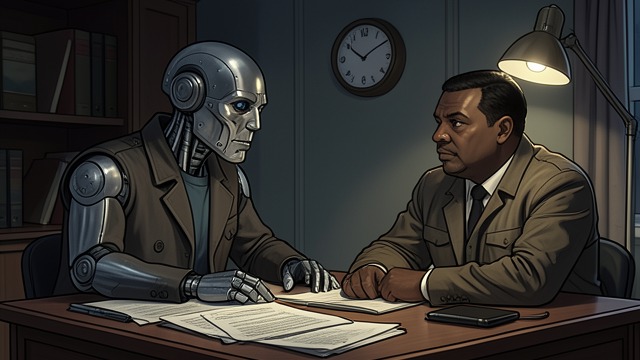
Jessie’s Name in a Report
Accuracy demanded
Daneel objects when Baley wants to omit Jessie’s name from the report. He regards a complete account as necessary to truthful procedure.
Human protection requested
Baley believes her participation was harmless and fears that official records would ruin her standing. His request makes the conflict personal: factual completeness may cause disproportionate harm.
Neither position is entirely free of cost.
The Frame’s False Proof

The Frame’s False Proof
Circumstantial logic
Baley’s trip through the plant, dislike of R. Sammy, and Jessie’s visit can be arranged into a plausible accusation. Each fact is true, but together they suggest a false motive.
The detective’s defense
Baley challenges the timeline and asks who had both opportunity and knowledge. He must work against the same evidentiary logic that could condemn him.
The case shows how facts can mislead when their arrangement is dishonest.
Confession Without Trial

Confession Without Trial
Truth established privately
Enderby’s reaction confirms Baley’s account, and the glasses provide physical support. Yet the solution is reached through confrontation rather than a complete public trial.
A compromise accepted
Baley and Daneel offer secrecy and a chance to repair the political damage if Enderby cooperates. Justice becomes a negotiated response to larger consequences.
The case ends with truth known but punishment uncertain.
At the first briefing
After Daneel identifies the watchers
After the motorway confession
During Enderby’s questioning of Baley
At the conclusion, after the glass fragments are identified
