Laník
The Glass RoomLaník, the young custodian of Landauer House, remains inside it through the Landauers’ flight, its seizure by the Nazi authorities, and its subsequent abandonment. He neither owns the house nor feels at home in its celebrated Glass Room; he and his sister depend on rooms at the rear of the garage and on the building’s kitchens and basement. His story exposes the gap between possession on paper and the precarious claim of people who need a roof, while his recollections preserve traces of the family whose home he occupies.
Identity and Place in the Household
Laník works for the Landauers and lives on the property with his sister. His position is intimate but subordinate: he moves through the house, tends to its fittings, and hears what happens behind doors, yet he is not part of the family. When the Landauers prepare to leave, Viktor gives him one of his final instructions: board up the onyx wall with plasterboard on both sides and make it an ordinary partition. The order treats the striking feature as something to conceal or alter, while leaving its implementation to the servant who will remain behind.
The house is not Laník’s ideal home. He has often told his sister that he cannot understand the family’s attachment to it, comparing it to a fish tank and saying that, if it is a house, it is not a home. Yet he prefers it within his own sphere of influence. That distinction defines his relationship to the building: aesthetic dislike does not cancel practical attachment, and dependence does not become ownership simply because the owners have gone.
The Family’s Departure and the Empty House
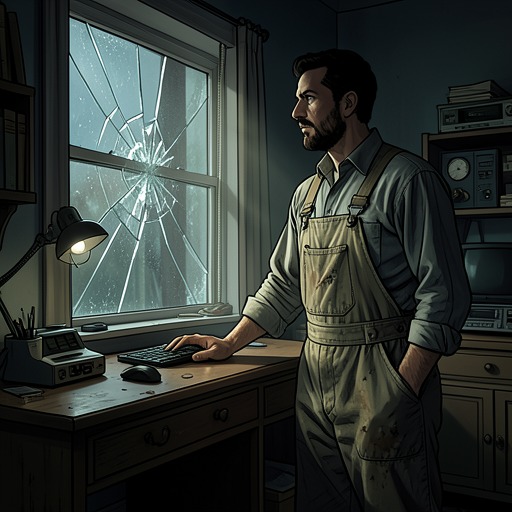
After the Landauers leave, Laník stands in the Glass Room and examines the chairs left behind, the glistening floor, the wooden dining partition, the honey-coloured onyx wall, the chrome pillars, the milk-white lights, and the plate glass. He feels immense relief that the family has gone and that he is his own master. But the release is qualified. The house feels like a theatre after its actors have departed: only the props remain, along with faint echoes of performances he once overheard from behind the kitchen door or glimpsed when he sneaked out to look.
His new control is therefore a borrowed and unstable one. He does not covet the house, but wants it to remain within his reach; meanwhile, the Landauers’ departure leaves him with their rooms, objects, and memories rather than a settled claim. When he hears that they may establish themselves in Switzerland, he speaks of them as people who never have a fixed home and uses an antisemitic slur for Jews. In the same exchange, however, he admits that he will miss Liesel. His prejudice and his personal attachment coexist, without resolving into either loyalty or simple hostility.
Occupation and the Limits of Possession
The house’s status changes from private home to state property under German occupation. When a planning-department official inspects it, he checks the plans against the nearly empty rooms and corrects Laník’s account of the children’s bedrooms: they were the children’s rooms. Laník then asks what will happen to him and his sister. The official gives no assurance, saying their position depends on what is done with the building. Laník insists that they live there too and need a roof over their heads; the plea makes clear that the disappearance of the owners does not make the building’s other residents secure.
The official measures the great room—approximately sixteen by thirty-two metres and more than five hundred square metres per floor—and dismisses it as a space in which people could hardly be housed, more like a gymnasium than a living room. The judgment reduces the Glass Room to an awkward administrative problem, while Laník’s immediate concern is the rooms behind the garage where he and his sister actually live. The contrast between monumental space and precarious shelter runs through his experience of the house.
The seizure becomes explicit when Rainer Stahl arrives with a requisition order transferring the property from the Municipality of Město for war purposes. Laník initially refuses to open the gate, saying that the house is council property. Stahl presents the occupation as legal and inevitable, invokes the document’s stamps and signature, and cajoles him into showing the building. Laník sniffs, looks from Stahl to the driver, and finally shrugs before leading them inside. His surrender is quiet, but the order makes plain that his limited authority at the gate cannot withstand the machinery of occupation.
Prejudice, Dependence, and Memory
Laník’s remarks reveal his own participation in the prejudice surrounding the former owners. When he says that he dislikes Jews, Stahl asks whether he disliked his employers; Laník answers that they were all right. The exchange does not erase the antisemitic statement. Instead, it shows the distance between an abstract group judgment and the relationships formed through daily work: he can repeat a hateful category while acknowledging the particular people he served.
The uncertainty that follows the family’s flight is also recorded in a letter. The writer reports that Laník and his sister remain in the house, now empty but in the authorities’ possession, and that they say everything is all right. The report is second-hand and offers no guarantee of their safety or future. It places Laník in the narrow space between the departed owners and the regime that has taken their home: still present at the site, but unable to restore what was lost or determine what the state will do next.
The Basement and the Future
Laník and his sister occupy the house like epiphytes on a tree: dependent on it for shelter, but not integrated into its life. Their daily world lies at its margins—in the two rooms behind the garage, the kitchen where his sister cooks, and the basement. That subterranean maze, with its low ceilings, narrow doors, laundry and storage rooms, boiler, pipes, water and fuel tanks, and motors that raise and lower the Glass Room windows, forms the inverse of the bright, open space above. The machinery beneath the house sustains its transparent modern ideal, while Laník’s life remains hidden in the service spaces that ideal excludes.
The basement also gives him a place to prepare for an uncertain aftermath. He keeps stores there and tells his sister that they have to think about the future, about what they can do when it is all over. She expects the Landauers to return and life to become as it was; Laník does not share that confidence. His practical hoarding and his insistence on planning make the basement more than a refuge: it is where dependence becomes a tentative strategy for survival. Yet he cannot know whether the house will remain theirs to inhabit. His arc ends in that unresolved tension—relief at the family’s absence, attachment to the shelter they have left, and awareness that both his security and theirs have been overtaken by forces he cannot control.