Event 1
First United Negro Baptist Church fire and manuscript discovery
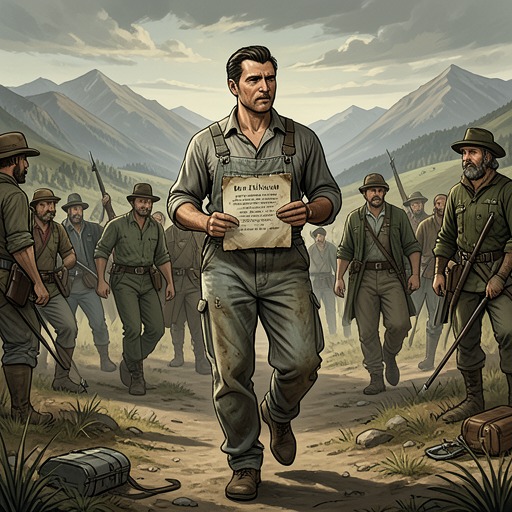
The [First United Negro Baptist Church fire and manuscript discovery](entity:event-recall-event-first-united-negro-bapt-9c58463a8561) began with a June 1966 blaze in [Wilmington, Delaware](entity:location-recall-location-50ec9239db9e), and ended with the unexpected recovery of [Henry Shackleford](entity:character-recall-character-henry-shackleford-18a5570494af)’s account from a concealed fireproof box. The discovery connected a local church fire to a larger history of slavery and abolition, while the congregation’s plan to authenticate and publish the account made its transition from hidden testimony to public document part of the event itself.
## The Fire and Its Discovery
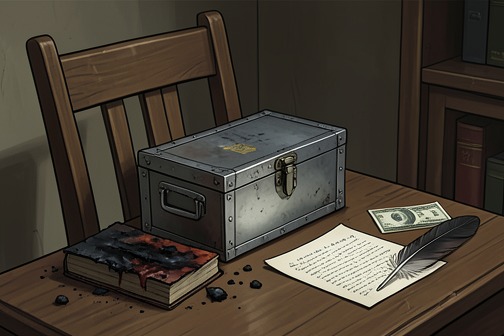
On June 14, 1966, the church at Fourth and Bainbridge Streets, described as the city’s oldest Black church, was destroyed by fire. Officials attributed the blaze to a faulty gas heater, and no one was injured. Among the scorched remains were notebooks belonging to the late church deacon Charles D. Higgins, prompting academic interest beyond Wilmington.
The account had been kept in a metal fireproof box beneath the floorboards of Higgins’s chair behind the pulpit. He had occupied that place faithfully every Sunday for more than forty-three years. The box also held twelve Confederate dollars, a rare ivory-billed woodpecker feather, and a note from Higgins’s late wife. These objects made the discovery more than the recovery of a manuscript: they preserved a small, enigmatic archive alongside it.
## The Account and Its Historical Reach
The recovered narrative was attributed to Henry Shackleford and characterized in the contemporary report as a wild slave narrative illuminating a little-known period of American history. Its first-person account gives its narrator a position as witness to [John Brown](entity:character-recall-character-678759feef97)’s antislavery campaign, but the narrative also foregrounds the instability of testimony: Henry distinguishes direct knowledge from what he has heard and notes how accounts of Brown’s final meeting with [Frederick Douglass](entity:character-recall-character-842ffe366ac9) circulated in multiple versions.
The story’s political world appears through concrete problems of communication and participation. Henry proposes teaching someone to read for money, while a message about Black people in [Baltimore](entity:location-recall-location-fffe9b5e5046) and Washington, D.C., eager to fight slavery describes their lack of telegraphs and access to letters. Public speeches likewise do not guarantee commitment: after listeners voice support for armed resistance, no one steps forward to volunteer. The recovered account therefore presents abolitionist history not only through celebrated figures and declarations, but through the practical limits on literacy, communication, and collective action.
## From Hidden Record to Public Document
The congregation announced that it would submit Henry’s account to an expert in Black history for verification and later sell the notebooks for publication, with the proceeds intended to buy a new church van. The plan placed authentication before publication while making the manuscript’s eventual circulation serve a local purpose. Its status remained provisional: the fire had revealed the document, but the announced scholarly review had yet to establish its authenticity.
The contrast between the hidden box and the proposed publication gives the discovery its narrative force. A record concealed beneath a pulpit for decades enters public discussion because of a destructive accident, and its contents challenge readers to reconsider who can preserve and recount history. The discovery thus turns a church’s loss into the beginning of an inquiry into testimony, memory, and the reach of an overlooked life.
Event 2
John Brown’s raid on Dutch Henry’s Tavern
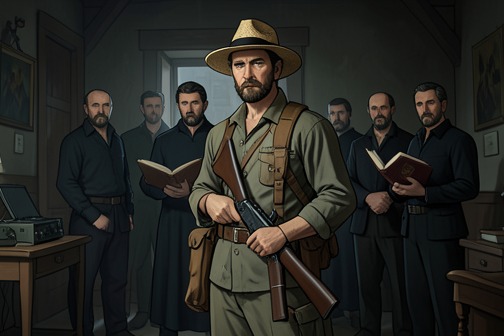
[John Brown’s raid on Dutch Henry’s Tavern](entity:event-recall-event-b1a54c3f7f27) is the novel’s first decisive encounter between Brown and [Henry Shackleford](entity:character-recall-character-henry-shackleford-18a5570494af): a sudden armed intervention that frees enslaved people in the tavern but also leaves Henry’s father dead and Henry himself carried away. Told through Henry’s retrospective, comic yet vulnerable testimony, the episode establishes the collision between Brown’s providential certainty and the people whose lives his mission abruptly redirects.
## Background and Confrontation
At noon, [Dutch Henry Sherman](entity:character-recall-character-dutch-henry-sherman-7e0c702475a4) entered the tavern to collect the money kept in a cigar box behind Pa’s barber chair. Dutch owned Pa and Henry, among others, though Pa was allowed to come and go because he had been Dutch’s first enslaved person. Dutch noticed an old man in Pa’s chair and challenged him to identify himself. The visitor was [John Brown](entity:character-recall-character-678759feef97), disguised in the tavern as an old man.
Dutch pressed Brown at gunpoint, but Brown’s composure shifted when Dutch threw down his Bible and swore. Brown answered in his unfeigned voice, warning that he might be commanded by God to deliver redemption. He then produced a Sharps rifle, disarmed the men who had been holding pistols on him, and announced that he was John Brown, captain of the [Pottawatomie Rifles](entity:organization-recall-organization-c3b887fcab2a), come to free every Black person in the territory.
## The Declaration of [Freedom](entity:concept-recall-concept-freedom-ccf89c22088f)
Brown ordered the Black people hiding in the room to come out and follow him. They emerged from beneath the tables and fled through the door, but Brown judged that they had not yet been saved to the Lord. He treated Pa’s repeated cries of “Lawdy” as agreement to join him, and declared Pa and Henry free, directing them toward the rear exit while he covered their retreat.
Brown’s declaration also misidentified Henry as a daughter. Henry knew that everyone at the tavern understood him to be a boy, and tried to correct Brown, but fear overcame him. Brown shushed Pa when he began to explain, saying that there would be time later to raise Henry to the Holy Word. The episode therefore makes liberation both an escape from ownership and an imposed new direction: Brown’s certainty leaves little room for the people he rescues to define themselves or choose what follows.
## Flight and Immediate Consequences
As horses approached in the alley, Brown took Henry by the hand and backed toward the rear door. Pa charged at him just as Dutch grabbed a pistol from the floor and fired. The shot missed Brown and struck the door; a splinter broke loose, and Pa ran into it. Brown’s escape continued as Dutch, left on the floor, accused him of theft and demanded the twelve hundred dollars he said Brown owed. Brown answered, “Charge it to the Lord, heathen,” picked Henry up, and left by the alley.
The escape thus separates Henry from his father at the instant Brown removes him from Dutch’s control. Pa’s fatal injury is not the result of Brown’s bullet, but occurs amid the confused struggle triggered by the raid and Dutch’s gunfire. Brown carries Henry away without Pa, making the rescue inseparable from loss.
## Retrospective Meaning
The raid’s consequences extend beyond the tavern. Henry later recalls being unsettled by Brown’s plans to purge America’s sin through blood and decides that [Canada](entity:location-recall-location-ed6a2f8d0910) is where he wants to stay. His subsequent encounters with abolitionists and freedom-seekers repeatedly test whether he will join the cause or seek safety for himself. In retrospect, the tavern escape stands as the beginning of that conflict: Brown’s mission offers freedom, but Henry experiences it first as a frightening rupture in his family and in the life he knew.
Event 3
Pottawatomie massacre
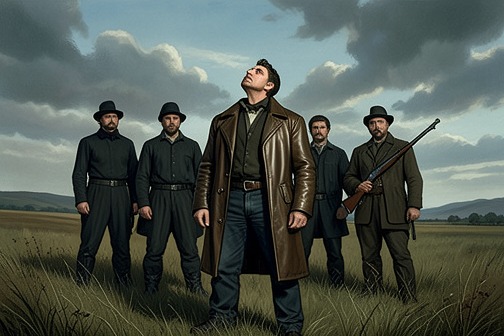
The [Pottawatomie massacre](entity:event-recall-event-17a9f53266ce) is depicted through Henry’s eyewitness account of [John Brown](entity:character-recall-character-678759feef97)’s party seizing James Doyle and his family and killing Doyle and his two older sons. The episode turns on Brown’s identification of Doyle with the pro-slavery faction, while the escape of Henry and the later consequences of Brown’s campaign place the violence within a wider story of danger, resistance, and anticipated retaliation.
## The raid on the Doyle cabin
Brown’s men approach the cabin after Henry has noticed a watchdog behind them. [Owen Brown](entity:character-recall-character-owen-brown-04e92835f845) and [Frederick Brown](entity:character-recall-character-frederick-brown-80a04246d8ec) go to the front door with their guns drawn and knock; when the door opens, they force their way inside. From a side window, Henry sees James Doyle, Doyle’s three sons, and his wife held under guard. Doyle is the man who had earlier held a .45 Colt on Brown at the tavern.
Brown searches his pockets before producing a worn paper and reading a declaration that the party has come to free enslaved people. He then asks which of the men is Dutch Henry. Doyle says that Dutch Henry does not live there. The identification of Doyle as an associate of the pro-slavery faction comes when his wife reproaches him for running with the “law-and-order people.” Brown orders Doyle and his two older sons outside. His wife pleads for the youngest, who is sixteen, and Brown eventually agrees to leave the boy behind, posting a guard at the door.
## The killings and Henry’s escape
Brown’s party divides, taking Doyle and his two older sons to separate parts of the thicket. Brown questions Doyle about whether he is pro-slavery or Free State; Doyle pleads that his words were only talk. Brown then says he will ask the Lord’s forgiveness and tells Frederick and Owen to act. They kill Doyle and his two older sons. Henry’s account makes the killings a decisive rupture in the raid: the captives’ family is divided, the youngest is spared, and the party’s violence reaches beyond the confrontation with Doyle himself.
In the immediate aftermath, one of Brown’s sons, John, runs from the scene, and Brown and the others pursue him. Henry takes the opportunity to escape. He reaches the tethered horses, mounts Dutch’s old pinto, and rides away, leaving Brown’s party behind. The event is thus also a turning point in Henry’s own trajectory: an eyewitness to Brown’s violence, he breaks from the group rather than continue with it.
## The episode’s wider stakes
The novel later connects Brown’s campaign to the peril faced by enslaved people and Black families. A man who has a wife and three children in bondage warns Henry that, if Brown is killed, white retaliation will fall on Black people nearby: some may be killed, while others may be sold away. His fear is personal as well as political; he has saved enough to buy only one of his children and faces an immediate choice about what to do.
Henry’s retrospective narration also resists treating Brown’s cause as a simple guarantee of safety or liberation. He recalls Brown as both a devoted, Bible-centered abolitionist and a man whose actions carried grave risks for others. The massacre’s significance therefore lies not only in the deaths at Pottawatomie but in the conflict between the goal of ending enslavement and the foreseeable dangers that armed action could impose on the very people it aimed to free.
Event 4
Death of Frederick Brown
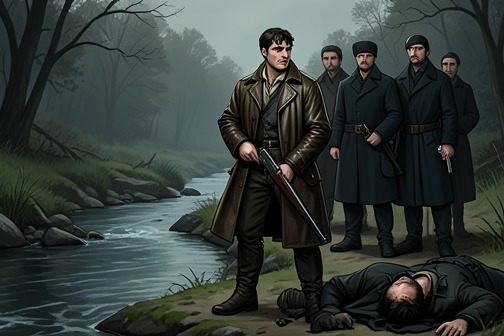
[Frederick Brown](entity:character-recall-character-frederick-brown-80a04246d8ec)’s death occurs when [Reverend Martin](entity:character-recall-character-reverend-martin-e73dab41d622)’s armed party catches him alone near a creek and shoots him before he can defend himself. [Henry Shackleford](entity:character-recall-character-henry-shackleford-18a5570494af) witnesses the killing from hiding; the aftermath leaves him disoriented and grieving, while Frederick’s family encounters his body as fighting reaches nearby [Osawatomie](entity:location-recall-location-63bb76745694).
## The Creekside Encounter
About eight redshirts ride up the bank toward Frederick, with Reverend Martin at their head. Martin is the man Frederick had drawn on at [John Brown](entity:character-recall-character-678759feef97)’s camp. Frederick stands smiling, wearing his weapons, but his seven-shooters are not drawn; the only gun in his hand is an already-spent squirrel gun. He does not recognize Martin immediately, and that hesitation proves fatal.
Martin greets him, and Frederick begins to recognize him. Without another word, Martin draws his pistol from horseback and shoots Frederick in the chest. Frederick twitches and dies. Martin dismounts, takes every gun Frederick is wearing, and boasts to his men that he has captured one of Brown’s men—the biggest one.
## The Armed Party’s Departure
The killing provokes an argument among Martin’s men. Some object that Frederick had not drawn on Martin and was neither a cattle rustler nor someone stealing another person’s enslaved people; they question the rules of the conflict. Others side with Martin. The dispute lasts several minutes, until Martin warns that John Brown will come looking for his dead son. The party then rides away.
Henry has been concealed nearby, unable to intervene. As dusk gathers, he comes out and looks at Frederick’s face, which still seems to hold a small smile. Holding the Good Lord Bird, he considers fetching a shovel to bury Frederick and the bird together, since Frederick had called it an angel. Instead, overwhelmed and unsure what to do, Henry lies curled beside the body and falls asleep.
## The Family Finds Frederick
The next day, John Brown finds Henry beside Frederick. Henry explains who killed him and gently places the Good Lord Bird on Frederick’s chest. Nearby, gunfire and artillery boom as fighting spills into Osawatomie; grapeshot passes over the group, but John Brown and the others remain mounted. Henry recognizes Jason and John among them, while Frederick’s brothers are visibly distressed.
After the fighting, John Brown returns to Frederick’s body. Frederick’s little cap remains on his head and the bird rests on his chest. Henry says he should have come out of hiding to help, but admits he does not know how to shoot. John Brown tells him he should not have shot: Henry is a girl soon to be a woman, and he had been Frederick’s friend. Brown says he is grateful for that friendship.
## Grief and Narrative Significance
Frederick’s death intensifies Henry’s sense that freedom and fighting slavery have brought him into a life he cannot manage. He considers returning to [Dutch Henry Sherman](entity:character-recall-character-dutch-henry-sherman-7e0c702475a4), the person he knows outside John Brown’s circle, and reflects on his own uncertainty about living as a girl. His grief is inseparable from fear and exhaustion: rather than burying Frederick, he falls asleep beside him, still holding the bird.
The Good Lord Bird makes the death’s aftermath an image of interrupted meaning. Frederick had regarded the bird as an angel, and Henry briefly imagines placing them together in the ground; instead, the bird is laid on Frederick’s chest by daybreak. The scene does not resolve Henry’s doubts or explain whether Frederick’s belief in the bird’s protection contributed to what happened. It preserves the bird as a charged witness to the death and to the tenderness that remains around Frederick after the violence.
Event 5
John Brown and Frederick Douglass's meeting in Rochester
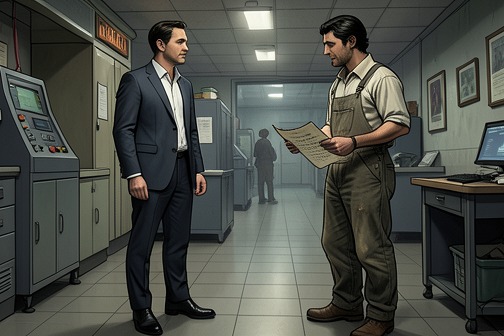
The Rochester meeting between [John Brown](entity:character-recall-character-678759feef97) and [Frederick Douglass](entity:character-recall-character-842ffe366ac9) begins as a carefully financed detour and a promise of alliance, but Onion’s retrospective account turns its welcoming platform scene into a warning: Brown believes he has secured the help he needs, while the narrator insists that the relationship will disappoint him when it matters most. The encounter also brings Onion, introduced under the name Henrietta Shackleford and identified as Brown’s female companion, into the center of Brown’s abolitionist plans.
## The Rochester detour
After traveling through Pittsburgh and [Philadelphia](entity:location-recall-location-0c859ef79004), Brown changed his route at the last moment, spending his remaining money to redirect the journey from [Boston](entity:location-recall-location-ccccb9ca0ba9) to Rochester. He told Onion that Douglass was a great man who had promised to fight alongside them. Brown needed him to help recruit thousands of Black people for the campaign, a project he called hiving the bees, and urged Onion to be kind and polite so Douglass would keep his promise.
At the Rochester station, Douglass waited in a pressed suit, spotless boots, and a clean, starched shirt. Onion describes him as unlike any Black man the narrator had seen, standing erect and still like a king. Brown descended from the train, and the two men shook hands and embraced. He introduced Onion as Henrietta Shackleford, his consort, while also explaining that Onion went by that name. Onion greeted Douglass informally; Douglass corrected the address, then welcomed Onion as a young lady and suggested that the disguised traveler needed manners.
## A public picture and private misgivings
Brown treated Douglass with unusual deference. He praised Onion’s courage and presented the meeting as a defining moment in her life: she was meeting the man who would help free her people. Brown also declared his confidence that Douglass was someone on whom he could depend. Douglass smiled beside him on the platform, and Onion imagines how the two men, one white and one Black, would have made a striking picture together.
That image is immediately unsettled by the narrator’s hindsight. Onion says Brown could not have been more wrong about Douglass and imagines, after the fact, using a small derringer kept from the Pikesville episode to shoot Douglass in the foot or strike him with its handle. The violence is counterfactual, not an action taken at the meeting; it expresses Onion’s later anger at the harm Douglass would do Brown, especially when Brown most needed him. In the narrator’s telling, the cost of this failed expectation would exceed the fare Brown spent to reach Rochester.
## Three weeks in Douglass’s household
Brown remained at Douglass’s house for three weeks, spending most of that time alone in his room writing and studying. The confinement was unlike his preferred outdoor life: Onion recalls that he disliked feather beds, hearths, and ordinary kitchen food, favoring wild game instead. His lengthy stay therefore seems suspicious to the narrator, who notes that he rarely emerged except to use the privy.
Onion occasionally overheard Brown and Douglass arguing in raised voices. One fragment, Douglass’s words “Unto the death!”, stayed in the account without being explained. The meeting’s initial warmth thus gives way, in the household, to a more guarded picture: political discussions continue behind a closed door, and the narrator cannot make their terms out.
## Promise, rupture, and narrative memory
Brown left Douglass’s house looking unusually pleased. He told Onion that Douglass had given his word on something important, then boarded a westbound train toward Chicago, announcing that they would change there for horses and a wagon to Kansas. The narrator does not disclose the promise’s precise terms in this account, but Brown’s satisfaction and his continued dependence on the alliance establish how much he thought the visit had achieved.
The Rochester episode later acquires a second meaning in Onion’s account of the final meeting between Brown and Douglass at Chambersburg. Onion remarks that published versions of that encounter varied, while Douglass lived to describe it in different ways; Onion claims to have witnessed it too and offers a competing memory. That retrospective dispute casts the Rochester welcome in a sharper light: Brown’s faith in Douglass is part of a relationship whose interpretation and consequences remain contested. The episode also reflects the novel’s larger tension between celebrated abolitionist figures and the precarious, observant witness who records their promises, silences, and failures.
Event 6
Chatham Convention
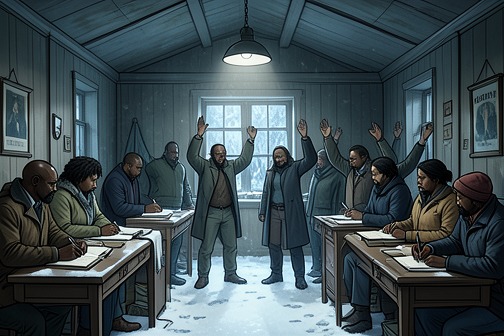
The [Chatham Convention](entity:event-recall-event-chatham-convention-6d75f8f6d778) is a January anti-slavery gathering in Chatham, Ontario, that marks a turning point in [John Brown](entity:character-recall-character-678759feef97)’s recruitment effort: after an audience of Black delegates cheers his call for a war against slavery but refuses to volunteer, [Harriet Tubman](entity:character-recall-character-8a3203fb305e) rebukes their hesitation and the narrator unexpectedly speaks up, prompting everyone present to sign. The scene makes collective action emerge not from enthusiasm alone, but from a sharp encounter with fear, unequal risk, and the moral pressure to act.
## Setting and Attendance
John Brown presents the gathering as a historic convention of Black people from the United States and [Canada](entity:location-recall-location-ed6a2f8d0910), assembled to pass a resolution against slavery. He tells the narrator that the war is beginning in earnest and imagines the convention producing numbers, resolve, and revolution. In practice, only forty-five people make it to Chatham. Nearly a third are white men from Brown’s party or people who joined it along the way. Held in January amid cold and snow, the convention occupies an old Masons’ lodge for a single day; the narrator recalls speeches, resolutions, declarations written by Brown, and no food.
The proceedings are shaped by the gap between Brown’s expectation and the modest turnout. [Frederick Douglass](entity:character-recall-character-842ffe366ac9), whom Brown regards as a friend, does not attend, and Brown is visibly disappointed. He nevertheless insists that the gathering is changing the country’s course. The narrator punctures that self-importance: Brown is the appointed main speaker, wrote the constitution, and set the bylaws, so the convention’s importance is inseparable from the authority he has given himself within it.
## Brown’s Appeal and the Refusal to Volunteer
Brown speaks at the end of the day. Wearing a string tie and a tattered suit repaired with three mismatched buttons, he addresses a predominantly free and educated Black audience of teachers, ministers, and doctors. His opening declaration that victory is at hand gives way to a forceful call to destroy slavery and free the enslaved by force. The delegates answer with shouts of assent. Yet when Brown holds up a paper inviting volunteers to join his war, nobody comes forward.
The silence reveals that public agreement does not settle the practical question of participation. One man asks for Brown’s specific plan. Brown says he intends to purge the country’s sin with blood, with the help of Black people. The prospect frightens the narrator, who decides to stay in Canada and thinks about using his hidden clothes and saved pennies to make a new start. His reaction registers the bodily stakes beneath the convention’s language of revolution: commitment could mean hunger, danger, and death, not simply approval of an antislavery cause.
Other delegates voice the problem more directly. A participant objects that the white organizer has little to lose while Black people stand to lose everything, and asks why they should trust him. Brown answers by invoking his record, his religious purpose, the sacrifices his family has made, and the continuing war he intends to wage whether or not they join. He asks them to keep what they have heard secret. The challenge does not disappear, but the exchange makes the unequal distribution of risk central to the meeting’s stalled recruitment.
## Tubman’s Intervention and the Signing
As Brown moves to close the convention, Harriet Tubman rises from the back of the room. Dressed in a maid’s clothes and men’s boots, with a worn, colorful shawl over her arm, she appears to the narrator both quiet and formidable. She identifies herself and says she knows Brown: he needs no explanation for this woman. She points to the cost he has already borne—the beatings he has taken, his family’s hardship, and the death of one of his sons—and turns the question of sacrifice back on the assembled delegates. Brown, she argues, is asking them to help free themselves, not to support him personally.
Tubman shifts the discussion from the delegates’ safety to the people still held in slavery: children separated from mothers, fathers from wives, and families living in bondage. Her rebuke shames the narrator, who wants to be a man but fears dying, going hungry, and losing the care others provide. He thinks of Sibonia, who had faced the gallows without shame or fear, and hears Tubman’s appeal as a challenge to his own instinct to flee. Before he fully understands what he is doing, he cries that he will follow Brown to the ends of the earth. Tubman praises God and calls the narrator a child who will lead.
The cry breaks the impasse. Everyone in the room rises and presses forward to sign Brown’s paper: clergymen, doctors, blacksmiths, barbers, and teachers, including men who have never handled a gun or sword. The narrator’s accidental declaration becomes the immediate spark for a collective act that Brown’s speech alone had not secured.
## Aftermath and Significance
Once the hall empties, the narrator sweeps the floor while Brown and Tubman remain together. Tubman warns that if Brown has no real plan, everyone will suffer for nothing. Brown replies that he is working on it with God’s help. Their exchange leaves the convention’s central tension unresolved: signatures establish willingness to join, but do not answer whether the campaign can succeed or how its participants will be protected.
The narrator’s later recollections place the meeting among a longer sequence of encounters with literacy, bondage, and escape. Elsewhere he seeks paid work teaching someone to read, challenges Jim about white people’s power, and lies when Annie asks whether he has been trying to rouse Black people near Harpers Ferry. He also recalls that a prominent organizer of the [Underground Railroad](entity:organization-recall-organization-7fee998d2457) doubts Brown can gather the two hundred Black participants he would need. These later episodes sharpen the convention’s significance without making its initial signing a guarantee of broad support: recruitment depends on trust, information, and the risks people must carry. The narrator also says that accounts of Brown’s later meeting with Douglass multiplied in books, while only a few men were present and the narrator himself saw it differently. That contrast between public retelling and a vulnerable witness’s account frames the convention, too: its revolutionary promise is narrated through a participant who remembers not only the signatures, but his hunger, fear, and startled voice.