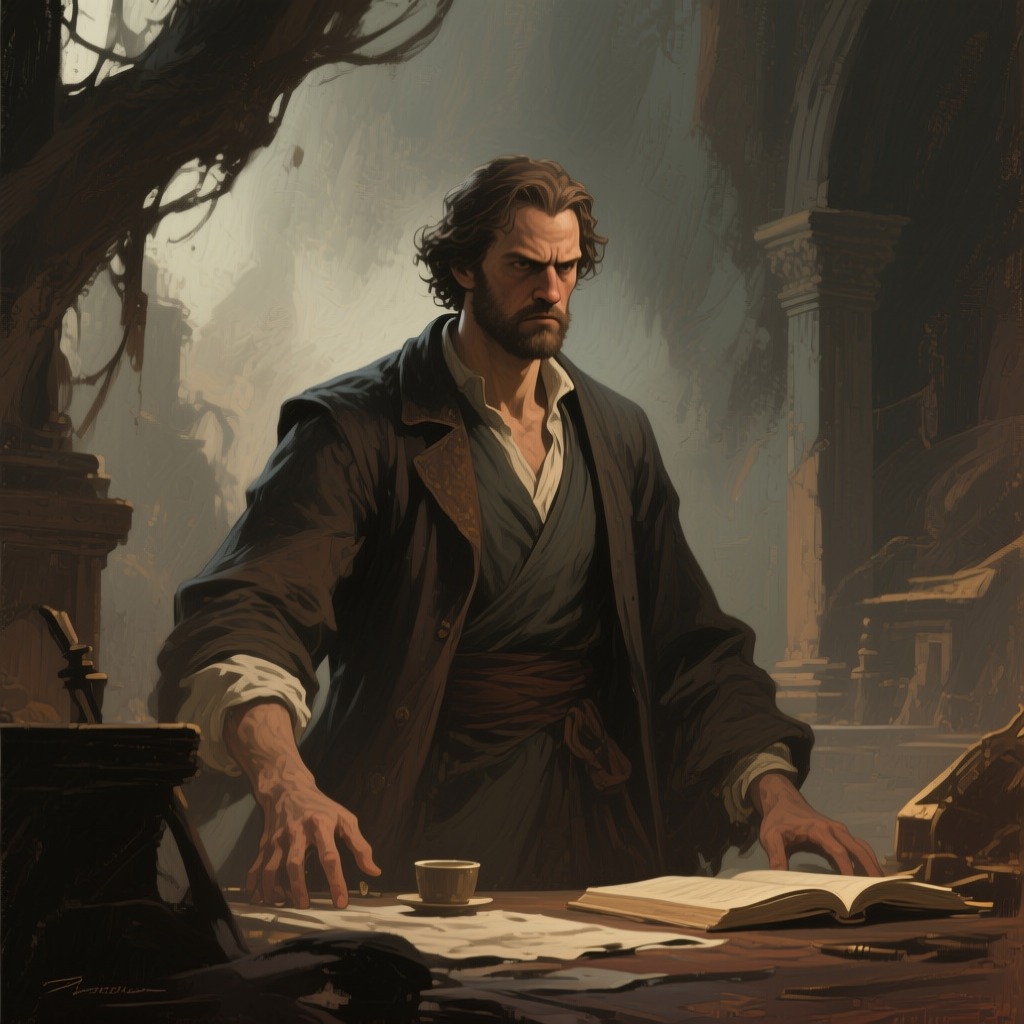
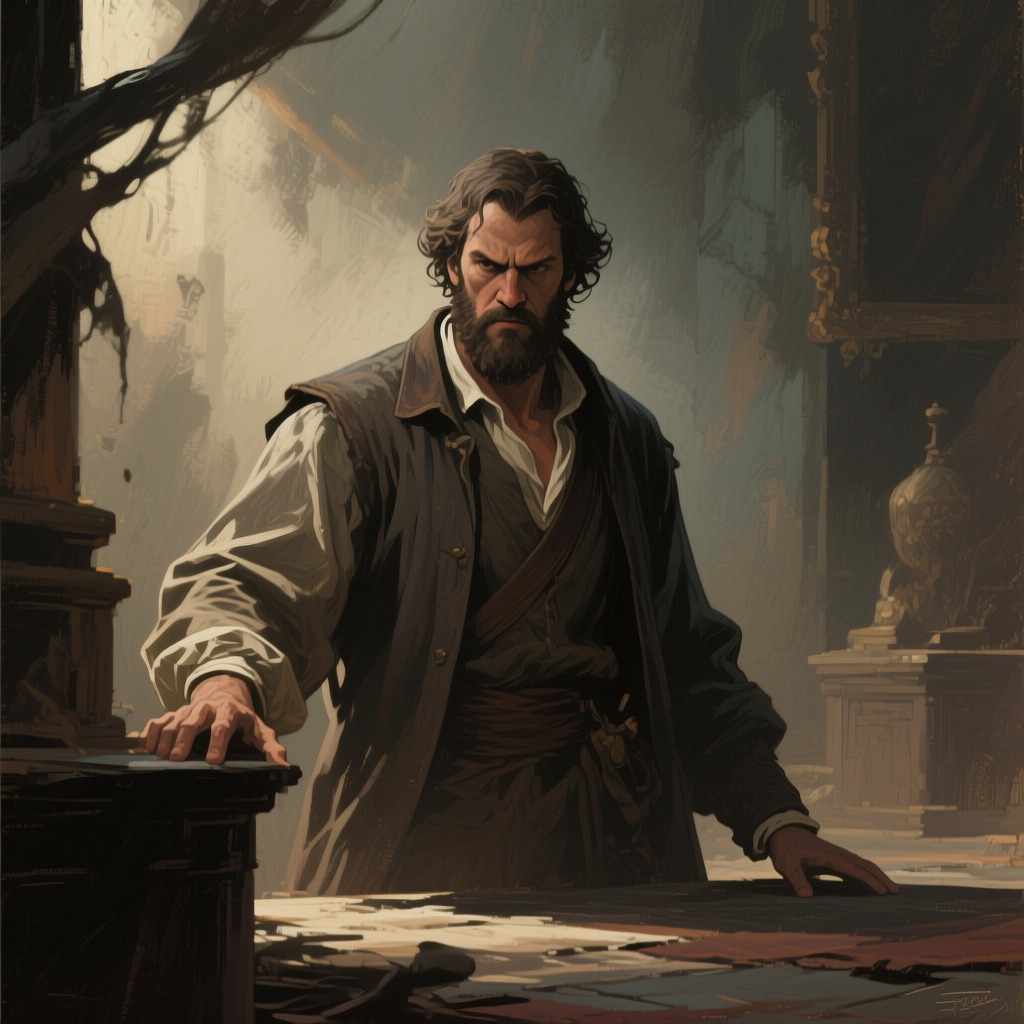
Eduard Delacroix
Eduard Delacroix, a slight, balding Cajun with the worried face of an embezzler about to be discovered, arrives on E Block at Cold Mountain Penitentiary in the summer of 1932, condemned for the rape and murder of a young girl and the arson fire that killed six more people, including two children. He is a man whose crime seems to have already vacated him; by the time he reaches the Green Mile, the violence that drove him is gone, leaving only a mild-mannered, frightened man who will soon sit in Old Sparky's lap. His story, brief and terrible, becomes one of the novel's central tragedies, a testament to both the fragile goodness that can bloom even in a death house and the casual, monstrous cruelty that can destroy it.
Identity and Arrival
Delacroix is a small man, described as "half-bald" with long hair straggling over the back of his shirt-collar, and he speaks with a lilting Cajun accent that makes even ordinary words sound exotic. He is brought onto the block not with the grim ceremony reserved for most condemned men, but with violence: Percy Wetmore drags him through the door, beating him with a hickory baton and shouting obscenities, while Delacroix babbles in a mixture of English and Cajun French, begging not to be hit anymore. Paul Edgecombe, the block superintendent, catches him as he falls, and later sees the bruises covering the little man's body from "Christmas to Easter." Delacroix's crime—raping a girl, killing her, then setting her body on fire, a blaze that engulfed an apartment building and killed six more people—is monstrous, but on the block he is simply a frightened, lonely man who cries through Edgecombe's orientation speech and cringes at every movement.
Life on the Mile: Mr. Jingles and the Spool
Delacroix's existence on E Block is transformed by the appearance of a mouse, a creature that first arrives on the Mile as a curious, fearless visitor the guards call Steamboat Willy. The mouse, which Delacroix renames Mr. Jingles, becomes his constant companion and the focus of his remaining days. Delacroix claims the mouse whispered its name in his ear, and he trains it—or perhaps it trains itself—to perform tricks: it sits on his shoulder, eats peppermint candies with astonishing neatness, and, most famously, chases and retrieves a brightly colored wooden spool that Delacroix decorates with crayons. The spool, one end yellow, the other green, the drum firehouse red, becomes the centerpiece of their act. Delacroix would trumpet, "Maintenant, m'sieurs et mesdames! Le cirque présentement le mous' amusant et amazeant!" and then fling the spool, sending Mr. Jingles after it in a flash. The mouse would nose it back or roll it with his paws, a trick so remarkable that the other guards—Brutal, Harry, Dean—would gather to watch, and Delacroix would beam with a happiness he had likely never known. He keeps Mr. Jingles in a Corona cigar box lined with cotton batting, procured with the help of Percy Wetmore himself, who, in a rare moment of apparent goodwill, even sneaks padding from the dispensary. But Delacroix never trusts Percy, and the mouse, too, seems to remember the guard's earlier attempts to kill it, watching him with the wary eyes of an old enemy.
The Execution and Its Aftermath
Delacroix's date with Old Sparky is set for late October, and on the night of his execution, he is calm, having spent his last day playing with Mr. Jingles and saying goodbye. He entrusts the mouse to John Coffey, the gentle giant on the block, and walks the Green Mile with tears and prayers, reciting a Hail Mary in Cajun French. But the execution goes catastrophically wrong. Percy Wetmore, placed in charge of the cap and sponge as part of a deal to secure his transfer to another facility, has deliberately left the sponge dry. When the current is applied, instead of a quick, clean death, Delacroix is slowly cooked alive. The humming of the electricity wavers, smoke pours from the cap, and Delacroix begins to scream, his body jittering and twisting, his eyes blown from their sockets, his face catching fire. The witnesses panic, the doctor faints, and the guards can do nothing but wait for the two-minute ordeal to end. Delacroix dies in unspeakable agony, his body charred and smoking, a direct result of Percy's petty, murderous cruelty. The event shatters the remaining illusions of the guards, particularly Paul Edgecombe, and sets in motion the desperate, morally fraught plan to save the warden's wife by taking John Coffey out of the prison. Delacroix's death is the novel's darkest moment, a reminder that the state's machinery of execution can be hijacked by a single sadistic man, and that the worst horrors are not always the work of the condemned.