Louis-Joseph de Montcalm
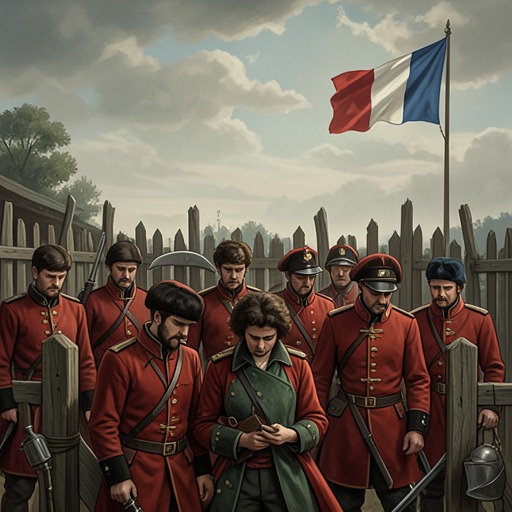
The Last of the MohicansLouis-Joseph de Montcalm is the French commander whose advance toward the English forts sets the military crisis in motion, yet the limits of his power emerge most clearly in his dealings with Indigenous allies. His effort to maintain a truce and preserve the French alliance with Magua reveals a central contradiction of the campaign: imperial commanders claim authority over the war, while allied peoples retain their own injuries, loyalties, and decisions.
Command in the Northern Campaign
When word reaches Fort Edward that Montcalm is moving up Lake Champlain with an army described as numerous as the leaves on the trees, the English recognize the danger to Fort William Henry. The post is held by Colonel Munro with too few men to withstand the force Montcalm brings against its earthworks. General Webb, stationed at Fort Edward with more than five thousand men, could assemble a force nearly twice the French commander’s strength, but the English officers and soldiers are disposed to remain behind their defenses rather than strike at Montcalm’s advance. His campaign therefore confronts not only a fortified enemy but also the effects of English hesitation and weak coordination.
Montcalm’s presence shapes the decisions of Indigenous groups as well as European armies. The Delawares have followed him into English territory and are raiding Mohawk hunting grounds, but they withhold assistance when it is most needed. The narrative links their reluctance to an old treaty that once made them dependent on the Six Nations for military protection and now restrains them from fighting their former masters. Montcalm chooses to tolerate this passive ally rather than risk turning it into an open enemy; the Delawares explain their inaction by saying that their hatchets are dull and need time to be sharpened.
Truce and Magua’s Defiance
Montcalm’s attempt to impose the truce on his Indigenous allies becomes explicit when he interrupts Magua’s treacherous aim and leads him away from danger. Exposing his French uniform and the cross of St. Louis, he rebukes Magua for acting as though the hatchet between the English and their Canadian father were not buried. Magua answers that the Hurons have taken no scalps while the pale faces make friends, framing restraint as a cost imposed on his people rather than a settled reconciliation.
When Magua asks why the French commander brought his young men into the woods and fired cannon at the earthen house, Montcalm explains that the purpose was to subdue the fort: his master claims the land, and Magua’s father was ordered to drive off the English settlers. Because they have agreed to leave, Montcalm says, they are no longer enemies. Magua rejects the implication that this ends his grievance. His hatchet, he says, has been colored with blood and will be buried only when it is red. Montcalm counters that Magua is pledged not to sully the lilies of France: the enemies of the French king across the salt lake are the Hurons’ enemies, and his friends are theirs. Magua repeats the word friends in scorn and asks Montcalm to give him a hand.
Montcalm complies reluctantly. Magua guides the commander’s fingers to a deep scar on his breast and asks whether he knows it; Montcalm identifies it as the mark of a lead bullet. The gesture makes Magua’s injury a physical argument against the abstract language of alliance. Montcalm can appeal to military pledges, but Magua makes clear that the wound and the grievance it represents remain his own.
Diplomacy and the Limits of Command
The narrator describes Montcalm as understanding that his influence over the warlike tribes gathered around him must be maintained by concession rather than power. This judgment clarifies why he submits to Magua’s demand despite his stated expectation of obedience. His authority is real but conditional: French strategy depends on Indigenous cooperation, and an order alone cannot erase local rivalries or personal claims for redress.
The wider political setting reinforces that constraint. Hawkeye observes that English policy has thrown Indigenous nations into confusion: Hurons and Oneidas who speak nearly the same language fight one another, while the Delawares are divided, with some fighting alongside the Mingoes and many others in Canada because of their enmity toward the Maquas. In that fractured field, Montcalm’s attempt to define enemies and friends cannot make every alliance seamless. The Delawares’ withholding of support, and Magua’s refusal to treat the English departure as the end of his conflict, show how Indigenous decisions complicate the imperial designs that enlist them.
Narrative Significance
Montcalm embodies the distinction between claiming a territory and securing obedience within it. His explanation that the French king owns the land and can order the English away presents conquest as a matter of imperial title; the scene with Magua immediately unsettles that claim by placing an individual Indigenous warrior’s injury and judgment alongside the commander’s policy. Montcalm can negotiate, invoke a truce, and make concessions, but he cannot simply convert allied peoples into instruments of French command.
The character is thus presented through a tension between military power and diplomatic dependence. His campaign threatens English positions, while his handling of Magua and the Delawares reveals how precarious the coalition behind that campaign is. The novel’s account of warfare is not only a contest between French and English forces: it is also a struggle over who can define the terms of alliance, the meaning of peace, and the right to decide when an old grievance has ended.