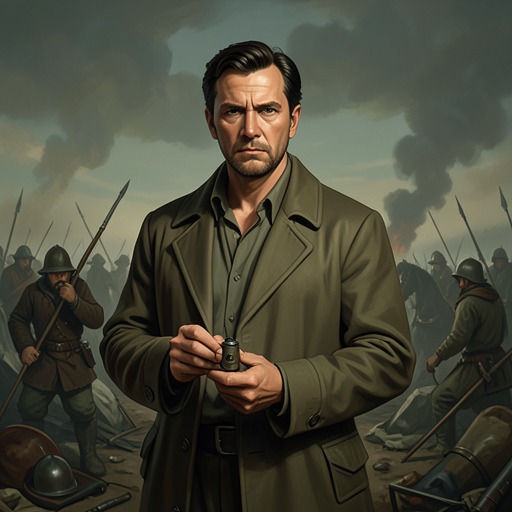
“Are we not here now, and are we not gone in a moment”
The Life and Opinions of Tristram Shandy, Gentleman“Are we not here now, and are we not gone in a moment?” is Corporal Trim’s meditation on how swiftly life vanishes, and the fall of his hat gives the thought its force. The line moves from commonplace truth to a small theatrical enactment of mortality: a body is present, then the hat lies on the floor like a corpse, and a crowded kitchen feels the change together.
The Occasion
The words arise amid news that Bobby Shandy is dead. Trim first laments the loss, calling Bobby a poor creature, a poor boy, and a poor gentleman. When the coachman says Bobby was alive at the previous Whitsontide, Trim answers that no past season or time can alter the present fact of death. He asks whether they are here now and gone in a moment, bringing the distant calendar into immediate human scale.
The Gesture That Makes the Thought
Trim delivers the first version with his right arm extended, in the same posture he had used while reading a sermon. He strikes the end of his stick perpendicularly on the floor to suggest health and stability, then drops his hat as he says that they are gone. The contrast is physical: the upright stick marks life’s apparent firmness; the hat’s descent gives sudden shape to its disappearance.
The narrator insists that the sentence alone is an everyday self-evident truth. Its effect depends on Trim’s handling of the hat, not on novelty of thought. In a second, more closely described rendering, Trim pauses before the final word and lets the hat fall plumb to the ground. It seems to descend as though a heavy lump of clay had been kneaded into its crown; his hand appears to vanish from beneath it, and his eye fixes on the fallen object as if it were a corpse.
A Shared Response
The hat’s fall turns reflection into a communal scene. Susannah bursts into tears, and Jonathan, Obadiah, the cook-maid, and even the scullion are moved. The whole kitchen gathers around Trim. The narration emphasizes that the gesture succeeds not by stating an abstract proposition but by making the listeners see and feel a passage from apparent stability to lifelessness.
The narrator further distinguishes this carefully timed drop from any ordinary way of letting a hat fall. A throw, a slip, or an awkward motion would not carry the same meaning; the gesture’s pause, direction, and solemn attention make it a type and forerunner of mortality. Its simplicity is therefore inseparable from its performance.
Narrative and Thematic Significance
The line recurs in the narrator’s account as he returns to the “mortality of Trim’s hat” and then reconstructs the moment in greater detail. This repetition slows a fleeting gesture and asks the reader to reconsider how an ordinary sentence acquires emotional power. The scene presents eloquence as embodied action: Trim’s words matter, but the pause and falling hat give them their memorable form.
The passage also moves between sorrow and comic precision. The hat becomes an eloquent image of death, while the narrator’s elaborate consideration of every possible way it might have fallen turns the scene’s solemnity into a meditation on theatrical timing. Mortality is stated as an everyday truth, yet its emotional force depends on the exact manner in which it is made visible.