
The Little Prince
Book Introduction
'The Little Prince' (French: 'Le Petit Prince') is a novella written and illustrated by the French aristocrat, aviator, and writer Antoine de Saint-Exupéry. It was first published in April 1943 in both English and French in the United States, and later in France in 1945. The work defies simple genre classification, blending elements of children's literature, fantasy, science fiction, and philosophical fable. It is widely regarded as one of the most important books of the twentieth century.
Plot Summary
The story is narrated by a pilot who, after his plane crashes in the Sahara Desert, meets a young boy he calls the 'little prince.' The little prince comes from a tiny asteroid known as B-612, where he tends to three volcanoes and a beautiful but vain rose. Feeling misunderstood, he leaves his planet and travels through the universe, visiting six other asteroids. On his journey, he encounters a series of adults who represent different aspects of human folly: a king who claims to rule over everything, a conceited man who wants only admiration, a drunkard who drinks to forget his shame, a businessman who counts stars as his possessions, a lamplighter who follows orders without question, and a geographer who never leaves his desk. The geographer advises the prince to visit Earth. On Earth, the prince lands in the desert and meets a snake, a desert flower, a garden of roses, and finally a fox. The fox teaches him the meaning of 'taming' – creating bonds of responsibility and affection. The fox's revelation that 'what is essential is invisible to the eye' becomes the central lesson of the book. The prince realizes that his rose is unique because of the time he has devoted to her. He then allows the snake to bite him, presumably to return to his planet. The pilot, after repairing his plane, leaves the desert, deeply changed by his encounter.
Themes
The novella is a profound meditation on love, loss, friendship, and the nature of human relationships. It critiques the absurdity and materialism of adult life, contrasting it with the innocence and wonder of childhood. The concept of 'taming' underscores the idea that true connection requires time, effort, and mutual responsibility. Saint-Exupéry also explores the value of imagination and the importance of seeing with the heart rather than with the eyes. The book's melancholy tone reflects the author's own feelings of exile and loss during World War II.
Writing Background
Saint-Exupéry wrote 'The Little Prince' while living in exile in New York City after the fall of France in 1940. The work was deeply personal, drawing on his own near-fatal crash in the Sahara in 1935. The watercolor illustrations, created by the author himself, are integral to the story. The book was published at a time of great global conflict, and its message of peace and human connection resonated with readers seeking hope.
Legacy and Influence
Since its publication, 'The Little Prince' has been translated into more than 300 languages and dialects, making it one of the most translated books in history. Over 200 million copies have been sold worldwide, and it is often cited as the best-selling book after the Bible. It has been adapted for stage, film, opera, and animation. In 2019, it was awarded a retroactive Hugo Award for Best Novella. The book remains a staple in school curricula and continues to inspire readers of all ages with its timeless wisdom.
About the Author
Author Biography
Antoine de Saint-Exupéry was born on June 29, 1900, in Lyon, France, into an aristocratic but impoverished family. His father, a count, died of a stroke when Antoine was only four years old, leaving his mother to raise five children. Saint-Exupéry attended Jesuit schools and later prepared for the French Naval Academy, but he failed the entrance exams. He then studied architecture at the École des Beaux-Arts in Paris but soon dropped out, taking odd jobs including selling trucks.
Aviation Career
In 1921, Saint-Exupéry was conscripted into the French Air Force, where he trained as a pilot. After leaving the military, he briefly worked various jobs before joining the Aéropostale (the French postal airline) in 1926. He flew mail routes across the Sahara Desert and the Andes Mountains, pioneering air travel in remote regions. In 1935, he and his mechanic survived a crash in the Sahara, an ordeal that later inspired the desert setting of 'The Little Prince.' He also served as the director of the Argentine airline Aeroposta Argentina, extending air routes to Tierra del Fuego.
Literary Work
Saint-Exupéry's writing career began in earnest with his first novel, 'Southern Mail' (1928), followed by 'Night Flight' (1931), which won the Prix Femina and established his literary reputation. His memoir 'Wind, Sand and Stars' (1939), published in French as 'Terre des hommes,' received the Grand Prix du Roman de l'Académie Française and the U.S. National Book Award. During World War II, after the fall of France, he fled to the United States, where he wrote 'Flight to Arras' (1942) and his masterpiece 'The Little Prince' (1943). After his death, his unfinished philosophical work 'The Wisdom of the Sands' (or 'Citadelle') was published posthumously.
Disappearance and Death
Despite his age and health problems, Saint-Exupéry returned to active service in the Free French Air Force in 1943. On July 31, 1944, he took off from Corsica on a reconnaissance mission over the Mediterranean and never returned. He was declared missing in action. For decades, his fate was a mystery until the wreckage of his Lockheed P-38 Lightning was discovered off the coast of Marseille in 2004. He was posthumously declared 'Mort pour la France' (died for France).
Legacy
Saint-Exupéry is celebrated as a national hero in France and a literary icon worldwide. His face and the little prince appear on the French 50-franc banknote, and Lyon's international airport bears his name. His works, particularly 'The Little Prince,' continue to be read and cherished by millions, embodying a unique blend of adventure, poetry, and humanism.
StoryFlow
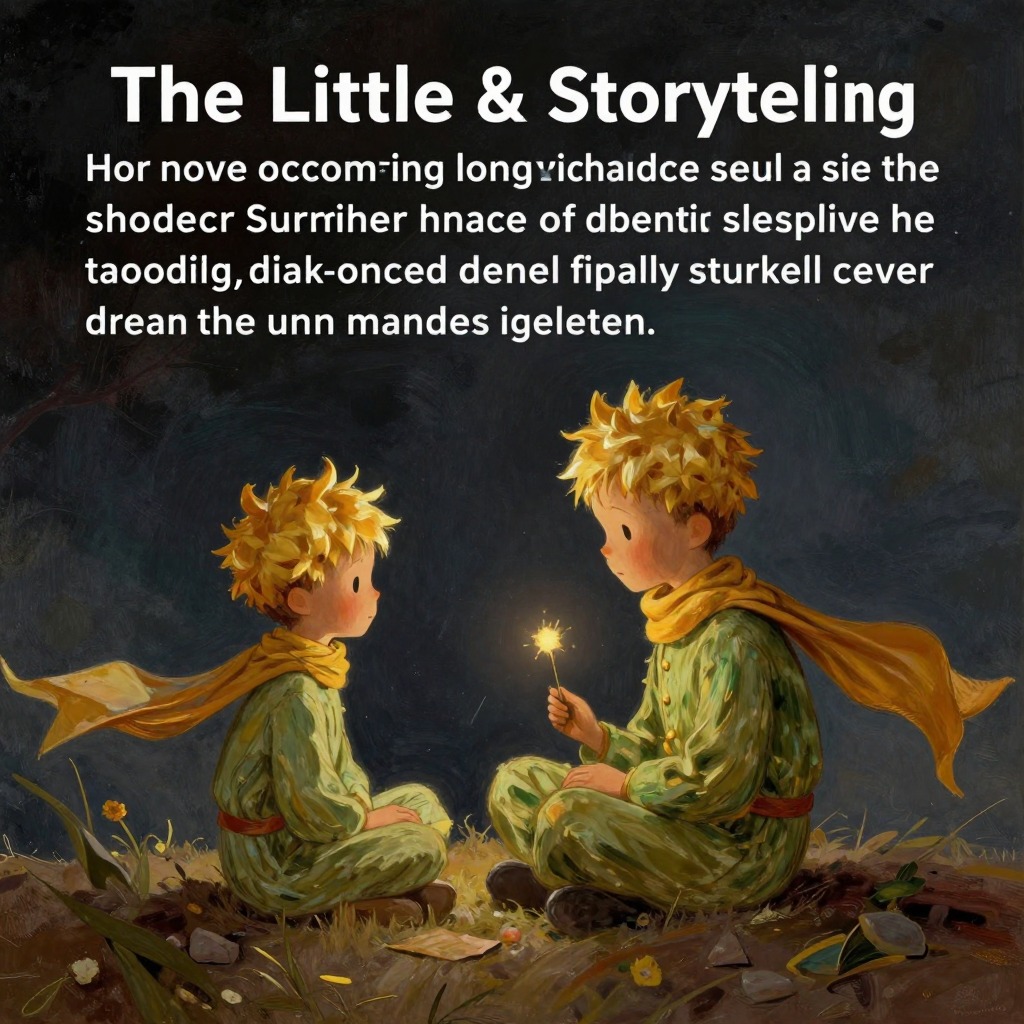
The Narrator's Long-Delayed Storytelling
Traces how the narrator, six years after the Little Prince's disappearance, finally breaks his silence and tells the story, transforming his private grief into a shared account.
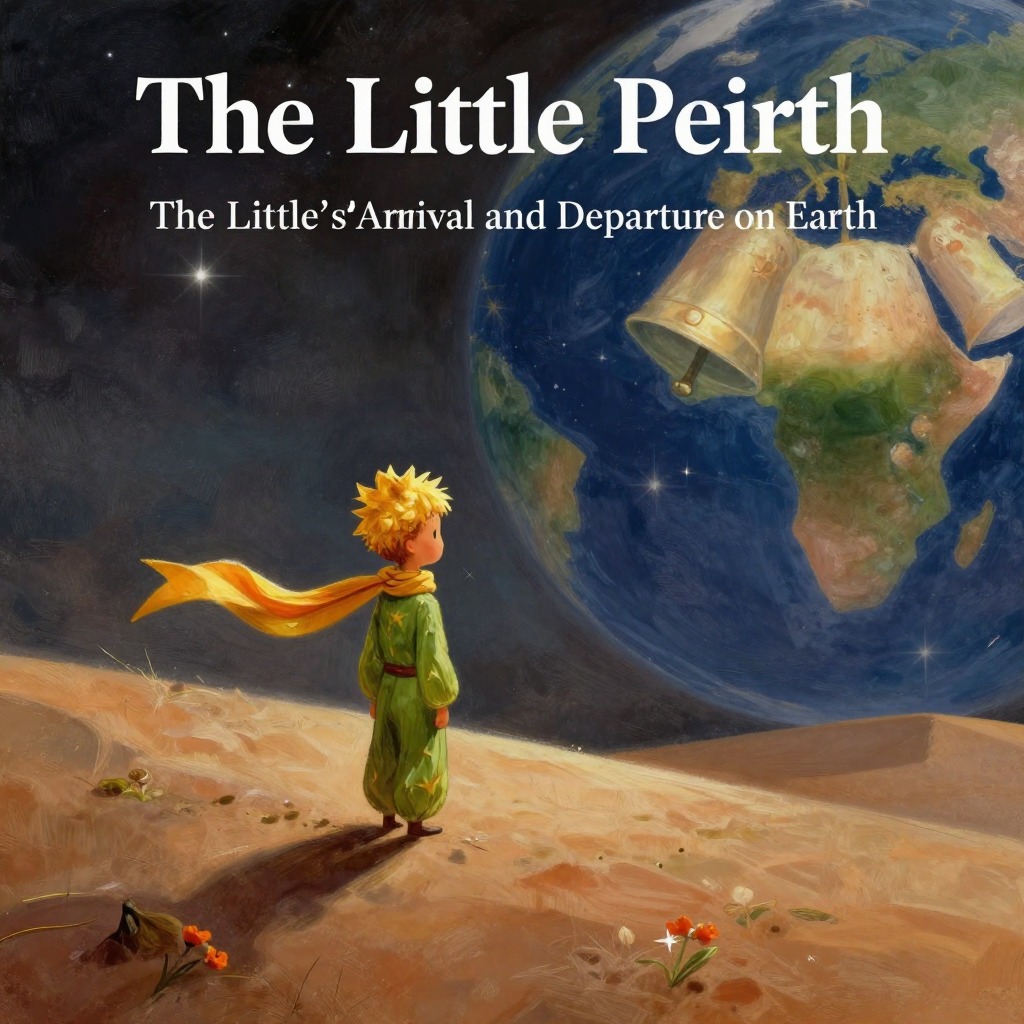
The Little Prince's Arrival and Departure on Earth
Follows the prince's brief presence in the desert and his removal from Earth, leaving only the narrator's memory and the starry bells as traces.
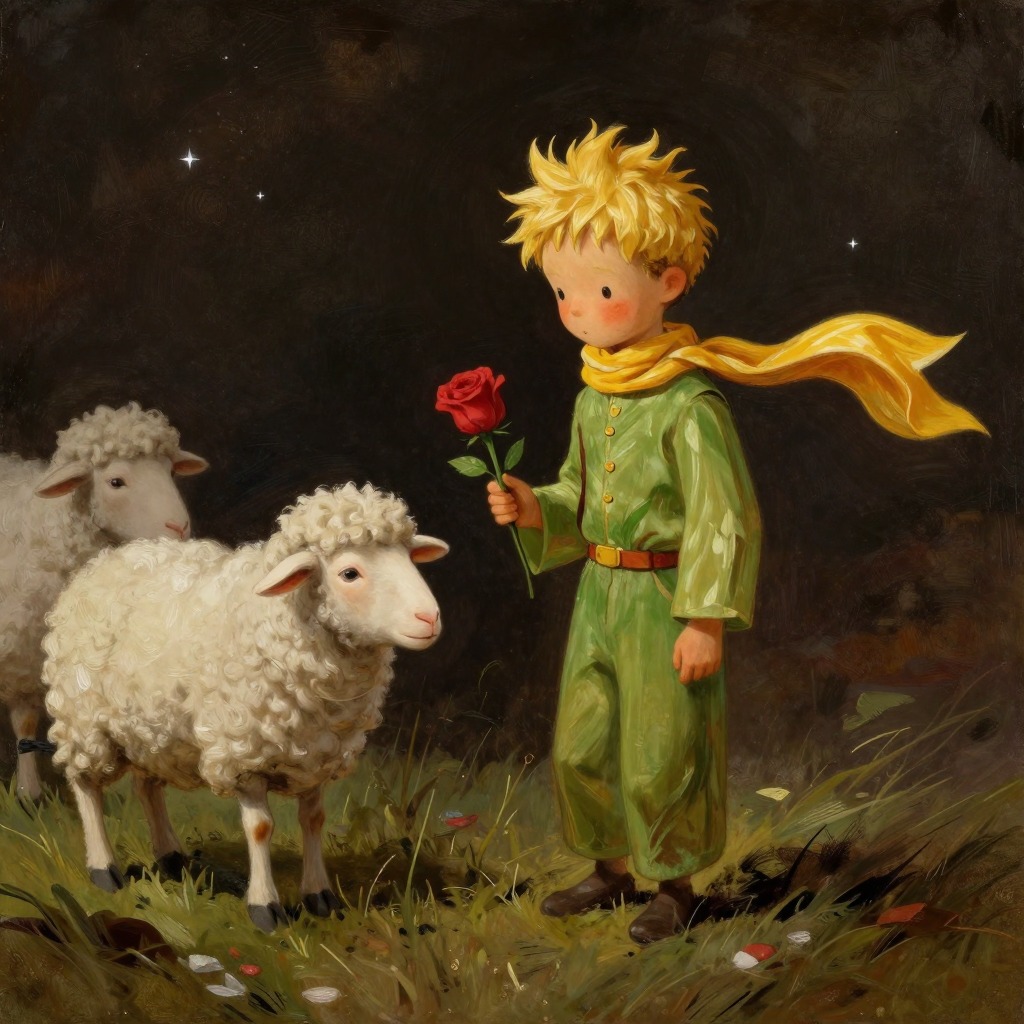
The Unresolved Mystery of the Sheep and the Rose
Traces the narrator's obsessive, unresolved question of whether the Sheep destroyed the Rose, and the cosmic consequences of that uncertainty.
