Theo Jaxon
The Passage (Justin Cronin Edition)Theo Jaxon’s story joins public responsibility to private vulnerability: a First Family officer who helps lead expeditions and guards the Colony, he is also Peter Jaxon’s brother, Mausami Patal’s partner, and the father of a child whose existence gives her a reason to imagine a future after his disappearance. His repeated departures and returns make survival more than a matter of staying alive; it becomes a question of whether he can remain connected to the people who need him.
Identity and responsibilities
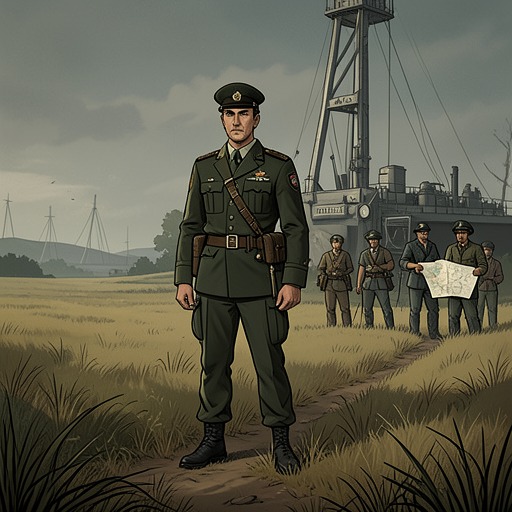
Theo belongs to the First Family and Household and serves as a Second Captain of the Watch. Twelve days before his disappearance, a viral had been killed in the Watch’s nets by Arlo Wilson, an incident that supplies the immediate background to the chain of events eventually leading to Theo’s loss. On the morning of an expedition, Theo takes the position at the front beside Peter, while Arlo and Mausami bring up the rear. He is not simply accompanying the party: as its officer in charge, he leads it to a fenced concrete bunker and uses the key worn on a leather lanyard to open the control panel, cut the electric current, and let the group through the gate.
The role comes with practical authority, but also with a burden of judgment. After Caleb is rescued, Theo objects sharply to the actions that put the power station offline, insisting that its operation sustains everyone’s lights and safety. His anger reflects an understanding of how closely the Colony’s survival depends on infrastructure and on decisions made by the people responsible for protecting it. In another late-night conversation, he tells Peter that the guns they have been discussing belonged to their father. Peter later recognizes that the weapons point beyond the familiar divide between the Time Before and the Colony: their father had been searching in the outside world, and the past he had treated as irretrievable may still contain questions worth pursuing.
Disappearance and its meaning
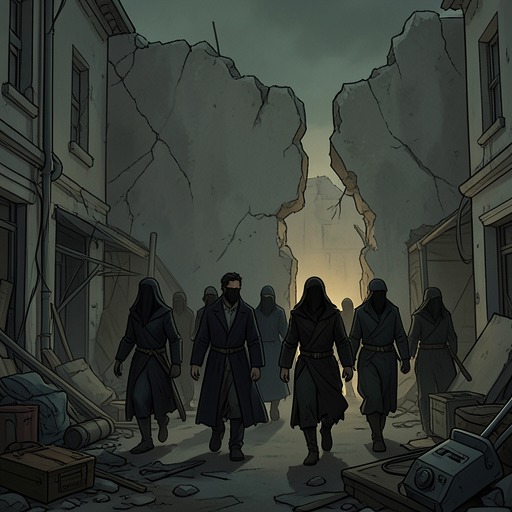
Theo disappears during an expedition when virals attack from above. One drops through the roof of the atrium; another seizes Theo and carries him away through the open space above. Peter sees his brother’s rifle fall as Theo is taken, but cannot follow or prevent his disappearance. The suddenness of the event leaves the others with no clear account of what happened to him, and Sanjay later tells Peter that Theo’s place in the Household is now a matter requiring discussion. Even those who knew him are left trying to reconcile his disappearance with the person they thought they understood.
Peter’s loss is also a turning point in how he interprets his family’s past. His mother had charged him to look after Theo, describing his brother as the less strong of the two, and Peter had understood the instruction as a straightforward request for protection. Later, while searching among the objects of the past in Auntie’s room, he remembers the words and realizes that their meaning may not be as simple as he once believed. That altered memory connects Theo’s disappearance to Peter’s larger reassessment of family duty: care cannot be reduced to keeping someone safe, especially when the person being protected has a life and choices of his own.
Mausami, Theo, and the child
Theo’s disappearance leaves Mausami with grief complicated by a secret she had intended to share with him. Though she is married to Galen Strauss, she knows that Theo is the father of her pregnancy. She had planned to tell him during their ride to the station, and remembers how the two of them were alone there after a late game with Alicia and Dale Levine. When she began to cry, Theo comforted her; the closeness that followed became the circumstance in which the child was conceived. Mausami had misrepresented the timing of her missed periods to Galen, but in her own mind there is no uncertainty about the child’s father.
The pregnancy changes the scale of Mausami’s grief. She had wanted to tell Theo about the baby on their first night at the station, and now has to reckon with the possibility that he will never know. Yet the child is not an abstract consolation. Mausami thinks of a baby as a real being whose life implies a future: something that will crawl, walk, and continue living in a world whose prospects otherwise seem uncertain. Her recognition that Theo’s baby cannot be separated from Theo’s life gives her a powerful, if emotionally difficult, way to resist the finality of his disappearance. She wakes with the conviction that she is going to have his child and that, because the child is Theo’s, Theo cannot simply be dead to her.
Captivity, return, and family life
Theo later wakes from a dream of the baby and finds Mausami beside him. The scene marks a return to the living world and to the family he had been separated from. His thoughts also reveal how long despair had shaped his life. In the cell, he had wanted to die; even before that, he had often felt drawn toward giving up. He describes having moved through ordinary days as if he were already half dead, concealing the depth of his struggle from others, including Peter. The difference between that history and his present closeness to Mausami and the child is not presented as a simple cure: rather, his family gives him something concrete to be glad of and to remain present for.
When the expedition prepares to leave the farmstead, Theo and Mausami decide to stay behind for the winter. They have shelter, small game nearby, and canned food in the basement; Mausami can have the baby there. Peter objects, but cannot change Theo’s mind. Theo promises that they will see each other in spring and asks Peter to stop by on his way back from whatever he finds. The decision establishes a temporary separation on different terms from the earlier disappearance: this time Theo is present, the choice is shared with Mausami, and the reason is to protect the family they are building.
Threat and the ending
By spring, the baby is coming. Theo is with Mausami and the infant when danger reaches them. He is thrown first onto their car and then into a wall; the attack leaves him with a badly injured leg that must be splinted from ankle to hip. The account does not describe the injury in detail, but its consequences are plain: Theo survives, though he is physically incapacitated and dependent on care while the family remains together.
The closing image gathers the arc around that fragile survival. Theo and Mausami lie asleep on the same bed, with their baby swaddled between them. His position beside them contrasts with the earlier disappearance that left Mausami imagining a future without him and Peter struggling with the meaning of his loss. Theo’s ending is neither a return to uncomplicated security nor a solitary triumph. It is a precarious family scene, built from survival, shared responsibility, and the continuing presence of the child whose existence first made a future imaginable.