Mirko Czentovic’s discovery as a chess prodigy
The Royal GameMirko Czentovic’s discovery as a chess prodigy turns a village evening game into the beginning of a public career. The boy whom his teachers knew as slow, apathetic, and barely literate proves able to defeat experienced players with unshakable certainty. A priest’s curiosity carries the discovery from a local contest to a crowded chess room, where further victories persuade the town to arrange professional training for him.
The unfinished game
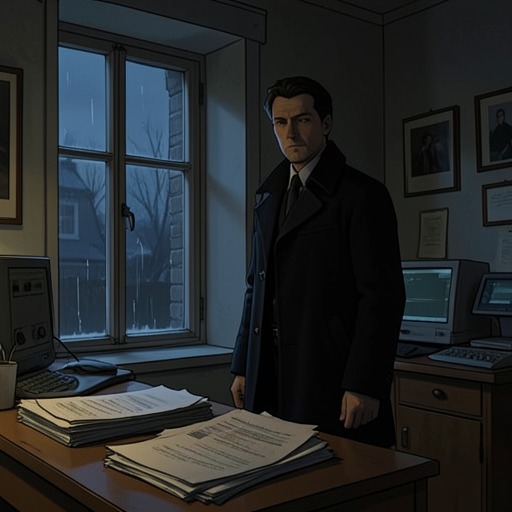
The discovery begins in winter, during the priest’s habitual evening chess games with the local gendarme sergeant. A farmer arrives urgently to ask the priest to administer the last rites to his dying mother, and the priest leaves before the game is finished. As the sergeant prepares to follow, he notices that Mirko’s attention is fixed on the board. The boy’s earlier manner had given no reason to expect an interest in chess: he had sat beside the players in silence, apparently indifferent.
The sergeant jokingly asks Mirko to take over, assuming that the somnolent adolescent will not know how to move the pieces. Mirko takes the priest’s seat. In fourteen moves he defeats the sergeant, who cannot dismiss the result as the consequence of one of his own careless mistakes; Mirko wins a second game as well. The invitation meant as a jest becomes the first test of a talent neither man had recognized.
When the priest returns, he challenges his attendant himself and loses with ease. Mirko’s play is slow and dogged, but certain: he keeps his attention lowered to the board and does not falter. In the following days, neither the priest nor the sergeant can win a game against him. The priest’s astonishment matters because he knows Mirko’s difficulties as a pupil firsthand; he is therefore moved not simply by a surprising victory but by the apparent coexistence of profound limitations and a precise, powerful chess ability.
Testing the talent
Rather than relying on the two men’s experience, the priest takes Mirko to a nearby town to face a chess club whose members are stronger than he is. He has the boy’s straw-blond hair cut so that he will look presentable, then brings him to the club’s café. Mirko arrives in a sheepskin and heavy work boots, embarrassed and standing shyly in a corner until someone calls him to a table. The setting shifts the discovery from private surprise to public trial.
The first game exposes the limits of Mirko’s experience: he loses because he has never encountered the Sicilian opening. But the loss does not settle the question of his ability. He draws against the club’s best player in the second game, then wins the third and fourth, defeating the members in succession. His performance shows that the initial victories over the priest and sergeant were not merely a lucky run, while the unfamiliar opening demonstrates how much ordinary chess knowledge he has yet to acquire.
The town’s notables rapidly turn the match into a local sensation. They arrange for Mirko to stay overnight so that additional club members can be summoned and old Graf Simczic, a chess enthusiast who lives at his castle, can be notified. The priest, newly proud of his ward, nevertheless has to return to conduct Sunday Mass; he agrees to leave Mirko for another test. At the chess club’s expense, the boy stays in a hotel, where he encounters a water closet for the first time.
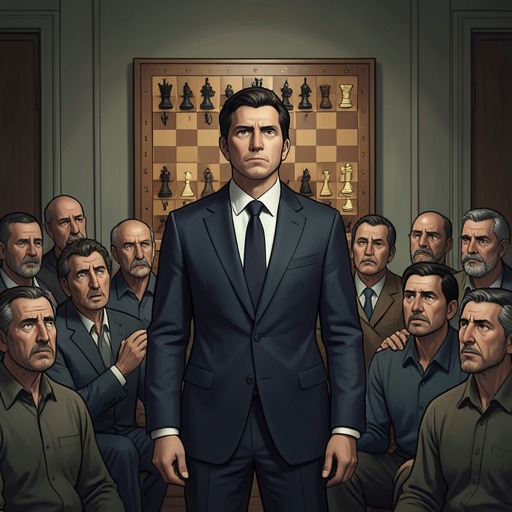
On Sunday afternoon the chess room is packed. Mirko sits almost motionless for four hours, does not speak, and never looks up as he defeats one player after another. The club then proposes a simultaneous match. It takes time for the uneducated boy to understand that he must play several opponents in turn, but once the arrangement is clear, he walks from table to table in his heavy, creaking shoes and wins seven of the eight games. The feat gives the discovery a more demanding public confirmation: his strength persists across multiple concurrent games, not only in a single contest.
From local sensation to career
The victories ignite the town’s pride. Although Mirko does not strictly belong to the town, its residents imagine that his success might bring recognition to a place few people have noticed on a map. Discovery therefore becomes a collective ambition: the chess players are not only assessing an unusual boy but also considering whether his talent can be carried beyond their provincial setting.
An agent named Koller, who normally supplies singers for the garrison stage, offers to arrange professional chess training in Vienna with a master he knows, provided a year’s grant is secured. Graf Simczic agrees to the contract at once. In the narrative, this agreement marks the first day of Mirko’s career: the local tests have established enough to turn an unexplained aptitude into an organized professional path.
The later course of that career clarifies the scale of what the town has recognized. After six months of training, Mirko has learned chess technique, though he remains unable to play blind: he needs a physical board and pieces before him. At seventeen he has won a dozen chess prizes; at eighteen he becomes Hungarian champion; at twenty he becomes world champion. Those later outcomes distinguish the discovery from a brief local marvel. The priest’s decision to test the boy, and the club’s decision to secure instruction, have set in motion an ascent to the highest level of the game.
The talent’s distinctive limits
Mirko’s discovery does not resolve the contradiction between his general difficulties and his chess mastery; it makes that contrast central to how his talent is understood. The boy can barely read and has trouble retaining elementary lessons, yet he defeats experienced chess players with exactness and persistence. His ability is not presented as a general intellectual brilliance revealed at last, but as a remarkable, sharply bounded capacity.
That boundary appears in his inability to play blind. Even during his later fame, he carries a folding pocket chessboard so he can reconstruct a match or work through a problem with the positions visible. The contrast gives the discovery a lasting qualification: Mirko’s chess strength is immense, but it depends on the tangible board rather than an ability to hold the game wholly in imagination. His victories in the village and town establish the power of his play; the later limitation reveals its particular form.