World War II
The Screwtape LettersWorld War II enters the letters not as a sustained account of campaigns but as an escalating pressure on the patient’s inner life. The war first offers Screwtape and Wormwood the prospect of fear, confusion, and suffering; as raids approach, however, it also draws the patient toward duty, attention to others, and dependence on God. Its decisive significance is this reversal: danger may be exploited by the tempters, but it can also bring moral choices into sharp focus and make their intended prey harder to lose.
Historical Frame and Narrative Function
The novel’s preface explicitly limits the war’s place in the correspondence. Its history matters only when it impinges on one human being’s spiritual condition, and the letters’ chronology is not presented as a reliable terrestrial timeline. The narrative therefore uses wartime conditions selectively: large-scale conflict is registered through the patient’s anxiety, responsibilities, and exposure to death, rather than through a comprehensive account of the war.
Screwtape’s first response to Wormwood’s excitement over the outbreak is corrective. Wormwood has described himself as “delirious with joy” at the prospect of war, but Screwtape diagnoses not strategic insight but intoxication with a first taste of a human soul’s anguish and bewilderment. The difference matters: immediate suffering pleases the devils, yet pleasure in suffering is not the same as securing a soul. Screwtape insists that Wormwood’s task is to undermine faith and prevent virtue, not to lose himself in the emotional spectacle.
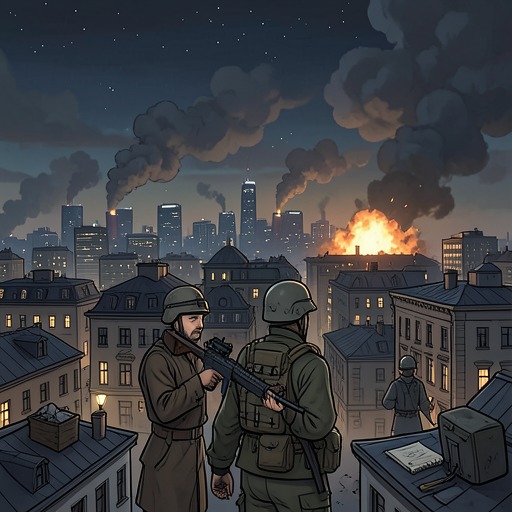
The war’s course is conveyed through shifts in the patient’s circumstances rather than through a dated sequence of military events. A lull in the fighting corresponds with a lull in his anxieties; later, bombardment of his town becomes certain, and his duties place him in danger. The preface cautions against treating the correspondence as a precise chronology, while these changing conditions give the spiritual argument its practical setting: uncertainty, a temporary easing of fear, and then the approach of raids.
Fear, Suffering, and the Uses of War
Screwtape regards wartime fear and suffering as useful only insofar as they can be turned toward the devils’ larger purpose. Wormwood is told to report the patient’s response so they can consider whether to encourage extreme patriotism or ardent pacifism. Neither stance is valuable to them in itself; the question is whether the patient’s reaction can be made to weaken faith or prevent the formation of virtue.
The war is dangerous to Hell precisely because tribulation can redirect attention beyond the self. Screwtape expects cruelty and unchastity, but also sees the possibility that people will turn toward God or toward causes they consider higher than themselves. Even when those causes are ones God does not approve, he may still value people who sacrifice themselves while acting according to what they understand to be good. The war can therefore produce outcomes that frustrate infernal calculation: suffering that the devils would like to consume as a source of pleasure may instead become an occasion for self-forgetfulness or moral commitment.
Screwtape also objects to deaths for which people are prepared. He contrasts them with deaths in nursing homes, where the devils would prefer doctors, nurses, and friends to conceal the dying person’s condition, encourage indulgence, and keep a priest from being called. War enforces the remembrance of death and makes the belief in indefinite earthly life difficult to sustain. Its pressure weakens the complacent worldliness that Screwtape calls one of Hell’s best weapons.
The danger of war is not only that it can provoke fear, but that it can make moral distinctions harder to evade. Screwtape instructs Wormwood to direct malice toward people the patient encounters nearby while extending benevolence toward remote strangers. Hatred of German leaders, he argues, may remain theatrical and based on newspaper images, whereas charity toward family, an employer, or a fellow passenger is tested in daily contact. He notes the contradiction of people who demand harsh treatment for enemies in principle yet offer tea and cigarettes to a wounded German pilot who appears at the door. The war thus exposes a gap between abstract hostility and conduct toward an actual person.
The Present Moment and Wartime Attention
Screwtape’s analysis of war also depends on where the patient’s attention is directed in time. He argues that God calls people toward eternity and the present moment: the present is where freedom and action are available, whether in obeying conscience, bearing a present burden, receiving grace, or giving thanks. The devils instead try to draw people away from both, especially by fixing their thoughts on the future, which is unknown and therefore readily filled with hopes and fears.
This distinction clarifies why wartime uncertainty is both an opportunity and a threat to Wormwood. Fear about what may happen can lead the patient into imagined futures, but the immediate demands of defense work and care for neighbors can bring him back to present responsibilities. Screwtape recognizes that the approaching danger has the patient full of his duties and increasingly attentive to those around him. Although the devils can exploit apprehension, they cannot assume that anxiety will culminate in self-absorption or spiritual decline.
When bombardment becomes certain, Screwtape considers cowardice, courage, and hatred as possible targets. He doubts the devils can create bravery themselves: they can only try to use virtues that God has supplied, which gives God a foothold even in people the devils otherwise believe they have secured. Hatred, by contrast, can be encouraged by directing the strain of danger and fatigue into resentment. Wormwood is advised to frame hatred as concern for women and children, while obscuring the Christian demand to forgive one’s own enemies.
Screwtape identifies fear as a means of making hatred more attractive: hatred can compensate for the distress of fear and soften the shame of cowardice. Yet making the patient a coward carries a risk for the tempters. If he recognizes his failure, he may gain moral self-knowledge and turn toward repentance and humility. Screwtape says that, in the previous war, many people first discovered the moral world through discovering their own cowardice. For him, the dangerous world is one in which questions of courage and conduct become unavoidable.
The Raid and Its Spiritual Consequences
The first air raid reveals how little Wormwood’s immediate tally of faults explains the patient’s conduct. The patient is frightened and thinks himself a coward, but performs what duty requires and perhaps more. Screwtape treats this as a defeat for the tempter: fear has not prevented the patient from acting responsibly, and his lack of pride in the performance prevents the action from simply becoming a source of self-congratulation. Wormwood can point to irritability toward a dog, excessive smoking, and a forgotten prayer, but these fail to outweigh the patient’s conduct.
Screwtape’s response underscores the difference between feeling afraid and surrendering to cowardice. The patient’s fear is real; his behavior nevertheless meets his duty. The episode also makes the war’s moral stakes concrete without turning the patient into a triumphant figure. He believes himself cowardly even as his actions indicate that he has done what was required.
Fatigue supplies Wormwood with another possible opening, but Screwtape warns that exhaustion does not produce only irritability. It can also bring gentleness, quiet, or a kind of vision. Moderate fatigue may encourage peevishness when unexpected demands are experienced as injuries, whereas exhaustion after hope of relief has been abandoned can foster humility and gentleness. The tempter is therefore advised to feed the patient false expectations that the raid will not recur and that he will soon enjoy his bed. By encouraging him to endure only for a limited, imagined period, Wormwood may make him give way just when relief is near. War’s pressure becomes a contest not merely over endurance, but over whether endurance is conditional on a promised end.
Survival, Love, and the Ending
As the danger to the patient becomes immediate, Screwtape’s priorities invert Wormwood’s delight in human suffering. He rebukes his nephew for celebrating the prospect of heavy air raids without attending to the fact that bombs may kill the patient. The patient has escaped the worldly friends through whom Wormwood tried to entangle him, has fallen in love with a Christian woman, and remains difficult to corrupt. He is occupied with defense work and with the woman he loves, attends to neighbors more than before, finds satisfaction in doing so, and is becoming more consciously dependent on God.
For that reason, Screwtape wants the patient kept alive. If he dies at this point, the devils lose him; if he survives, they can hope to exploit the long routine of middle age, the fading of youthful loves and hopes, and the difficulty of perseverance. The patient’s lover and mother are praying for his bodily safety, and Screwtape recognizes that the devils’ immediate objective is now the same. Survival is not their ultimate moral good: it is a way to preserve time as a possible ally in their campaign.
The letters finally show the patient dying in a bombing and entering Heaven, an outcome that overturns Screwtape’s investment in survival. At death, the patient recognizes the spiritual beings who had accompanied him through life and understands their part in moments when he thought himself alone. He sees God, whose presence is not terror to him but clarity, and his earlier earthly attractions lose their power beside the reality he encounters. World War II’s danger had given the devils a chance to exploit fear, but the patient’s death is not the victory Screwtape sought: the war’s final consequence is his loss to Hell.
The war’s literary function lies in this double exposure. It reveals the devils’ appetite for suffering and their fear of losing the patient, while testing whether anxiety will become hatred, cowardice, or self-absorption—or whether duty and attention to others will take precedence. The letters do not make war spiritually beneficial in itself; they show that its pressure can bring choices into view that calmer conditions allow a person to evade. The preface’s insistence that military history matters only as it affects one soul is fulfilled in the patient’s trajectory from wartime anxiety and service to death and entry into Heaven.