the upstairs nursery
The Yellow Wall PaperThe upstairs nursery is the principal setting of the narrator’s confinement and psychological unravelling. John selects it as a place of air and rest, but its barred windows, scarred walls, immovable bed, and repellent yellow wallpaper turn the room into a material record of restriction. As the narrator studies the pattern, imagines a woman trapped behind it, and eventually tears it down, the nursery shifts from a prescribed bedroom into the stage for her attempt to claim freedom.
Selection and Physical Setting
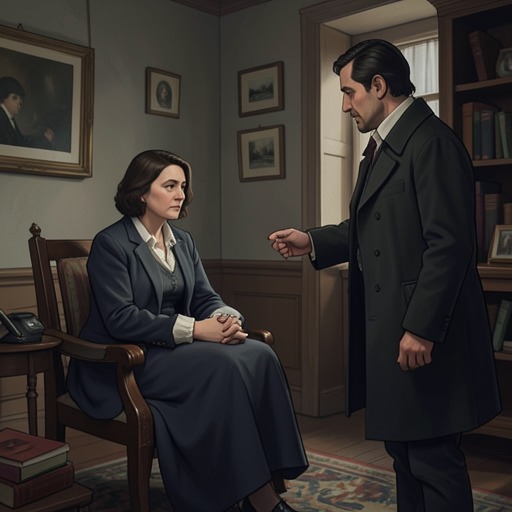
John says that the couple have come to the house for the narrator’s sake, so that she can rest and have all the air she can get. On that rationale they take the nursery on the top floor. The narrator would rather have a downstairs room opening onto the piazza, with roses at the window and old-fashioned chintz hangings, but John refuses: that room has only one window, cannot accommodate two beds, and would leave him without a nearby room. His practical arguments determine where she must stay, even as he describes the arrangement as care.
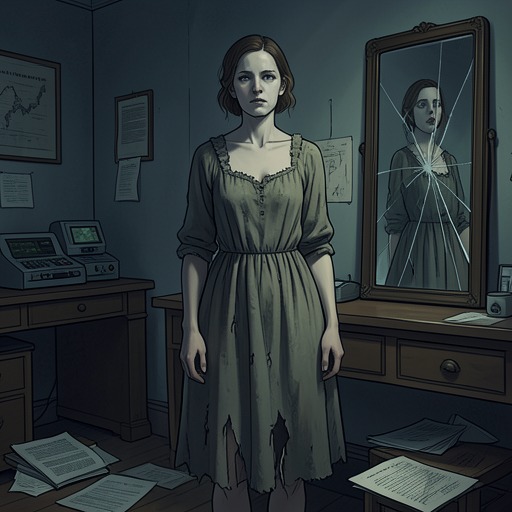
The nursery occupies nearly the whole floor. Its windows face in different directions, admitting air and sunshine, but they are barred for small children. Rings and other fixtures remain in the walls, evidence of the room’s earlier uses as a nursery, playroom, and gymnasium. The furnishings brought up from downstairs do not harmonize with the space, and the room’s broad, exposed dimensions offer little of the domestic prettiness the narrator wanted. Its openness to light and air therefore coexists with physical signs of containment.
The walls and floor preserve the marks of earlier occupants. Paper has been stripped away in patches around the head of the bed and low on the opposite side; the floor is scratched, gouged, and splintered, the plaster dug out in places, and the heavy bed looks battered. The narrator attributes the damage to children’s vigorous dislike of the room and says that the wallpaper alone troubles her. The battered surfaces give the setting a history of resistance before she begins her own struggle with it.
The Room and the Wallpaper
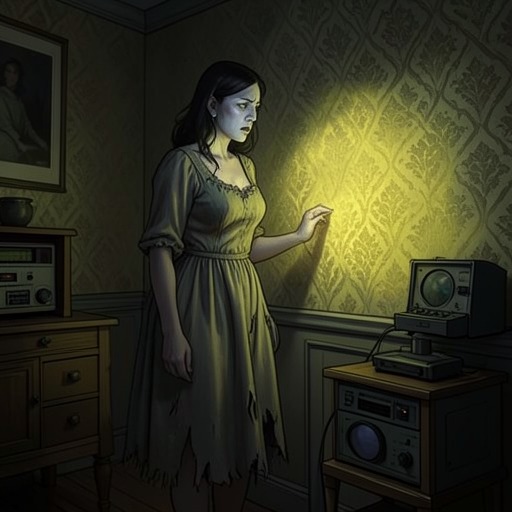
The wallpaper dominates the narrator’s attention. Its sprawling design seems to violate every principle of composition: its uncertain curves abruptly break into angles, and its repeated breadths offer no satisfying order. Its colors shift between dull, lurid orange and sickly sulphur. The narrator first describes it as an irritation, but prolonged observation makes it the central object around which her days and thoughts gather.
Her bed becomes a fixed viewing point. She lies on the great, apparently nailed-down bed and follows the pattern for hours, repeatedly trying to trace its aimless course to a conclusion. What begins as an exercise in looking becomes an absorbing routine; the room’s immovable furniture keeps her body in place while the pattern supplies a seemingly endless field for mental activity. The narrator’s growing attachment to the room is inseparable from her fixation on its paper: she admits that she is becoming fond of the room, perhaps because of it.
The nursery also holds the narrator’s writing, though only secretly. She stops writing whenever John approaches because he hates to see her write, and later finds a moment by the window when she can continue so long as her strength allows. She believes writing might relieve the pressure of her ideas, yet becomes tired when she tries and lacks advice or companionship about her work. The room is thus both the place where her self-expression is curtailed and the private enclosure in which she continues it.
Confinement, Observation, and the Imagined Occupant
John’s care makes the nursery part of a wider regimen. He prescribes a schedule for each hour, directs the narrator’s activity, and insists that she is improving. When she tells him she is not gaining and wants to leave, he points to their lease, unfinished repairs at home, and his inability to leave town; he also claims that her flesh, color, and appetite have improved. She disputes his account, saying she has not gained weight and eats worse in the morning when he is away. The room’s physical comfort, in John’s view, supports his judgment, while the narrator’s account of her suffering fails to alter the plan.
The nursery’s distance from the rest of the house gives the narrator a vantage on the grounds but does not grant her free movement. From one window she sees the garden, shaded arbors, old flowers, bushes, and trees; from another, the bay, a private wharf, and a lane leading down from the house. She sometimes imagines people moving through the paths, but John warns her against indulging her imagination. In the room, looking outward and being told not to trust what she imagines become opposing habits.
The wallpaper gradually acquires an apparent inhabitant. The narrator sees a woman behind its pattern, creeping and shaking it, and interprets the marks and repetitions in the room as clues to movement. A long, even streak low on the wall runs behind the furniture, which the narrator wonders might have been rubbed round and round. The wall’s physical trace and the design’s visual disorder feed her sense that something is happening within the room, though the account does not establish an independent presence behind the paper.
The narrator’s own actions increasingly echo the movement she attributes to the woman. She creeps by daylight and locks the door so that no one will see her; she does not do so at night because she thinks John would suspect something. She wants to be the only person who can get the woman out. The nursery’s door, windows, and furnishings now organize a private routine of concealment: she controls access to the room even while remaining confined within it.
Tearing the Paper and the Ending
On the last day before departure, John stays in town overnight. Jennie wants to sleep with the narrator, but the narrator persuades her that she will rest better alone. When moonlight brings the imagined woman’s movement into focus, the narrator gets up to help her. She pulls while the woman shakes the pattern, and together, in the narrator’s account, they strip away yards of paper before morning, removing a band about as high as her head and extending halfway around the room.
The narrator then keeps others from interfering. She locks the door and throws the key onto the front path, telling Jennie that the room is quiet, empty, and clean and that she intends to sleep. After Jennie and the servants leave and the furniture is removed, the nursery is reduced to its nailed-down bed and canvas mattress. The narrator finds rope that Jennie had not discovered, imagining that she can use it if the woman tries to escape. She cannot reach far without something to stand on, cannot move the bed despite trying until she is lame, and bites a corner of it in anger. She tears off all the wallpaper she can reach from the floor; its stubborn adhesion makes the work laborious rather than triumphant.
When John returns, the locked door and discarded key prevent him from entering immediately. He finds the key beneath a plantain leaf, unlocks the door, and sees the narrator creeping around the room. She tells him that she has got out and pulled off most of the paper so he cannot put her back. John faints across her path, and she continues creeping, having to pass over him each time. The nursery’s final transformation is both material and interpretive: the paper is largely stripped, the room emptied, and the narrator treats its circuit as the route of her escape, while the act leaves her isolated within the space where her breakdown has become unmistakable.