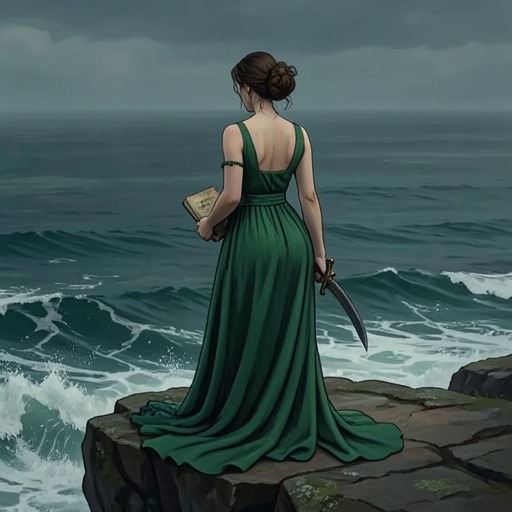
Merfolk
TideMerfolk are an aquatic people whose place in the story emerges through Meira: a mermaid, daughter of King Strom, and guardian of the Eastern Seal. Her rescue of Prince James and her attempt to live as a human bring the people of the sea into direct contact with Mhuirlan’s royal and magical affairs. Through Meira, the book presents merfolk identity not as a distant legend but as a life shaped by kinship, isolation, duty, and the consequences of crossing between sea and shore.
Identity and Place
Galahad Stormcrane identifies Meira as a princess and daughter of King Strom, and recognizes her as Merfolk when she understands Brimtung but cannot speak. She is the king’s eldest daughter. These details place her within a royal family beneath the water, while her role as guardian connects her personally to a protective order whose reach extends beyond her own people.
The evidence offers a limited view of merfolk society rather than a general account of its customs. Meira’s family lives much farther out to sea, while she guards the Eastern Seal near Mhuirlan. Galahad’s letter describes the surf near Mhuirlan as rough, savage, and cold, and notes the danger posed by fishermen’s nets and snares. Her guardianship therefore entails separation from her family and exposure to hazards associated with the human coast. The text makes these concrete conditions part of her particular life; it does not establish that every merfolk shares them.
The Eastern Seal and Its Guardian
Meira’s identity is bound to the Eastern Seal. Galahad explains that the seals were laid down by the first Curse-Breakers to protect Edel from Curse-Makers arriving from other shores. Each seal has a guardian whose life is bound to it, and whose duty is to guard and strengthen it. Meira’s position is thus both a personal responsibility and part of a wider system of protection.
The seal’s scale underscores the difference between its hidden function and its visible presence. One lies in the sea near Mhuirlan, where it may appear from above as a vast circle of dark stone, perhaps a mile wide. The royal family knows of the structure, but the prince initially does not know that it has a guardian whose life is bound to it. Meira’s existence supplies the missing human—or, more precisely, merfolk—presence behind the kingdom’s knowledge of the seal.
This duty also makes her transformation consequential beyond her private hopes. Meira takes a spell from Myrkur, the Sea Witch, in order to become human. Her agreement costs her voice and carries a fatal condition: she must marry the man she loves, or die if he refuses or marries someone else. Galahad recognizes that the arrangement threatens the guardian’s life and, by extension, the protection attached to her post. The bargain brings Meira’s desire to cross into human life into conflict with a responsibility she cannot simply leave behind without wider consequences.
Meira Between Sea and Shore
Meira’s connection to Prince James begins with a shipwreck. A storm drives his ship onto Serpent’s Pass, the ring of protruding stones between Hanter-broder and Hanter-hwor; the vessel is destroyed and its crew lost. James later remembers arms taking hold of him and a woman’s singing voice. Meira is the mermaid who rescues him. His recollection establishes her first as a rescuer, before he knows who she is or what her intervention will cost her.
Galahad finds Meira on a beach, unable to speak, and discovers the ancient rune for M on her hand. He takes her to the house, where Little Emblyn bathes and dresses her, and communicates with her through questions she can answer by gesture. She can understand Brimtung, but the spell prevents her from answering aloud. Her silence is therefore not presented as an inability to understand human speech: it is a condition imposed as part of the bargain with Myrkur.
The difference between understanding and speaking becomes a defining feature of Meira’s passage between communities. She can comprehend the language used around her, yet cannot make herself heard in it. Her pointing to her ring finger lets Galahad infer the marriage condition, while her nod confirms his interpretation. The scene gives her a means of communicating, but also shows how much of her situation must be pieced together by another person while her own voice is withheld.
Narrative Significance
Meira’s story unsettles the assumption that the sea and the human world are separate domains. The prince’s survival depends on a mermaid’s action; the guardian protecting Mhuirlan’s seal belongs to an underwater royal family; and a spell intended to make her human entangles her in the succession of human relationships and obligations. Her life joins these worlds without erasing the risks or inequalities involved in that crossing.
The narrative later confirms the importance of her origin through Beatrix, who has assumed that the seal was guarded by merfolk. Galahad confirms that it was, and explains that Meira made a bargain with Myrkur to become human forever if she married the man she loved. The revelation reframes Meira’s silence and human appearance: what seemed like a personal mystery is also evidence of the sea people’s place in the kingdom’s protective order and of the danger that Myrkur’s bargain posed to it.
Merfolk are consequently associated with both rescue and guardianship, but the story does not treat those roles as effortless or romantic. Meira saves James, yet her own survival becomes conditional on his choice; she guards a seal, yet her isolation and exposure to human hazards remain part of that service. Through her, the people of the sea become essential to Mhuirlan’s safety while remaining distinct from its court—a connection that is powerful precisely because it does not dissolve the boundary between them.