opening years of the ten-year marriage
The Paper Marriage
[Jacinta Colt](entity:character-recall-character-jacinta-colt-048d04b4f70e) and [Aaron Colt](entity:character-recall-character-aaron-colt-3a05471ce57e) have been married for ten years, raising [Willa Colt](entity:character-recall-character-willa-colt-d931627bdf34) and [Theo Colt](entity:character-recall-character-theo-colt-f6ab4b48443b) within a carefully organized household. Jacinta’s labeled bins, color-coded calendar, and drawer of [Aaron's ten-year notes](entity:object-recall-object-aaron-18c09e2c258b) make their domestic life appear secure, though the notes also reveal how much of their intimacy exists on paper rather than in public recognition.
three years before the opening
The Renewal Centre Project
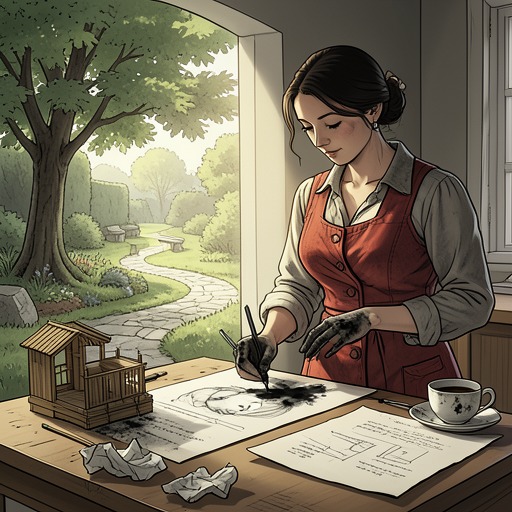
Jacinta conceives and develops the [Renewal Centre](entity:location-recall-location-renewal-centre-30b799230202) from an informal sketch into a major recovery and wellness facility. She creates its sensory rooms, site plans, grant applications, and budgets, believing the gala will finally identify her as the project’s creator rather than merely [Aaron Colt](entity:character-recall-character-aaron-colt-3a05471ce57e)’s wife.
ten days before the gala
The Vale Group Breakfast
Aaron leaves a note saying he is having breakfast with the [Vale Group](entity:organization-recall-organization-vale-group-1f41038c2884), a name that immediately evokes [Cassandra Vale](entity:character-recall-character-cassandra-vale-af2edd69369e), the woman [Beatrice Colt](entity:character-recall-character-beatrice-colt-4d91214e4940) once preferred for him. Aaron later explains that the [Vale family](entity:character-recall-character-vale-b918a6754357) will cover the gala venue and catering, introducing the financial leverage that will shape his later decisions.
Tuesday at 11:07 p.m.
Cassandra’s Hotel Visit
[Cassandra Vale](entity:character-recall-character-cassandra-vale-af2edd69369e) arrives at Aaron’s hotel suite in a silk robe and tries to revive their former relationship. She tells him Jacinta is the wrong woman and touches him, but Aaron removes her hand, calls security, and has her escorted away without an incident report.
immediately after the hotel incident
The Deleted Confession
Aaron writes Jacinta a message explaining that Cassandra came to his room and that nothing happened. He deletes it after remembering that the [Vale venue contract](entity:object-recall-object-vale-6ad23894357b) remains unsigned and fearing that the family could withdraw its support for the [Renewal Centre](entity:location-recall-location-renewal-centre-30b799230202).
gala week
The Erased Program Credit
Jacinta receives the revised gala program and discovers that her name has disappeared from the [Renewal Centre](entity:location-recall-location-renewal-centre-30b799230202) page. The project is described as the [Colt Foundation](entity:organization-recall-organization-colt-foundation-de843200c614)’s vision, establishing the central authorship-erasure that will culminate at the gala.
the week before the gala
The Hotel Corridor Photograph
An unknown sender transmits Jacinta a photograph of Cassandra touching Aaron in a hotel corridor. The image is carefully timed and framed to suggest an affair, although the details match the night Aaron rejected Cassandra.
Monday of gala week
The False Meeting Notice
Cassandra claims that the [Renewal Centre](entity:location-recall-location-renewal-centre-30b799230202) walkthrough was moved from ten to nine and reveals that the notification was sent to a nearly identical email address. She tells Jacinta that Beatrice believes she is overwhelmed and that Cassandra’s team has taken every logistical detail from her.
Tuesday of gala week
The Access Revocation
Jacinta loses access to the shared [Renewal Centre](entity:location-recall-location-renewal-centre-30b799230202) files and is redirected to Penny on the Vale events team. The administrative exclusion confirms that her removal from the project is operational rather than a mere printing mistake.
Tuesday of gala week at noon
The Northlight Discovery
Unable to reach the project files, Jacinta reconstructs the project through the finance portal. She finds repeated payments totaling $95,000 to [Northlight Consulting](entity:organization-recall-organization-northlight-consu-a8f9777d1635), a newly created Delaware mailbox company with no contract or deliverables, approved by [Celeste Colt](entity:character-recall-character-celeste-colt-3dd279c252ba).
Tuesday night of gala week
Aaron’s Demand for Silence
Jacinta confronts Aaron with both the erased program and the Northlight payments. Aaron does not initially ask whether the evidence is genuine; he asks where she obtained it, then tells her to remain silent until after the gala so he can protect the project and preserve the Vale relationship.
Thursday of gala week
The Recipes Evidence Folder
After receiving a final program crediting Cassandra as event director, Jacinta realizes that the photograph and the instability narrative are designed to provoke a reaction. She creates a hidden folder called Recipes containing the photograph, email headers, budget records, and program versions, turning her organizational habits into a defensive archive.
pre-gala dinner
The Marital Place Card
At the pre-gala dinner, Jacinta is given a place card reading Mrs. [Aaron Colt](entity:character-recall-character-aaron-colt-3a05471ce57e) while everyone else receives an individual name. Beatrice seats her at the end of the table, and Cassandra arrives in white to occupy a place bearing her own name, dramatizing the family’s decision to make Jacinta socially invisible.
gala night at 8 p.m.
Beatrice’s Gala Accusation
Beatrice presents the [Renewal Centre](entity:location-recall-location-renewal-centre-30b799230202) as a family achievement made possible by the [Vale family](entity:character-recall-character-vale-b918a6754357) and stewarded by Celeste. She then turns toward Jacinta and publicly describes her as struggling and unable to carry great things, converting a private mental-health vulnerability into gala entertainment.
immediately after Beatrice’s speech
Aaron Sits Down
Aaron rises halfway from his chair while the ballroom watches Jacinta. He calculates the venue, the Vales, the contract, and the cameras, then sits back down instead of defending her.
minutes after Jacinta leaves the ballroom
Elliot’s Deposition
[Elliot Grant](entity:character-recall-character-elliot-grant-0d983ab3b592) follows Jacinta into the corridor and identifies himself as a witness to her authorship. He remembers her initials on the project files every Friday for three years and promises to testify about what he saw, forming Jacinta’s first professional alliance outside the [Colt family](entity:character-recall-character-colt-692130dba569).
later on gala night
The Gold Corridor Confrontation
Aaron finds Jacinta in the same gold corridor shown in the photograph. She asks him to say one word in her defense, but he answers only that it is not the place or time, leaving her to recognize the full meaning of his repeated silence.
Sunday after the gala
The Hotel Truth
Jacinta finally asks Aaron directly about the photograph. He admits that Cassandra came to his room, that he rejected her, and that he wrote but deleted a message explaining everything because the venue contract was vulnerable.
Sunday after the gala
The Fixed-Cost Revelation
Aaron frames his concealment as protection of Jacinta’s project, but she rejects that explanation. She tells him he used her and the project as currency, giving the story its governing insight: fixed costs do not send invoices, but they can still leave.
Sunday after the gala
The Marriage Ledger
In Aaron’s office, Jacinta finds the private list he wrote before their wedding. Cassandra is described as easy and socially advantageous, while Jacinta is called brilliant, funny, chaotic, and certain to stay; the concluding instruction is “[Choose the one who stays](entity:expression-recall-expression-choose-the-one-who-7c0ae1e5383c).”
the weekend after the gala
Jacinta’s Departure
Jacinta packs herself and the children for [Haven House](entity:location-recall-location-haven-house-fe6f49205d94) at [Bellweather Cove](entity:location-recall-location-bellweather-cove-b205bf11e64b). Aaron tries to characterize the departure as an episode of overwhelm and warns that leaving will validate Beatrice’s story, but Jacinta recognizes that he is still asking her to manage the family narrative.
the day Jacinta leaves
The Paper Marriage Returned
Jacinta places [Aaron's ten-year notes](entity:object-recall-object-aaron-18c09e2c258b) on his pillow and leaves the accumulated paper evidence of their marriage behind. She takes the [“Choose the one who stays” list](entity:object-recall-object-choose-the-one-who-sta-c082469b0eee) and the Recipes folder, transforming what once represented devotion into evidence of the bargain that governed their home.
first month after separation
The Failed Grand Gestures
Aaron sends white peonies, an expensive sapphire necklace, and a new Volvo to [Haven House](entity:location-recall-location-haven-house-fe6f49205d94). Jacinta rejects all three gestures; the peonies are repurposed for a chapel and Willa explains that an apology is not a centerpiece.
each Sunday after separation at 6:30 p.m.
The Sunday Court
The children’s Sunday calls become a recurring court of appeals. Theo asks Aaron whether he is in trouble, while Willa asks why he did not say Jacinta’s name at the gala and later evaluates his attempts at accountability.
three weeks after Jacinta’s departure
Beatrice Confronted
Beatrice accuses Aaron of embarrassing the [Colt family](entity:character-recall-character-colt-692130dba569) and describes Jacinta as a problem she had tried to manage. Aaron finally names Beatrice’s role in exposing Jacinta, erasing her authorship, and publicly stigmatizing her, then orders his mother to leave and remove the foundation from his building.
the first month after separation
Aaron Begins Therapy
Aaron begins seeing [Dr. Feld](entity:character-recall-character-dr-feld-17b6fdf717fc), who challenges his expensive gifts as tendered offers rather than apologies. He admits that he treated Jacinta as a fixed cost and finally understands that her loyalty was not an asset he could spend indefinitely.
about one month after separation
The Vale Scheme Exposed
With help from [Elliot Grant](entity:character-recall-character-elliot-grant-0d983ab3b592) and his technical team, Aaron obtains the hotel corridor log and traces the false email address to a vendor on the Vale events payroll. He confronts Cassandra with the evidence and states that her staged photograph, fake email, and burner messages were part of a deliberate campaign.
about one month after separation
The Vale Alliance Terminated
Aaron terminates the Vale venue and development relationship despite its estimated value of $41 million. He publicly identifies Jacinta as the [Renewal Centre](entity:location-recall-location-renewal-centre-30b799230202)’s true designer and releases the evidence of the staged photograph and manipulated communications.
immediately after Aaron’s disclosure
Jacinta’s Credit Restored
News coverage names Jacinta as the designer of the [Renewal Centre](entity:location-recall-location-renewal-centre-30b799230202) and reports Aaron’s admission that the erasure occurred on his watch. Jacinta reads her name in print but refuses to return merely because a headline has corrected the public record.
several weeks after separation
The Leaked Marriage List
Beatrice leaks the private [“Choose the one who stays” list](entity:object-recall-object-choose-the-one-who-sta-c082469b0eee) to the press, producing a headline that treats [the Colt marriage](entity:state-recall-state-colt-699cd74722db) as a spreadsheet. The disclosure exposes Aaron’s original calculation and intensifies the public judgment against him.
after the leaked list
Aaron’s Board Confession
Before the [Colt Global](entity:organization-recall-organization-colt-global-782969288909) board, Aaron confirms that the list is genuine. He admits that he treated Jacinta as a capital asset, allowed his family to operate by the same policy, and failed to update the ledger even after realizing that its assumptions were wrong.
the same period as the board confession
The Northlight Financial File
Elliot brings Aaron the complete [Northlight Consulting financial records](entity:object-recall-object-northlight-consulting-a4fac0760ab7). The payments are countersigned by both Celeste and Beatrice, proving that the embezzlement reaches the foundation’s leadership rather than stopping with Aaron’s sister.
Thursday after the investigation
The Foundation Purge
The [Colt Foundation](entity:organization-recall-organization-colt-foundation-de843200c614) board reviews the false consulting company, missing deliverables, and family signatures. Celeste resigns and is referred to the state’s attorney, while Beatrice is removed as chair of the foundation she controlled for decades.
immediately after the foundation purge
Celeste’s Admission
Celeste privately tells Aaron that she knew Jacinta was being credited over at the gala and waved anyway. Her confession confirms that the family’s public performance was knowingly built on Jacinta’s erasure, even though Celeste’s remorse cannot undo the damage.
about six months after Jacinta’s departure
Aaron Loses the Chair
The [Colt Global](entity:organization-recall-organization-colt-global-782969288909) chairmanship vote removes Aaron by an 8–4 margin, though he remains CEO because the company still needs him. He accepts the loss as an honest accounting rather than fighting to preserve every position his family once guaranteed.
six months after separation
The Lake Community Emerges
At [Bellweather Cove](entity:location-recall-location-bellweather-cove-b205bf11e64b), Jacinta establishes a new life with systems that are practical rather than defensive. She redesigns the local library reading room and receives the first building plaque bearing her name, while [Noah](entity:character-recall-character-noah-a98b7615ea8f) becomes a reliable friend who respects her boundaries and work.
about six months after separation
The Recovery Gardens Concept
Jacinta begins sketching the abandoned summer camp beside [Haven House](entity:location-recall-location-haven-house-fe6f49205d94) as a new recovery facility. She imagines gardens, sensory-friendly quiet rooms, a structured kitchen, and a porch light left on, converting the architecture of her own survival into a future nonprofit.
April of the first year after separation
Cassandra’s Final Offer
Cassandra offers Aaron a return to the Vale alliance, a restored foundation gap, a public engagement, and the power to make the scandal disappear. Aaron refuses, accepting that even if Jacinta never returns, he can still choose truth over the market value of appearances.
June of the first year after separation
Beatrice’s Hospital Bargain
After Beatrice suffers a heart attack, she continues trying to negotiate through the crisis by asking Aaron to stop the investigation and pursue custody pressure against Jacinta. Aaron refuses, distinguishing filial care from obedience and maintaining the boundary he had never previously enforced.
July of the first year after separation
Celeste’s Plea
Celeste accepts a plea deal for the Northlight misconduct and apologizes to Aaron without attaching an excuse. Aaron continues visiting Beatrice but refuses to withdraw the legal consequences, allowing accountability to remain separate from family loyalty.
July of the first year after separation
Therapy Ground Rules
Jacinta initiates couples therapy with [Dr. Weiss](entity:character-recall-character-dr-weiss-15b9c17502e3), explicitly stating that reconciliation is not the purpose. The couple agrees to live apart, avoid performance, and allow Jacinta to ask any question, creating the first relationship structure in which she receives an equal vote.
first six weeks of couples therapy
The Undecorated Answers
Jacinta asks whether Aaron would have told her about Cassandra if the contract had been secure, how often he defended her in absent rooms, and whether he loved her or merely loved that she stayed. Aaron answers with uncertainty and direct admissions instead of polished reassurance.
August of the first year after separation
The Courtship Request
After seven therapy sessions, Aaron asks Jacinta for permission to court her rather than asking for forgiveness or reconciliation. He acknowledges that he proposed to a certainty instead of courting a chosen partner and accepts that she may reject him at any time.
immediately after the courtship request
The Courtship Terms
Jacinta permits one public coffee under strict conditions: her town, her time, no gifts, no pressure, and no charm. Aaron accepts that honesty may be boring and that every future step depends on Jacinta’s continuing choice.
October of the first year after separation
The Grant Presentation
Jacinta presents the [Haven House Recovery Gardens](entity:location-recall-location-haven-house-recovery-5f82c59edafa) to the [Lake Counties Health Foundation](entity:organization-recall-organization-lake-counties-he-6e50100535e7). She openly describes her neurodivergent mind and the theft of the [Renewal Centre](entity:location-recall-location-renewal-centre-30b799230202), then declares that this new project belongs to her and will allow every participating woman to receive credit for her own work.
October of the first year after separation
Aaron Rejects Meridian
[Meridian Health](entity:organization-recall-organization-meridian-health-541b859882e0) offers to fund the Recovery Gardens at scale, but only if Jacinta is reduced to a consultant and the program carries Meridian’s name. It also offers Aaron a chairmanship, making the proposal another version of the original bargain; he rejects both the erasure and the power.
immediately after Meridian’s offer
The Intellectual Property Transfer
Aaron transfers every [Renewal Centre](entity:location-recall-location-renewal-centre-30b799230202) design file and piece of intellectual property to the [Haven House Recovery Gardens](entity:location-recall-location-haven-house-recovery-5f82c59edafa) without conditions or reversion rights. He tells Elliot that the material was never his to return; his responsibility is to stop holding it.
nearly one year after separation
The New Marriage Proposal
Jacinta calls Aaron and states that she will not return to their old marriage. Instead, she proposes building a new one in [Bellweather Cove](entity:location-recall-location-bellweather-cove-b205bf11e64b), with total information, same-day disclosure, continuing therapy, and permanent ownership of her name and work.
the year of reconstructed marriage
The Daily Choice
Aaron moves into Jacinta’s lake community part-time and maintains a disciplined pattern of therapy, Sunday coffees, and dependable involvement with the children. Their marriage is reconstructed through repeated choices rather than a single grand reconciliation, while Willa gradually upgrades Aaron’s moral grade.
one year later
The Recovery Gardens Opening
The [Haven House Recovery Gardens](entity:location-recall-location-haven-house-recovery-5f82c59edafa) opens at the former camp beside [Haven House](entity:location-recall-location-haven-house-fe6f49205d94). Its gardens, quiet rooms, accessible paths, structured kitchen, and credit charter embody Jacinta’s design, and the building bears her name as founder and designer.
opening day one year later
Beatrice Faces the Plaque
Beatrice attends the opening under strict boundaries and acknowledges that Jacinta built the Gardens. The moment is not a full apology, but it is an unvarnished recognition, while Aaron escorts his mother away without allowing her old control to re-enter the celebration.
opening day one year later
Everybody Gets Credited
Willa and Theo cut the ribbon, and Willa announces that the family is effectively a nonprofit where everyone receives credit and everyone is audited. The statement transforms Jacinta’s private struggle over authorship into the governing ethic of the new institution.
evening of the opening
The Final Review
Willa gives Aaron an A for consistently pouring coffee and showing up at Jacinta’s party without demanding applause. Her judgment marks the completion of his long movement from performance toward dependable participation.
the night after the opening and every night thereafter
The Still Ritual
Aaron leaves a note on Jacinta’s pillow asking “Still?” and Jacinta writes “Yes” beneath it. The ritual replaces the old drawer of proof with a daily ballot, making their marriage an ongoing choice rather than a promise secured by habit or possession.