Water spirits
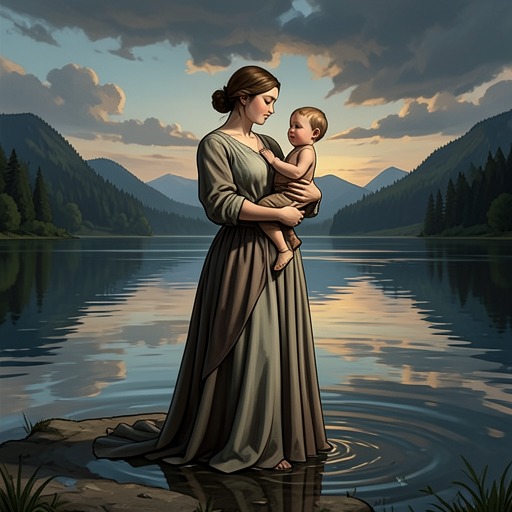
UndineWater spirits are one of the novel’s elemental peoples: beautiful beings who dwell beneath lakes and streams, command or answer to water, and differ from mortals above all in lacking souls. Their desire for a soul makes human attachment both a possibility and a danger. Through Undine and her relatives, the book makes water at once a home, a power, a boundary between worlds, and the medium through which a marriage is tested.
Nature and Underwater World
The water spirits belong to a wider family of beings associated with the elements. The novel places them alongside salamanders that glitter in flames, malicious gnomes deep within the earth, and spirits of the air that wander through forests. The water spirits inhabit lakes, streams, and brooks, and their underwater country is not an empty abyss: it has crystal domes through which sun and stars can be seen, gardens of tall coral trees bearing blue and crimson fruits, clean sand, patterned shells, and treasures from an older world. Water veils these monuments from human sight, preserving below the surface a beautiful realm that the present world is said no longer to deserve.
In appearance, water spirits are exceptionally fair, often more beautiful than human beings. Fishermen who glimpse a tender mermaid rising to sing may carry stories of her beauty far beyond the water; such beings are called Undines. The account grants them a culture and a form resembling those of humans, and they call themselves human for that reason, but resemblance does not erase the difference between their kind and mortal life.
Souls, Mortality, and Human Union
The decisive difference is spiritual as well as physical. When water spirits and their kindred die, they vanish into dust, body and spirit, leaving no trace. The elements move them during life and may obey them, but at death scatter them; without souls, they are merry like nightingales and little gold-fishes, untouched by the grief associated with a soul. Their condition is thus enviable in its freedom from sorrow and incomplete in its exclusion from a purer life after death.
The novel connects this lack to a desire to rise beyond their elemental condition. Undine’s father, a powerful water-prince in the Mediterranean Sea, wants his only daughter to gain a soul, although that change will bring her human suffering. A water spirit can acquire a soul only through the closest union of affection with a human being. Undine tells Sir Huldbrand of Ringstetten that she has gained one through their bond: she thanks him for it, but warns that rejection would leave her a loving, suffering, soul-endowed woman without human companionship. Her transformation makes love a passage between kinds, while making the soul both a gift and a source of vulnerability.
Kinship, Water’s Agency, and the Human World
Water spirits are related to particular waters as well as to one another. Undine identifies the Forest Brook by the Lake as her uncle, describing him as powerful and beloved by many great streams. He brought her, a laughing child, to the fisherman and could take her back to her parents. That family connection gives the landscape a personal dimension: the brook is not simply a route or feature of the setting, but a relative and a possible way home.
The water spirits’ influence also reaches into human affairs. During the journey down the Danube, Kuhleborn disrupts the travelers with contrary winds and agitated waves; Undine’s rebukes quiet the disturbance, though it returns. When a huge hand takes Bertalda’s gold necklace from the river and a laugh rises from below, the episode sharpens the travelers’ awareness that the water’s unseen inhabitants can intrude directly into their company. Undine then produces a brilliant coral necklace from her wet hand and offers it to Bertalda, setting the river’s threatening seizure beside a gift of underwater beauty.
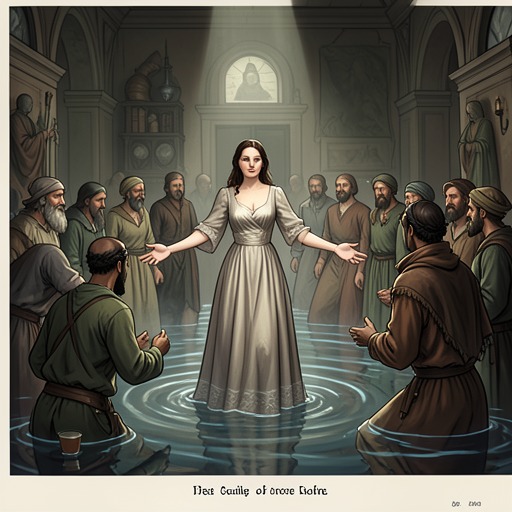
Their claims also impose limits on human conduct. Undine warns Sir Huldbrand of Ringstetten never to rage at her on the water, or even near it, because her relatives would then acquire a right over her. They might tear her away to live below in the crystal palaces, or send her back to the human world under circumstances she fears even more. The warning makes proximity to water consequential: the shore is not neutral ground, and a husband’s behavior there can activate the authority of his wife’s elemental kin.
Marriage Law and the Water’s Continuing Claim
The water spirits’ marriage law becomes clearest after Undine has left Sir Huldbrand of Ringstetten. In the Mediterranean Sea, she tells Kuhleborn that although she lives beneath the water, she has brought her soul with her and can therefore grieve. He replies that she remains subject to the laws of her element: if her husband marries again and is unfaithful to her, she is bound to take his life. The rule makes the human marriage persist beyond physical separation, but it translates fidelity into a perilous obligation enforced by the water spirits’ law.
Undine has already taken steps to prevent that law from being exercised against him. She ordered the household at Ringstetten Castle to cover the castle fountain with a great stone, explaining that it had to be closed to avoid a greater evil. The fountain is a point of access between the household and her kind: she later says she has sealed it against herself and her race, and therefore cannot use it to reach or harm her husband. Her protective act is also a renunciation of access to the water-linked home she shares with him.
The novel consequently presents the water spirits neither as distant marvels nor as simple antagonists. Their underwater beauty and their command of waves and streams coexist with rules that can threaten human life; their difference from mortals is bound to the very soul Undine gains through love. Water repeatedly draws that conflict into view—as dwelling, kinship, gift, obstruction, and threshold—while Undine’s grief shows that gaining a soul does not free her from the laws of her element.