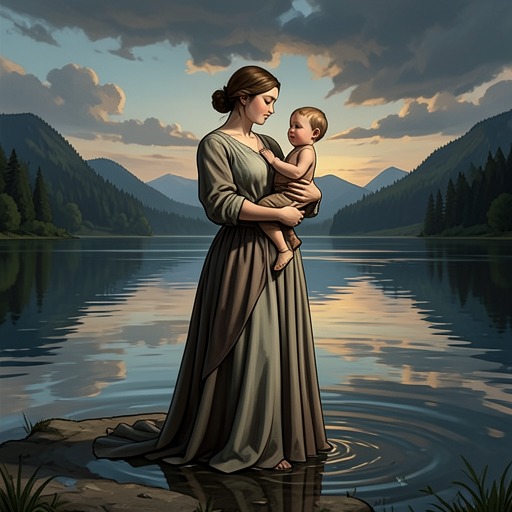
about fifteen years before the main story
The Fisherman’s Lost Child
An elderly fisherman and his wife lived in a cottage on [The Fisherman’s Peninsula](entity:location-recall-location-84f6aea444a1), isolated between [The Lake](entity:location-recall-location-ff13e9ab1e93) and the [Haunted Forest](entity:location-recall-location-haunted-forest-12716d279274). When their newborn daughter reached toward something in the water, she slipped from her mother’s arms and vanished beneath the surface; the parents searched in vain and mourned her as dead.
That same evening, a strange little girl appeared at their door, soaked but unharmed. The couple, grieving their own child, took her in and raised her as their foster daughter, [Undine](entity:character-recall-character-undine-aa6ba6bce33a).
about fifteen years before the main story
Bertalda’s Abduction
At roughly the same time, water spirits took the infant who had gone missing from the fisherman's parents and brought her away, placing her on a piece of grass. Later, a duke found her there. The duke and his wife raised the child as their daughter, naming her Betaarda, and
shortly after Undine arrives at the cottage
Undine’s New Name
The adoptive parents tried to figure out where this mysterious child came from, but her account was confused. She remembered sitting with her mother on a boat that was sailing on a large lake, then she fell into the water; she also mentioned some fishermen and a wife who could not explain a distant wonder
eight days before Sir Huldbrand reaches the cottage
The Tournament Meeting
Sir Huldbrand of Rinkensteinten rode into an unknown imperial free city to attend a jousting tournament and a bullfighting contest. Among the spectators, he noticed the beautiful adopted daughter of the duke, Betalda, who also noticed him. They danced together at the
the day before Sir Huldbrand reaches the cottage
The Forest Challenge
On the third day of the festival, Sir Hulderbrand's initial fascination with Betaerta began to fade, but he still sought to be with her. When he jokingly asked her for a glove, she proposed a condition: he should explore the ghost forest alone and bring back news of the
the morning of Sir Huldbrand’s forest expedition
The Goblin in the Oak
Sir Hurdbrand entered the ghost forest in the morning. At first, he found the bright leaves and green grass in the forest very pleasant. Deep in the woods, a shadow sat on an oak tree mocking him and threatening to roast him. The sudden noise scared his horse into the forest
later that morning
The Brook Saves the Horse
Kangma rushed toward the rocky cliff, but a tall white figure seemed to block its way. In the critical moment, Sir Hulderbrand recognized that it was not a person, but a bright stream flowing down from the mountain, crossing in front of the horse. The stream blocked the horse
around midday during the forest expedition
The Imp’s False Gold
After regaining control of the horse, Sir Hurdbrand encountered a strange, short man. The man claimed he had saved him and demanded payment for the drink. The knight gave him a gold coin, but insisted that it was the stream that had blocked the horse, not the little fairy. The
toward evening during the forest expedition
The White Figure’s Guidance
In the late afternoon, Sir Hulderbrand saw a shifting white face in the thicket and tried to ride toward a path he thought would lead to the town. The face suddenly turned into foam, making him and the horse unable to see and driving them away from the path
the evening Sir Huldbrand reaches the peninsula
A Knight at the Cottage
At dusk, the fisherman sat in his small house repairing the fishing net, hearing a rider approaching from the ghost forest. He recalled the various illusions in the forest and felt fear; however, the terrifying white figure finally revealed itself to be a familiar stream, with a knight dressed in fine clothes riding
later that evening
Undine Meets the Knight
When a family is talking, water splashes on the window of the small house. The fisherman scolds his adopted daughter, Wendy, for causing trouble outside and explains that she is almost 18 but still impulsive. Wendy rushes into the house and sees Sir Hulderbrand. She
that evening
Undine Runs into the Night
The fisherman would not let Sir Hurdbrand tell the forest experience late at night, Wendyne protested angrily. Her adoptive parents also joined in scolding her, she replied that she would rather sleep outside than listen to their scolding
later that night
The Storm Night Search
Sir Hulderbrand and the fisherman stayed awake, waiting for Wendyine to return; in between, the old man told them how she had come to them. His story revealed their child's death and the memory of a wet girl appearing that night. The couple decided to take her in and
the storm night
The Flood Makes an Island
Sir Huldebrand searched in the storm, finding the swollen stream had cut off the land, turning the fisherman's peninsula into an island. He worried that Wendy might have crossed the ghost forest, so he tried to wade through the swift current toward the other side. A familiar voice warned
just before dawn after the storm
The Song by the Stream
Wendy wanted to be alone with Sir Huldbrand, listening to his experiences in the forest, but the fisherman called them from the other side. She did not want to go back until Sir Huldbrand told her that the old man was worried, and he would also care. Wendy
at dawn the morning after Sir Huldbrand arrives
The Glove and the Journey
Sir Huldbrand told [Undine](entity:character-recall-character-undine-aa6ba6bce33a) that [Bertalda](entity:character-recall-character-bertalda-24c1b7769e21) had challenged him to explore the [Haunted Forest](entity:location-recall-location-haunted-forest-12716d279274) alone. He admitted that he had once been attracted to Bertalda, prompting Undine to bite his finger and accuse him of leaving too much of her rival in his story.
He then described the forest’s goblins, brook, and white apparition. When he finished, Undine pointed out that the flood had made escape impossible: the stream was too dangerous to cross, and the fisherman’s boat could not safely venture onto [The Lake](entity:location-recall-location-ff13e9ab1e93).
during Sir Huldbrand’s stay on the peninsula
The Wine Cask
Sir Huldbrand and the fisherman grew dispirited when their supply of wine ran out. [Undine](entity:character-recall-character-undine-aa6ba6bce33a) went outside and soon returned with news that the flood had carried a cask into a sheltered creek; she guessed, correctly, that it contained wine.
The three struggled to bring it home as a storm broke, but Undine’s playful challenge to the clouds seemed to leave them untouched by the rain. The cask proved full of excellent wine, giving the isolated household a welcome store and setting off a cheerful evening around the hearth.
the evening the wine cask is opened
Undine’s Hardhearted Reply
The fisherman worried that the cask’s owner might have drowned in the flood, and Sir Huldbrand promised to seek the owner or heirs and repay them generously. [Undine](entity:character-recall-character-undine-aa6ba6bce33a) declared that the owner was alive, but told her husband he had spoken foolishly by offering to risk himself for a stranger.
Her claim that charity began at home appalled the old couple, who scolded her for seeming heathenish and selfish. She retreated to Sir Huldbrand for comfort, and the household fell into embarrassed silence, exposing a difference between Undine’s merry nature and the moral obligations that mattered to human beings.
later that stormy evening
The Priest Arrives
A knocking and groan at the cottage door frightened the household, and [Undine](entity:character-recall-character-undine-aa6ba6bce33a) challenged the unseen visitor by invoking [Kuhleborn](entity:character-recall-character-kuhleborn-c56b80e02462). A drenched elderly priest answered that he was a human being in need of help, and the family admitted him, warmed him, and gave him dry clothes.
The priest explained that he had been traveling from the [Monastery of Our Lady](entity:organization-recall-organization-monastery-of-our-a2735867ceed) to report flood damage to the bishop. A storm had wrecked his boat and cast him onto the island, where he feared the rising waters might leave him and the household cut off from the world.
the same evening
A Marriage Before Dawn
The priest’s account of possible isolation gave Sir Huldbrand a sudden vision of a life spent on the peninsula with [Undine](entity:character-recall-character-undine-aa6ba6bce33a). He announced that the two were pledged and asked [Father Heilmann](entity:character-recall-character-father-heilmann-e87c2dfbe427) to marry them that evening, with the consent of Undine and her foster parents.
Undine produced two costly rings that she said her parents had sewn into her clothes and instructed her to keep until her wedding. Father Heilmann performed the ceremony by consecrated candles, though he noticed a tall white figure watching from outside the window.
after the wedding ceremony
Undine’s Fear of the Soul
After the ceremony, [Undine](entity:character-recall-character-undine-aa6ba6bce33a) returned to her teasing and unruly ways. When [Father Heilmann](entity:character-recall-character-father-heilmann-e87c2dfbe427) urged her to attune her soul to her husband’s, she laughed that she had no soul at all, then broke into tears as the thought of such a burden began to frighten her.
The priest could find no evil in her, but recognized that something about her was mysterious. Left alone with Sir Huldbrand, Undine feared he would reject her; he instead embraced her, and she evaded his questions about the spirits and [Kuhleborn](entity:character-recall-character-kuhleborn-c56b80e02462) by calling them children’s tales.
the morning after the wedding
Undine Gains a Soul
By morning, [Undine](entity:character-recall-character-undine-aa6ba6bce33a) had become gentle, humble, and attentive. She apologized to [Father Heilmann](entity:character-recall-character-father-heilmann-e87c2dfbe427), asked him to pray for her soul, and thanked the fisherman and his wife with a depth of feeling they had never seen in her before.
She explained to Sir Huldbrand that beings of the elements, including water spirits, lived without souls and vanished entirely at death. Her father, a powerful water prince, had wanted his daughter to gain a soul, which she could do only through the closest union of affection with a human being; marriage to Sir Huldbrand had fulfilled that wish.
the evening after the wedding
The Vow Beside the Brook
[Undine](entity:character-recall-character-undine-aa6ba6bce33a) led Sir Huldbrand to the now-calm [Forest Brook by the Lake](entity:location-recall-location-dad403e84051) and told him he could leave once the water receded. She warned that if he rejected her, she would return through the brook to her water-spirit kin, though she could not bear the thought of losing him.
Sir Huldbrand swore that he would never forsake her and carried her back from the little island. Undine accepted her new, soul-bearing life, even though it meant leaving behind the crystal palaces and family she had known beneath the water.
the following morning
The Journey Through the Forest
The brook had returned to its channel, and [Undine](entity:character-recall-character-undine-aa6ba6bce33a) told Sir Huldbrand that its waters and their companions had settled again. He wished to remain several more days, but she urged him to leave before the fisherman and his wife discovered how completely her new soul had changed her.
Sir Huldbrand and [Father Heilmann](entity:character-recall-character-father-heilmann-e87c2dfbe427) helped Undine mount her horse, and they set out through the [Haunted Forest](entity:location-recall-location-haunted-forest-12716d279274). The old couple grieved openly as their foster daughter departed, sensing that the quiet, loving woman they had just met was something they would not keep in their home.
during the journey through the Haunted Forest
Kuhleborn Reveals Himself
A tall stranger in flowing white joined the travelers and introduced himself to [Father Heilmann](entity:character-recall-character-father-heilmann-e87c2dfbe427) as [Kuhleborn](entity:character-recall-character-kuhleborn-c56b80e02462). He moved beside [Undine](entity:character-recall-character-undine-aa6ba6bce33a) and reminded her that he was her uncle, the water-spirit who had carried her through the region and helped bring the priest safely ashore.
Undine feared that Sir Huldbrand would recoil from her strange relations and asked Kuhleborn to leave. When he turned threatening, Sir Huldbrand struck at him with his sword, only for the blade to cut through a waterfall. The water-spirit’s voice warned the knight to protect his wife as they emerged from the forest.
the evening the travelers leave the Haunted Forest
Return to the Imperial City
Sir Huldbrand’s sudden disappearance had led the [Unnamed Imperial Free City](entity:location-recall-location-130ef6cdb617) to believe that he had died in the floods. [Bertalda](entity:character-recall-character-bertalda-24c1b7769e21) had openly mourned him and blamed herself for sending him into the forest, while his servants remained behind waiting for news.
His return with [Undine](entity:character-recall-character-undine-aa6ba6bce33a) and [Father Heilmann](entity:character-recall-character-father-heilmann-e87c2dfbe427) astonished the city. Bertalda alone could not welcome the news without pain: she had truly loved Sir Huldbrand, and his marriage made her earlier public grief difficult to bear. Still, she treated Undine with outward friendliness, and the couple kept the true story of their marriage and Undine’s origin private.
during the travelers’ stay in the city
The Fountain Meeting
[Undine](entity:character-recall-character-undine-aa6ba6bce33a) and [Bertalda](entity:character-recall-character-bertalda-24c1b7769e21) felt an immediate and unusually deep affection for one another, and their closeness helped delay the young couple’s departure for [Ringstetten Castle](entity:location-recall-location-320dc2135060). During an evening walk, a tall man approached the three and whispered to Undine in a foreign tongue.
Sir Huldbrand recognized the visitor as [Kuhleborn](entity:character-recall-character-kuhleborn-c56b80e02462), who vanished into the city fountain after Undine dismissed him. She told the others that Bertalda would learn the reason for the meeting on her name-day, keeping secret a discovery that promised to transform the young woman’s understanding of her past.
Bertalda’s name-day
The Songs of Bertalda’s Origins
At a feast in the [Unnamed Imperial Free City](entity:location-recall-location-130ef6cdb617), [Undine](entity:character-recall-character-undine-aa6ba6bce33a) sang of an infant found alone beside a lake and taken home by a passing duke. The song then turned to the child’s bereaved parents, who searched their empty home and grieved for the daughter they believed lost.
Undine summoned the fisherman and his wife from among the onlookers and identified them as [Bertalda](entity:character-recall-character-bertalda-24c1b7769e21)’s parents. The old couple embraced the young woman, but Bertalda recoiled in anger and accused Undine of deception, unable to accept that her noble upbringing had begun with an abduction from a poor household.
immediately after the songs
Bertalda’s Birthmark
The fisherman’s wife offered to prove the claim with distinctive birthmarks on [Bertalda](entity:character-recall-character-bertalda-24c1b7769e21)’s body. The duchess took Bertalda aside with the old woman and confirmed that the marks were present; she then publicly acknowledged that Bertalda was the fisherman’s daughter.
Bertalda’s discovery of her parentage became a public humiliation, and her anger fell on [Undine](entity:character-recall-character-undine-aa6ba6bce33a) and the grieving old couple. Undine, shaken by her friend’s cruelty and asking whether Bertalda truly had a soul, was left weeping in Sir Huldbrand’s arms as the guests dispersed.
the morning after the name-day feast
Bertalda Seeks Forgiveness
As Sir Huldbrand and [Undine](entity:character-recall-character-undine-aa6ba6bce33a) prepared to leave the city, a fisher-girl appeared before them in tears. It was [Bertalda](entity:character-recall-character-bertalda-24c1b7769e21), whose adoptive parents had withdrawn their protection after her behavior at the feast, though they had given her a substantial portion.
Bertalda said she had meant to return to her birth parents but was afraid of the [Haunted Forest](entity:location-recall-location-haunted-forest-12716d279274) and ashamed of her conduct. Undine forgave her and asked her to come to [Ringstetten Castle](entity:location-recall-location-320dc2135060) as a sister, while Sir Huldbrand offered her his protection and promised to send word to the fisherman.
several days after leaving the city
Arrival at Ringstetten Castle
After several days of travel, Sir Huldbrand, [Undine](entity:character-recall-character-undine-aa6ba6bce33a), and [Bertalda](entity:character-recall-character-bertalda-24c1b7769e21) arrived at [Ringstetten Castle](entity:location-recall-location-320dc2135060). While Sir Huldbrand attended to the estate, the two young women walked on the ramparts and spoke about the mysterious events surrounding their lives.
[Kuhleborn](entity:character-recall-character-kuhleborn-c56b80e02462) appeared again, prompting Undine to explain that he was her uncle and had arranged Bertalda’s abduction from the fisherman’s family. Bertalda believed the account because it fitted the evidence, yet the revelation made Undine seem more like a spirit than a human companion and introduced fear into their intimacy.
during the months at Ringstetten Castle
The Household Grows Uneasy
As time passed, Sir Huldbrand’s affection began to drift from [Undine](entity:character-recall-character-undine-aa6ba6bce33a) toward [Bertalda](entity:character-recall-character-bertalda-24c1b7769e21), while Bertalda returned his feelings. They grew more wary of Undine’s mysterious nature, and the injured wife’s tears stirred remorse in Sir Huldbrand without restoring his former devotion.
[Kuhleborn](entity:character-recall-character-kuhleborn-c56b80e02462)’s apparitions haunted the castle’s galleries, especially frightening Bertalda. A letter from the fisherman warned that she must never harm Undine, but Bertalda kept the warning that suited her and discarded the rest, while the household’s emotional distance deepened.
later during the household’s stay at Ringstetten Castle
Undine Seals the Fountain
While Sir Huldbrand was away, [Undine](entity:character-recall-character-undine-aa6ba6bce33a) ordered the servants to cover the castle fountain with a large stone. The water churned as if something inside were struggling to escape, and Undine carved strange characters into the stone after it was set in place.
[Bertalda](entity:character-recall-character-bertalda-24c1b7769e21) protested because she used the fountain water to care for her complexion, but Undine insisted that sealing it was necessary to prevent a greater danger. When Sir Huldbrand returned, Undine explained privately that the fountain was [Kuhleborn](entity:character-recall-character-kuhleborn-c56b80e02462)’s only entrance to the castle and that the inscription would keep him away from them.
the evening the fountain is sealed
Undine’s Warning to Her Husband
[Undine](entity:character-recall-character-undine-aa6ba6bce33a) explained that [Kuhleborn](entity:character-recall-character-kuhleborn-c56b80e02462) could not understand the inner life of human beings, and mistook the household’s mixed laughter and sorrow for contradictions. Sealing the fountain was her way of protecting Sir Huldbrand and [Bertalda](entity:character-recall-character-bertalda-24c1b7769e21) from his intrusions, even though the servants could reopen it if ordered.
She also warned Sir Huldbrand never to lose his temper with her on or near water. Her relatives would interpret such anger as an injury to their own kind and could claim her for the water forever. Moved by her sacrifice, he promised that the stone would remain in place.
the evening after the fountain is sealed
Bertalda Leaves the Castle
[Bertalda](entity:character-recall-character-bertalda-24c1b7769e21) arrived with workmen and demanded that the stone be removed, but Sir Huldbrand upheld [Undine](entity:character-recall-character-undine-aa6ba6bce33a)’s authority and rebuked her. Humiliated and resentful, Bertalda left a letter saying she was ashamed of forgetting her humble birth and would return to her parents’ cottage.
Undine urged Sir Huldbrand to bring Bertalda back, and his renewed passion for the young woman drove him out at once. When he took the road through the [Black Valley](entity:location-recall-location-b31f5d89b063), Undine called after him in terror and then saddled her horse to follow alone.
that evening in the Black Valley
The Apparition in the Valley
Sir Huldbrand rode into the shadowed [Black Valley](entity:location-recall-location-b31f5d89b063), searching for [Bertalda](entity:character-recall-character-bertalda-24c1b7769e21) as thunder gathered over the mountains. He saw a white-clad female figure lying on the ground and approached, believing it might be the fugitive.
A flash of lightning revealed a distorted face, and the figure demanded a kiss before warning him to go home. Sir Huldbrand recognized the trick as one of [Kuhleborn](entity:character-recall-character-kuhleborn-c56b80e02462)’s transformations and threw his sword at it; the apparition vanished in a splash of water, confirming the water-spirit’s presence.
later that evening
The Rescue in the Black Valley
Sir Huldbrand found [Bertalda](entity:character-recall-character-bertalda-24c1b7769e21) exhausted and frightened, trying to climb away from the darkness. He comforted her and led her toward his horse, but the animal had been driven wild by the apparition, making it impossible to carry her safely.
A wagoner offered help, calming the horse with a whispered charm and taking Sir Huldbrand and Bertalda into his wagon. As they traveled, their intimate conversation renewed Sir Huldbrand’s awareness of his love for Bertalda, while the storm and the rising water closed around them.
during the return from the Black Valley
The Wagoner’s Revelation
The wagon’s horses plunged into what appeared to be a foaming stream, and Sir Huldbrand demanded to know why the road had disappeared beneath the water. The wagoner replied that the water had flooded the road, then revealed that he was [Kuhleborn](entity:character-recall-character-kuhleborn-c56b80e02462) himself.
The wagon, horses, and driver dissolved into foam, and a towering wave dragged Sir Huldbrand’s horse beneath the flood. [Undine](entity:character-recall-character-undine-aa6ba6bce33a) appeared on the heights, commanded the waters to withdraw, and rescued both Sir Huldbrand and [Bertalda](entity:character-recall-character-bertalda-24c1b7769e21) before bringing them back to [Ringstetten Castle](entity:location-recall-location-320dc2135060).
the days after the Black Valley rescue
Peace at the Castle
After their rescue, Sir Huldbrand recognized the goodness [Undine](entity:character-recall-character-undine-aa6ba6bce33a) had shown in pursuing and saving him, and [Bertalda](entity:character-recall-character-bertalda-24c1b7769e21) became more grateful and humble. Undine’s renewed affection and Sir Huldbrand’s esteem restored a measure of peace at [Ringstetten Castle](entity:location-recall-location-320dc2135060).
As winter passed and spring arrived, the household believed its troubles were over. The prospect of traveling along the Danube toward [Vienna](entity:location-recall-location-8daae28d814e) delighted Bertalda, and Undine agreed to the journey, confident that she could restrain [Kuhleborn](entity:character-recall-character-kuhleborn-c56b80e02462)’s interference.
during the first days of the Danube journey
Kuhleborn Harasses the Voyage
The travelers began their journey down the Danube in high spirits, enjoying the changing landscape and anticipating [Vienna](entity:location-recall-location-8daae28d814e). But [Kuhleborn](entity:character-recall-character-kuhleborn-c56b80e02462) repeatedly sent troubled waters and contrary winds against their boat, forcing [Undine](entity:character-recall-character-undine-aa6ba6bce33a) to rebuke the river and interrupting the pleasure of the trip.
Sir Huldbrand grew resentful, thinking that his marriage to a water-spirit had made him a prisoner of her relations. His irritation hurt Undine, who struggled to shield the party from the water-spirit’s power and eventually fell asleep from exhaustion.
one evening during the Danube voyage
The River’s Horrible Faces
While [Undine](entity:character-recall-character-undine-aa6ba6bce33a) slept, the travelers saw hideous human heads rising upright from the water around the boat. Each person tried to warn the others, only to discover that the apparition appeared in every direction, laughing and threatening as the river filled with distorted faces.
The sight woke Undine, and the heads vanished as soon as she opened her eyes. Sir Huldbrand wanted to curse the water-spirit, but Undine begged him not to become angry with her while they were on the water, reminding him of the danger her kin could then pose.
later on the Danube voyage
The Lost Necklace
[Bertalda](entity:character-recall-character-bertalda-24c1b7769e21), absorbed in her thoughts about [Undine](entity:character-recall-character-undine-aa6ba6bce33a)’s origins, unclasped a gold necklace and trailed it over the water. A huge hand emerged from the Danube, seized the ornament, and vanished with it, while a scornful laugh sounded from below.
Sir Huldbrand erupted in anger and challenged the unseen spirits. Undine dipped her hand into the river and produced a dazzling coral necklace as compensation, but he tore it away and hurled it back into the water, accusing her of remaining allied to her kind.
immediately after the necklace is thrown away
Undine Leaves the Danube
[Undine](entity:character-recall-character-undine-aa6ba6bce33a) looked at Sir Huldbrand in grief and told [Bertalda](entity:character-recall-character-bertalda-24c1b7769e21) that the water spirits would do her no harm if she remained true. She said that she had to leave, and vanished over the side of the boat before anyone could stop her.
Her departure was the consequence of Sir Huldbrand’s anger on the water, the very act she had warned could give her relatives power over her. Only small waves remained beside the boat, seeming to repeat her plea that he remain faithful, while Sir Huldbrand collapsed in tears.
the months following Undine’s departure
Life After Undine
Sir Huldbrand and [Bertalda](entity:character-recall-character-bertalda-24c1b7769e21) lived quietly at [Ringstetten Castle](entity:location-recall-location-320dc2135060), grieving for [Undine](entity:character-recall-character-undine-aa6ba6bce33a) and for a time almost forgetting their earlier attachment to one another. Undine often visited Sir Huldbrand in dreams, where she caressed him and left him waking with tears on his face.
As time passed, the dreams became rarer and his grief less consuming. The old fisherman eventually arrived to insist that Bertalda return to him, arguing that her honor was endangered by living with the widowed knight. The prospect of losing her awakened Sir Huldbrand’s affection for Bertalda again.
after the fisherman demands Bertalda’s return
The Second Marriage Plan
The fisherman objected to a marriage between Sir Huldbrand and [Bertalda](entity:character-recall-character-bertalda-24c1b7769e21), both because [Undine](entity:character-recall-character-undine-aa6ba6bce33a) might still be alive and because Bertalda had played a part in her disappearance. Yet Bertalda’s tears and changed humility, together with the fisherman’s regard for Sir Huldbrand, gradually overcame his resistance.
The household arranged for [Father Heilmann](entity:character-recall-character-father-heilmann-e87c2dfbe427), who had married Sir Huldbrand and Undine, to return and perform a second ceremony. The plan moved forward despite the unresolved possibility that Undine was alive and despite the grief that still marked Sir Huldbrand.
shortly before the second wedding
Father Heilmann’s Warning
[Father Heilmann](entity:character-recall-character-father-heilmann-e87c2dfbe427) hurried to [Ringstetten Castle](entity:location-recall-location-320dc2135060) after receiving the invitation, hoping to prevent the proposed marriage. He told Sir Huldbrand that [Undine](entity:character-recall-character-undine-aa6ba6bce33a) had appeared to him in dreams for a fortnight, pleading that she was still alive and asking him to save her husband’s life and soul.
The priest warned that Sir Huldbrand still belonged to his first wife and urged both him and [Bertalda](entity:character-recall-character-bertalda-24c1b7769e21) to abandon the match. The three listeners felt the truth of his words but resisted them, and Father Heilmann left without accepting their hospitality. Sir Huldbrand arranged for another monk to perform the ceremony.
the night before the second wedding
The Dream Beneath the Sea
Between sleep and waking, Sir Huldbrand dreamed that swans carried him over land and sea to the [Mediterranean Sea](entity:location-recall-location-faab9330cc7a). He saw [Undine](entity:character-recall-character-undine-aa6ba6bce33a) beneath a crystal arch, where she told [Kuhleborn](entity:character-recall-character-kuhleborn-c56b80e02462) that her new soul allowed her to grieve and that her tears were blessed.
Kuhleborn warned that if Sir Huldbrand married again, Undine would be bound by the water spirits’ law to take his life. She replied that the sealed fountain prevented her return to the castle, but feared that he might reopen it or leave the estate. The dream became a warning that Sir Huldbrand chose not to heed.
a few days after Father Heilmann’s warning
The Second Wedding
Sir Huldbrand and [Bertalda](entity:character-recall-character-bertalda-24c1b7769e21) married at [Ringstetten Castle](entity:location-recall-location-320dc2135060) despite [Father Heilmann](entity:character-recall-character-father-heilmann-e87c2dfbe427)’s appeal. The celebration was subdued, as the guests felt that [Undine](entity:character-recall-character-undine-aa6ba6bce33a)’s absence overshadowed the feast and feared that the dead wife might still be alive.
Bertalda alone seemed largely able to enjoy the occasion, though even she was troubled by thoughts of Undine’s fate. After the guests dispersed, she noticed freckles on her neck and longed for the beautifying water from the sealed fountain, setting in motion the event that would bring Undine back.
the second wedding night
The Fountain Is Reopened
[Bertalda](entity:character-recall-character-bertalda-24c1b7769e21)’s waiting maid, hoping to please her mistress, led workmen to remove the stone from the castle fountain. The stone lifted more easily than expected, as if the water beneath were pushing upward, and a white column rose from the opening.
The column became a veiled woman, weeping and wringing her hands as she walked toward the castle. Bertalda recognized [Undine](entity:character-recall-character-undine-aa6ba6bce33a) beneath the veil and watched in horror as the figure passed through the familiar halls, heading toward Sir Huldbrand’s chamber.
later on the second wedding night
Undine’s Final Embrace
Sir Huldbrand heard a familiar tap at his door and saw [Undine](entity:character-recall-character-undine-aa6ba6bce33a) enter, her face hidden by a veil. She told him that the fountain had been opened and that she had come to take his life, as the water spirits’ law required after his second marriage.
Sir Huldbrand begged not to see a frightening face at the moment of death, but Undine assured him that she remained as beautiful as when he had first loved her. She kissed him and held him in her arms, weeping until his breathing stopped. As she left, she told the servants, “I have wept him to death.”
the day after Sir Huldbrand’s death
The Funeral Procession
[Father Heilmann](entity:character-recall-character-father-heilmann-e87c2dfbe427) returned when news of Sir Huldbrand’s death spread, while the monk who had performed the second marriage fled the castle. He comforted [Bertalda](entity:character-recall-character-bertalda-24c1b7769e21), who called [Undine](entity:character-recall-character-undine-aa6ba6bce33a) a murderess, but the fisherman saw the death as a consequence of events and grieved for the forsaken Undine as well as for Sir Huldbrand.
At the funeral, a veiled white figure appeared among the mourners, wringing her hands as she followed the procession. When Bertalda ordered her away at the graveside, the figure silently refused, then vanished after the burial prayers.
at the close of the funeral
The Spring at the Grave
When the mourners rose from their knees, the white stranger had disappeared. In the place where she had knelt, a little silver spring bubbled out of the turf and flowed around Sir Huldbrand’s grave.
The spring continued onward until it reached a nearby lake. The villagers came to regard it as [Undine](entity:character-recall-character-undine-aa6ba6bce33a), still embracing her husband in her sorrow and love, giving the story a final image of devotion that outlasted death.