Cam and Lucifer’s fifteen-day wager over Lilith’s love
UnforgivenCam and Lucifer’s fifteen-day wager over Lilith’s love is a supernatural bargain that makes Lilith’s freedom depend on whether Cam can make her love him again before her current Hell expires. It converts Cam’s desire to relieve her suffering into a test with an absolute deadline and an extreme penalty: failure means eternal service to Lucifer. As Lilith’s Hell-cycle gives way to a final confrontation, Cam’s willingness to take her place reveals how far his understanding of the wager’s stakes has changed.
Origin and Conditions
The wager begins after Cam returns to Hell’s food court, where Lucifer’s snow globes represent the many Hells made for Lilith. Cam has learned that Lilith dies in one Hell, returns to this place to be reminded of his betrayal, and is then sent into another torment designed for her. Lucifer describes her anger and hatred as what keeps her going, and explains that her current life is a deliberately ordinary-seeming but bleak school existence, with no weekends and classes every day of the year. Against this cycle, Cam asks what it would take for Lucifer to release her and offers to do anything.
Lucifer sets the clock by Lilith’s existing sentence: her current Hell is due to expire in fifteen days. Rather than simply release her, he proposes watching Cam make her more miserable during the time remaining. The deadline is thus not an incidental limit on the wager; it is the length of the torment already in progress, and Lucifer uses it to turn Cam’s rescue attempt into a timed contest.
Terms, Stakes, and Imbalance
To win, Cam must cleanse Lilith’s heart of hatred for him and persuade her to fall in love with him again, with Lucifer specifying that the love must be genuine. Success would end Lucifer’s practice of assigning Lilith bespoke Hells. Cam asks what happens after he wins, and Lucifer promises that he will be free to live out the rest of Lilith’s mortal days with her. The promised reward joins Lilith’s release to Cam’s chance at a shared life with her.
The condition is made crueler by the difference between what the two participants know. Cam initially argues that Lilith hates her miserable world, not him, and points out that she does not remember who he is. Lucifer counters that the hatred of her present circumstances conceals an older hatred of Cam: even without recognizing his face, Lilith recognizes his soul and loathes him. The wager therefore asks Cam to overcome an injury whose history he knows but whose victim cannot consciously identify him as its source. Lucifer also insists that Cam himself supplied the cause by betraying her.
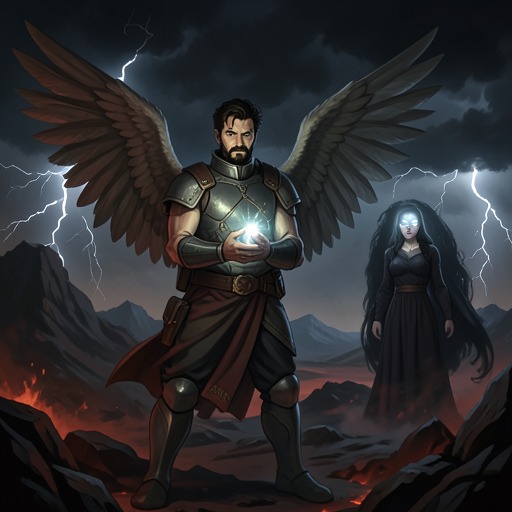
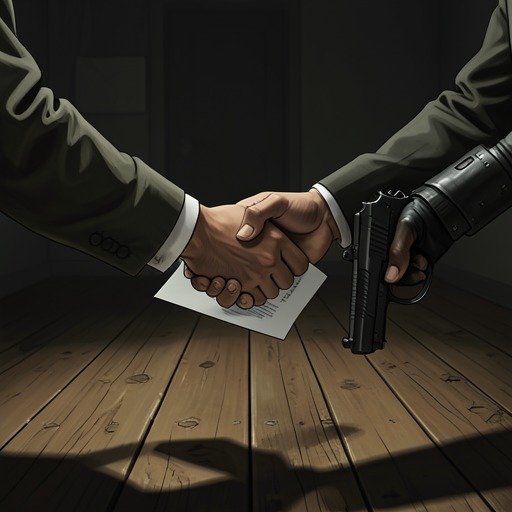
Failure carries a penalty far beyond losing an ordinary contest. Lucifer says Cam must return to his place beside him, abandon his travels through the galaxies, and serve eternally at Lucifer’s right hand behind the Wall of Darkness. The threat also concerns Cam’s wings: Lucifer says there will be no more white in them. Cam considers that Luce and Daniel have given him an opportunity to rewrite his fate, but focuses instead on Lilith’s suffering across millennia. He accepts. Lucifer rejects a handshake as unnecessary, claiming Cam’s word is enough to bind him. The refusal makes the bargain’s power feel less like a negotiated contract between equals than a declaration backed by Lucifer’s control over Cam’s fate.
Other Agreements and Contrasting Forms of Consent
The story places this wager among other arrangements that also shape the characters’ futures, while keeping their terms distinct. When Lilith asks to marry in a temple rather than by the river, she challenges Cam’s proposed wedding setting and asserts what she wants from their marriage. This is a disagreement about a shared ceremony, not a condition imposed on her freedom by Lucifer. Elsewhere, a stranger offers to take her to Cam but warns that the journey will be long and dangerous and that he will not return by the same way; Lilith accepts the journey with that cost in view. Its risk is disclosed before she chooses, unlike the wager’s unequal distribution of knowledge about the source of Lilith’s hatred.
At the Battle of the Bands, Lucifer interrupts Cam as he is trying to speak to Lilith so that the performers can sign a King Media waiver. The document concerns liability and permission to use their images in promotional material. Its mundane, printed terms make a sharp contrast with Lucifer’s wager: both put a choice before characters, but the waiver states its practical conditions plainly, while the wager entangles affection, spiritual allegiance, and eternal punishment. These episodes show how the novel repeatedly uses agreements to direct action, without making the documents or bargains interchangeable.
From Romantic Test to Sacrifice
The wager’s original terms make Lilith’s love the measure of Cam’s success, but the final confrontation changes the question. As the stage shakes and the crater’s edge nears his boots, Cam refuses to resume the position of Lucifer’s second-in-command and proposes a new arrangement: he will remain in exile below and take Lilith’s place as Lucifer’s subject if Lilith is set free. This offer no longer makes her liberation conditional on her ability to love Cam. It places the cost on Cam himself.
Lilith asks why he would sacrifice himself for her. Cam answers that he would do anything for her, and reaches for her hand; she does not pull away. His response reframes the wager’s central promise. Earlier, Cam accepted Lucifer’s test because he hoped to win Lilith’s love and end her torment. At the crisis, he offers to relinquish his own freedom rather than require her affection as the price of release. The bargain has moved from proving love through a desired outcome to expressing it through willingness to bear the consequence.
Wings and the Wager’s Resolution
Lucifer’s threatened return to service is associated with Cam’s allegiance and with the visible state of his wings. In the angelic order described in the novel, fallen angels who have pledged themselves to Lucifer bear golden wings, while those restored to Heaven show silver through their feathers. Lucifer’s warning that Cam will have no more white in his wings therefore links the wager’s penalty to the spiritual identity Cam might lose if he fails.
After the confrontation, Cam’s wings begin to change: charred, leathery pieces slough away as new filaments grow, and white spreads beneath them until the wings are restored to their original brilliance. This transformation contrasts with Lucifer’s threat and gives the wager’s promised loss a visible counter-image. The wager begins as Lucifer’s attempt to bind Cam to an eternal future of service if he cannot recover Lilith’s love; its later movement toward substitution and the restoration of Cam’s white wings marks a decisive change in the story’s terms of devotion, punishment, and freedom.