Music’s connection to the soul
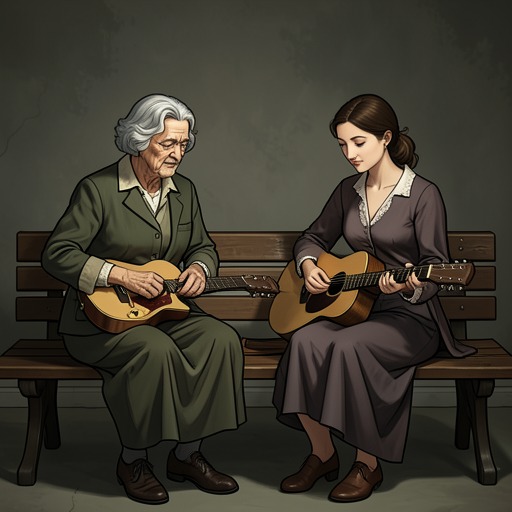
UnforgivenMusic’s connection to the soul is expressed through Lilith’s experience of playing: music gives shape to sorrow, offers companionship where ordinary life withholds it, and carries a melody across lives and Hells. It is not only something she composes or performs. In listening, remembering, rehearsing, and answering one another onstage, Lilith and the people around her form bonds that speech alone cannot establish.
Private refuge and an emerging voice
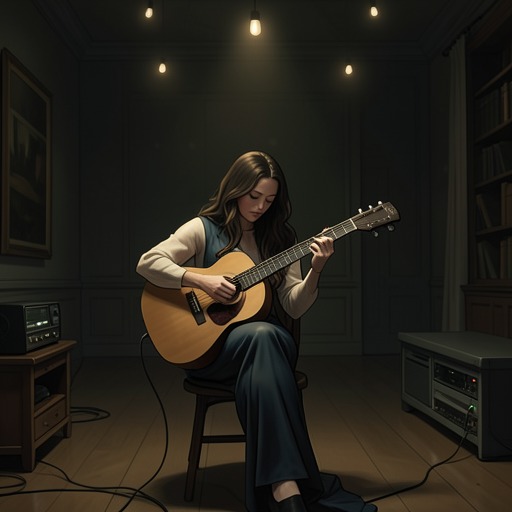
At Rattlesnake Creek, Lilith’s music begins in solitude. She keeps her guitar case in the crook of a tree and plays beside the creek, in a grove she values precisely because she believes no one else would call it beautiful. The instrument itself bears a visible flaw: a dark orange Martin 000-45 with a crack slanting down its body, discarded by someone on her street. Lilith cannot afford to be choosy, but she also hears a virtue in the damage, believing the crack makes the guitar sound richer. Her battered instrument is not merely a substitute for something better; its imperfect sound becomes part of the means by which she makes music her own.
Playing changes how Lilith experiences isolation. As chords fill the grove, she feels as if an invisible hand is smoothing her rough edges and as if she is surrounded by friends she does not have. That sensation does not erase her loneliness; it gives the loneliness a form she can inhabit and work with. Her wish to meet someone who shares her taste is sharpened by the memory of a cheerleader describing the Four Horsemen as sounding like whipped dogs. Lilith dreams of seeing the band live, yet its size and the cost of a ticket make that dream feel unreachable for a family that barely has enough money for food. Music holds both her desire for connection and her awareness of the barriers between her and the world she wants to enter.
That private practice becomes composition almost without her noticing. Lilith tumbles into a song that is not yet fully formed, her sorrow melding with the guitar; when she stops, a black-haired boy nearby begins to clap. The moment marks a small but consequential change: music that had seemed to surround her with imagined friends has reached another person. The response does not establish an instant intimacy, but it makes audible the possibility that a feeling born in solitude can be received by someone else.
Melody as memory across time
The novel also gives music a persistence beyond a single performance or lifetime. When Cam turns the knob of a snow globe containing a tiny lyre, the music recalls the melody he has been humming since he flew away from Troy. He recognizes it as Lilith’s song, and hearing it takes him back to the riverbank in Canaan, three millennia earlier, where he had listened to her play. The globe’s small, mechanical music does not reproduce the original encounter in full; instead, its melody acts as a thread joining Cam’s present to an earlier moment with Lilith.
The other globes multiply that thread. One contains a tiny violin and plays a different version of the same bittersweet song; another holds a cello, while others contain sitars, harps, violas, lap steel guitars, balalaikas, and mandolins. Cam recognizes the shared melody beneath these different arrangements and understands the globes as representing the different Hells in which Lucifer has trapped Lilith. Each miniature instrument gives the song another timbre, but the music remains an ode to her broken heart. The sequence turns musical variation into a pattern of recurrence: Lilith’s suffering changes its setting, while the melody gives Cam a way to recognize what persists through those changes.
In Canaan, music’s force is immediate and absorbing. Lilith retrieves a lyre from the hollow trunk of a carob tree, sits among irises, and tunes it by ear with the ease of someone who does so every day. At Cam’s request, she agrees to play if he will listen. Her notes seem to entwine like lovers and follow the bends of the river; the melody appears to assume the shape of words. She sings a sad love song, and Cam becomes so absorbed that Lucifer, the Throne, Daniel, and Lucinda recede from his attention. The scene presents listening not as passive reception but as an encounter that reorganizes what matters to him, even if only for the duration of the song.
Song, recognition, and rejection
In Crossroads, Lilith’s performance of Exile makes music a means of showing what anger has obscured. Cam urges her to play the guitar and show the others herself. Lilith returns to the microphone and introduces the song; as she sings, the performance reveals a quality of her that Cam recognizes beneath her bitterness. Her voice is soft and clear, and the song seems to him to carry an echo of the girl he fell in love with. His response is physical: he trembles with emotion.
The melody also confirms that something from their earlier story remains in the present. Cam hears in Exile a version of the song he had been humming as he left Troy. He takes Lilith’s apparent knowledge of it as evidence that some remnant of their love is still alive in her. Yet the scene sharply separates emotional recognition from public approval. Lilith lifts her fingers from the strings and waits, hoping for applause; instead, the audience laughs. Music has made an intimate feeling legible to Cam, but it has not made the surrounding crowd sympathetic. Its power to connect is real, not guaranteed: the same performance that restores a sense of recognition between two people exposes Lilith to ridicule from others.
Rehearsal as shared practice
Music becomes relational in another way when Lilith plays with Jean Rah and Cam. Cam tells Lilith to begin wherever she wants and assures her that the others will follow. Jean Rah taps his drumsticks together four times; Cam takes up a slim green Jaguar bass, and Lilith lets her fingers go. The band’s sound is built through mutual adjustment rather than a fully fixed arrangement. Her guitar locks with Jean Rah’s kick drum like a heartbeat, while Cam’s scratchy chords cross the heavy rhythm. Jean Rah adds a short black Moog synthesizer, whose buzzing chords settle into spaces left by the other instruments.
The details matter because the performance is collective without making the players interchangeable. Each instrument has its own sound and task, but the emerging music depends on how those parts meet. When Cam raises his hand, Lilith and Jean Rah stop; they can all sense that they have found something. Cam then suggests moving on to vocals. Music here is not simply Lilith’s private expression or a finished object delivered to an audience. Rehearsal is an activity in which attention, timing, and response allow a group to discover what it can make together.
The stage as a shared connection
At the prom, Lilith carries that practice into a public performance. Under a blinding spotlight, she grips the microphone, ignores her shaking knees and pounding heart, and counts the band in. The guitar rests across her chest as she begins with a slow, sad riff before the song opens into a fuller sound. Cam’s guitar finds hers, and they play together as if the fate of the universe depended on how they sounded. In that moment, the music is not only the realization of Lilith’s dream of performing; it is something she and Cam make in relation to one another.
The audience’s response differs radically from the laughter after Exile. Lilith’s mother and brother stand apart from the crowd but dance with abandon, while cheers rise around the band. Lilith turns from the microphone to play, arching her back and letting her fingers fly across the strings; her attention gathers around herself, her band, and their music. After the bridge, Cam joins her on the last verse, finding harmonies they have never practiced. When Lilith lifts her arm and stops before the final couplet, Jean Rah, Luis, and Cam stop with her, and the audience screams louder. The ending makes the connection audible in both directions: the players attend to one another closely enough to stop together, while the crowd answers their performance. Music has moved from Lilith’s solitary refuge to a shared act of creation and reception, without losing the sorrow and longing from which it first arose.