Music and songwriting as connections
UnforgivenMusic and songwriting as connections is a recurring pattern in Lilith’s life: music begins as a private refuge for a lonely songwriter, then becomes a language she shares with friends, family, and Cam. Songs do not merely express feelings already understood; making and performing them helps Lilith recognize what she feels, while listening and collaboration let other people meet her on her own terms.
A Private Refuge and a Voice of Her Own
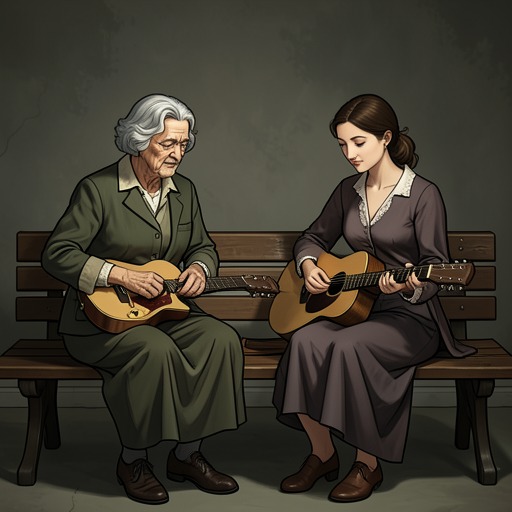
At the creek, Lilith’s guitar is both an imperfect, salvaged object and the center of a private world. The dark orange Martin 000-45 has a crack slanting down its body and was thrown away by someone on her street. Because Lilith cannot afford to be particular, she keeps it; she also believes the flaw gives the instrument a richer sound. Its damaged surface does not prevent expression, and may even contribute to the sound she values.
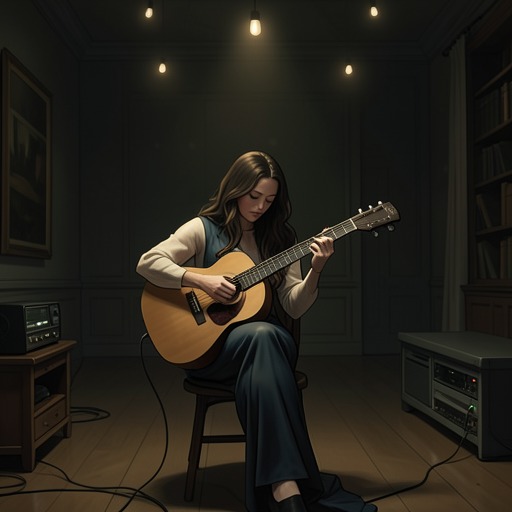
Playing offers Lilith a kind of companionship before she has found a community. As chords fill the grove, she feels as if an invisible hand is smoothing her rough edges and as if she is surrounded by friends she does not have. She prefers this small place to celebrated sights because its beauty feels like something she alone recognizes. Her musical refuge is therefore not just escape: it is a place where her own taste counts, even when she has no audience to affirm it.
That solitude also sharpens her longing to share music. Lilith wonders what it would be like to meet someone with her taste, particularly someone who does not dismiss The Four Horsemen as a cheerleader once did. She dreams of seeing the band live, but assumes the group is too famous to play Crossroads and a ticket too expensive for her family. Music holds out the possibility of belonging even while money and geography make that possibility seem remote.
Songs Turn Feeling into Expression
Lilith’s songwriting gives her a way to handle feelings before she can speak about them directly. When a word on a page stirs something deep in her soul, she wants to confront Cam but does not know where he lives. Instead, she takes out her black notebook and lets the feeling come out as a song. Creation becomes an alternative to an unanswered conversation: she can give the feeling form without first having to explain it to another person.
The same process gives painful experience a future beyond the moment in which it was written. Lilith later reflects that the lyrics of Somebody’s Other Blues came from a grim, lonely state and served as the only therapy she could afford. At a celebration with her brother, Cam, and newly found friends, she sees that those sad words have led to happiness she could not have imagined while writing them. Cam’s belief in her is part of that change, but the song’s path from private anguish to shared celebration also helps Lilith believe in herself.
That recognition becomes personal as well as artistic. Surrounded by the people gathered to celebrate, Lilith considers Cam’s forwardness and his care for her brother alongside the laughter and excitement she feels with him. She realizes she is falling in love. The shift is conveyed through her response to the shared moment: the song and its celebration have helped her understand the attachment growing between them.
Collaboration as Care and Friendship
Music also makes knowledge shareable. When Lilith struggles with biology homework, Luis turns the subject into a catchy song about the cell, using a mnemonic for each part. He describes it as his version of Schoolhouse Rock. Jean Rah claps when he finishes, and Lilith hugs him before realizing what she is doing. His improvised teaching changes homework into a musical exchange, and the embrace marks how naturally that exchange has brought them closer.
Cam’s treatment of Lilith’s song offers a different kind of connection: attentive listening expressed through performance. After giving food to a family, Cam takes the oldest boy’s beat-up guitar, although two strings are broken, and keeps trying to tune it until it sounds somewhat better. Asked for a lullaby, he says he learned one from a talented musician named Lilith and sings Exile. He performs it twice, slowly and with emotion, while the children settle toward sleep and their father applauds softly. Lilith is so moved by hearing her work carried into this setting that she can say no more. The song reaches people who do not know its writer, while Cam’s choice to sing it makes his regard for her audible.
Lilith later turns the same attentive practice toward Chloe King. In Chloe’s bedroom, Lilith picks up a guitar and suggests that they write a song together. Chloe plays Rich Bitch, but doubts the song; Lilith proposes changing its point of view so that it expresses the pain of feeling unknown rather than presenting Chloe through the envy of others. Chloe tries again, singing with such emotion that she cries, and Lilith’s own eyes fill with tears. Lilith applauds sincerely, and Chloe invites her to a show at Alfie’s the following night. Their musical exchange does not erase the awkwardness of appearing together in public, but it creates a concrete opening between former antagonists.
From Private Song to Public Performance
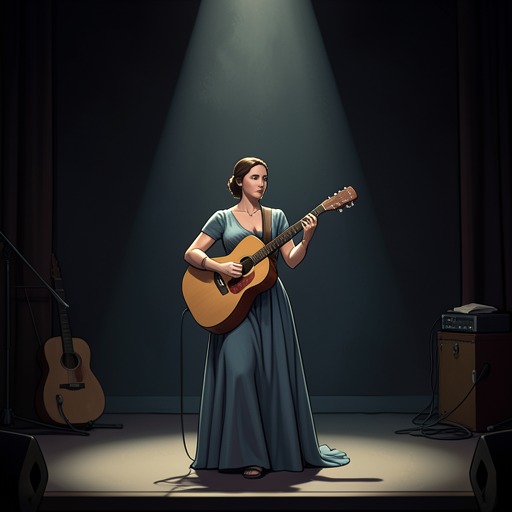
At prom, the connection music has made possible becomes visible onstage. Lilith remembers that without Cam she would have been alone in her bedroom writing songs rather than facing a packed dance floor with her band. With her gown and guitar, she counts the band in; the drums enter, her slow, sad riff expands, and Cam’s guitar meets hers. Her description of the moment makes performance a shared action: the band plays together, and Lilith is no longer afraid but living a dream she had once thought out of reach.
The audience and her family become part of that experience. Lilith catches sight of her brother and mother dancing apart from the crowd, then hears the audience cheering as she turns from the microphone to play. After the bridge, Cam joins her on the last verse, finding harmonies they have never practiced. When Lilith stops before the final couplet, Jean Rah, Luis, and Cam stop with her, while the audience screams louder. The pause makes the performance’s relationships legible: the band follows her lead, the audience answers, and the unpracticed harmony between Lilith and Cam grows out of playing together.
Across these moments, music connects people without making them interchangeable. Lilith’s songs begin in solitude, but their meanings change through another person’s voice, a shared guitar, a study mnemonic, a revised lyric, or a live performance. The movement from the cracked guitar in the grove to a band holding together before a cheering crowd does not discard the private songwriter; it gives her work a circle of listeners and collaborators. Songwriting remains Lilith’s own expression even as it becomes one of the ways she finds friendship, care, confidence, and love.