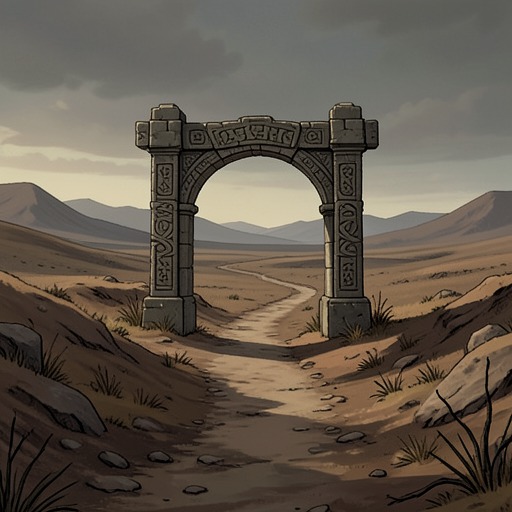
The season of unceasing wildfires
UnforgivenThe season of unceasing wildfires is not a passing interval in Lilith’s life in Crossroads but the town’s relentless condition: the hills burn, smoke settles over daily routines, and ash falls across the school grounds. As Cam discovers, the fires also help define the limits of Lilith’s Hell. The season joins mundane pressures—classes, a missed bus, a school exam—to a landscape whose apparent permanence signals that the town is a prison rather than an ordinary place.
Definition and Persistence
The narration makes the season’s abnormal duration explicit: it is wildfire season, and it is always wildfire season. That insistence collapses the distinction between a temporary hazard and the enduring state of the town. The fires are not introduced as a new crisis with a clear beginning or expected end; instead, their presence is already woven into Lilith’s surroundings. Smoke thickens her lungs, and the red blaze in the hills is part of the world she wakes into.
The language of season normally suggests time moving through recurring phases. Here, the repeated condition offers no such relief. The fires persist while other forms of time continue to register: Lilith’s bedside clock flashes midnight even as her thin curtains glow gray with dawn. The power is apparently out again, and she thinks ahead to a biology test in fourth period. Those details place an ordinary school day inside an environment where the apparent boundaries of night and morning are already unsettled. The clock and timetable advance; the wildfire season does not.
Smoke in Ordinary Life
The smoke follows Lilith beyond her bedroom and into the routines that structure her day. She walks three miles to school after the bus has gone, her guitar case bouncing against her back. Her route passes from the poorer neighborhood known as the Slump, by a strip mall and beneath a highway tunnel, toward the smoother streets near Trumbull Preparatory School. The smoldering hills encircle the town, and when Lilith emerges near campus, she is coughing and her eyes burn. Ash drifts down over her hair and the brittle gray-green grass.
At school, the wildfire atmosphere coexists with the familiar signs of student life. Banners advertise a basketball game and a science fair meeting; enlarged yearbook photographs promote a student’s bid for prom king. The brown stucco building is made uglier by the banners, but the contrast is not between a school untouched by disaster and a burning wilderness: smoke already wreathes the campus. The season becomes part of the setting in which lateness, examinations, and school authority still matter. Lilith’s immediate concern remains the test she may have to take, even as the air around her is filled with ash.
Her attempt to leave school makes the same pressure physical. Outside, the air is white and hot, and ash twists down from the sky. She climbs the flimsy chain-link fence beyond the cafeteria, then hesitates when she recognizes that skipping an exam proctored by her mother will bring punishment. The decision is framed through familiar school and family consequences, but the landscape offers no uncomplicated escape: going one way would take her back to her peeling house, while the other leads across the parking lot and among the carob trees toward the hidden edge of Rattlesnake Creek. The fire season surrounds these choices rather than replacing them.
The Fires as a Boundary of Hell
Cam’s view of the fires changes their meaning from environmental hardship to evidence about the structure of Lilith’s world. After waiting at school for Lilith to return, he walks alone to the open mic through smoky air. He sees the burning hillsides as the barely disguised flames of her Hell. A fire truck has driven toward the blaze, but the firefighters appear blank-faced to him; he reasons that they may spend every day hosing water onto trees whose smoldering never diminishes. In his understanding, the town’s inhabitants and routines are governed by Lucifer, and nothing in Crossroads will change unless the devil wants it to.
The season’s permanence is thus connected to the apparent stasis of the town. Fire crews respond, but Cam sees no lasting reduction in the fire. The roads themselves reinforce his suspicion when he flies high enough to see that the main routes, including the highway beside the school, form loops that send cars around in endless circles. Beyond the broadest road lies the ring of burning hills. Above him, a translucent barrier curves across the sky, resembling the glass around the snow globes Lucifer showed him in Aevum. Cam recognizes that he has reached the upper limits of Lilith’s Hell. The wildfires are both a constant feature of the landscape and part of the enclosure that contains it.
Narrative Significance
The season links Lilith’s ordinary, pressured existence to the hidden design of her surroundings. For her, smoke means coughing, burning eyes, ash on the school grounds, and a day that still demands attendance and tests. For Cam, the same fires become evidence of Lucifer’s control and of the town’s circular, unchanging construction. That difference in perspective lets the environment function at once as lived hardship and as a clue to the nature of the Hell.
The season’s most important temporal quality is not simply that the fires last, but that their persistence contrasts with the small units of time that continue to organize the characters’ lives: midnight, dawn, the late bell, fourth period, and the coming open mic. These markers promise progression through a day, while the burning hills remain. The phrase “it was always wildfire season” therefore names more than weather. It gives the town’s recurring smoke a stark narrative function: a visible, inhaled reminder that Lilith’s surroundings do not obey the expectations of an ordinary world, and that moving through a day does not mean moving beyond the Hell that contains it.