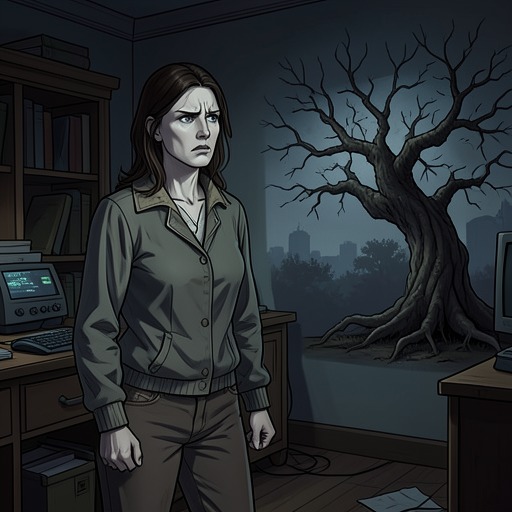
Slangen
UpSlangen is a recurring hallucination in Emma’s account of her illness, first described through an unnerving journey along a narrow bike path in a polder. Its importance lies not only in the frightening image itself, but in what remains after the image passes: Emma can identify Slangen as unreal and still be unable to act without fear. The episodes turn an ordinary stretch of road into a test of perception, while the branch left in the path shows how an experience can continue to restrict her after the hallucination has ended.
Appearance and setting
Emma tells Rajid Panjani that most of her unusual perceptions are merely strange, but that sometimes she sees Slangen. She traces the first episode back several years, to a particular route she had to travel a few times a week. The bike path was narrow and ran dangerously beside a road with an 80-kilometer speed limit, cutting across the polder. The setting matters: this was not an abstract vision detached from daily life, but a repeated encounter on a route Emma had to use.
At first, Emma saw what appeared to be Slangen lying on the path. She was frightened and wanted to turn around. Then she reasoned that the Netherlands had many more earthworms than snakes, and that it was unlikely that the one adder found in the country would have made its way there from the Veluwe. She concentrated until the image resolved into a branch. The apparent correction did not settle the matter. Twenty metres farther on, another branch appeared to be Slangen; concentration again revealed wood, but when Emma stopped concentrating, Slangen returned to her perception.
Duration and the work of checking
The path took about half an hour to travel, and Emma had to make the return journey as well. Her initial description of an hour therefore concealed the larger duration of the problem: she had to traverse that route several times a week, and the last period in which she saw Slangen there lasted three months. Each trip required her to scrutinize the path and repeatedly determine whether the image was a snake or an ordinary object. What sounds like a brief misperception occupied a substantial part of a recurring journey.
Emma describes the process as exhausting, though she says a person can grow accustomed to trying to think the image away. The habit does not make the perception harmless. She continues to be startled, and the repeated effort to establish what is real can become desperate in itself. Slangen therefore signifies more than the momentary mistake of seeing one thing as another: the hallucination recruits attention again and again, making everyday movement depend on sustained vigilance.
In explaining the experience, Rajid distinguishes hallucinations from delusions. A hallucination involves perceiving the surroundings incorrectly; a delusion involves perceiving them accurately but drawing a false conclusion. His distinction gives the conversation a clinical vocabulary, but it does not reduce Emma’s account to a definition. The branches are ordinary objects that become Slangen in her perception, while Emma’s ability to reason about probability and to recognize the branches demonstrates that awareness and perceptual control are not the same thing.
Fear after the image
Emma draws a sharper line between inconvenience and genuine impairment through a storm-felled branch. By the time it fell across the path, the period of seeing Slangen had ended months earlier. The branch was perhaps two metres long. Emma thought it should be moved before darkness, so that no one would collide with it, but she could not even kick it aside. She feared that it might turn into Slangen.
The practical task was small, but the fear made it impossible. Emma left the branch where it lay; somebody else eventually moved it. She considers this a more consequential burden than the hallucinations alone, because the images had passed while the fear remained inscribed in her mind. Even on that same stretch of path, she thinks she might still be unable to move such an object. Slangen thus marks the gap between knowing that a perception is false and recovering the freedom to behave as though it were false.
The scene also resists an easy division between an unreal image and a real consequence. The branch does not become Slangen, but Emma’s fear changes what she can do in the physical world, and another person has to perform the task she could not. The hallucination’s afterlife is measured not by a continuing vision but by an ordinary action left undone.
Recurrence and uncertainty
Later, Emma discusses hallucinations with other patients and recalls Slangen as one of the frightening examples. She says that the difficulty may lie less in what the hallucination depicts than in the fact that it appears at all: even a less threatening perception can startle her when she must repeatedly work out what is real. She describes the repeated checking as an exhausting demand, not as evidence that she has simply mistaken a branch once and moved on.
That uncertainty broadens when Emma paces in the PAAZ garden after learning that her thoughts may not always be reliable. She wonders how to know when reality differs from her own perception and recalls Slangen alongside other troubling experiences, including wolves in the chapel and events in the hospital shop whose reality she questions. The passage does not establish that these memories have the same cause or status. Instead, it shows how the question raised by Slangen spreads: once perception is in doubt, Emma finds herself asking what can still be trusted.
Narrative significance
The account moves from a specific, testable encounter—an apparent snake that concentration reveals to be a branch—to a less easily resolved consequence: fear that survives the episode and shapes Emma’s actions. Its chronology is important. Slangen appears on the path; the image recurs over months; the visions stop; and, months later, a branch still cannot be touched. The delayed consequence gives the episode its force without suggesting that Emma mistakes every branch for Slangen at all times.
Emma’s explanation also holds clinical recognition and lived uncertainty together. She can describe the difference between what she knows and what she believes, and she can identify the limits of her perception, yet those insights do not instantly release her from fear. Slangen is therefore neither merely a frightening creature nor a simple symbol for illness. It is a repeated perceptual experience with a specific place, duration, routine, and aftermath—a concrete example of how knowing that an image is unreal may coexist with the real work and restriction it leaves behind.