Vrijwillige deelname aan herstel
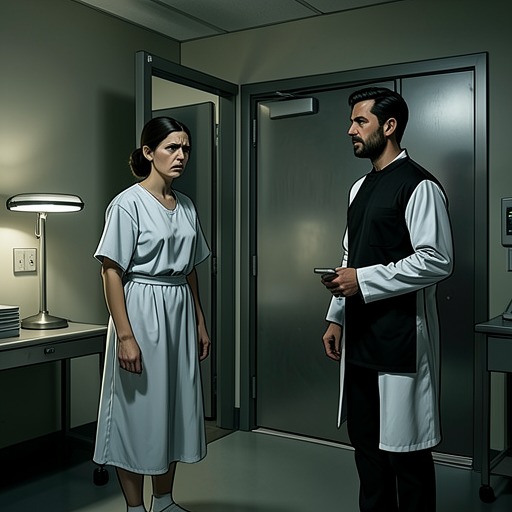
UpVrijwillige deelname aan herstel is the principle that participation in Emma’s recovery program is voluntary, not compulsory. In Gwen’s discussion with Emma, that principle becomes more than a procedural detail: it gives Emma grounds to question whether therapy is helping her, and to leave a therapeutic relationship that feels unsafe. Its meaning is tested against the PAAZ’s separate responses to acute suicide risk, where staff and loved ones take practical steps to make medication less accessible.
The Rule and Its Scope
Gwen tells Emma that recovery is voluntary and that participation is not listed in the plan drawn up at her psychiatric intake. The distinction matters because Emma assumes that therapy must be difficult, that resistance should be overcome, and that quitting would amount to giving up. Gwen challenges that assumption: difficulty is not proof that a treatment is beneficial, and a therapeutic relationship should not be a struggle. She does not condemn the recovery program or Pieter, nor does she report complaints from other patients. Her point is narrower and personal: Emma’s distress is reason to ask whether this particular experience is helping her.
Gwen also broadens the question beyond the recovery program. If Emma feels unsafe with any therapist, she should consider what she can still gain from that therapy. The rule therefore supports a patient’s choice to participate without turning every treatment decision into a test of obedience or endurance. It does not, in the available evidence, amount to a claim that every intervention or safety measure is optional.
Emma’s Decision About Therapy
The conversation helps Emma reconsider her relationship with Lars. Gwen’s distinction between doing something because it is beneficial and doing it out of duty unsettles Emma’s belief that she must push through resistance simply because therapy is supposed to be hard. As Gwen traces circles in the water, Emma recognizes the relevance of an earlier crisis: two weeks before, Gwen had called when Emma was on a bridge, after Lars’s words had brought her close to the edge. Emma draws her scarf closer and reaches the conclusion that she should stop seeing Lars.
That decision is not presented as proof that Emma has recovered or no longer needs help. When she later tells Lars that he must let her go, he explains that he fears her condition will worsen. Emma acknowledges the possibility rather than promising improvement: it will get worse again. She understands that Lars sees her as a patient for whom he is responsible, someone who may need protection from herself, but insists that this is also her life and that she must live it herself. The voluntary principle gives her room to make that choice while recognizing that ongoing illness and future deterioration remain possible.
Voluntary Choice Alongside Suicide Prevention
The narrative distinguishes a voluntary recovery program from decisions made in response to an immediate suicide risk. Earlier, when a psychiatrist discovers that Emma has obtained medication beyond the seven-day supplies intended to reduce risk, he presents her with two options: go home and surrender all her medication and prescriptions, or be admitted. Emma objects that some pills have already been partly crushed and that one prescription is at the pharmacy; the psychiatrist says he will handle those complications and asks whether she will hand over the medication. The scene shows that the practical limits placed on access to dangerous means are treated separately from participation in recovery.
Rajid later explains the reason for removing Emma’s stockpiled medication. When she was admitted, she had gathered a large supply and intended to take it all at once. If the medication remained close at hand, a future crisis could move from intention to action within minutes, without the delay of visiting pharmacies. Rajid says the medication must disappear, whether it is discarded, returned to a pharmacy, or handed in at the hospital; keeping it at Sergei’s home would not make Emma free of access to it. These measures address the conditions of a crisis. They do not establish that Emma’s participation in recovery itself is compulsory.
Support Without Taking Over
The same distinction between support and personal agency appears when Emma finds Beatrice holding a missing bag of pills. Staff have been searching for it for more than an hour. Emma urges Beatrice to return it to the nurses and offers to say she found it if Beatrice cannot bring herself to do so. When Beatrice says she cannot, Emma reminds her of the agreement to wait until Christmas, still more than a month away, and of the choice Beatrice made to be admitted and postpone suicide for her family. Rather than take the bag by force, Emma proposes that they do it together. The scene presents help as shared action: Emma makes the next safe step easier without pretending Beatrice’s crisis is resolved.
Emma’s own actions on the bridge carry a related, though distinct, ethical weight. After recalling the harm that suicide can cause to those left behind, she pushes herself away from the railing and back onto the bridge. Her concern for others helps her turn away from immediate danger, but it does not replace her later insistence that she must also act as a person responsible for her own life. Taken together, these scenes keep the rule from becoming a simple choice between independence and care. Voluntary participation protects Emma’s ability to decide whether a program or therapeutic relationship is right for her; practical support and suicide-prevention measures address moments when danger requires others to help make a safer action possible.