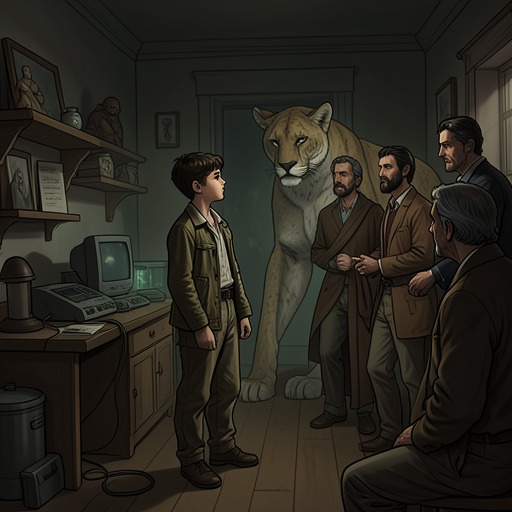
Carag Fights Bridger in the Midterm Exam
WoodwalkersCarag’s midyear combat examination against Bill Brighteye turns a calculated attempt to lose into an involuntary victory. He enters the contest hoping to fail, but when Brighteye’s bite triggers his puma instincts, Carag defeats him instead. The win brings a respectable score and an apology from the teacher, yet it frustrates Carag’s plan and is followed by a more consequential failure: he cannot transform for the examination that comes next.
Rules and Stakes
The fight takes place within a school that explicitly regulates both predation and student combat. Clearwater High Rule 3 forbids predators from looking down on prey or harming them. Earlier, when Jeffrey intimidated Nimble by baring his fangs, Nimble had invoked that rule; Jeffrey’s partial transformation made the threat physical, and Nimble retreated. That encounter gives the rule a concrete setting: it is meant to restrain the power predators can exercise over students who might otherwise be treated as prey.
Combat between students is also limited to the appropriate class. When Bridger stopped an earlier confrontation, he reminded Carag that Clearwater High Rule 5 permits student fights only in Fight and Survival lessons, and that transforming during school hours requires a teacher’s permission. The midyear test, by contrast, places combat within an authorized instructional setting, with Brighteye as examiner. Its formal boundaries do not make the encounter harmless: Carag is injured, and the teacher later acknowledges that he began the escalation.
Carag’s stakes extend beyond his score. He fears that losing the exam will mean failing midyear, leaving his class, and starting again with the new students. He also worries that a poor performance will disappoint Andrew Milling, Lissa Clearwater, Bridger, Theo, and his friends. The prospect of Jeffrey and the other wolves enjoying his failure adds a social humiliation to the academic one. At the same time, Carag has another objective that reverses the usual purpose of an exam: he believes it is better to lose, and deliberately shapes his performance toward defeat.
The Fight Against Brighteye
When Lissa calls for him to begin, Carag uses the transformation word Timbuctoo and imagines himself as a puma. He becomes a feline and faces Brighteye, a large black wolf with yellow eyes. Carag recognizes that this is no ordinary match: other wolves have faced him in pairs, whereas Brighteye needs no help. The disparity makes his plan to lose seem plausible, but Carag does not simply surrender. He attacks, then makes his defense conspicuously weak, swiping with retracted claws and only grazing Brighteye once.
Brighteye counters, and Carag lets himself be knocked onto his back. He waves his paws in the air in a display he knows looks ridiculous, then springs upright and backs away. The audience murmurs as Carag appears to lose the first round; its confusion reflects the distance between the performance expected of him and the feebleness he is showing. Carag glances toward Andrew Milling and sees his mouth set in a thin line. That reaction reassures Carag that his deliberate underperformance is having the effect he intended.
After only a short pause, Carag attacks again, feigning an attempt to seize Brighteye by the nape. Brighteye evades him easily and urges him to fight in earnest. Carag stays silent, knowing that explaining his strategy would defeat its purpose. His passivity, however, has a cost. When he again defends himself clumsily, Brighteye bites his shoulder. The spectators’ murmur grows; the narration presents the deliberate injury of a student by a teacher during an examination as apparently unprecedented.
The pain breaks through Carag’s plan. A surge of brute strength replaces calculation, and he responds not as an examinee trying to fail but as a puma fighting a larger opponent. Before Brighteye can react, Carag reaches him and hurls him away with a powerful paw strike. He leaps after the fallen wolf and brings his canines close to Brighteye’s neck. The gong sounds: Carag has won. The reversal is immediate and unwanted. He had come close to losing, but instinct has turned the contest around at the decisive moment.
A Win That Complicates the Exam
The hall erupts in cheers, and Lissa announces a ten-minute break. Carag is dismayed rather than celebratory: winning has defeated the purpose of his strategy. The gap between the crowd’s joy and his own regret makes the outcome feel less like a simple triumph than a loss of control over what the victory will mean. The fight has shown that his intention to hold back cannot reliably govern his response once he is hurt.
After they have transformed and dressed, Brighteye pats Carag’s healthy shoulder and smiles. He gives Carag an eight, explaining that he waited too long to react. Only when Carag sees the bloody streaks along Brighteye’s side does he understand that he has injured his teacher. Carag apologizes; Brighteye stops him and says that he is the one who should apologize because he started the attack. He also explains that he could not stand by while his best student gave such a poor performance. His praise and admission of fault complicate the encounter: Brighteye recognizes Carag’s ability, but that recognition comes after he has caused Carag pain and Carag has wounded him in return.
The Transformation Test and Aftermath
The combat result does not settle the larger problem Carag had hoped to address. As the examinations continue, he thinks that Brighteye’s comments will mean Andrew Milling will not let him go; the anticipated danger remains even though Carag has won. In the next test, Isidore Ellwood asks him to show his second form. Bridger is seated two chairs from Milling, and seeing him recalls Carag’s lessons in the quiet, mist-covered forest. Carag uses the relaxation Bridger taught him and tries to find the puma that defeated Brighteye, but his own inner voice obstructs his concentration.
Carag whispers Timbuctoo and apologizes to Ellwood before sitting down again. He has failed the transformation examination: after the fight, the puma is buried too deeply for him to summon. The sequence therefore separates physical success from control over transformation. In the combat test, the puma appears with overwhelming force when Carag is hurt, against his conscious plan; at the following test, he cannot reach that form when he deliberately needs it. The victory earns an eight, but it cannot substitute for command of his second form, and it leaves Carag facing both the failed examination and the unresolved danger he had hoped defeat might avert.