The Jackson Hole Campground Incident
WoodwalkersThe Jackson Hole Campground Incident is Carag’s disastrous first attempt to hunt as a puma near a human campground. A stumble over a tent rope turns his imagined debut as a skilled predator into a frightening encounter with campers, an evacuation, and a newspaper story that casts him as a killer. The episode makes the gap between Carag’s confidence in his animal nature and his inexperience unmistakable, while giving Lissa Clearwater a concrete reason to urge him toward Clearwater High.
Causes and Setting
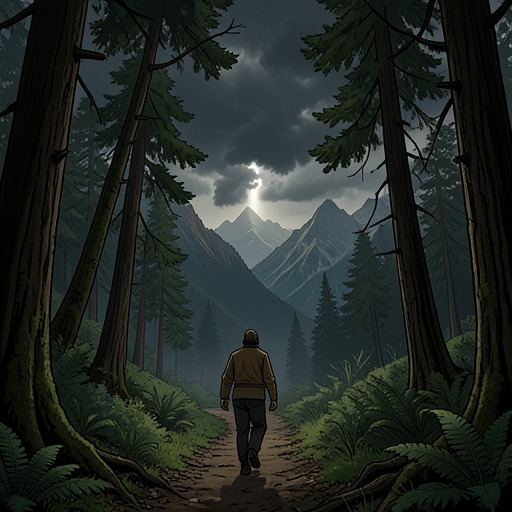
After the Ralston household has fallen asleep, Carag changes into his puma form in his bedroom and climbs onto the windowsill. He waits until he is sure no one is nearby, then leaps from the second floor, crosses the garden, and slips into the woods. In the moonless night, his feline eyes pick up the starlight; the distant cries of wapiti suggest plentiful prey. For Carag, the transformation feels like a return to freedom and strength, and he approaches the excursion believing that killing is a skill he can begin practicing at once.
He soon finds three wapiti, two females and a male, grazing in a clearing. Their proximity to the campground makes him uneasy, but he still imagines that the campers might receive a share of the meat if they asked politely. The thought reveals how little he understands the human situation around him: he sees the animals as prey and the nearby people as potential beneficiaries, not as frightened witnesses who may mistake him for a threat. His confidence is sharpened by remembered instruction from his father, who taught him to approach quietly, but Carag has not yet learned to account for every obstacle in an unfamiliar hunting ground.
The Failed Hunt and the Campers’ Panic
Carag moves low to the ground, watching the wapiti and carefully placing one paw before the other. When one raises its head, he briefly wonders whether he has made a mistake, then convinces himself that the wind cannot have betrayed him. He waits until he is about twenty metres away and launches himself at the herd. The strike never lands: his forepaw catches on a thin tent rope, pitching him into an aerial tumble and onto his back in the grass.
The wapiti stare at him, then walk away, shaking themselves and displaying their white rumps. Carag reads their retreat as mockery and wants to chase them to prove that a puma should not be laughed at. Instead, he hears a rustle and recognizes the consequence of the rope: it is attached to something. The incident’s central reversal is immediate and physical. The predator who thought he had arranged a perfect ambush has blundered into the human camp, and his failed attack has drawn attention before he has caught anything.
Sounds come from a tent, followed by a cry identifying him as a bear. Carag knows the identification is wrong, but the people have seen a large animal in the dark and react in fear. He runs in the wrong direction and nearly collides with Hugo’s mother. He swerves at the last moment, but his tail strikes her legs, knocking her down and adding her screams to the confusion. Flashlights pick out his fur as campers emerge from their tents; some try to climb trees and do so clumsily. Carag realizes that the noise is spreading far beyond his original encounter and abandons the hunt.
The panic escalates when a man throws stones and one hits Carag on the muzzle. At the same time, the headlights of a large car flare into his eyes and its engine roars. Disoriented and unable to find the exit, he leaps over a washbasin and discovers that the road is clear on the other side. He escapes into the dark woods and keeps running until the voices and engine fade. He finally reaches the Ralston home and leaps back into his second-floor bedroom, ending the night’s excursion where it began.
Public Account and Immediate Aftermath
By the following day, the event has become a newspaper story. Its headline describes a puma attacking a campground, and the report says that eleven-year-old Hugo and his forty-one-year-old mother, Michelle, from Chicago narrowly escaped the predator; Michelle is quoted in the article as saying she feared she would die. That public account gives the incident a simple, alarming shape, unlike Carag’s own experience: he had set out to hunt wapiti, stumbled over a tent rope, and fled after the campers mistook him for a bear and chased him with lights and stones.
The campground has already been evacuated that night because the rangers fear the dangerous carnivore may still be nearby. Carag recognizes that their concern is justified, even though he is now back at home: the campsite is only about five kilometres away in a straight line. The distance turns his escape into an incomplete resolution. He has returned unseen to his bedroom, but the frightened people and the responding authorities have been left to deal with the consequences of his presence.
At breakfast, Donald asks whether the article has awakened any memories. He hopes that Carag’s memory might eventually return, and has tried psychological techniques and hypnosis without success. Carag dismisses the story as merely interesting rather than admitting that he was the animal in it. His answer preserves the concealment surrounding his identity and keeps Donald from connecting the newspaper report to the boy at the table. The episode therefore has a private aftermath as well as a public one: Carag escapes the campground, then must maintain the appearance that he knows nothing about what happened.
Consequences for Carag’s Path
When Lissa Clearwater later urges Carag to transfer to Clearwater High, she refers specifically to the previous night’s campground episode as something the school might help prevent from happening again. She offers practical support: he could enroll immediately, learn to transform more easily, and practice dealing with difficult humans. The incident thus becomes more than an embarrassing failed hunt; it supplies a concrete reason for formal training and helps connect Carag’s uncontrolled experiment with his eventual school life.
The episode also establishes a recurring tension in Carag’s life as a puma and a human-raised boy. His heightened senses and physical power let him move through the night and escape the campground, but they do not give him the judgment needed to hunt safely near people. A tent rope, an obstacle ordinary to the campers, defeats his carefully rehearsed approach; a mistaken identification then transforms a private failure into a public emergency. The contrast gives the incident its lasting significance: Carag’s animal instincts are real, but acting on them without knowledge of the human world can endanger others and draw unwanted attention to the hidden world he inhabits.