Gratz
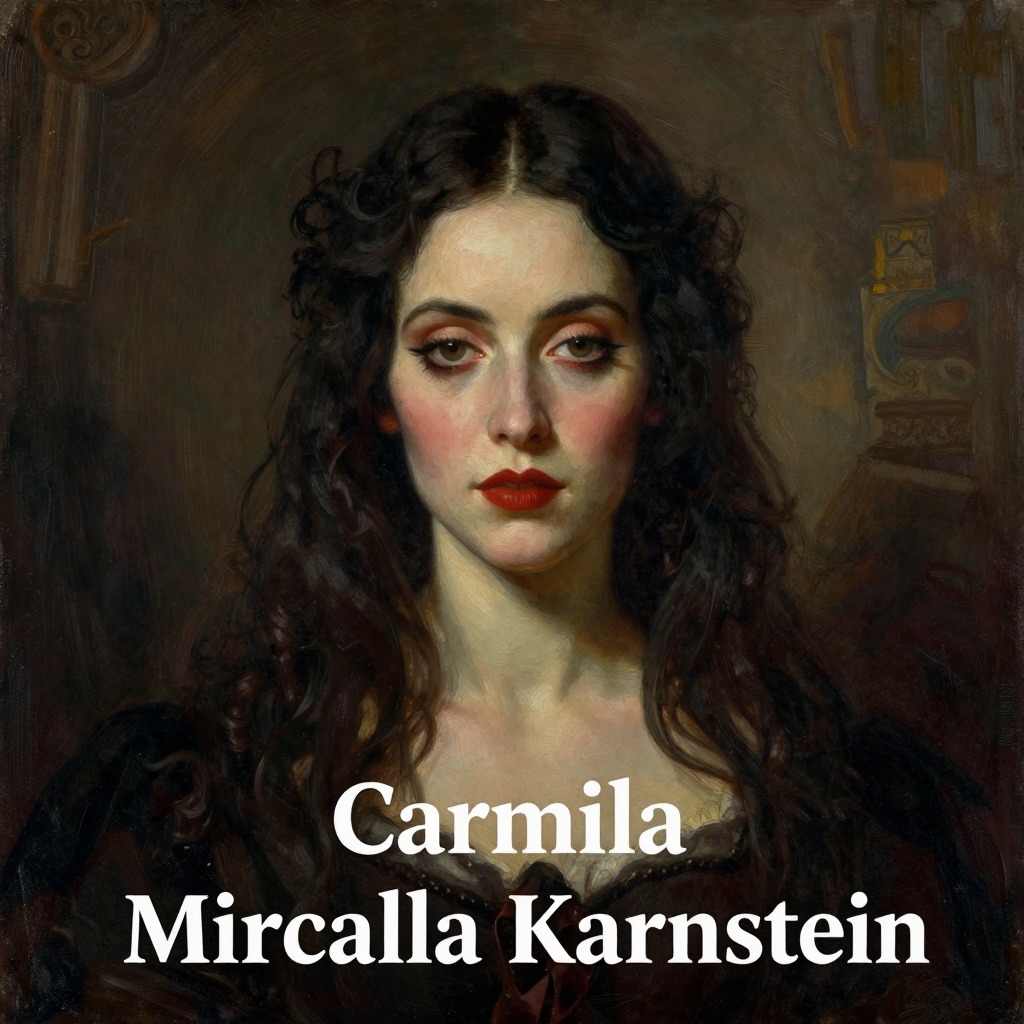
Gratz, the capital of Styria, functions as the nearest urban center to the remote schloss where Laura lives with her father, and it is the point of origin for several crucial arrivals that advance the narrative. The city is first mentioned when a messenger arrives from Gratz with two large packing cases of restored pictures, a journey of ten leagues that creates a sensation in the secluded household. Among the portraits brought to light is the small, nearly square painting of Mircalla, Countess Karnstein, dated 1698, which Laura immediately recognizes as an exact likeness of Carmilla, complete with the little mole on her throat. This discovery, made possible by the picture cleaner's son traveling from Gratz, provides the first concrete link between the beautiful guest and the long-extinct Karnstein family.
Medical Consultation from Gratz
When Bertha Rheinfeldt's mysterious illness proved resistant to the local physician's treatments, General Spielsdorf summoned an abler doctor from Gratz. This physician, described as a good, pious, and learned man, arrived after several days and immediately recognized the symptoms as those of vampiric visitation. He wrote a letter diagnosing the vampire, which he instructed the General to open only in the presence of the nearest clergyman, warning that without such spiritual witness the document would be dismissed as absurd. The letter detailed the punctures near the throat, the small livid mark left by the demon's lips, and the exact conformity of every symptom with recorded cases of vampirism. Though the General initially remained skeptical, the doctor from Gratz urged him to invite a man curiously learned on the subject—a recommendation that eventually led to the involvement of Baron Vordenburg.
Baron Vordenburg's Residence and Scholarship
Baron Vordenburg, the eccentric scholar whose curious lore proved essential to discovering the long-concealed tomb of Mircalla Countess Karnstein, had taken up his abode in Gratz, living upon a mere pittance that was all that remained of his family's once princely estates in Upper Styria. From this modest base, he devoted himself to the minute and laborious investigation of the marvelously authenticated tradition of vampirism, amassing a voluminous digest of all judicial cases and extracting a system of principles governing the vampire condition. He possessed at his fingers' ends all the great and little works upon the subject, including "Magia Posthuma," "Phlegon de Mirabilibus," "Augustinus de cura pro Mortuis," and "Philosophicae et Christianae Cogitationes de Vampiris" by John Christofer Herenberg, among a thousand others. After the expulsion of Carmilla, Baron Vordenburg remained with Laura's family for two or three weeks, during which he revealed the story of his ancestor, the Moravian nobleman who had been the passionate and favored lover of the beautiful Mircalla and who had deliberately concealed her tomb to protect her remains from posthumous execution. The Baron's papers, including tracings and notes made by that ancestor in old age, guided the party to the exact spot in the Chapel of Karnstein where the vampire's leaden coffin lay, thus enabling the formal proceedings that ended the century-long plague.