Highbury
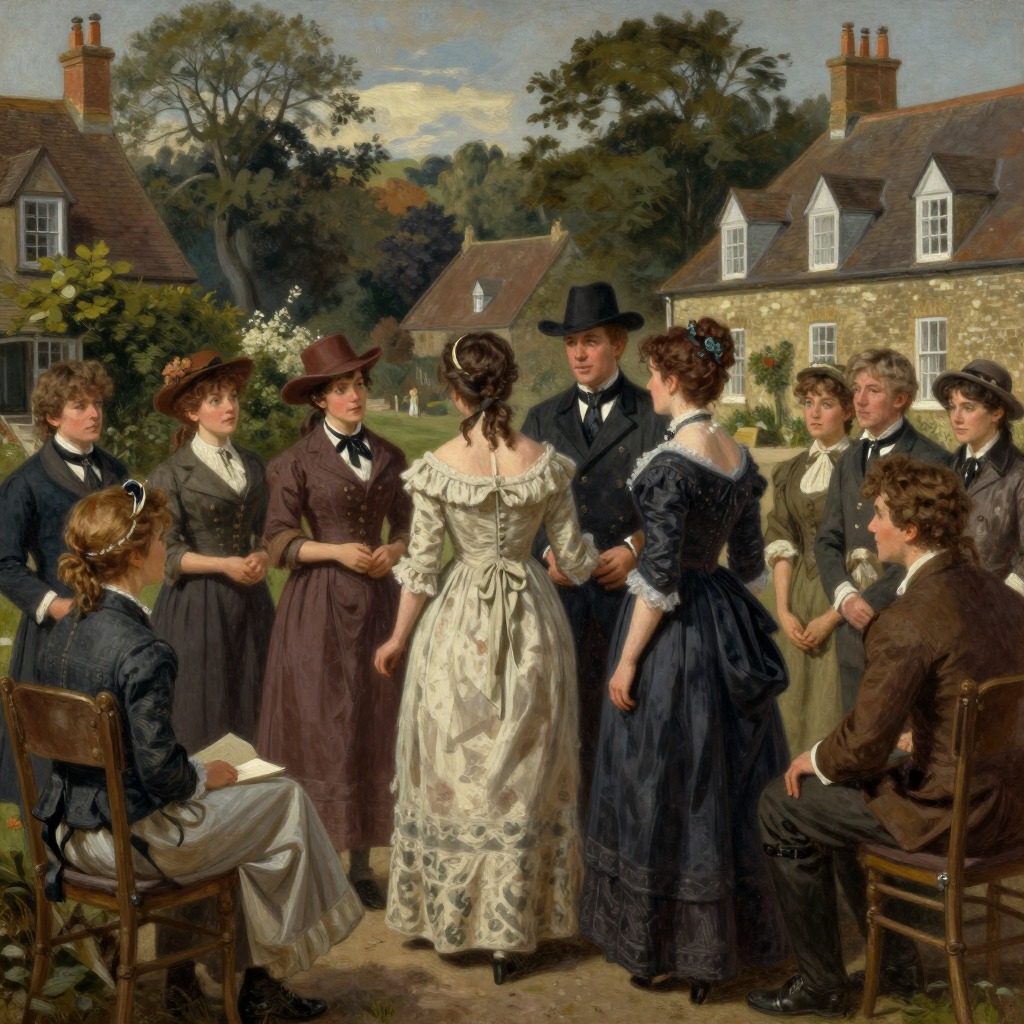
Highbury is the large and populous village, almost amounting to a town, to which Hartfield, in spite of its separate lawn and shrubberies, does really belong. It is the world in which Emma Woodhouse, handsome, clever, and rich, has lived nearly twenty-one years with very little to distress or vex her, and where the Woodhouses are first in consequence. The village is not merely a backdrop but the very fabric of the novel, its social structure, its daily rhythms, and its network of relationships providing the engine for the entire plot. From the grand estates of Hartfield and Donwell Abbey to the modest lodgings of the Bates family and the bustling shop of Ford's, Highbury is a complete and self-contained society, where every character's standing is known and every event is a matter of common interest.
Geography and Social Hierarchy
Highbury is a place of distinct social layers, each with its own geography. At the top are the landed gentry: the Woodhouses at Hartfield, Mr. Knightley at Donwell Abbey in the adjoining parish, and the Westons at Randalls, only half a mile from Hartfield. The village itself contains the Vicarage, home of Mr. Elton, and the homes of the second set, including Mrs. and Miss Bates, who occupy the drawing-room floor of a house belonging to people in business, and Mrs. Goddard, whose honest, old-fashioned boarding-school is in high repute. The commercial heart of Highbury is Ford's, the principal woollen-draper, linen-draper, and haberdasher's shop, where every body attends every day of their lives. The Crown Inn, though an inconsiderable house, is the principal one of its sort, and its large room, built for a ball-room, becomes the site of a pivotal dance. The landed property of Hartfield itself is but a sort of notch in the Donwell Abbey estate, to which all the rest of Highbury belongs, yet the Woodhouses' fortune from other sources makes them scarcely secondary to Donwell Abbey itself in every other kind of consequence.
Social Life and Daily Routine
The social life of Highbury revolves around visits, dinners, and card-parties. Mr. Woodhouse, a valetudinarian, prefers evening parties and can command the visits of his own little circle. The Westons and Mr. Knightley are constant visitors, while Mr. Elton, a young man living alone, eagerly exchanges his blank solitude for the society of Hartfield. Mrs. and Miss Bates and Mrs. Goddard are always at the service of an invitation. The arrival of a new person, such as Harriet Smith or Frank Churchill, or the return of a familiar one like Jane Fairfax, creates a sensation and becomes the subject of every morning visit. News travels fast: the handsome letter Frank Churchill writes to Mrs. Weston is mentioned in every house, and the engagement of Mr. Elton to a Miss Hawkins is known throughout the village within hours. The daily walk to the post-office is a ritual, and the shops, particularly Ford's, are places of social encounter.
Key Events and Their Significance
Highbury is the stage for all the novel's major events. It is where Emma first meets Harriet Smith and begins her ill-fated matchmaking schemes. It is where Mr. Elton's charade is delivered and misinterpreted, and where the shocking carriage ride reveals his true intentions. The ball at the Crown Inn, a project of Mr. Weston's, brings the whole community together and provides the setting for Mr. Knightley's public kindness to Harriet. The gypsy incident on the Richmond road, just half a mile beyond Highbury, throws Frank Churchill and Harriet together in a way that fuels Emma's imagination. The picnic at Box Hill, a nearby beauty spot, is the scene of Emma's cruel insult to Miss Bates and Mr. Knightley's subsequent reproach. The strawberry party at Donwell Abbey and the final revelations of Frank Churchill's secret engagement to Jane Fairfax all unfold within the village's compass. The very identity of Highbury is tied to its inhabitants; Frank Churchill, though he has never been there, is looked on as sufficiently belonging to the place to make his merits and prospects a kind of common concern.
Narrative and Thematic Significance
Highbury functions as a microcosm of English society, where the constraints of social rank, the importance of income, and the pressures of propriety are constantly at play. It is a place where a woman's destiny is largely determined by marriage, and where the community's watchful eye both supports and judges its members. The village's stability is both a comfort and a limitation; characters are fixed in their places, and any change, such as a marriage or a departure, is felt by all. Emma's own growth from a self-satisfied young woman who thinks she knows every body's business to a more humble and self-aware person is measured by her changing relationships within Highbury. The novel's final happiness is achieved within this familiar world: Emma and Mr. Knightley will live at Hartfield, Harriet marries Robert Martin and settles at Abbey Mill Farm, and Jane Fairfax is restored to her beloved home with the Campbells. Highbury, with all its gossip, its kindness, and its rigid hierarchies, remains the enduring home of its people.