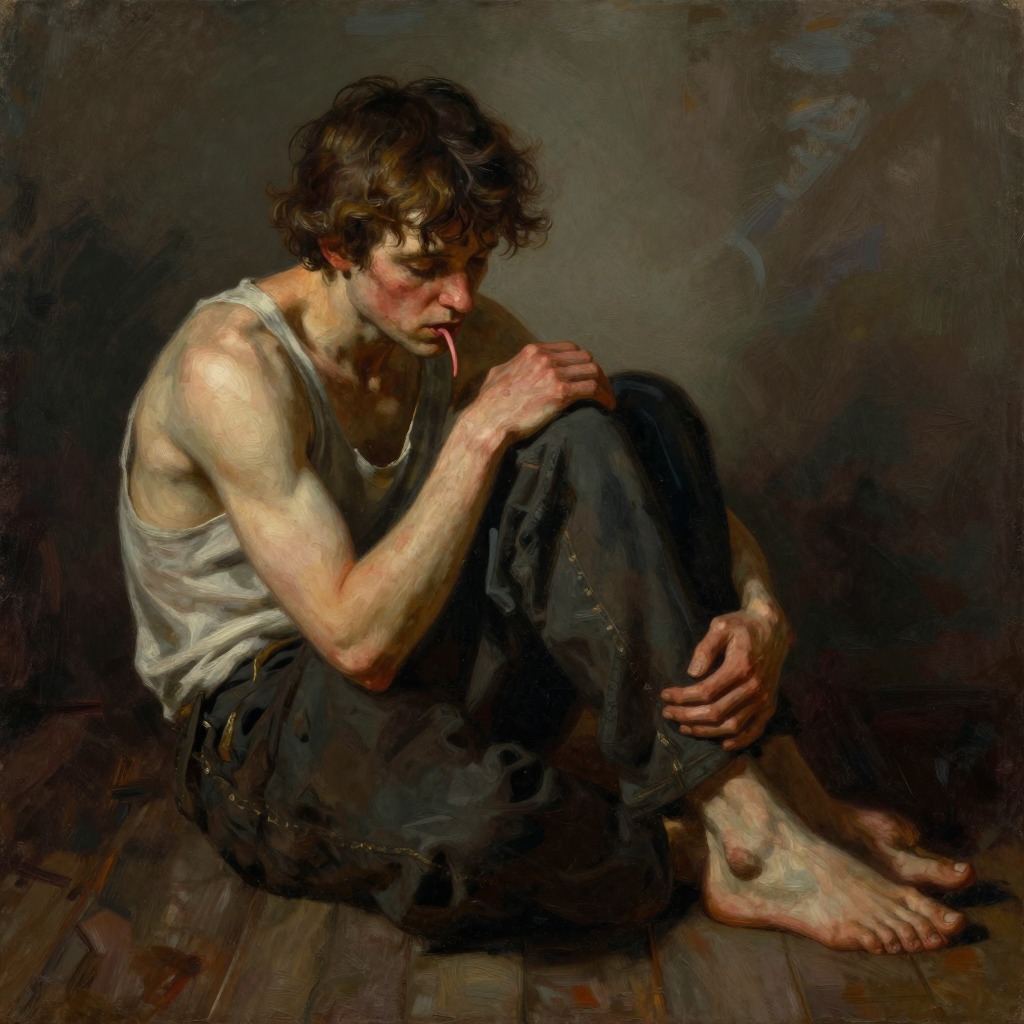
Mrs. Gundersen
Mrs. Gundersen is the landlady of the attic room the protagonist rents in Christiania, and her demands for payment become a relentless, material force that accelerates his descent into homelessness and psychological crisis. She appears first as a spectral presence—the protagonist steals down the stairs to avoid her attention because a few days have passed since his rent fell due and he has nothing left to pawn. Her silent, inquiring look when he meets her on the stairs torments him all day, rising up even in his pleasant hours. This unspoken accusation is more powerful than any words; it drives him to leave the park and fetch his pencil from the pawnbroker, hoping to finish an article and pay her.
The Eviction Notice and the Protagonist's Response
Mrs. Gundersen's first direct communication is a slip of paper left on the protagonist's table, in which she begs him to pay his rent in advance or else move as soon as he can, adding that he must not be offended—it is absolutely a necessary request. The protagonist, buoyed by the hope of a successful story, writes a note promising her five shillings and leaves it behind, then bows to the lighthouse director's announcement and Miss Andersen's winding-sheet advertisement before departing. He wants to prove to her what an upright sort of person her roof has sheltered. This gesture, however, is a fantasy; he has no money, and the eviction is real.
The Return and the Letter
Weeks later, after a night in the guard-house and a period of extreme hunger, the protagonist returns to the attic out of habit. He finds the room as he left it, with a note on the table—not his own, but a letter from the editor accepting his story and enclosing half-a-sovereign. Mrs. Gundersen is not present; the protagonist never faces her again in that room. The eviction, which had seemed a final catastrophe, is overtaken by a sudden rescue, but the pattern of debt and flight has been established.
The Final Confrontation
Mrs. Gundersen reappears in the fourth part of the novel, when the protagonist is staying at a lodging-house in Vaterland. She is the landlady there, and she has grown hostile. She confronts him about his unpaid bill—three weeks' board and lodging—and tells him she cannot afford to give credit. When he protests that he is working on an article, she replies bluntly that he will never finish it. She then evicts him from his room to make space for a sailor who has paid a month in advance. The protagonist is forced to sleep on the floor of the family room, and Mrs. Gundersen's contempt becomes open. She tells him, "This is the last night you sleep here, so now you know it." The next morning, he leaves before she wakes, and when he later returns to retrieve his papers, she screams that she will fetch the police. The protagonist, in a final act of defiance, throws a half-sovereign—given to him by Ylajali—in her face. Mrs. Gundersen is the embodiment of the economic reality that the protagonist cannot escape: she is not cruel, but she is practical, and her practicality is a form of violence against a man who has no resources.