shark cage
The shark cage is a protective diving device that Matt Hooper brings aboard the Orca to film the great white shark at close range, and it becomes the site of his violent death when the shark breaches the cage and kills him. Hooper's insistence on using the cage sets him in direct conflict with both Quint and Martin Brody, and its failure as a safeguard dramatizes the shark's overwhelming power and the limits of human technology against nature.
Design and Arrival
The cage is an aluminum structure, slightly over six feet tall, six feet wide, and four feet deep. It contains a control panel, two cylindrical flotation tanks on top, and a scuba tank, regulator, face mask, and wet suit on its floor. Hooper has it sent down from the Woods Hole Oceanographic Institute by truck, and when it arrives at the dock, he argues with Quint and Brody about bringing it aboard. Quint objects that it will take up too much room and that a fish as large as the great white could eat the cage for breakfast. Hooper counters that the shark might bump or mouth the cage but would not seriously try to eat it, and he offers Quint a hundred dollars in cash to allow it on the boat. Brody initially forbids the cage, but when Hooper threatens not to go on the hunt without it, and Quint admits he cannot find another mate on short notice, Brody relents. The cage is light enough that two men can carry it; Hooper and Quint slide it into a corner under the overhang that supports the flying bridge, and Hooper secures it with two pieces of rope.
Deployment and Hooper's Descent
After the shark has taken several baited squid and is lurking beneath the boat, Hooper proposes putting the cage overboard to draw the fish out. Quint agrees, saying it cannot hurt just to put it in the water. They tip the cage onto its side, Hooper crawls through the top hatch and removes the diving gear, then they tip the cage upright and slide it to the starboard gunwale. Quint provides two coils of rope, which they tie to an after cleat and a cleat amidships, then secure the ends to the bars on top of the cage. They lift the cage, tip it backward, and push it overboard; it sinks until the ropes stop it a few feet beneath the surface, where it rises and falls slowly in the swells. Hooper dons his neoprene wet suit, fits the regulator onto the air tank, and puts his right wrist through the thong at the end of a bang stick—an underwater gun that fires a twelve-gauge shotgun shell on contact. He also carries a movie camera in a waterproof housing. Before diving, he retrieves a tiger shark tooth pendant from his trousers, drops it inside his wet suit, and zips up the jacket. He kneels on the gunwale, puts the mouthpiece in his mouth, and dives overboard through the open hatch. Once inside, he closes the hatch and gives Brody the okay sign. Brody and Quint release the ropes, and the cage descends until the hatch is about four feet beneath the surface.
The Attack
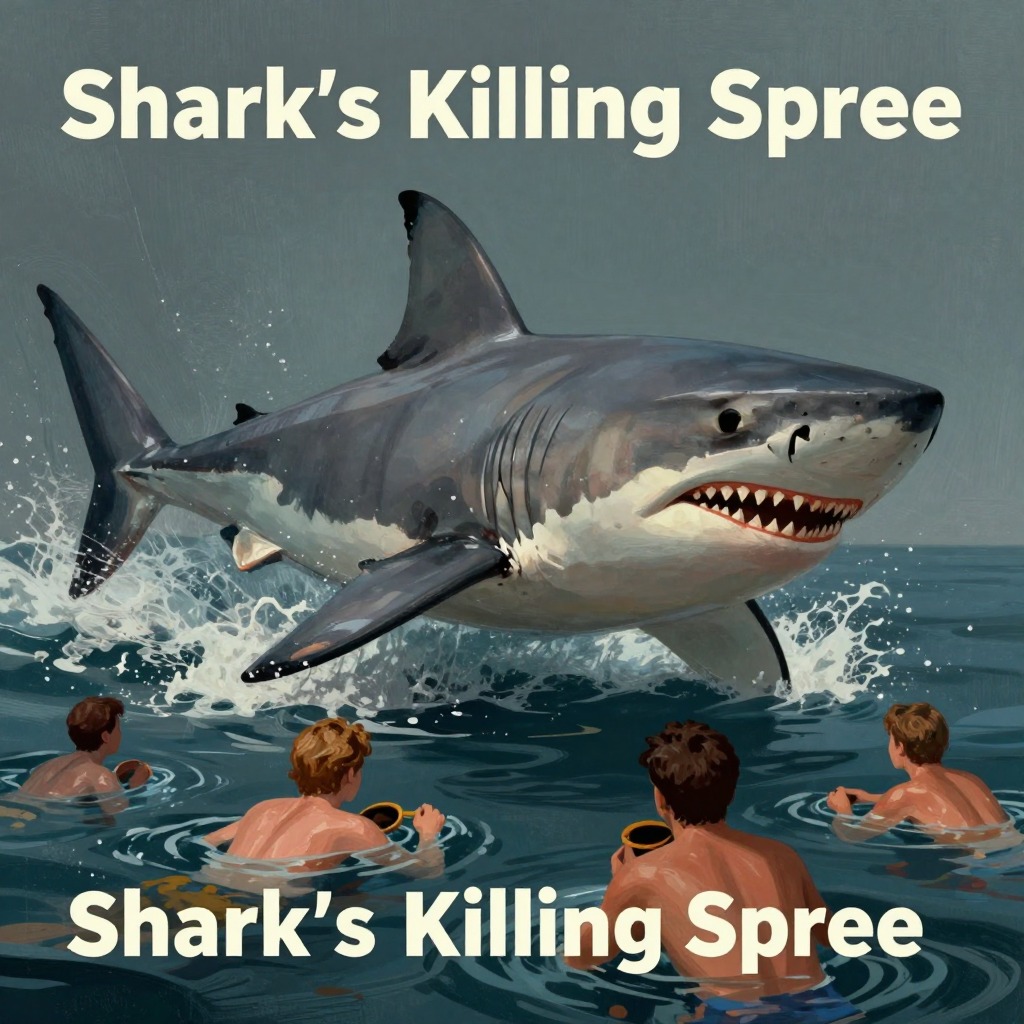
Inside the cage, Hooper experiences the serene freedom he always feels when diving: alone in blue silence, the only sounds his own breathing. He holds on to the bars to keep his tank from clanging against the hatch. The visibility is poor—no more than forty feet—and he turns slowly, searching for the shark. He looks downward and sees the great white rising at him from the darkling blue, slowly and smoothly, like an angel of death. The fish passes before the cage, and Hooper marvels at its colors: the top a hard ferrous gray, bluish where dappled with streaks of sun, the underside creamy, ghostly white. He tentatively sticks a hand through the bars and touches the flank, which feels cold and hard, smooth as vinyl. The fish moves away, and Hooper raises his camera to film it as it emerges from the darkness. Through the viewfinder he sees the fish turn toward him, moving fast, its mouth opening and closing. It strikes the cage head on, its snout ramming between two bars and spreading them. The snout hits Hooper in the chest and knocks him backward; the camera flies from his hands, and the mouthpiece shoots from his mouth. The fish turns on its side, and the pounding tail forces its body farther into the cage. Hooper gropes for his mouthpiece, finds it, and clears it, drawing an agonized breath. He sees the wide gap in the bars and the giant head lunging through. He raises his hands above his head, grasping at the escape hatch. The fish rams through the space, spreading the bars still farther. Hooper, flattened against the back of the cage, sees the mouth reaching for him. He tries to lower his right arm and grab the bang stick, but the fish thrusts again, and the jaws close around his torso. Hooper feels a terrible pressure, as if his guts are being compacted. He jabs his fist into the shark's black eye. The fish bites down, and the last thing Hooper sees before he dies is the eye gazing at him through a cloud of his own blood.
Aftermath
Holding Hooper's body in its mouth, the shark backs out of the cage and sinks a few feet, chewing and swallowing. It then drives upward, breaking the surface fifteen feet from the boat. Hooper's body protrudes from each side of the mouth—head and arms hanging limply down one side, knees, calves, and feet from the other. Brody, seeing Hooper's glazed, dead eyes staring through his face mask, reaches for the rifle and fires without aiming; his third shot strikes Hooper in the neck. Quint grabs the rifle and fires two shots, but the fish slips beneath the surface. The cage remains undamaged on the surface, but Hooper is gone. Later, after the Orca sinks and Quint is dragged to his death, Brody cuts the cage loose on Quint's orders before they head back to shore. The cage, which Hooper had intended as a means of safely observing and filming the shark, instead becomes the instrument of his death, its bars failing to withstand the force of the great white's assault.