The Angels of the Apocalypse are a military division within the Republic of Gilead, deployed in combat operations against rebel forces such as Baptist guerillas. They are depicted in state-controlled news broadcasts as instruments of the regime's military power, and their presence is a constant, threatening backdrop to the lives of the Handmaids.
The Quakers, or Society of Friends, appear in The Handmaid's Tale as a persecuted religious sect whose members are arrested for smuggling precious national resources over the border into Canada, and whose homes serve as stations on the Underground Femaleroad, the clandestine network that helps women escape the Republic of Gilead.
The Bath Day Requirement is a mandatory weekly ritual imposed on Handmaids in the Republic of Gilead, serving as a state-sanctioned act of bodily purification that simultaneously enforces vulnerability, surveillance, and the reduction of the female body to a mere reproductive vessel.
The patronymic naming system for Handmaids in Gilead strips them of their former identities and binds them to the Commanders they serve, functioning as a tool of control, erasure, and redefinition.
The Great Purge was a middle-period internal cleansing within the Republic of Gilead that discredited and liquidated many of the original architects of the regime, including the Commander, Frederick R. Waterford, and fundamentally altered the power structure of the state.
The Manhattan Cleanup was a state-orchestrated public destruction of sexually explicit and luxury women's clothing and materials in New York City, staged as a televised spectacle of purification that marked the early Gilead regime's consolidation of power over women's bodies and appearances.
The Sons of Jacob Think Tanks were the secret, high-level planning sessions at which the philosophy, social structure, and key policies of the Republic of Gilead were designed and debated before the regime's takeover. Drawing on a range of historical precedents and pseudoscientific theories, these meetings produced the blueprint for Gilead's totalitarian system, including its reproductive policies, its system of social control, and its symbolic apparatus.
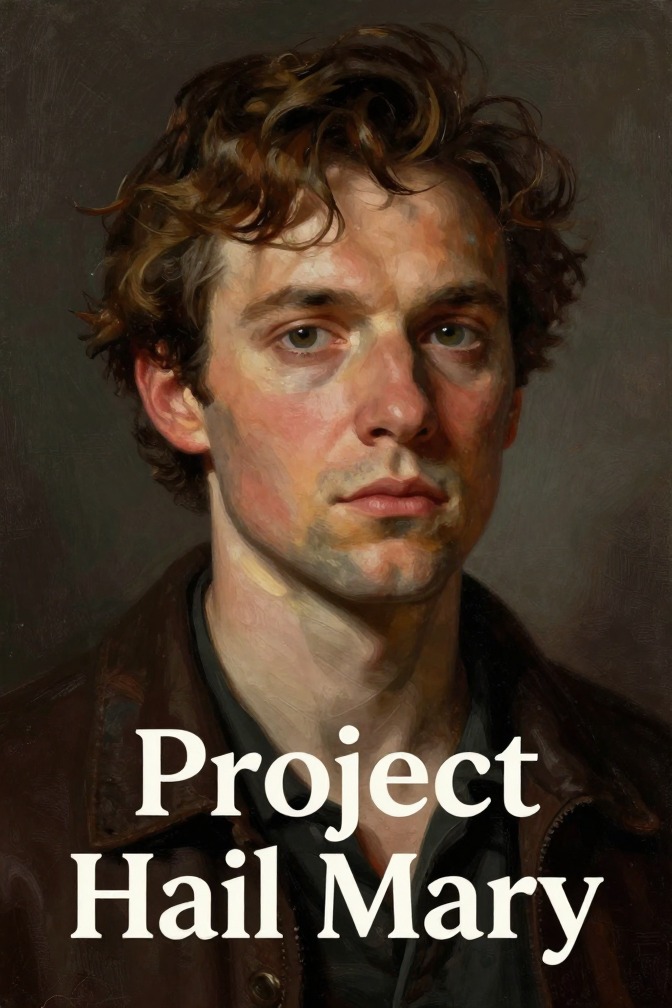
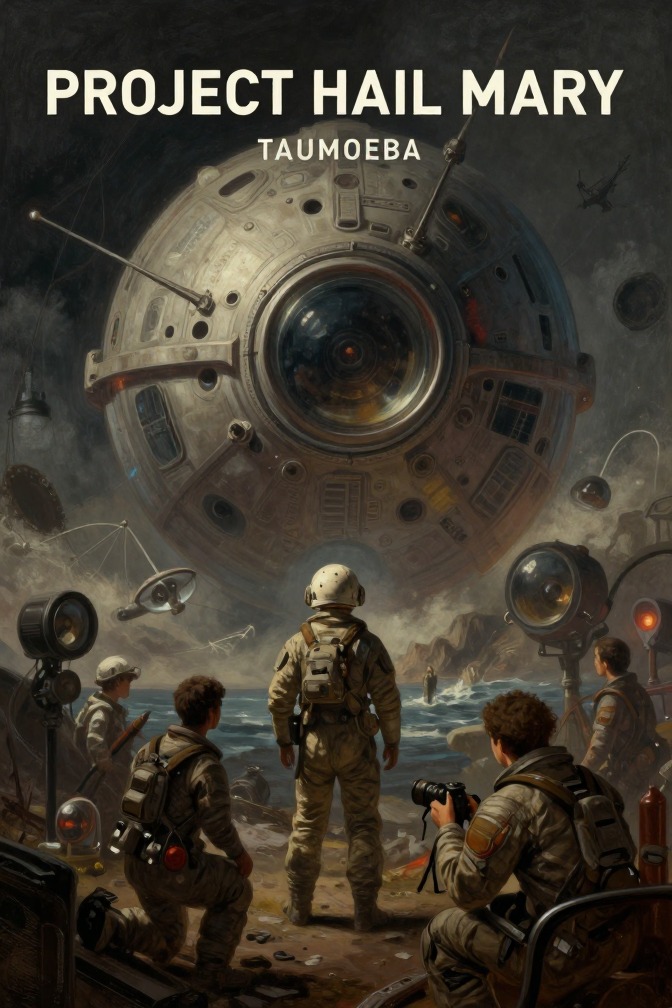
After discovering that the Taumoeba-82.5 strain he bred can penetrate xenonite and has contaminated Rocky's ship, Ryland Grace abandons his own return to Earth and turns the Hail Mary around to rescue his alien friend, knowing it means he will starve to death on Erid.
Annie Shapiro is a brilliant microbiologist and DNA-splicing specialist who serves as the backup science specialist for the Hail Mary mission. She is known for inventing the Shapiro method of DNA splicing, a groundbreaking technique that creates entirely new enzymes from scratch. Alongside her professional partner and lover Martin DuBois, she perishes in a catastrophic Astrophage explosion at the Baikonur research center just days before launch, an event that forces Eva Stratt to conscript Ryland Grace as the mission's science specialist against his will.
François Leclerc is a world-renowned French climatologist recruited by Eva Stratt to lead the climate-effects analysis of the Astrophage crisis. He is the reluctant architect of the nuclear strike on Antarctica, a desperate measure to release methane and buy humanity a few extra years before the sun's dimming triggers mass starvation.
Adrian is the third planet orbiting Tau Ceti, named by Ryland Grace after Rocky's mate. It is a pale-green super-Earth with a thick carbon-dioxide atmosphere, and it serves as the Astrophage homeworld—the source of the predator Taumoeba that ultimately saves both Earth and Erid.
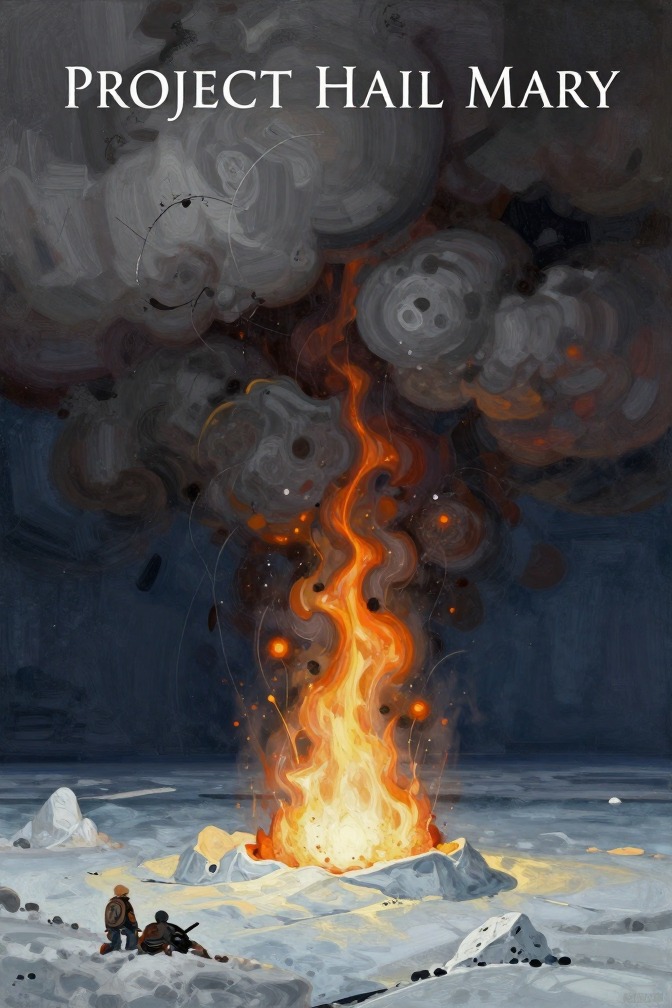
The Antarctica methane release was a desperate, world-altering geoengineering project ordered by Eva Stratt and designed by climatologist François Leclerc to buy humanity enough time for the Hail Mary mission to succeed. By detonating 241 nuclear weapons along a fissure in Western Antarctica, the project aimed to cleave ice shelves into the sea, releasing trapped methane into the atmosphere as a powerful greenhouse gas to counteract the rapid cooling caused by the Astrophage-induced solar dimming. The operation was a stopgap measure, intended to delay a catastrophic global famine and buy the twenty-six years needed for the Hail Mary to reach Tau Ceti and return its findings, but it came at a tremendous environmental and moral cost.
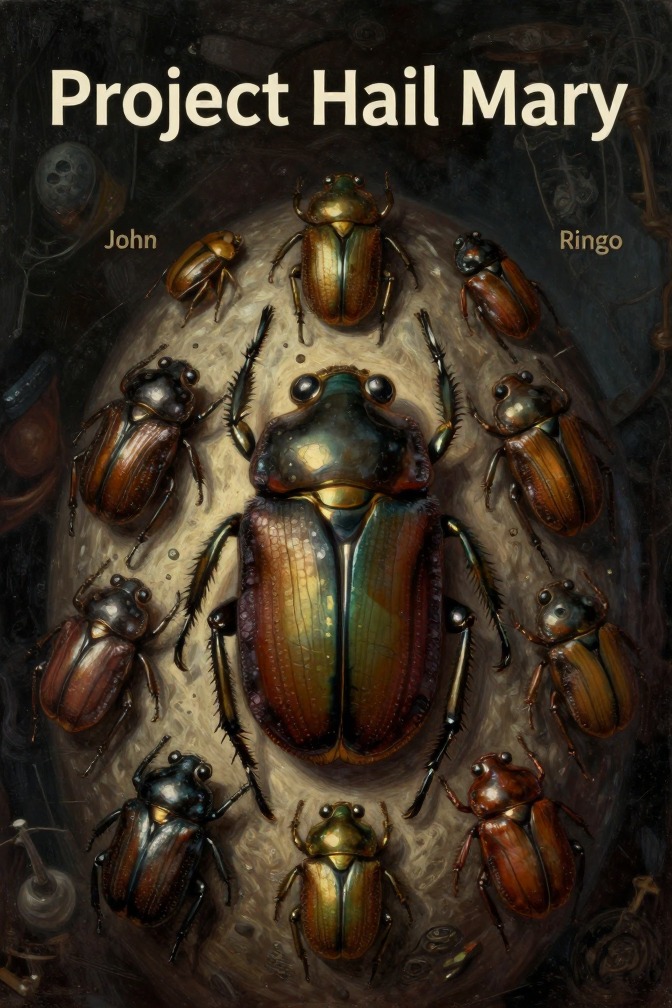
The four beetle probes aboard the Hail Mary are named John, Paul, George, and Ringo, after the Beatles, and serve as the mission's data-return system, each carrying 5 terabytes of information and 120 kilograms of Astrophage fuel to autonomously navigate back to Earth from Tau Ceti.
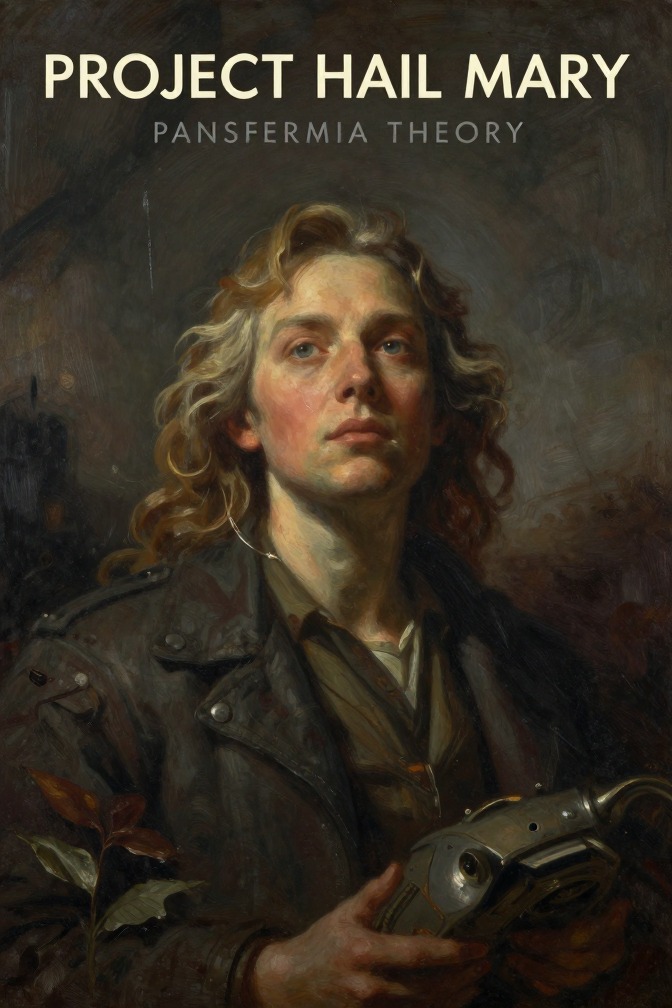
The panspermia theory in Project Hail Mary proposes that life on Earth and Erid did not arise independently but was seeded by a common interstellar ancestor related to Astrophage, explaining the striking biochemical similarities between the two biospheres and suggesting that life may be widespread in the galaxy.
Ryland Grace discovers that the star he is observing is not the Sun but an alien star, confirming he is in a different solar system, a revelation that reshapes his understanding of his mission and his place in the universe.
Ryland Grace discovers that the Astrophage infestation of Tau Ceti has a natural predator, a microbe he names Taumoeba, which offers a potential solution to the solar-diming crisis threatening Earth and Erid.
CERN, the European Organization for Nuclear Research, is the world-renowned particle physics laboratory that played a critical role in Project Hail Mary by discovering the mechanism by which Astrophage stores energy—through neutrino pair production—and by confirming the material's extraordinary radiation-blocking properties, which directly shaped the Hail Mary's hull design.
Nairobi is the Kenyan city where a research team, working with Astrophage samples distributed by Eva Stratt's global network, made a critical early discovery: they exposed Astrophage to Earth's atmosphere and found it was unaffected, thereby allowing laboratories worldwide to abandon the cumbersome argon-filled containment rooms that had been required for safety.
The Sahara Desert is the vast North African desert that becomes the site of the largest industrial project in human history: the Blackpanel Astrophage-breeding farm. Under the authority of Eva Stratt, the desert is partially paved with trillions of black-anodized metal panels designed to absorb sunlight and breed Astrophage on an unprecedented scale, producing the millions of kilograms of fuel needed for the Hail Mary mission. The project is conceived by the imprisoned engineer Bob Redell and executed by global industrial mobilization, and its environmental consequences—including weather disruption across the Mediterranean and Europe—become a major point of contention within the science team.
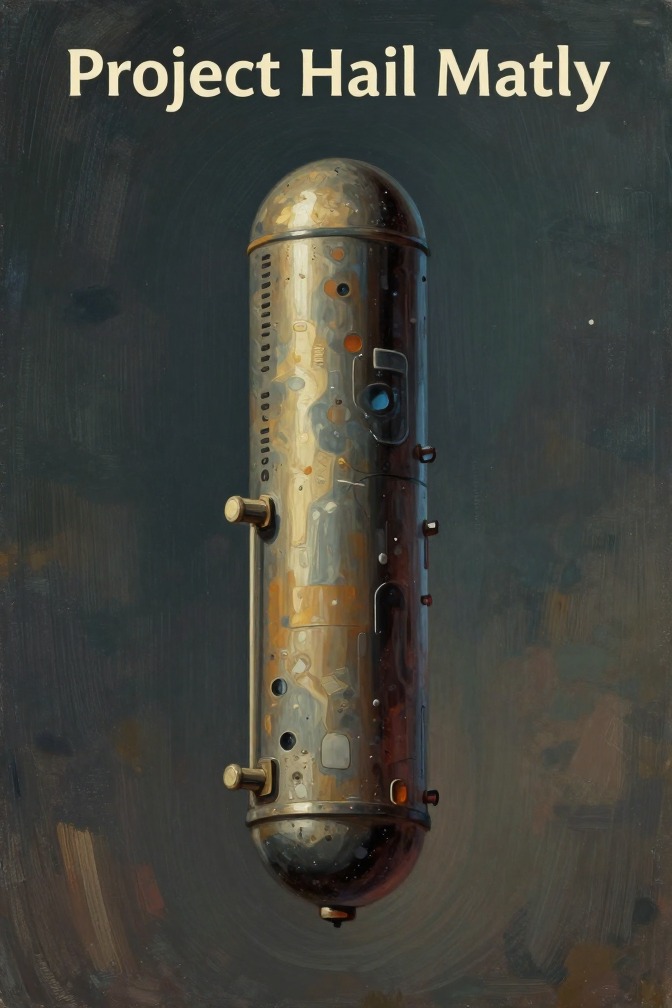
The alien cylinder is the first physical object exchanged between Ryland Grace and the alien ship Blip-A, serving as the initial medium of communication and the catalyst for first contact. Delivered by a hull-mounted robot, the warm, ammonia-scented cylinder contains a star map model that reveals the Eridians' origin and purpose, establishing a shared understanding of the Astrophage crisis and enabling the two species to begin building a cooperative relationship.
The U.S. Navy is a branch of the United States armed forces that, during the Astrophage crisis, operates under the authority of Eva Stratt, providing logistical support, transportation, and personnel for Project Hail Mary, including the deployment of nuclear weapons and the transport of key scientists.
Roscosmos, the Russian Federal Space Agency, is a key national space organization that participates in the international effort to combat the Astrophage crisis. It provides critical logistical support, including the recovery of the ArcLight sample return capsule and the supply of EVA suits and engineering expertise for the Hail Mary mission, while its personnel and symbols are woven into the fabric of the multinational project.
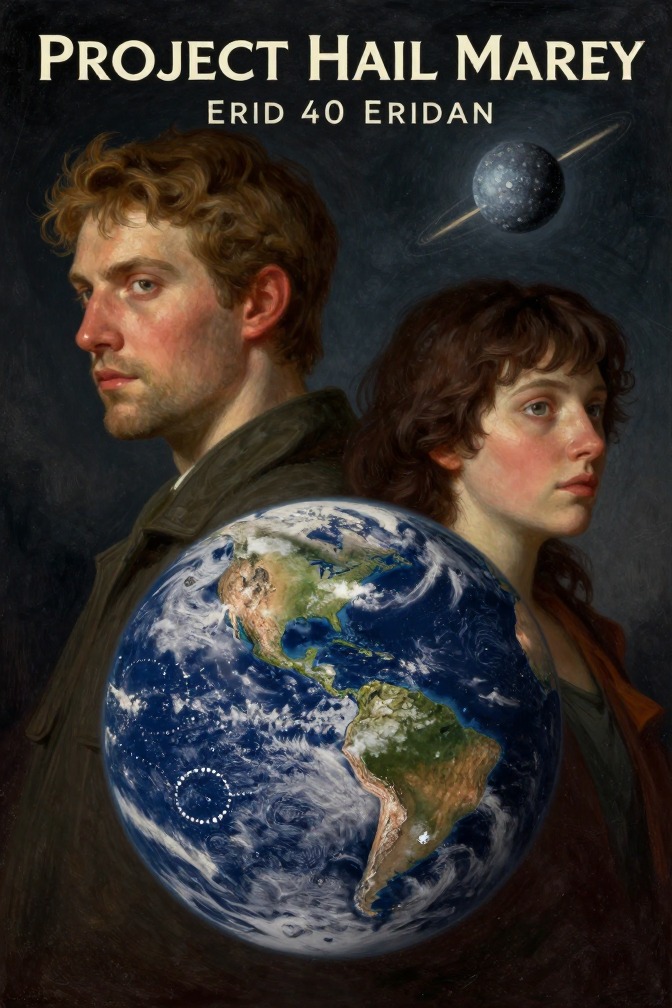
Earth and Erid (40 Eridani) share a common existential crisis: both are threatened by the Astrophage infestation that is dimming their respective stars. The two planets, sixteen light-years apart, are linked by the same problem and the same potential solution, and their respective missions to Tau Ceti—the Hail Mary and the Blip-A—are driven by identical desperation. This relationship is defined by parallel suffering, mutual discovery, and a shared scientific and emotional bond that ultimately saves both worlds.
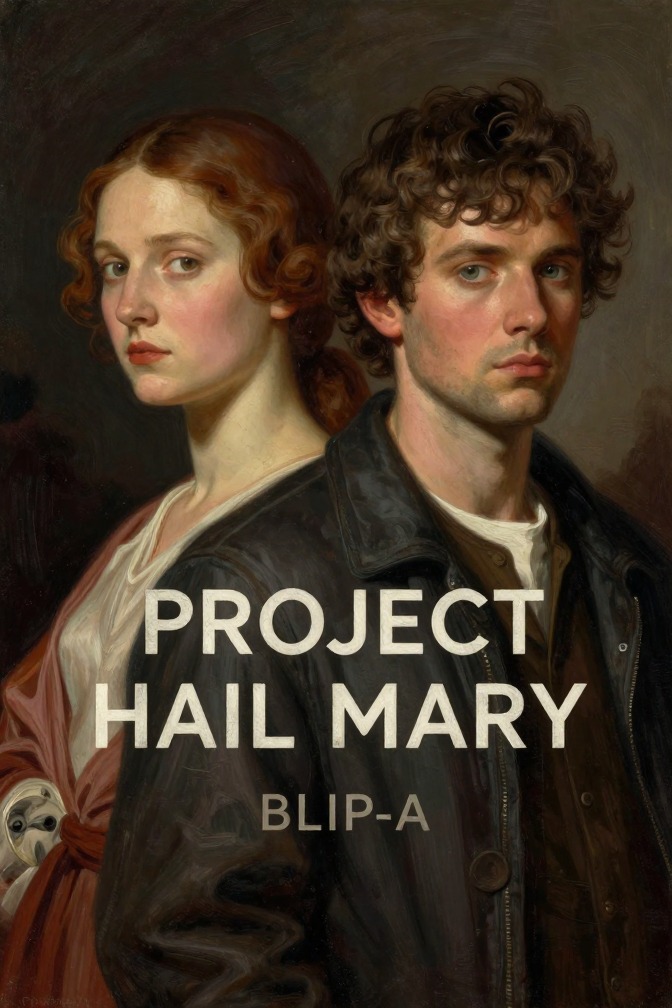
The Hail Mary and the Blip-A, two interstellar spacecraft from Earth and the 40 Eridani system respectively, form an unprecedented alliance in the Tau Ceti system. Their relationship evolves from cautious first contact through a shared tunnel and airlock system into a deep, collaborative partnership that enables the exchange of scientific knowledge, the joint development of a solution to the Astrophage crisis, and ultimately a mutual rescue that saves both species.
The Hail Mary mission is a one-way interstellar voyage to Tau Ceti, designed to find a solution to the Astrophage crisis that threatens all life on Earth. The mission is a suicide mission: the crew is not expected to return, and the ship carries only enough fuel for a single journey. This fundamental premise shapes every aspect of the narrative, from the crew's psychological state to the mission's engineering and the protagonist's ultimate choices.
The Taumoeba infection is a recurring crisis in which the engineered predator microbe Taumoeba escapes its containment and consumes the ship's Astrophage fuel, threatening the Hail Mary's power and propulsion. This state first emerges when Taumoeba contaminates the fuel supply after the Adrian sampling mission, and later recurs when a nitrogen-resistant strain (Taumoeba-82.5) proves capable of permeating xenonite walls, leading to a catastrophic fuel loss that forces Grace to abandon his return to Earth and instead rescue Rocky.
The Eridian year is the orbital period of the planet Erid around the star 40 Eridani, lasting 198.8 Eridian days—a unit Rocky uses to measure time and which Grace converts into Earth years for comparison. This timescale underscores the vast difference in lifespans between the two species and frames the urgency of Earth's crisis against Erid's slower decline.
Jack Torrance disables the snowmobile in the equipment shed, sabotaging the family's only means of escape from the Overlook Hotel and sealing their fate for the winter.
The Party is a recurring spectral masquerade ball at the Overlook Hotel, most famously held on August 29, 1945, to celebrate the hotel's grand reopening under Horace Derwent. It becomes a central symbol of the hotel's seductive, timeless, and ultimately destructive power, manifesting as a hallucinatory trap for Jack Torrance and a source of terror for Danny.
Unmasking is the climactic ritual of the Overlook Hotel's eternal masquerade party, a moment when the guests remove their masks to reveal their true, monstrous identities. In the novel, this act is repeatedly invoked by Horace Derwent and other spectral figures, and it becomes a symbol of the hotel's power to strip away pretense and expose the hidden, destructive nature of its inhabitants. The concept culminates in the final confrontation between Danny and the possessed Jack, where the unmasking reveals not a human face but a composite of all the hotel's horrors, and ultimately leads to the destruction of the Overlook itself.