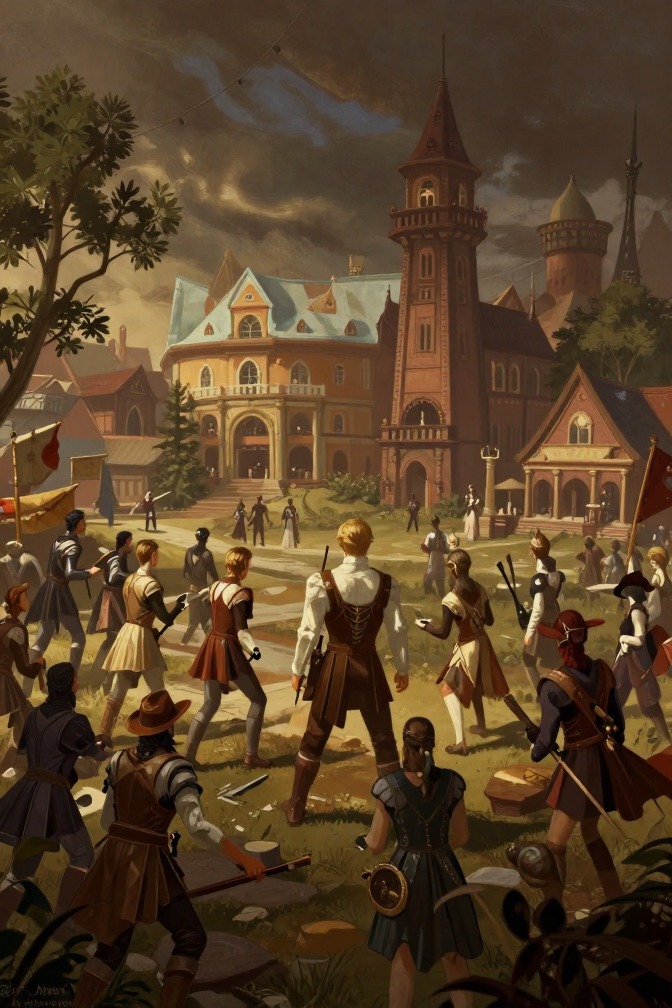
District 2 is one of the twelve districts of Panem, known for its wealth, loyalty to the Capitol, and its production of Peacekeepers and other military personnel. Its tributes, often Career Tributes who volunteer for the Hunger Games, are among the most formidable and well-trained competitors, consistently posing the greatest threat to Katniss Everdeen and the other tributes from poorer districts.
District 6 is one of the twelve districts of Panem, a nation built on the ruins of North America. It is a conquered territory under the tyrannical rule of the Capitol, forced to send two tributes each year to the Hunger Games. The district is known for its factories, producing televisions, automobiles, and explosives, and its tributes are often overlooked, with one notable tribute, a boy named Titus, who went savage and attempted cannibalism during the Games.
The Arena is the vast, outdoor battleground where the annual Hunger Games take place, a death match among twenty-four tributes. Designed and controlled by the Gamemakers, it is a manufactured environment that can range from a burning desert to a frozen wasteland, and it serves as the central stage for the Capitol's brutal assertion of power over the districts.
The Justice Building in District 12 serves as the administrative and ceremonial center of the district, where the annual reaping for the Hunger Games takes place, where tributes say their final goodbyes to loved ones, and where the district's authority figures—the mayor and Peacekeepers—enforce the Capitol's laws. It is a site of profound emotional weight, marking both the beginning of Katniss Everdeen's journey into the Games and the moment she volunteers to take her sister Prim's place.
The Fence is the electrified chain-link barrier that encloses District 12, separating the coal-mining district from the surrounding woods. It functions as both a physical boundary and a symbol of the Capitol's control, but its frequent power outages and the existence of loose sections allow Katniss Everdeen to slip through illegally to hunt, making it a site of transgression and survival.
The First-Aid Kit is a standard-issue medical pack obtained by Katniss from the slain boy from District 1, containing basic supplies such as bandages, fever pills, and stomach-calming medicine. It proves critically inadequate for treating Peeta's severe leg wound, which has become infected and requires high-grade Capitol medicine that the kit cannot provide. The kit's limitations force Katniss to improvise with herbal remedies and ultimately to risk her life at the Feast to obtain the proper medication.
The flashlight is a pair of night-vision glasses that Rue identifies in Katniss's orange backpack, revealing a dark truth about District 11's brutality and transforming from a useless object into a crucial tactical advantage for Katniss in the arena.
Matches are a basic survival item included in the standard supply backpack Katniss retrieves from the Cornucopia during the initial bloodbath of the Seventy-fourth Hunger Games. Though a simple tool, the matches become a crucial resource for Katniss and her ally Rue, enabling them to cook food, signal each other across the arena, and execute their plan to destroy the Career Tributes' food supplies. The matches' presence and use highlight the fundamental shift from the Capitol's lavish feasts to the raw struggle for survival, and they serve as a practical link between Katniss's hunting skills and her strategic thinking in the arena.
Strawberries are a recurring symbol of luxury, trade, and fleeting normalcy in Katniss Everdeen's world, appearing as a prized commodity in District 12's black market, a gift for the mayor, and a poignant reminder of the life she left behind before the Hunger Games.
The Sword is a weapon wielded by Cato, the male tribute from District 2, and serves as the primary instrument of his physical dominance throughout the Seventy-fourth Hunger Games. It is a short, heavy blade that Cato prefers over the bow, and it becomes the tool with which he wounds Peeta Mellark, nearly killing him, and the weapon he carries into the final confrontation against Katniss and Peeta. The sword's presence marks Cato as the most physically formidable opponent in the arena, and its eventual failure—when it cannot save him from the mutt pack—underscores the limits of brute force against the Gamemakers' engineered horrors.
The relationship between Katniss Everdeen and her mentor Haymitch Abernathy is a volatile, mutually antagonistic alliance forged in the life-or-death context of the Seventy-fourth Hunger Games, defined by Haymitch's drunken cynicism, Katniss's defiant pride, and a grudging, unspoken respect that emerges through coded acts of survival.
Katniss and President Snow's antagonism is the central political conflict of The Hunger Games, a relationship defined by the Capitol's absolute power and Katniss's instinctive defiance, which culminates in a direct challenge to the regime's authority through the berry incident and leaves her marked for future punishment.
The alliance between Katniss Everdeen and Rue, the twelve-year-old tribute from District 11, is a brief but profoundly significant partnership in the Seventy-fourth Hunger Games. Formed out of mutual recognition and survival instinct, their bond transforms Katniss from a solitary fugitive into a protector and strategist, and Rue's tragic death becomes the catalyst for Katniss's first open act of rebellion against the Capitol.
Katniss and Thresh's debt is a pivotal relationship in the Hunger Games, defined by a single, charged encounter at the feast where Thresh spares Katniss's life as repayment for her kindness to Rue, establishing a moral economy of obligation that stands in stark contrast to the brutality of the arena.
The Electric Barrier is a high-voltage fence that encloses District 12, designed to keep predators out and residents in, but its unreliable power supply and the existence of weak spots make it a permeable boundary that Katniss routinely crosses to hunt illegally in the woods.
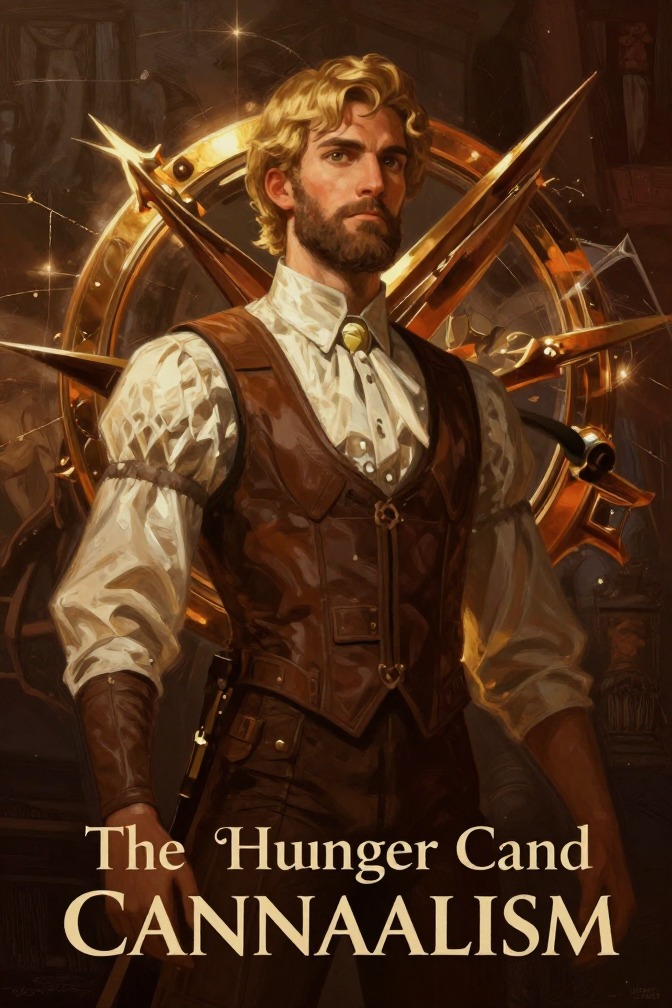
The No Cannibalism rule is an unwritten but enforced prohibition within the Hunger Games, preventing tributes from consuming the flesh of their slain competitors. Though the official rules of the Games are minimal—primarily the sixty-second stand on the metal plates and the directive that only one tribute may survive—the Capitol actively intervenes to stop cannibalism, as it does not play well with the audience. This rule is a key example of how the Gamemakers manipulate the arena to maintain a specific spectacle, prioritizing entertainment value over the absolute freedom of the tributes.
The Token Rule allows each tribute to bring one item from their district into the arena as a reminder of home, subject to approval by a review board that may reject items deemed to provide an unfair advantage.
Heathcliff overhears Catherine Earnshaw tell Nelly Dean that it would degrade her to marry him, and he leaves Wuthering Heights before she can finish speaking, an event that sets in motion years of separation, his transformation, and his eventual return as a wealthy and vengeful man.
Edgar Linton strikes Heathcliff in a moment of violent confrontation, marking a decisive rupture in the already strained relations between the two households and precipitating Catherine Earnshaw's final descent into illness and death.
Joseph is the elderly, pious, and sour-tempered servant at Wuthering Heights, whose self-righteous religious fanaticism and loyalty to the Earnshaw family make him a constant, judgmental presence across two generations of the household.
Linton Heathcliff is the sickly, selfish son of Heathcliff and Isabella Linton, whose frail constitution and manipulative temperament make him a tool of his father's revenge and a tragic figure in the second generation of Wuthering Heights.
Catherine's Ghost is the spectral presence of Catherine Earnshaw that appears throughout Wuthering Heights, functioning as both a literal haunting and a symbolic embodiment of the novel's central themes of obsessive love, unresolved grief, and the boundary between life and death. The ghost manifests in multiple forms—as a child's face at the window, as an invisible companion felt by Heathcliff, and as a persistent memory that shapes the lives of the surviving characters—making it one of the most powerful and ambiguous supernatural elements in English literature.
Heaven and Hell in *Wuthering Heights* are not conventional religious destinations but are radically reimagined as states of spiritual union or separation from the beloved, primarily Catherine Earnshaw and Heathcliff. The novel transforms the Christian afterlife into a personal cosmology where earthly love determines eternal fate, and where the moors and the house itself become contested territories between sacred longing and profane suffering.
Cows appear throughout *Wuthering Heights* as a recurring element of the farm life at Wuthering Heights, often in the background of key scenes, as objects of labor, and as part of the domestic economy that contrasts with the passionate dramas of the human characters.
Cathy and Linton's secret correspondence is a clandestine exchange of letters between Catherine Linton and Linton Heathcliff that begins after their first meeting in childhood and continues for months, hidden from Edgar Linton and Nelly Dean. This covert communication deepens Cathy's emotional attachment to her cousin, sets the stage for Heathcliff's manipulative schemes, and ultimately leads to a crisis when Nelly discovers the letters and forces their destruction, marking a pivotal moment in the younger generation's entangled fates.
Edgar Linton's death is the quiet, peaceful culmination of a life marked by devotion, grief, and resignation, occurring shortly after his daughter Catherine's return from Wuthering Heights and providing a stark contrast to the violent, tormented ends of other characters.
Hindley Earnshaw dies at twenty-seven, a drunkard and a debtor, having mortgaged every acre of Wuthering Heights to Heathcliff. His death, which follows his sister Catherine's by scarcely six months, completes Heathcliff's first great act of revenge and leaves Hareton a penniless dependent in his father's enemy's house.
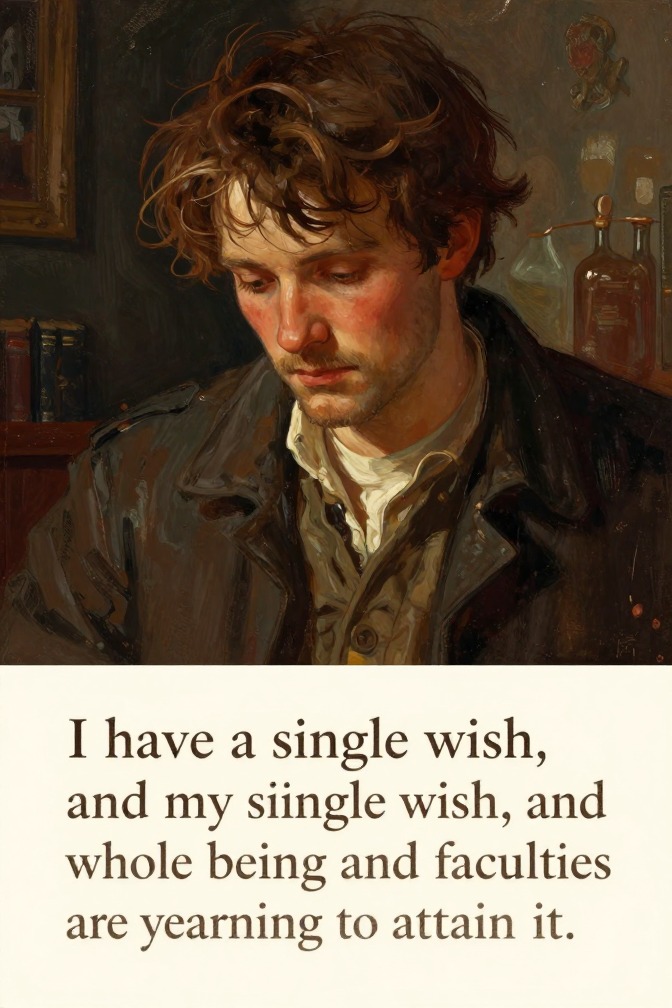
This expression, uttered by Heathcliff to Nelly Dean late in the novel, crystallizes the single-minded, all-consuming obsession that has driven his entire adult existence: the yearning to be reunited with Catherine Earnshaw in death. It marks the moment when his lifelong project of revenge gives way to a purely metaphysical longing, and it foreshadows the strange, ecstatic end that awaits him.
This expression captures Heathcliff's defining vow of revenge against Hindley Earnshaw, articulated in his youth after a Christmas humiliation, and it becomes the engine of the novel's central conflict, driving his patient, methodical destruction of both the Earnshaw and Linton families over nearly two decades.
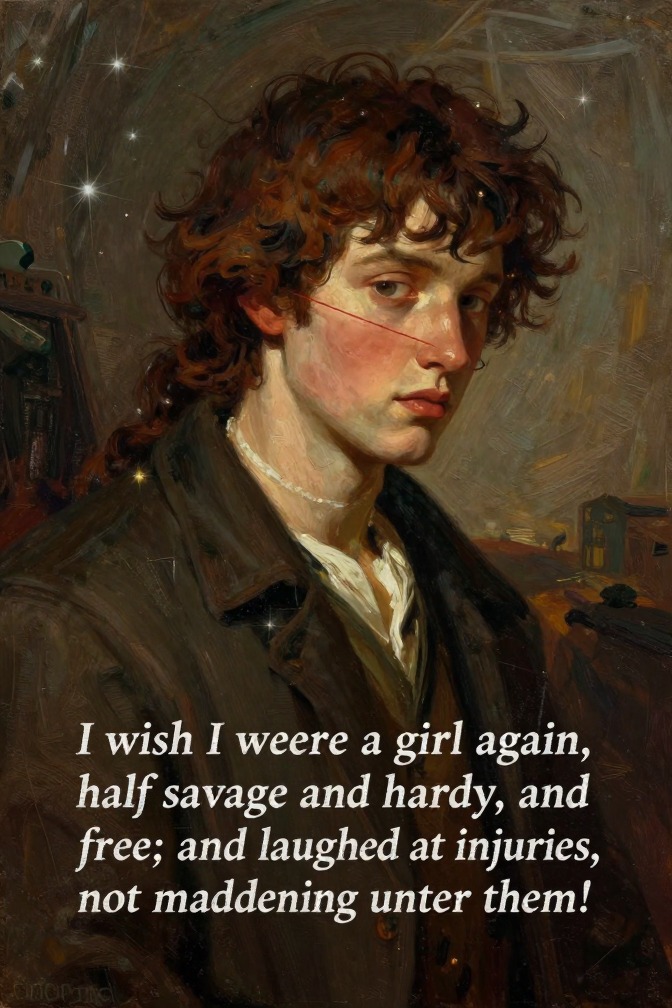
Catherine Earnshaw's desperate cry to be a girl again, half savage and hardy and free, captures the novel's central tension between wild, authentic selfhood and the suffocating constraints of civilized adulthood, and marks the moment her identity fractures irreparably.