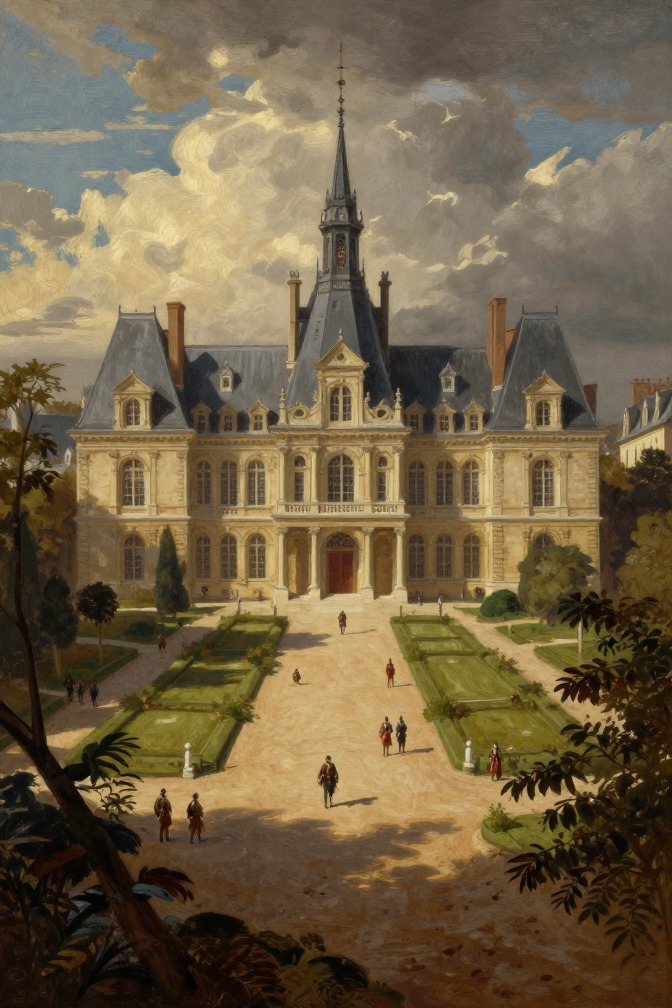
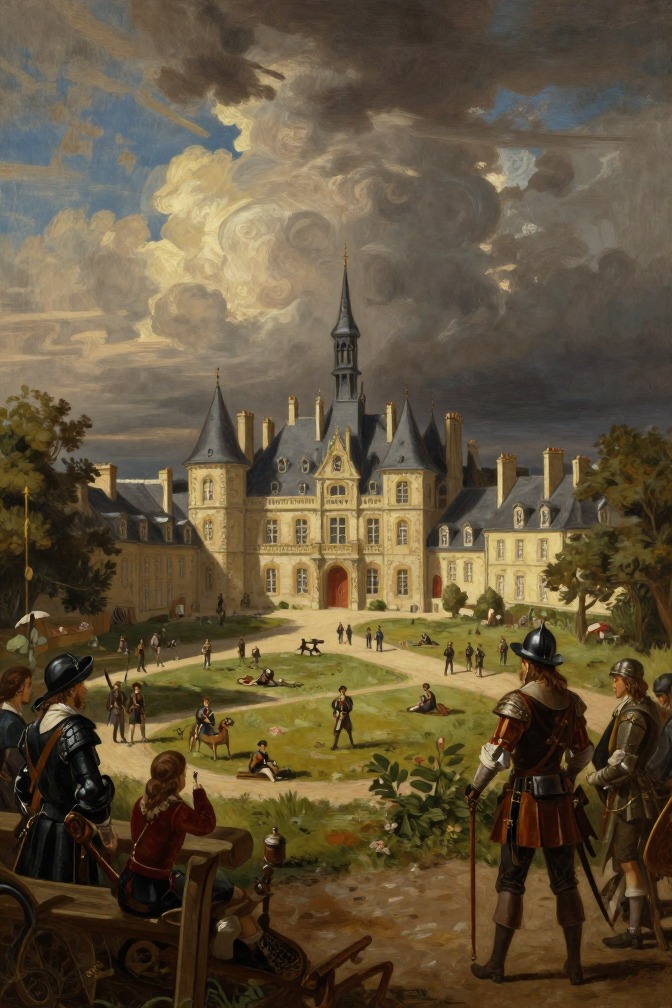
Nantes is a city in western France that serves as a secondary but significant location in the novel, primarily as the site of Constance Bonacieux's imprisonment in a state prison, from which she is transferred to a convent by order of the queen.
Fort de La Pree is a small fortification on the Isle of Re, whose defense by the Comte de Toiras and a hundred men against the Duke of Buckingham's invading English army in 1627 became a pivotal military event that shaped the siege of La Rochelle and the broader war between France and England.
Chaillot is a road on the outskirts of Paris that serves as the setting for a crucial, fleeting encounter between d'Artagnan and the imprisoned Constance Bonacieux, and later as the site where d'Artagnan confirms her fate, marking a pivotal turn in the novel's romantic and political intrigues.
Piedmont is a region in northwestern Italy that serves as the final posting for Planchet, d'Artagnan's loyal lackey, after the events of the novel. Rochefort secures Planchet a sergeant's rank in the Piedmont regiment, marking the culmination of Planchet's journey from a timid servant to a rewarded soldier.
St. Germain is a royal town near Paris that serves as a key setting for several pivotal events in the novel, including the king's hunting expeditions, the queen's secret rendezvous with the Duke of Buckingham, and the departure point for the king's journey to the siege of La Rochelle.
Surgeres is a small town in western France that serves as a key meeting point between King Louis XIII and Cardinal Richelieu during the final stages of the Siege of La Rochelle, where the cardinal receives d'Artagnan after the execution of Milady and grants him a lieutenant's commission in the Musketeers.
Rue St. Honore is a major Parisian street that serves as a key thoroughfare in the novel, connecting the Louvre Palace to the Palais-Cardinal and the Place Royale, and is the site of several crucial encounters, including the passage of the carriage carrying the condemned and the final meeting of the four friends before their departure.
Lorraine is a historical region in northeastern France that serves as a remote refuge in the novel, a place where characters plan to send Constance Bonacieux to safety after her rescue from the convent at Bethune, and where Aramis ultimately disappears into a convent after the siege of La Rochelle.
The Dyke at La Rochelle was the massive engineering project ordered by Cardinal Richelieu to blockade the Huguenot stronghold of La Rochelle by sea, starving the city into submission during the 1627–1628 siege. It became the cardinal's central strategic instrument, a symbol of his relentless political will, and the physical backdrop against which the novel's final acts of intrigue, vengeance, and resolution unfold.
The rope ladder is the crucial physical object that enables Milady's escape from her prison in Lord de Winter's castle, transforming her from a captive into a free agent who can pursue her vengeance and ultimately bring about the assassination of the Duke of Buckingham.
The Bastille Prison, a fortress and state prison in Paris, functions in Alexandre Dumas's The Three Musketeers as the cardinal's primary instrument of political repression, a place of terror for commoners like Monsieur Bonacieux, and a symbol of the arbitrary power that the heroes must navigate or resist.
The City of Paris (Aldermen) is the municipal governing body of Paris during the reign of Louis XIII, responsible for organizing the grand ball at the Hôtel de Ville in October 1628, an event that becomes the decisive stage for the resolution of the diamond studs affair and the public confrontation between the king, queen, and Cardinal Richelieu.
The Jesuits, or the Society of Jesus, appear in *The Three Musketeers* as a powerful religious order deeply entangled with the political and personal intrigues of the French court, most notably through their association with Aramis's spiritual struggles and Cardinal Richelieu's machinations.
The assassination of the Duke of Buckingham by John Felton is the pivotal act of vengeance that Milady de Winter orchestrates through religious manipulation, transforming a Puritan fanatic into her instrument and thereby eliminating the cardinal's most powerful rival while sealing her own fate.
The gratitude of Queen Anne of Austria toward d'Artagnan is a decisive force in his rise from a provincial Gascon cadet to a lieutenant of the Musketeers, expressed through a series of tangible rewards—a diamond ring, a private audience, and a signed commission—that mark the queen's recognition of his loyalty and service in the affair of the diamond studs and the defense of her honor.
The love affair between Porthos and Mme. Coquenard is a mercenary and comedic relationship in which the vain Musketeer exploits the infatuation of a middle-aged procurator's wife to finance his military equipment, while she, in turn, uses her household's resources to secure his attention, creating a cycle of manipulation, disappointment, and reluctant reconciliation.
The master-servant relationship between Porthos and Mousqueton is a comic and pragmatic bond in which the servant's loyalty, resourcefulness, and larcenous skills sustain his master's extravagant lifestyle, while Porthos's vanity and bluster provide the framework for Mousqueton's inventive service.
The protege relationship between d'Artagnan and Monsieur de Treville is the foundational social and professional bond that launches the young Gascon's Parisian career, providing him with access, protection, and a model of loyal service to the crown that shapes his entire trajectory.
The religious conflict between Catholics and Huguenots in 17th-century France forms the historical backdrop of *The Three Musketeers*, shaping the political alliances, military campaigns, and personal loyalties that drive the plot. This deep-seated division, rooted in the Wars of Religion, is not merely a background detail but an active force that determines the fate of cities, the strategies of ministers, and the moral choices of characters.
The spy relationship between Bonacieux and Cardinal Richelieu transforms the timid mercer from a pawn of the queen into a willing informant for the cardinal, a shift that exposes the cardinal's pervasive surveillance network and directly endangers d'Artagnan and his friends.
At the tournament of the Hand, Ser Gregor Clegane, the Mountain, kills his horse in a rage after being unhorsed by Ser Loras Tyrell and charges at the young knight with drawn sword, only to be intercepted and fought to a standstill by his brother Sandor Clegane, the Hound, in a brutal, unresolved duel that exposes the deep, violent rift between them before the king intervenes.
Arya Stark, fleeing the Red Keep after her father's arrest, kills a stable boy who tries to capture her for the queen, marking her first killing and the violent end of her childhood innocence.
Jon Snow fights a reanimated corpse—the wight of the ranger Othor—inside the Lord Commander's Tower at Castle Black, an event that forces him to confront the reality of the supernatural threat beyond the Wall and cements his bond with Jeor Mormont.
Addam Marbrand is a capable and loyal Lannister bannerman who serves as the commander of Lord Tywin Lannister's outriders and later leads the right wing of cavalry at the Battle of the Green Fork. A seasoned knight from House Marbrand, he is distinguished by his competence, his cool-headedness in council, and his unwavering loyalty to House Lannister, though he is not afraid to speak his mind even to his liege lord.
Ser Jaremy Rykker is a ranger of the Night's Watch at Castle Black, a knight who fought on the losing side at King's Landing and was given the choice of the black or death. He serves as a senior officer under Lord Commander Jeor Mormont, commanding the rangers in the absence of Benjen Stark, and is present at the discovery of the wights and the subsequent attack that kills him.
Septa Mordane is the stern, devout septa who serves as the governess and needlework instructor to Sansa and Arya Stark at Winterfell and later in King's Landing, embodying the restrictive feminine ideals of the Faith of the Seven against which Arya's wildness rebels and Sansa's courtliness is measured.
The Seven, also known as the new gods, is the dominant religion of the southern Seven Kingdoms of Westeros, a faith of order, hierarchy, and ritual brought by the Andals thousands of years ago. Its worship stands in stark contrast to the nameless, faceless old gods of the forest still honored in the North, and its institutions—the sept, the septon, the High Septon—are deeply woven into the political and legal fabric of the realm, from coronations to trials by combat.
Khal Drogo's death marks the catastrophic collapse of Daenerys Targaryen's world and the violent birth of her transformation from a frightened exile into a dragon's daughter. After a wound from battle festers and the bloodmage Mirri Maz Duur's spell leaves him a mindless shell, Daenerys is forced to end his life herself, then walks into his funeral pyre to emerge as the mother of dragons.
After being freed from the sky cells of the Eyrie, Tyrion Lannister, traveling south through the Mountains of the Moon with the sellsword Bronn, is confronted by the Stone Crows and other mountain clans. Rather than fight, Tyrion uses his wits and promises of steel, gold, and ultimately the Vale of Arryn to win the clans' allegiance, transforming a band of ragged brigands into a personal fighting force that will serve him in the wars to come.
Eddard Stark, the Hand of the King, is betrayed, arrested, and forced to falsely confess to treason before being executed on the orders of King Joffrey Baratheon, a pivotal event that shatters the realm's peace and ignites full-scale war between the Starks and the Lannisters.