The rule "Nobody gonna hurt nobody nor steal from 'em" is the moral and emotional core of George and Lennie's shared dream, a promise of a peaceful, self-sufficient life on their own farm that stands in stark contrast to the violence and exploitation of the itinerant worker's world. It is the final, consoling vision George offers Lennie before killing him, transforming the dream into a mercy that fulfills its own terms even as it is destroyed.
We got each other is the central affirmation of the bond between George Milton and Lennie Small, a phrase that encapsulates their shared dream and mutual dependence in a world of itinerant loneliness. It is the emotional and thematic core of their relationship, recited as a ritual of hope and comfort, and its final utterance marks the tragic climax of the novel.
Cardinal Richelieu is the master strategist and de facto ruler of France in The Three Musketeers, whose political machinations, personal vendettas, and manipulation of King Louis XIII drive the novel's central conflicts. As the archrival of both Queen Anne of Austria and the Duke of Buckingham, he orchestrates a web of espionage, assassination plots, and military campaigns—including the siege of La Rochelle—while simultaneously attempting to neutralize the four friends whose loyalty to the queen repeatedly thwarts his designs. His character embodies the tension between absolute power and the unpredictable forces of honor, love, and friendship that resist it.
Comte de Cramail is a minor courtier who appears in the retinue of King Louis XIII during the ball at the Hôtel de Ville, one of the many nobles accompanying the king and thereby forming part of the backdrop against which the central drama of the diamond studs unfolds.
John Felton is a Puritan naval lieutenant who becomes the unwitting instrument of Milady's vengeance, assassinating the Duke of Buckingham before being captured and executed.
The Bastille, the formidable state prison of seventeenth-century Paris, functions in Alexandre Dumas's *The Three Musketeers* as the cardinal's primary instrument of political repression, a place where the threat of arbitrary imprisonment hangs over characters from the king's Musketeers to humble mercers, and where the novel's central conflict between royal authority and ministerial power is made concrete.
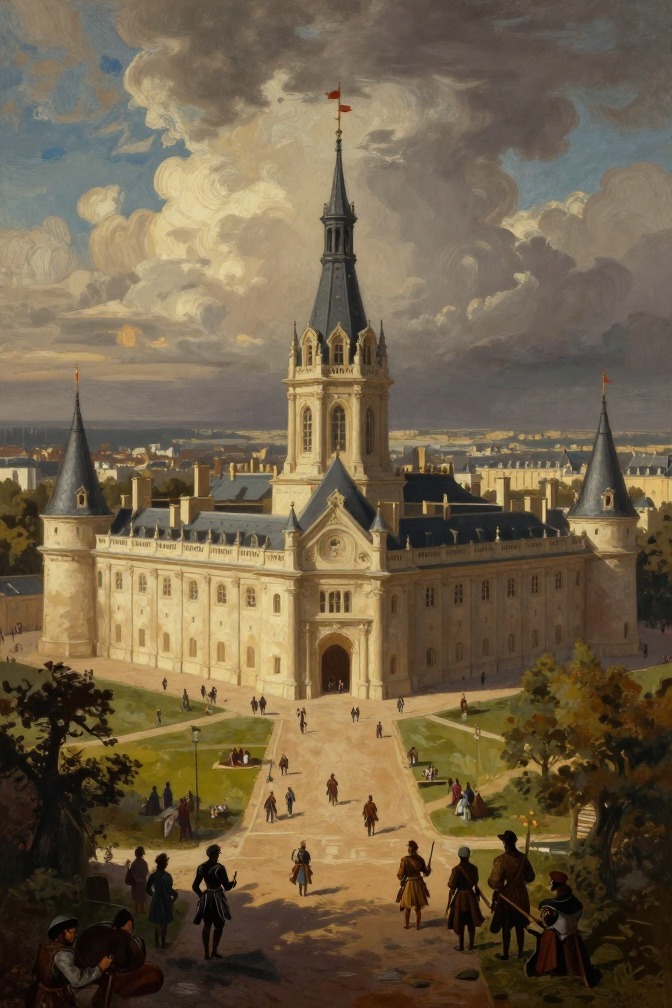
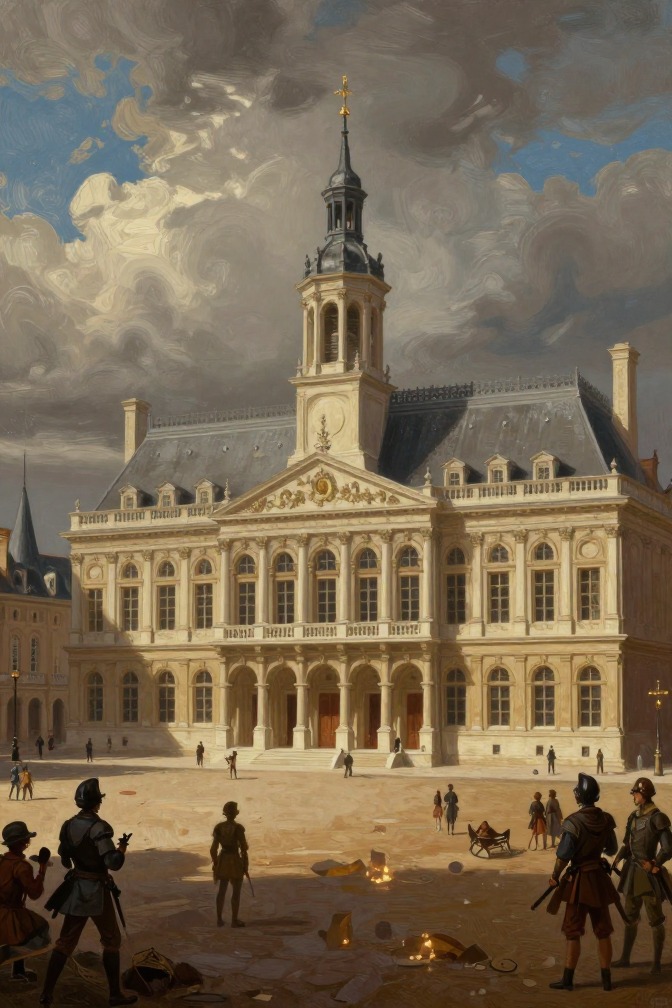
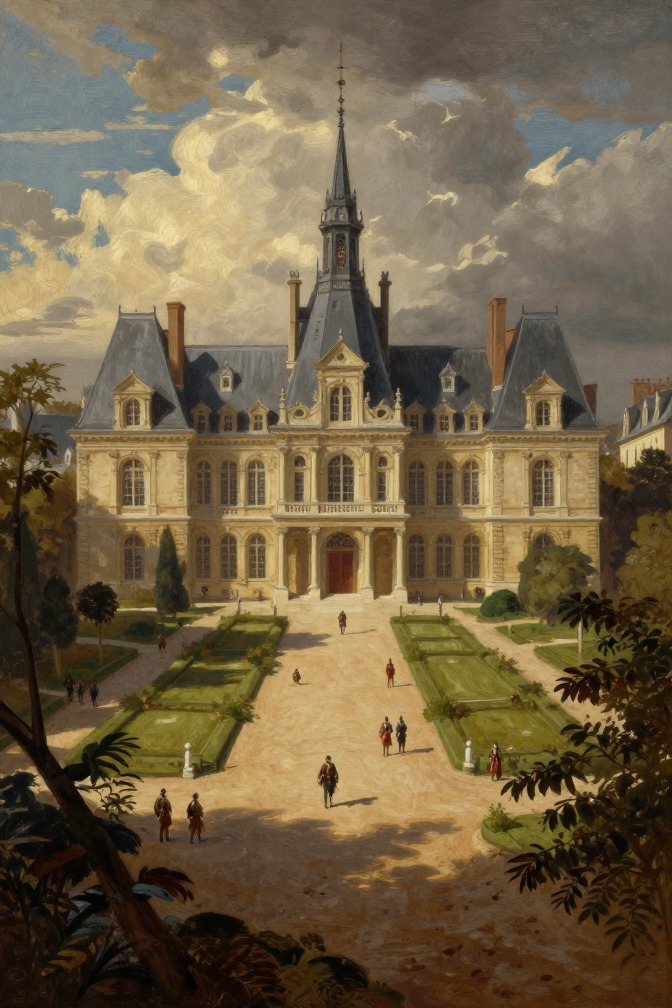
The Hotel de Ville (City Hall) of Paris serves as the magnificent setting for the climactic ball of the novel, where the fate of Queen Anne of Austria and the Duke of Buckingham is decided through the display of the diamond studs. It is also the site of a dramatic confrontation between King Louis XIII and the queen, orchestrated by Cardinal Richelieu, and the scene of d'Artagnan's ultimate triumph and reward.
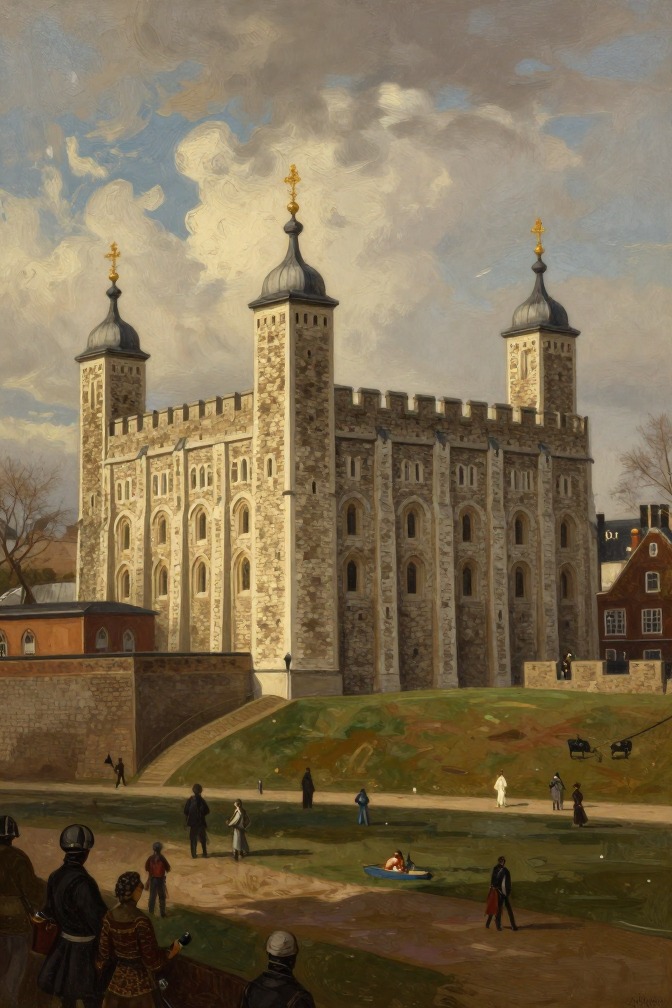
The Tower of London appears in *The Three Musketeers* as a landmark of English royal authority and a point of reference during d'Artagnan's journey to London, where he seeks the Duke of Buckingham to recover the queen's diamond studs.
The Minimes was the quarter where the Guards of Monsieur Dessessart, including d'Artagnan, were encamped during the Siege of La Rochelle, serving as the base from which he ventured into the dangerous no-man's-land and where the poisoned wine plot nearly killed him.
Finisterre is the northwestern cape of France, a rocky promontory on the Atlantic coast that appears in the novel as the first land Milady sees after nine days of stormy sailing from the Charente, marking her return to France after the assassination of the Duke of Buckingham.
Barriere St. Denis is the northern gate of Paris through which d'Artagnan and his three companions depart at two o'clock in the morning on their journey to London, marking the beginning of the perilous expedition that will test their loyalty and courage.
Rue de Seine is a Parisian street that serves as a key thoroughfare in the early adventures of d'Artagnan, connecting the Luxembourg quarter to the Seine and marking the path of his first, frustrated pursuit of the Man of Meung.
Nantes is a city in western France that serves as a secondary but significant location in the novel, primarily as the site of Constance Bonacieux's imprisonment in a state prison, from which she is transferred to a convent by order of the queen.
Fort de La Pree is a small fortification on the Isle of Re, whose defense by the Comte de Toiras and a hundred men against the Duke of Buckingham's invading English army in 1627 became a pivotal military event that shaped the siege of La Rochelle and the broader war between France and England.
Chaillot is a road on the outskirts of Paris that serves as the setting for a crucial, fleeting encounter between d'Artagnan and the imprisoned Constance Bonacieux, and later as the site where d'Artagnan confirms her fate, marking a pivotal turn in the novel's romantic and political intrigues.
Piedmont is a region in northwestern Italy that serves as the final posting for Planchet, d'Artagnan's loyal lackey, after the events of the novel. Rochefort secures Planchet a sergeant's rank in the Piedmont regiment, marking the culmination of Planchet's journey from a timid servant to a rewarded soldier.
St. Germain is a royal town near Paris that serves as a key setting for several pivotal events in the novel, including the king's hunting expeditions, the queen's secret rendezvous with the Duke of Buckingham, and the departure point for the king's journey to the siege of La Rochelle.
Surgeres is a small town in western France that serves as a key meeting point between King Louis XIII and Cardinal Richelieu during the final stages of the Siege of La Rochelle, where the cardinal receives d'Artagnan after the execution of Milady and grants him a lieutenant's commission in the Musketeers.
Rue St. Honore is a major Parisian street that serves as a key thoroughfare in the novel, connecting the Louvre Palace to the Palais-Cardinal and the Place Royale, and is the site of several crucial encounters, including the passage of the carriage carrying the condemned and the final meeting of the four friends before their departure.
Lorraine is a historical region in northeastern France that serves as a remote refuge in the novel, a place where characters plan to send Constance Bonacieux to safety after her rescue from the convent at Bethune, and where Aramis ultimately disappears into a convent after the siege of La Rochelle.
The Dyke at La Rochelle was the massive engineering project ordered by Cardinal Richelieu to blockade the Huguenot stronghold of La Rochelle by sea, starving the city into submission during the 1627–1628 siege. It became the cardinal's central strategic instrument, a symbol of his relentless political will, and the physical backdrop against which the novel's final acts of intrigue, vengeance, and resolution unfold.
The rope ladder is the crucial physical object that enables Milady's escape from her prison in Lord de Winter's castle, transforming her from a captive into a free agent who can pursue her vengeance and ultimately bring about the assassination of the Duke of Buckingham.
The Bastille Prison, a fortress and state prison in Paris, functions in Alexandre Dumas's The Three Musketeers as the cardinal's primary instrument of political repression, a place of terror for commoners like Monsieur Bonacieux, and a symbol of the arbitrary power that the heroes must navigate or resist.
The City of Paris (Aldermen) is the municipal governing body of Paris during the reign of Louis XIII, responsible for organizing the grand ball at the Hôtel de Ville in October 1628, an event that becomes the decisive stage for the resolution of the diamond studs affair and the public confrontation between the king, queen, and Cardinal Richelieu.
The Jesuits, or the Society of Jesus, appear in *The Three Musketeers* as a powerful religious order deeply entangled with the political and personal intrigues of the French court, most notably through their association with Aramis's spiritual struggles and Cardinal Richelieu's machinations.
The assassination of the Duke of Buckingham by John Felton is the pivotal act of vengeance that Milady de Winter orchestrates through religious manipulation, transforming a Puritan fanatic into her instrument and thereby eliminating the cardinal's most powerful rival while sealing her own fate.
The gratitude of Queen Anne of Austria toward d'Artagnan is a decisive force in his rise from a provincial Gascon cadet to a lieutenant of the Musketeers, expressed through a series of tangible rewards—a diamond ring, a private audience, and a signed commission—that mark the queen's recognition of his loyalty and service in the affair of the diamond studs and the defense of her honor.
The love affair between Porthos and Mme. Coquenard is a mercenary and comedic relationship in which the vain Musketeer exploits the infatuation of a middle-aged procurator's wife to finance his military equipment, while she, in turn, uses her household's resources to secure his attention, creating a cycle of manipulation, disappointment, and reluctant reconciliation.
The master-servant relationship between Porthos and Mousqueton is a comic and pragmatic bond in which the servant's loyalty, resourcefulness, and larcenous skills sustain his master's extravagant lifestyle, while Porthos's vanity and bluster provide the framework for Mousqueton's inventive service.
The protege relationship between d'Artagnan and Monsieur de Treville is the foundational social and professional bond that launches the young Gascon's Parisian career, providing him with access, protection, and a model of loyal service to the crown that shapes his entire trajectory.