The Petersburg Side is a district of St. Petersburg that serves as the setting for several key episodes in the novel, most notably the house where Nastasia Philipovna Barashkoff lodges with Madame Filisoff, and the site of Prince Muishkin's fateful, near-fatal encounter with Parfen Rogojin. It is a liminal space, associated with the prince's feverish search for Nastasia, his epileptic seizure, and the culmination of Rogojin's jealous stalking, embodying the city's capacity for both concealment and violent confrontation.
Pskoff is a provincial Russian town that serves as a crucial geographical and symbolic location in the novel, functioning as a place of exile, refuge, and revelation for several key characters, most notably Parfen Rogojin and Nastasia Philipovna Barashkoff.
Shestilavochnaya is a street in St. Petersburg where Hippolyte Terentieff, during a nocturnal walk in March, witnesses a man drop a pocketbook and follows him into a tenement, an episode that becomes a crucial seed for his 'last conviction' about the worthlessness of life and his eventual resolve to commit suicide.
Siberia functions in Dostoevsky's *The Idiot* as a distant, punitive space that defines the outer limit of Russian justice and social exile, a place whose mere mention carries the weight of legal condemnation, moral disgrace, and the severest form of banishment from civilized life.
Yelagin is a fashionable summer resort island near St. Petersburg, mentioned in Dostoevsky's *The Idiot* as an alternative summer destination that the Epanchin family considers but ultimately rejects in favor of Pavlofsk, reflecting the family's social anxieties and the novel's thematic preoccupation with place, class, and the search for a suitable social sphere.
The diamond earrings are a pivotal object in Dostoevsky's *The Idiot*, first appearing when Parfen Rogojin, in a fit of reckless passion, spends four hundred roubles beyond his means to buy them for Nastasia Philipovna Barashkoff. This impulsive gift ignites the central conflict of the novel, exposing the raw, destructive nature of Rogojin's love and setting in motion the tragic triangle of Rogojin, Nastasia, and Prince Muishkin. The earrings function as a concrete symbol of the commodification of human feeling, the violent intersection of wealth and desire, and the inescapable force of fate that binds the characters together.
The hedgehog is a small animal that Aglaya Ivanovna Epanchin sends to Prince Muishkin as a symbolic gift, serving as a cryptic token of reconciliation and affection after a quarrel, and becomes a subject of humorous and significant interpretation within the Epanchin household.
The pearls are a birthday gift from General Ivan Fedorovitch Epanchin to Nastasia Philipovna Barashkoff, a present that exposes the general's infatuation, the transactional nature of the marriage market, and the competing claims of money, status, and desire that drive the novel's central conflicts.
Playing cards serve as a recurring object in Dostoevsky's *The Idiot*, appearing in two distinct contexts: as a tool for social games during Nastasia Philipovna's birthday party and as a private ritual between Nastasia and Parfen Rogojin in the final days before her murder. The cards shift from a device of public humiliation and psychological exposure to a symbol of the strange, silent intimacy that binds Nastasia to her killer.
The Medical Academy is the institution to which Hippolyte Terentieff bequeaths his skeleton in his 'Necessary Explanation,' a document that serves as both a suicide note and a philosophical manifesto. This bequest, made in the final pages of his confession, transforms the Academy from a mere scientific body into the symbolic recipient of a defiant, materialist gesture against the mystery of death and the consolations of religion.
Schneider's establishment is the Swiss sanatorium where Prince Lef Nicolaievitch Muishkin spent four years being treated for epilepsy and a related nervous condition, and where he lived under the care of Professor Schneider after his benefactor's death. It functions as the site of the prince's partial recovery, his education, and the formation of his childlike, compassionate worldview, and it later becomes his final refuge after the catastrophic events of the novel.
The Warsaw and Petersburg Railway is the physical and symbolic conduit through which Prince Lef Nicolaievitch Muishkin enters the story, carrying him from Switzerland into the heart of Russian society and into his first fateful encounter with Parfen Rogojin.
The marriage of General Ardalion Alexandrovitch Ivolgin and Nina Alexandrovna Ivolgin is a central domestic relationship in the novel, defined by Nina's long-suffering devotion, Ardalion's alcoholic degradation and compulsive lying, and the family's struggle to contain the shame he brings upon them. Their bond is tested by poverty, scandal, and Ardalion's final stroke, which he suffers while attempting to confess a theft to his son Colia.
The relationship between Nastasya Filippovna Barashkoff and Afanasy Ivanovitch Totski is the foundational wound of the novel, a story of predatory guardianship, systematic exploitation, and a woman's long-delayed, catastrophic rebellion. Totski, a wealthy sensualist, took Nastasya as a child after her parents' ruin, raised her in secluded luxury as his mistress, and then, when he wished to marry, tried to pass her off to a husband he had selected, only to discover that the girl he had shaped into a dependent ornament had become a woman of implacable will who would rather destroy herself than be disposed of.
The relationship between Prince Lef Nicolaievitch Muishkin and Evgenie Pavlovitch Radomski begins with formal introduction and mutual curiosity, deepens through Evgenie's candid criticism of the prince's actions, and culminates in Evgenie becoming the prince's most reliable friend after the catastrophe, arranging his return to Schneider's clinic in Switzerland and maintaining long-term correspondence about his condition.
The Law of the Church, as articulated by Prince Muishkin in a heated outburst at the Epanchin party, is the principle that the Roman Catholic Church, by claiming universal temporal power, has distorted Christ's teaching and become a form of Anti-Christ, a view that positions Roman Catholicism as worse than atheism and as the root of modern socialism and unbelief.
Might is right is a philosophical principle invoked and debated in Dostoevsky's The Idiot, primarily through the character Evgenie Pavlovitch Radomski, who uses it to critique the moral logic of contemporary Russian liberalism and to warn that the doctrine leads directly to justifying murder. The novel stages the idea as a dangerous reduction of justice to force, linking it to the era's most disturbing crimes and to the broader crisis of faith and conscience that pervades the story.
Epilepsy is the defining medical and metaphysical condition of Prince Lef Nicolaievitch Muishkin, shaping his narrative identity, his moments of transcendent insight, and the catastrophic social consequences of his seizures. The novel presents epilepsy not merely as a neurological disorder but as a paradoxical state that grants the sufferer a fleeting, ecstatic clarity while simultaneously marking him as an 'idiot' in the eyes of society and precipitating his ultimate collapse.
Madness is a pervasive and ambiguous condition in The Idiot, manifesting not only as clinical insanity but also as a social label, a psychological state, and a narrative device that blurs the line between reason and unreason, innocence and pathology.
On the Fourth Night, after the Dreamer confesses his love, Nastenka, heartbroken by the Lodger's apparent abandonment, temporarily accepts the Dreamer's love and they make plans for a shared future, only for the Lodger to reappear and reclaim her.
Nastenka is the young woman at the heart of Fyodor Dostoevsky's "White Nights," whose brief, intense encounter with the lonely Dreamer transforms his life and exposes the chasm between fantasy and reality. She is a seventeen-year-old orphan living under the strict control of her blind grandmother, pinned to her dress, yet she possesses a bold, romantic spirit that leads her to initiate a secret relationship with a young lodger and, when he fails to appear as promised, to turn impulsively toward the Dreamer. Her story—of waiting, hope, betrayal, and a sudden return to her first love—drives the novella's emotional arc and crystallizes its central themes of solitude, longing, and the bittersweet value of a single moment of happiness.
The White Night is the central temporal and symbolic framework of Fyodor Dostoevsky's short story, a Petersburg summer phenomenon of luminous twilight that becomes the stage for the Dreamer's brief encounter with Nastenka and the collapse of his fantasy world into reality.
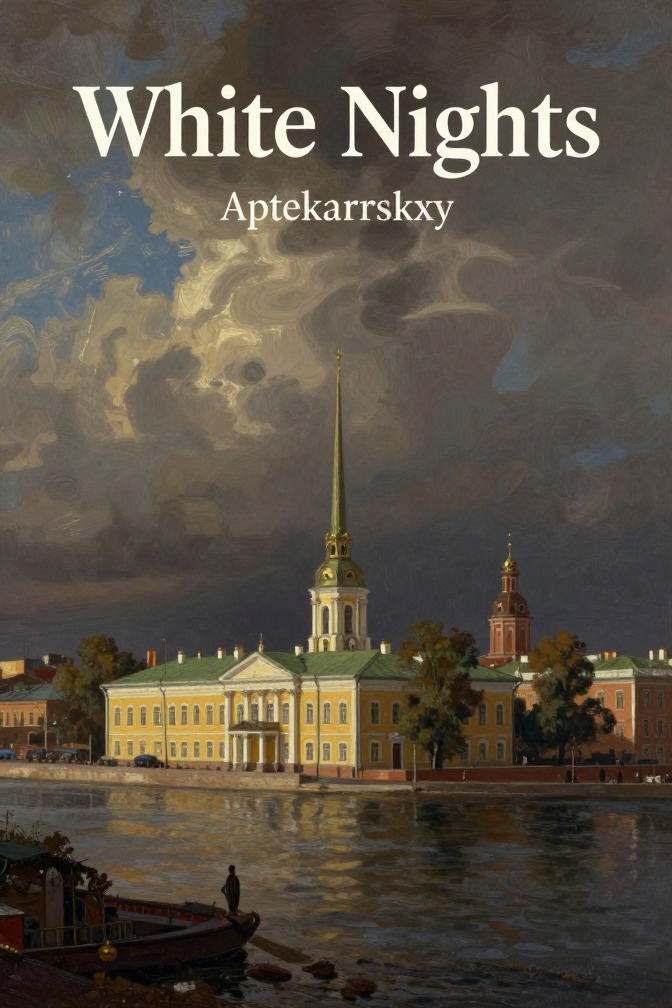
Aptekarsky Island is one of the summer villa destinations in Petersburg whose inhabitants the Dreamer identifies by their studied elegance and fashionable appearance during the annual summer exodus, a phenomenon that deepens his sense of isolation.
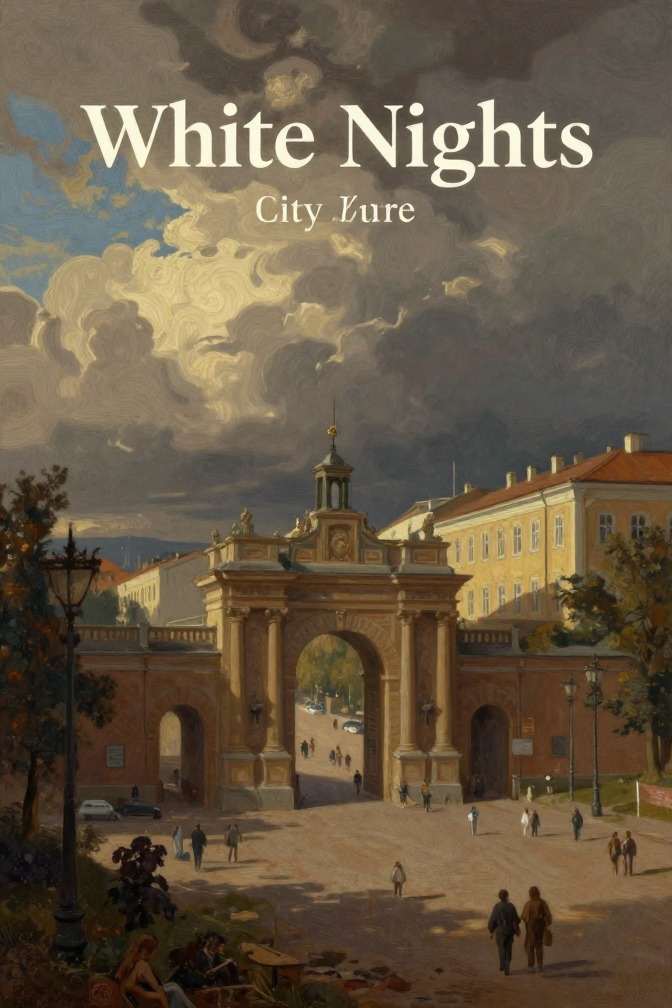
The City Gates mark a threshold in the Dreamer's Petersburg, where the boundary between urban confinement and liberating nature is crossed, and where his solitary, fantastical existence briefly yields to a moment of genuine, unburdened happiness.
Nevsky is the central thoroughfare of Petersburg, a bustling artery that the Dreamer navigates during the summer exodus, serving as a key site for his observations of the city's social life and his own profound isolation.
The dreamer state is the defining psychological condition of the unnamed narrator in Fyodor Dostoevsky's "White Nights," a mode of existence in which a person withdraws from real life into a self-created world of fantasy, substituting vivid inner dramas for genuine human connection. The narrator explicitly identifies himself as a "type" and a "dreamer," and his extended confession to Nastenka on the Second Night provides the most detailed anatomy of this condition in all of Dostoevsky's early work. The dreamer state is characterized by acute loneliness, a rich but exhausting imaginative life, a painful awareness of its own unreality, and a profound ambivalence toward the ordinary world it has abandoned.
The white nights season is the luminous, sleepless summer period in Petersburg that frames the entire narrative, serving as both the literal time of the story and the central metaphor for the Dreamer's brief, intense encounter with love and reality.
Mudrin 505 is the elderly, frail, and nearly blind paleographer of Saro University who, despite his advanced age and physical decrepitude, possesses the sharpest eyes on the campus for ancient inscriptions. He is the sole scholar capable of attempting a translation of the Thombo Tablets, the six clay slabs Siferra 89 excavated from the Hill of Thombo. His preliminary work reveals that the tablets are written in a very primitive form of the Beklimot script and appear to be an account of the periodic destruction of cities by fire—a finding that directly corroborates the apocalyptic prophecies of the Apostles of Flame and that, when combined with the astronomical discovery of the eclipse cycle, forces the four scientists to confront the reality of the coming catastrophe. Mudrin is later found dead on the stairs of the Archaeology building during the chaos of Nightfall, a victim of the general madness.
Thilanda 191 is an astrophotographer at the Saro University Observatory who plays a crucial technical role in the search for the hypothetical satellite Kalgash Two and in documenting the total eclipse of Dovim, though her initial skepticism about the satellite's existence gives way to the grim reality of the catastrophe.
Beklimot is the oldest known city on Kalgash, a cradle of civilization whose ruins on the Sagikan Peninsula become the site of Siferra 89's career-defining excavation and the source of archaeological evidence linking periodic fires to the recurring eclipses of Dovim.