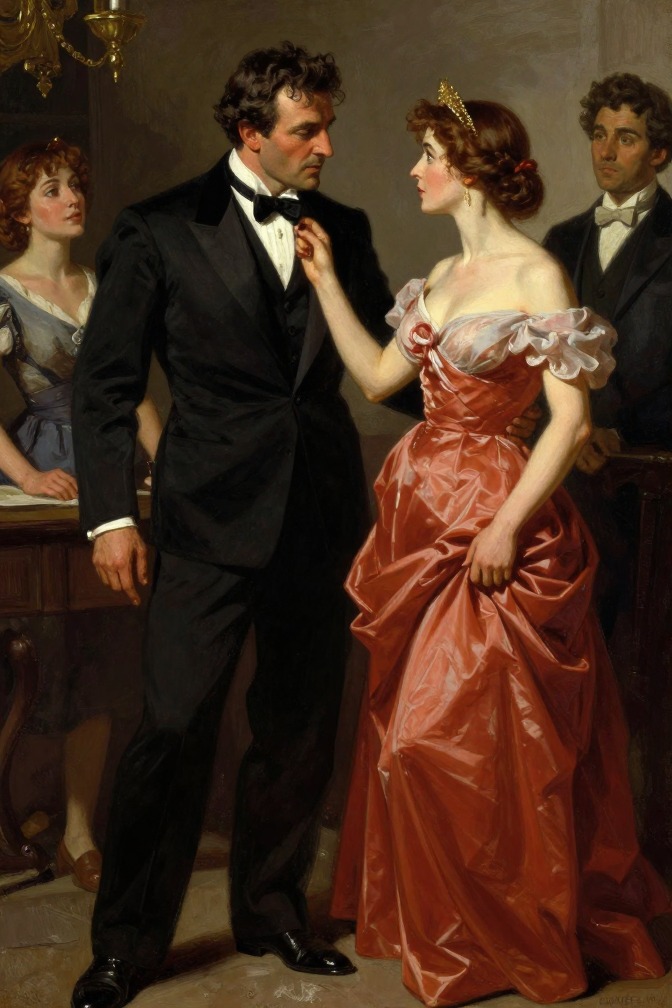
Stanley Rapes Blanche is the climactic act of sexual violence in Tennessee Williams' A Streetcar Named Desire, occurring in Scene Ten after Blanche's final illusions have been shattered and Stanley's dominance is fully asserted. This event marks the irreversible destruction of Blanche's fragile psyche and the ultimate triumph of Stanley's brutal, animalistic force over her refined but decaying world.
Stella Kowalski's declaration "I'm not in anything I want to get out of" is the play's most direct statement of her conscious choice to remain with Stanley, rejecting Blanche's rescue narrative and affirming her own desire-based commitment to her marriage and her life in the French Quarter.
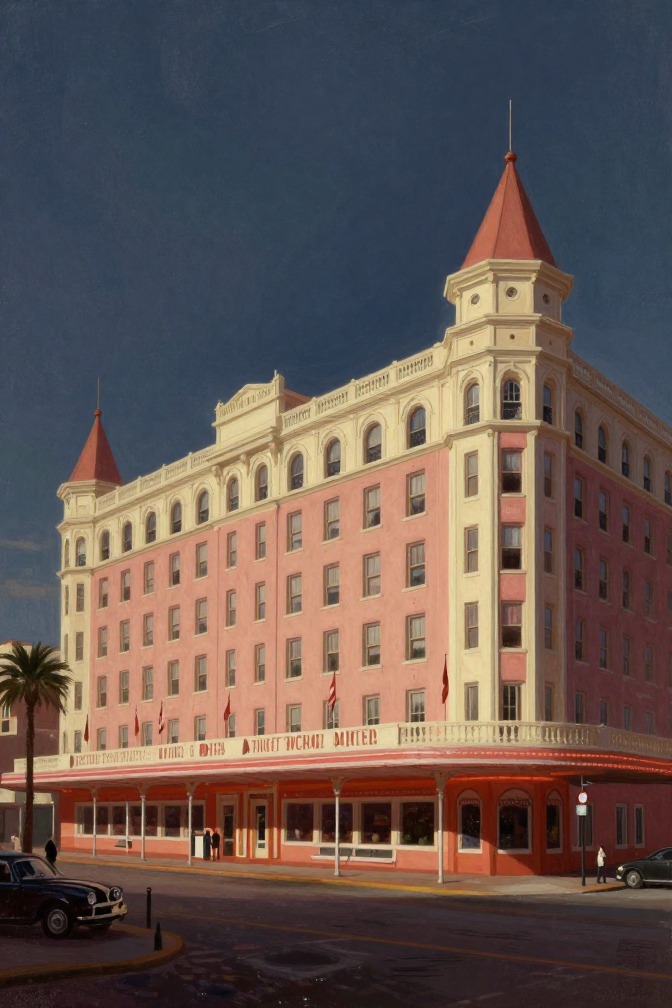
The Flamingo Hotel is a second-class hotel in Laurel, Mississippi, where Blanche DuBois stayed after losing Belle Reve, and from which she was eventually asked to leave due to her reputation; it becomes a key piece of evidence in Stanley Kowalski's campaign to expose her past and destroy her prospects in New Orleans.
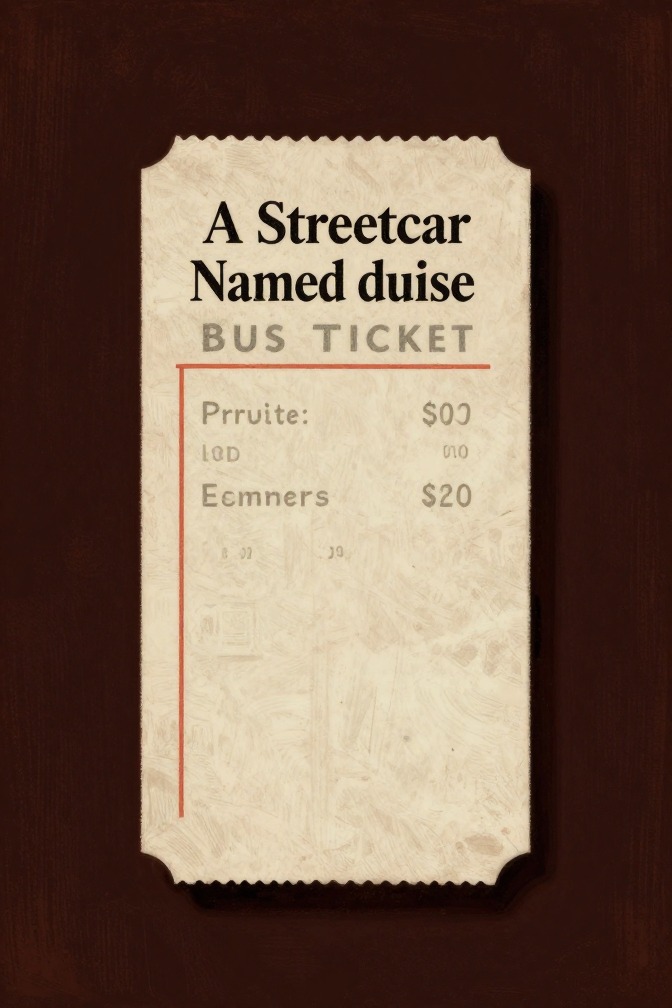
The bus ticket is a Greyhound ticket to Laurel that Stanley Kowalski buys for Blanche DuBois and presents to her at her birthday supper, functioning as the play's decisive instrument of expulsion and the material symbol of her final, irreversible rejection by the world she tried to enter.
The plaster statuette of Mae West is a carnival prize won by Harold Mitchell (Mitch) during his date with Blanche DuBois at an amusement park on Lake Pontchartrain, and it serves as a poignant symbol of the fragile, artificial romance they attempt to build and the inevitable collapse of their relationship under the weight of truth.
The rhinestone tiara is a costume jewelry crown worn by Blanche DuBois in Tennessee Williams's A Streetcar Named Desire. It functions as a central symbol of her self-deception and desperate clinging to a romanticized identity, appearing at key moments of crisis and exposure.
The telegram is a fictional device Blanche DuBois invents to fabricate an escape from her desperate situation in New Orleans, claiming an invitation from the wealthy Shep Huntleigh to join a Caribbean yacht cruise. It represents her final, fragile attempt to maintain the illusion of a rescue that never arrives, and its exposure by Stanley Kowalski marks the collapse of her constructed reality.
The Barrymore Theatre was the Broadway venue where Tennessee Williams's A Streetcar Named Desire premiered on December 3, 1947, a production that became a landmark in American theater history.
The Engineers' Corps is the military unit in which Stanley Kowalski served as a Master Sergeant during World War II, a background that shapes his identity, his marriage to Stella, and his social standing in the working-class world of the French Quarter.
The Provincetown Playhouse was a pioneering American theater company that produced Eugene O'Neill's first plays and whose legacy influenced the development of modern American drama, including the production of Tennessee Williams' A Streetcar Named Desire.
The Theatre Guild was a Broadway producing organization that, despite its commercial orientation, retained an artistic mission rooted in its origins with the Provincetown Playhouse and the production of Eugene O'Neill's early plays. It played a crucial role in the early careers of both Tennessee Williams and Arthur Miller, and its institutional practices—from prize committees to production credits—form the commercial and artistic backdrop against which A Streetcar Named Desire was created and launched.
The University of the South, located in Sewanee, Tennessee, is the copyright holder and licensing authority for Tennessee Williams's play *A Streetcar Named Desire*, a role that places it at the center of the play's legal and commercial life. As the owner of the copyright, the university controls all professional and amateur performance rights, licensing, and publication of the work, and it has been the beneficiary of royalties and the arbiter of permissions since the play's Broadway debut in 1947. This institutional stewardship has made the University of the South a key, if largely unseen, force in the play's enduring presence in global theater culture.
Western Union is the telegraph company that Blanche DuBois attempts to contact in two desperate moments during A Streetcar Named Desire, first when she tries to compose a wire to the wealthy Shep Huntleigh and later when she frantically calls for help after Stanley Kowalski exposes her lies and assaults her. The company functions as a symbol of Blanche's last, illusory lifeline to rescue and a measure of her progressive isolation.
The friendship between Stanley Kowalski and Harold Mitchell (Mitch) is a central relationship in A Streetcar Named Desire, rooted in shared military service, work, and leisure, but ultimately fractured by Stanley's exposure of Blanche DuBois's past.
The marriage of Blanche DuBois and Allan Grey is a foundational trauma in A Streetcar Named Desire, a brief union that ended in Allan's suicide after Blanche confronted him about his homosexuality, and whose memory haunts every subsequent relationship and breakdown Blanche experiences.
Every Man is a King is a political slogan invoked by Stanley Kowalski during a birthday supper confrontation to assert his absolute authority within his household, drawing on the populist rhetoric of Louisiana governor Huey Long to justify his dominance over Stella and Blanche.
The rule that "the lady must entertain the gentleman" is a social code Blanche DuBois invokes to explain her strained performance of gaiety during her date with Harold Mitchell, revealing the gendered labor and economic desperation underlying her romantic strategies.
1911 is the year of Tennessee Williams's birth, a foundational biographical fact that anchors the playwright's personal chronology and, through the lens of his work, the broader social and historical currents of the American South in the early twentieth century.
1928 marks a formative year in the early life of Tennessee Williams, encompassing his first published short story, a transformative European tour with his grandfather, and the beginning of his university education, all of which foreshadow the literary sensibility and thematic preoccupations that would later define his major works.
1930 is the year in which Tennessee Williams wrote his first one-act play, Beauty is the Word, for a local contest, marking the earliest recorded step in his literary career.
1947 was the pivotal year in which Tennessee Williams's A Streetcar Named Desire premiered on Broadway, marking a transformative moment in American theater by blending poetic language with raw realism and achieving both critical and popular success.
1950 was a pivotal year for Tennessee Williams and the cultural legacy of A Streetcar Named Desire, marked by the release of the film adaptation starring Vivien Leigh and Marlon Brando, the publication of his first novel, and the continued resonance of the play's social and poetic themes within the broader context of post-war America.
1951 was a landmark year for Tennessee Williams's A Streetcar Named Desire, marked by the release of the acclaimed film adaptation starring Vivien Leigh and Marlon Brando, and by the Broadway premiere of Williams's next major play, The Rose Tattoo, which won the Tony Award for Best Play.
1952 was a landmark year for Tennessee Williams, marked by the critical and institutional recognition of his work through a major revival of Summer and Smoke and his induction into the National Institute of Arts and Letters, while also being a year in which the cultural and legal context surrounding A Streetcar Named Desire—including its copyright, production history, and the social tensions it dramatized—continued to shape its legacy.
1958 was a pivotal year in Tennessee Williams's career, marked by the successful off-Broadway revival of *Summer and Smoke* and the premiere of *Suddenly Last Summer* and *Something Unspoken*, which together solidified his reputation as a major American playwright and demonstrated the continued vitality of his work beyond the commercial Broadway stage.
1961 was a landmark year for Tennessee Williams, marked by the Broadway premiere of The Night of the Iguana, which became his last major commercial success, and the release of film adaptations of Summer and Smoke and The Roman Spring of Mrs. Stone, while the play A Streetcar Named Desire continued to shape American theater through its enduring cultural presence and the ongoing relevance of its themes.
1968 was a year of significant professional activity and personal crisis for Tennessee Williams, marked by the Broadway production of Kingdom of Earth (under the title The Seven Descents of Myrtle) and the release of its film adaptation, as well as the broader cultural and legal context surrounding A Streetcar Named Desire.
1977 is a year in the chronology of Tennessee Williams, marked by the Broadway premiere and rapid closure of his play *Vieux Carrè*, and by the publication of his second volume of poetry, *Androgyne, Mon Amour*. It also serves as a temporal reference point for the historical and legal context of *A Streetcar Named Desire*, which was written in the late 1940s and whose action is governed by the Napoleonic code of Louisiana.
1978 is a year in the chronology of Tennessee Williams's life and career, marked by the premiere of his play Tiger Tail and the continued publication of his works, set against the broader historical context of the late 1940s in which A Streetcar Named Desire is set.
1985 is a year in the chronology of Tennessee Williams's life and legacy, marked by the posthumous publication of his collected stories and the ongoing critical reassessment of his work.