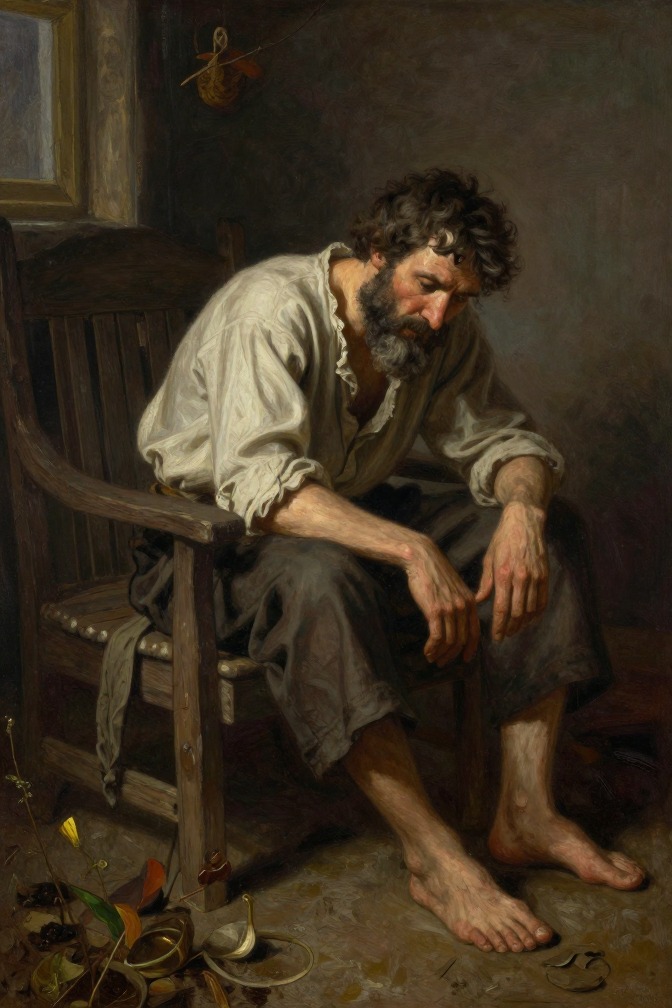
Peasant poverty is the chronic, grinding destitution of the Russian peasantry that Nekhludoff confronts when he visits his estates after the trial, and which becomes the central social indictment of the novel. The evidence shows that this poverty is not an occasional misfortune but a structural condition: peasants lack sufficient land, are crushed by taxes and fines, and are forced into a cycle of debt and hunger that Nekhludoff, through his own observations, comes to see as the direct consequence of the landlords' ownership of the land.
Autumn in Resurrection is the season of irreversible rupture and moral reckoning. It is the time when Katusha Maslova, pregnant and abandoned, makes her desperate night journey to the railway station, sees Nekhludoff laughing in a brightly lit first-class carriage, and undergoes the psychological collapse that destroys her faith in God and goodness. Autumn thus functions as the narrative's hinge: the moment when innocence is lost, the path to prostitution is set, and the crime that the entire novel will labor to redeem is finally and irrevocably committed.
The Decembrist era is a historical period in early 19th-century Russia that serves as a recurring point of reference in Tolstoy's 'Resurrection', invoked to measure the moral decline of the aristocracy and the enduring legacy of political idealism against the corruption of the present.
Easter in Tolstoy's *Resurrection* is the pivotal sacred time when Nekhludoff and Katusha Maslova experience their purest, most selfless love for each other and for all humanity, a moment of spiritual unity that makes his subsequent betrayal all the more devastating and that later becomes the measure of his moral fall and the goal of his redemption.
The four-year sentence of penal servitude imposed on Katerina Maslova is the central legal and emotional axis of the novel, a period that structures her punishment, her inner transformation, and the moral reckoning of Dmitri Ivanovitch Nekhludoff. This span of time, from the trial verdict to the eventual commutation, marks the duration of her formal suffering, the crucible in which her character is reshaped, and the measure against which Nekhludoff's own spiritual journey is calibrated.
Good Friday is the Christian holy day that commemorates the crucifixion of Jesus Christ, and in Tolstoy's Resurrection it serves as the pivotal temporal setting for Nekhludoff's second visit to his aunts' estate, where his renewed encounter with Katusha Maslova leads to her seduction and the beginning of her downfall.
Spring in Tolstoy's 'Resurrection' is not merely a seasonal backdrop but a powerful, ironic counterpoint to the human world of injustice, imprisonment, and moral decay. The novel opens with a vivid description of spring's renewal—the warming sun, budding trees, and joyful animals—which stands in stark contrast to the prison office's preoccupation with bureaucratic orders and the suffering of prisoners like Katerina Maslova. This seasonal motif recurs throughout the narrative, marking key moments of innocence, betrayal, and spiritual awakening, and ultimately serves as a symbol of the possibility of rebirth and the fundamental law of love that Nekhludoff comes to embrace.
Summer in *Resurrection* is a season of stark contrasts, serving as the backdrop for both the innocent idyll of Nekhludoff's youth and the brutal reality of the prison system. It is the time of Nekhludoff's first, pure love for Katusha and his subsequent betrayal, and also the season in which convicts die of sunstroke during forced marches, highlighting the novel's central conflict between natural beauty and human cruelty.
The Crime is the central event of Murder on the Orient Express: the stabbing death of Samuel Edward Ratchett (alias Cassetti) in his locked compartment during the night the train is snowbound. The murder is not a single act but a collective execution carried out by twelve passengers, each of whom stabs the victim once, acting as a self-appointed jury to avenge the kidnapping and murder of three-year-old Daisy Armstrong.
Lieutenant Dubosc is a young French officer who sees off Hercule Poirot at Aleppo station at the opening of the novel, serving as a minor but symbolically significant witness to the detective's successful completion of a secret mission that saved the honor of the French Army.
Hector MacQueen is the American secretary of Samuel Edward Ratchett, a key figure in the murder investigation on the Orient Express. His role is central to the plot, as he is both a suspect and a crucial member of the conspiracy to execute Ratchett for the Armstrong kidnapping case.
Colonel Arbuthnot is a British Army officer traveling from India to England on the Orient Express, who becomes a key suspect in the murder of Samuel Edward Ratchett due to a pipe-cleaner found at the crime scene, but is ultimately revealed to be one of the twelve conspirators executing private vengeance for the Armstrong kidnapping case.
Caroline Martha Hubbard, revealed in the final act to be the celebrated actress Linda Arden, is the mastermind and central figure behind the conspiracy to murder Samuel Edward Ratchett. As the mother of Sonia Armstrong and grandmother of the kidnapped and murdered Daisy Armstrong, she orchestrates the elaborate plot, playing the role of a garrulous, slightly ridiculous American matron to perfection while secretly directing the jury of twelve who carry out the execution.
Linda Arden, the celebrated American tragic actress and mother of Sonia Armstrong, is the hidden mastermind behind the murder of Samuel Edward Ratchett, alias Cassetti. Disguised as the garrulous Mrs. Caroline Martha Hubbard, she orchestrates a conspiracy of twelve passengers—all connected to the Armstrong kidnapping tragedy—to execute a collective act of vengeance on the Orient Express, and ultimately reveals her identity in a dramatic confession that transforms the investigation.
Count Andrenyi is a Hungarian aristocrat traveling on the Orient Express with his wife, Countess Andrenyi, whose true identity as Helena Goldenberg, the younger sister of Mrs. Armstrong, he desperately tries to conceal. His role in the murder of Samuel Edward Ratchett is that of a protector and conspirator: he takes his wife's place among the twelve executioners, stabbing Ratchett to avenge the Armstrong family tragedy, and then lies to the investigators to shield her from suspicion.
The Armstrong Case is the foundational tragedy of Murder on the Orient Express, a kidnapping and murder that destroyed a prominent family and motivated the collective revenge killing of Samuel Edward Ratchett (Cassetti).
The Jury of Twelve is the organizing principle behind the murder of Samuel Edward Ratchett in Agatha Christie's Murder on the Orient Express, a self-appointed group of twelve passengers who collectively execute the man who escaped justice for the kidnapping and murder of Daisy Armstrong. Each of the twelve strikes a single blow, transforming the crime from a private vengeance into a ritualized act of communal judgment that mirrors the legal system Ratchett evaded.
The Wagon Lit, formally the Compagnie Internationale des Wagons Lits, is the sleeping-car company that operates the Orient Express and provides the physical and institutional setting for the murder investigation. Its train, its conductor, and its uniform become central to the crime's execution and to Poirot's eventual solution.
In Agatha Christie's *Murder on the Orient Express*, the phrase "your strength is in your will—not in your arm" is spoken by Hercule Poirot to Princess Dragomiroff during his investigation. It encapsulates a central theme of the novel: the power of moral and psychological resolve over physical capability, and it becomes a key insight into the nature of the crime and the conspirators.
Aleppo is the Syrian city where the novel opens, serving as the departure point for the Taurus Express and the first setting in which Hercule Poirot, Mary Debenham, and Colonel Arbuthnot are introduced, establishing the initial narrative threads that lead to the murder on the Orient Express.
America is the country of origin for the victim Samuel Edward Ratchett (alias Cassetti), the setting of the Armstrong kidnapping tragedy that motivates the murder, and the homeland of several key passengers, including the detective Hardman and the secretary MacQueen. Its legal system's failure to convict Cassetti forms the central injustice that drives the entire plot.
The Armstrong house is the New York home of Colonel Armstrong and his family, the site of the kidnapping and murder of their daughter Daisy, and the emotional and moral center of the conspiracy that leads to the murder of Samuel Edward Ratchett on the Orient Express.
Baghdad is a city in Mesopotamia (modern-day Iraq) that serves as a key point of origin for several characters in Murder on the Orient Express, most notably Mary Debenham, who has been working there as a governess before boarding the Taurus Express for her journey to Europe. The city is also the starting point for Colonel Arbuthnot's overland route from India, and it is where the two first meet, sharing a convoy car from Kirkuk to Nissibin. Baghdad's significance lies in its role as the place where the initial connections among the conspirators against Ratchett were formed, and as a geographical anchor for the elaborate plot that culminates in the murder on the Orient Express.
East Africa is a geographical region referenced in the novel primarily as the destination of Sir Henry Tomlinson, whose departure led to Edward Masterman's employment with Ratchett, and as a symbolic location in the conspirators' plan to execute a private judgment on Cassetti, reflecting the novel's themes of justice, class, and transnational identity.
England is the home country of several key passengers on the Orient Express, including Mary Debenham, Colonel Arbuthnot, and the valet Edward Masterman, and serves as the ultimate destination of Hercule Poirot's journey. It is also the country where the Armstrong family, central to the murder's motive, had its roots, and where the surviving members of that family, such as Linda Arden, eventually settled. The narrative repeatedly contrasts English reserve and sense of justice with the more volatile temperaments of other nationalities, making England a touchstone for the story's moral and social values.
France serves as a crucial geographical and cultural reference point in *Murder on the Orient Express*, functioning as the home nation of key characters, the origin of the French nursemaid whose death galvanizes the conspiracy, and the symbolic source of the elegant handkerchief clue that misleads the investigation.
Germany appears in Murder on the Orient Express as a point of origin for several passengers and as a cultural reference that underscores the novel's theme of transnational justice. The country is associated with the German lady's-maid Hildegarde Schmidt, whose homeland is mentioned in connection with her employment and her moral reaction to the crime, and with the broader European setting through which the Orient Express travels. Germany also serves as a geographical marker in the passengers' conversations about weather and travel conditions, and its absence from the direct action of the murder highlights the international composition of the self-appointed jury that executes Ratchett.
London is the ultimate destination of Hercule Poirot's journey on the Orient Express, the city where his professional obligations and the resolution of the murder case converge, and it serves as the narrative anchor for the detective's return from the East.
New York is the American city where the Armstrong family lived and where the kidnapping and murder of Daisy Armstrong occurred, a tragedy that directly motivates the conspiracy aboard the Orient Express. It is also the home base of several key conspirators and the location of the legal system that failed to convict Cassetti.
Paris is the ultimate destination of the Simplon Orient Express and the home city of several key figures in the murder investigation, serving as a fixed point of arrival and departure that frames the entire journey and the resolution of the crime.