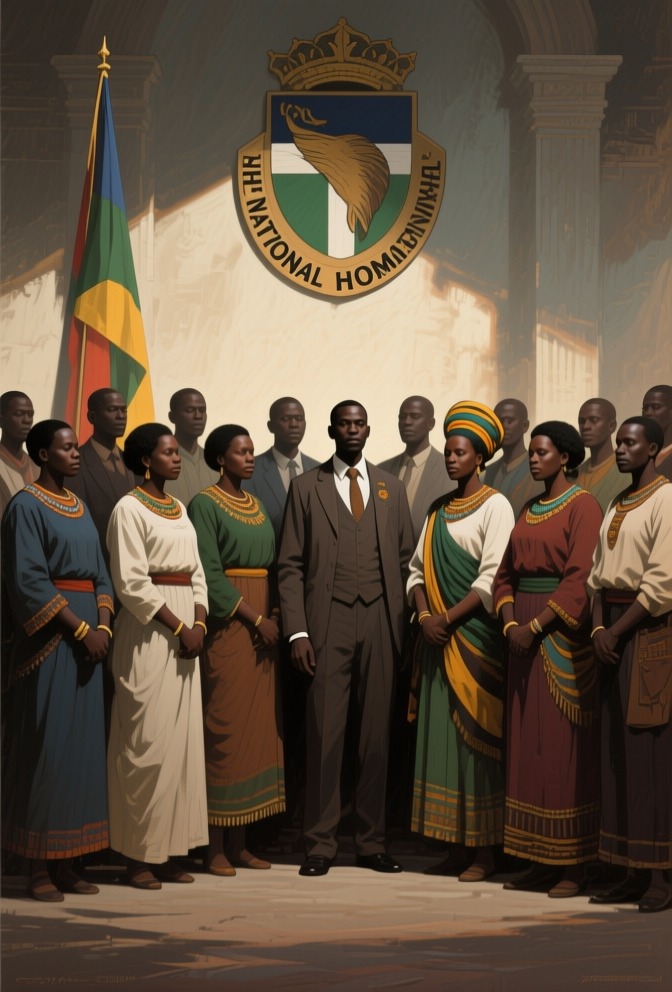
The National Homelands was a disastrous Gilead policy that forcibly relocated populations to fenced-in ghost towns in North Dakota, resulting in thousands of deaths from starvation and exposure, and generating international genocide charges that became a major embarrassment for the regime.
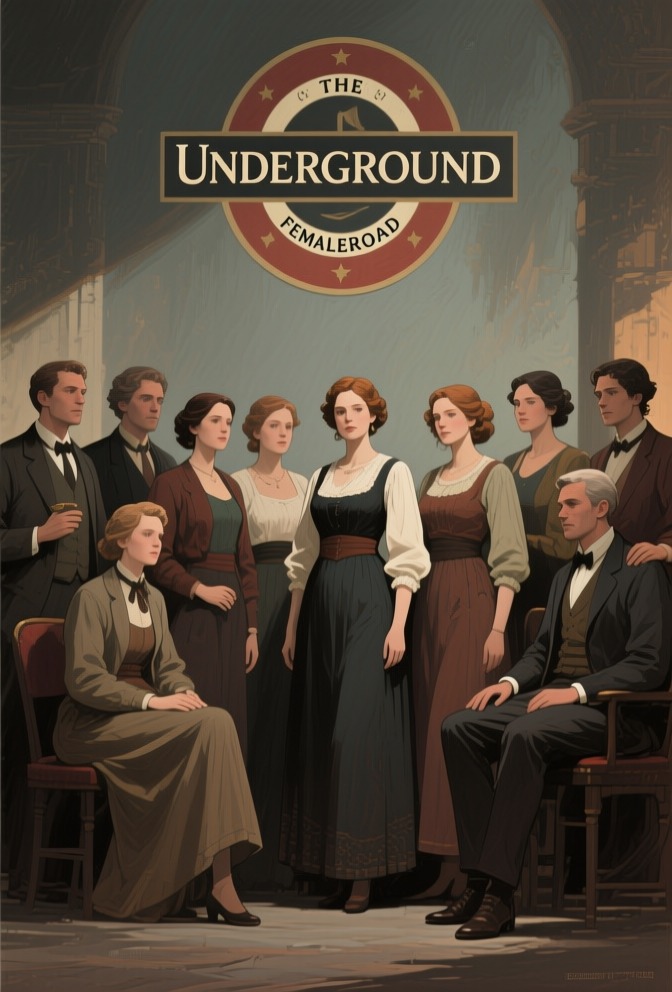
The Underground Femaleroad was a clandestine escape network that smuggled women and girls out of Gilead into Canada, operating through a chain of safe houses, guides, and covert communication methods. It was a primary target of Gilead's security apparatus, and its operations were critically aided by a high-level mole within Ardua Hall who supplied intelligence via microdots hidden in Pearl Girls brochures.
Ada and Melanie were close friends and Mayday colleagues who ran The Clothes Hound, a used clothing store in Toronto that served as a cover for their work with the Underground Femaleroad. Their partnership was built on mutual trust, shared risk, and a deep commitment to helping women escape Gilead, a bond that ultimately cost them their lives when they were killed by a car bomb orchestrated by Gilead's Eyes.
Agnes Jemima and Nicole (half-sisters) are the two young women whose parallel testimonies form the core of The Testaments. Raised apart—Agnes within Gilead as the adopted daughter of a Commander’s Wife, Nicole in Canada as the secretly protected Baby Nicole—they discover their shared mother through the Bloodlines Genealogical Archives and are brought together by Aunt Lydia’s plan to smuggle a microdot of incriminating evidence out of Gilead. Their escape from Ardua Hall, harrowing journey to Canada, and reunion with their mother provide the narrative engine that triggers the regime’s collapse.
The relationship between Aunt Elizabeth and Aunt Lydia is a complex power dynamic within the Gilead regime, characterized by Lydia's manipulation of Elizabeth's guilt and fear to secure her loyalty and eliminate their mutual rival, Aunt Vidala.
Becka and Agnes Jemima share a deep, sisterly bond forged in the oppressive environment of Gilead, a friendship that provides mutual support, emotional refuge, and ultimately enables a dangerous escape. Their relationship evolves from childhood schoolmates to inseparable confidantes within Ardua Hall, where they become each other's only family. Becka's tragic sacrifice to hide while Agnes and Nicole flee cements their bond as one of the novel's most poignant relationships, demonstrating how love and loyalty can persist even under a totalitarian regime.
Paula and Commander Kyle are the stepmother and adoptive father of Agnes Jemima, whose marriage after the death of Agnes's beloved mother Tabitha reshapes the girl's life from cherished security to hostile neglect, and whose hidden affair and complicity in murder are later exposed through secret files at Ardua Hall.
The Male Next of Kin Property Law was a decree issued by the provisional Gilead government immediately after the coup, which transferred all financial assets held by women to their nearest male relative, effectively stripping women of economic independence and legal personhood.
The rule that no man may enter Ardua Hall without the permission of the Aunts is a foundational legal and spatial principle of Gilead's separate female sphere, established by Aunt Lydia during the founding negotiations with Commander Judd and enforced as an inviolable boundary that protects the Aunts' autonomy and power.
The Prohibition of Women Wearing Men's Clothing is a foundational rule in Gilead that enforces a strict binary dress code based on biblical interpretation, treating any cross-dressing as an abomination punishable by death. This rule is central to the regime's project of controlling female identity and desire, and its violation is a key moment of rebellion for the protagonist Nicole.
Women Must Not Strike Men is a foundational rule of Gilead that codifies female physical submission to male authority, permitting women to use violence only in state-sanctioned executions such as Particicutions. The rule is enforced through education, religious doctrine, and social conditioning, and its violation carries severe consequences.
Easter is a religious holiday observed in Gilead as part of its liturgical calendar, marked by the consumption of dyed eggs and a special grace recited by Aunt Lydia at Ardua Hall. The holiday serves as a moment of communal ritual and reflection, but also as a stage for Aunt Lydia's manipulation of symbols—such as Baby Nicole—to reinforce ideological control.
The June moon is a password used by the Mayday resistance network to identify contacts during the escape of Agnes Jemima and Nicole from Gilead. It appears in the escape plan devised by Aunt Lydia, serving as the second half of a two-part verbal authentication code that the fugitives must deliver to their next contact after crossing the border.
The Spring Equinox in Gilead is a state-orchestrated religious festival that blends pagan fertility symbolism with the regime's patriarchal ideology, serving as a tool for social control, propaganda, and the reinforcement of gender hierarchy.
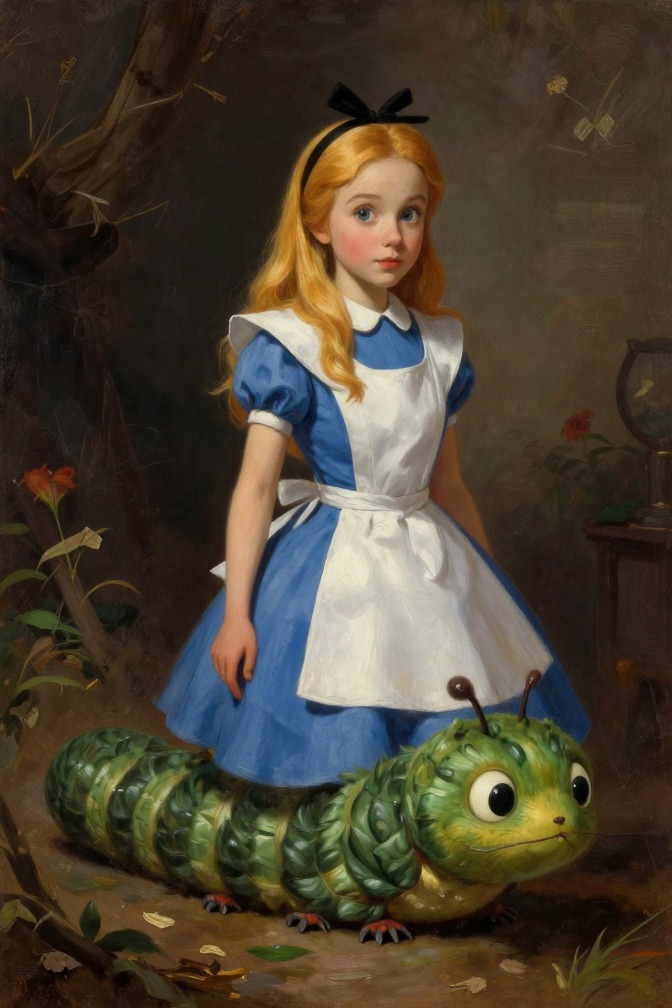
The Caterpillar is a pivotal figure in Wonderland who challenges Alice's sense of identity and provides her with the means to control her size, embodying the absurd logic and authority of the dream world.
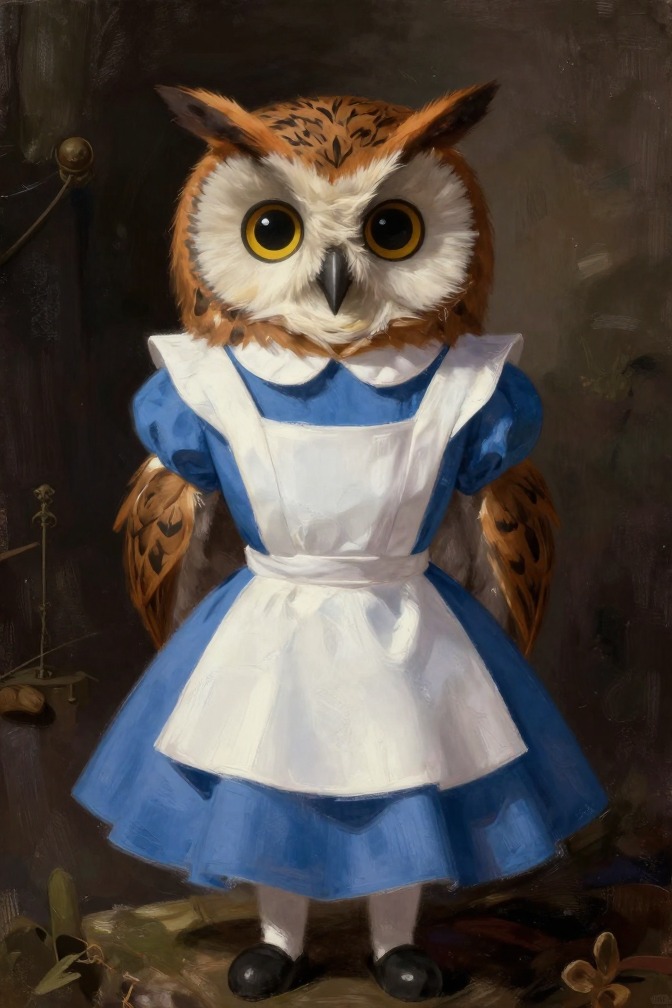
The Owl is a minor creature mentioned in Alice's garbled recitation of "I passed by his garden" during the trial scene, where it shares a pie with the Panther in a nonsensical verse that underscores the breakdown of language and meaning in Wonderland.
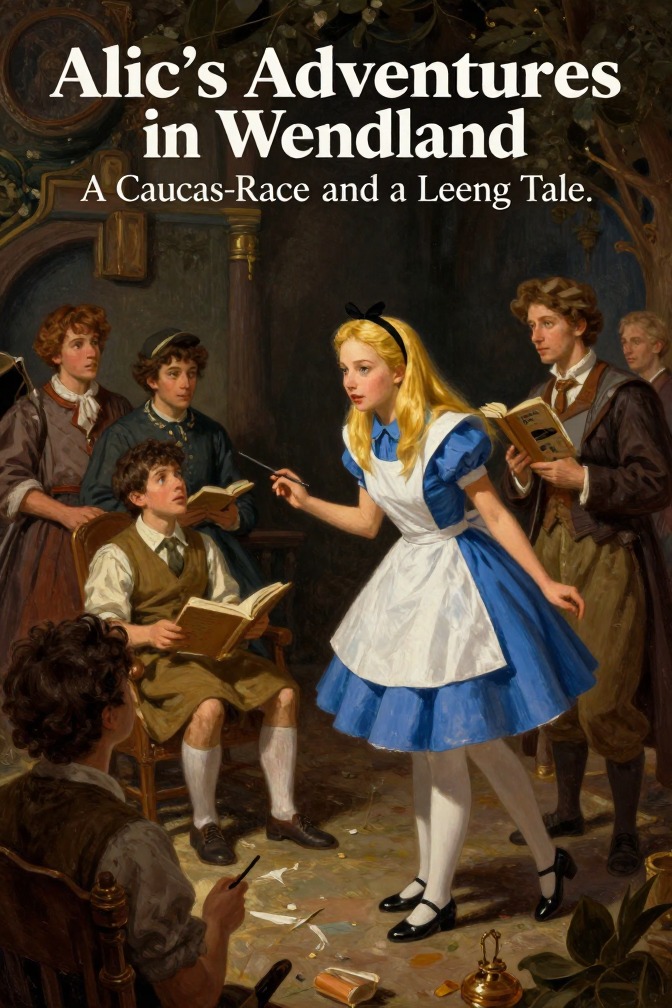
The Caucus-Race and the Mouse's Tale form a pivotal early episode in Wonderland, where Alice, soaked in her own tears, joins a chaotic assembly of birds and animals who stage a nonsensical race to dry themselves, and then listens to the Mouse's tale—a poem shaped like its tail—that ends in offense and abandonment, establishing the arbitrary logic, verbal play, and social fragility that define Wonderland.
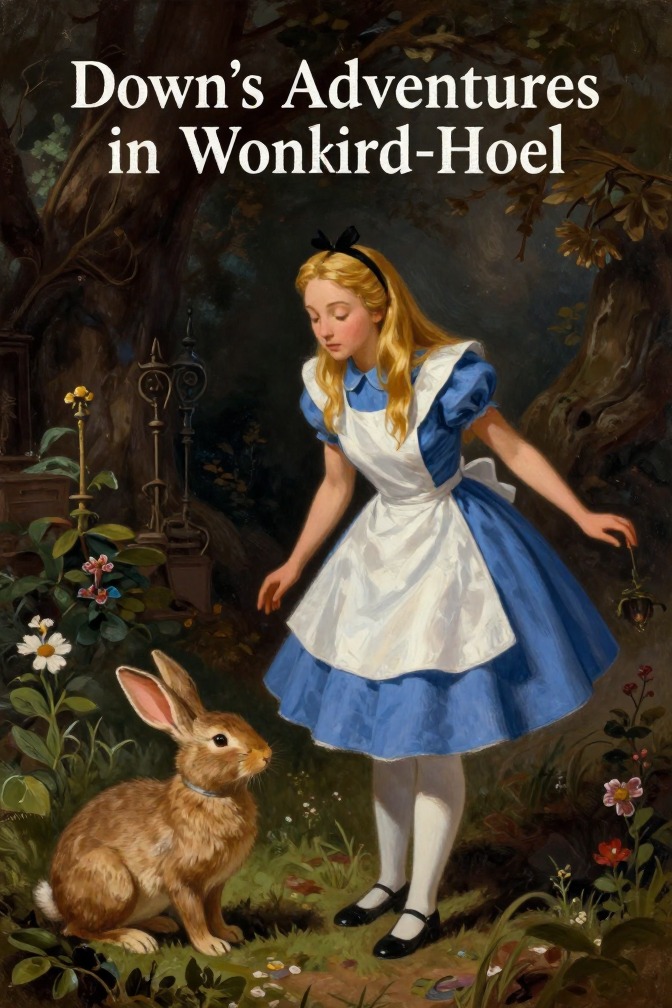
Down the Rabbit-Hole is the opening event of Alice's Adventures in Wonderland, in which the bored seven-year-old Alice follows a hurrying White Rabbit into a deep well-like tunnel and begins her surreal journey into Wonderland, an episode that establishes the dream-logic, physical instability, and identity crisis that define the entire book.
In Albert Camus's *The Fall*, God is a central yet paradoxical concept, invoked by the narrator Jean-Baptiste Clamence not as a source of faith or salvation, but as a figure whose absence defines the modern condition. God's sole usefulness, Clamence argues, would be to guarantee innocence, a function that has been abandoned, leaving humanity to face judgment without a law. The concept is explored through Clamence's reinterpretation of Christ's crucifixion, his rejection of divine judgment in favor of human condemnation, and his ultimate usurpation of a god-like role as the judge-penitent who dominates a world without grace.
The democracy of guilt is a central concept in Albert Camus's *The Fall*, articulated by Jean-Baptiste Clamence as a social and psychological condition in which universal guilt replaces individual innocence, creating a collective that judges and condemns itself without appeal, thereby making everyone both judge and penitent.
The heights are a central concept in Jean-Baptiste Clamence's self-conception, representing his psychological need for dominance, moral elevation, and escape from judgment. Clamence associates heights with freedom, power, and a sense of being above the ordinary human condition, while depths and enclosed spaces symbolize guilt, confinement, and the inescapable judgment of others.
The islands are a recurring motif in Jean-Baptiste Clamence's confession, representing an idealized realm of freedom, sensuality, and domination that stands in stark contrast to the foggy, canal-bound Amsterdam where he now lives. They function as a symbol of lost innocence, a geographical and psychological escape from guilt, and a site of colonial desire and mastery.
The master is a central concept in Jean-Baptiste Clamence's philosophy, representing the authority figure he believes humanity desperately craves to escape the burden of freedom and the terror of being judged without a law. Clamence argues that in the absence of God, people will submit to any master—political, social, or personal—to achieve the comfort of slavery and collective guilt, a solution he both preaches and embodies in his role as a judge-penitent.
The piranha appears in Jean-Baptiste Clamence's monologue as a metaphor for modern society's organized liquidation of individuals through gradual, collective attrition, contrasting with the more overt violence of criminals.
Don't rely on it is the motto of Jean-Baptiste Clamence's self-proclaimed house, a phrase that encapsulates his double-faced nature and his fundamental distrust of appearances, sincerity, and the judgments of others.
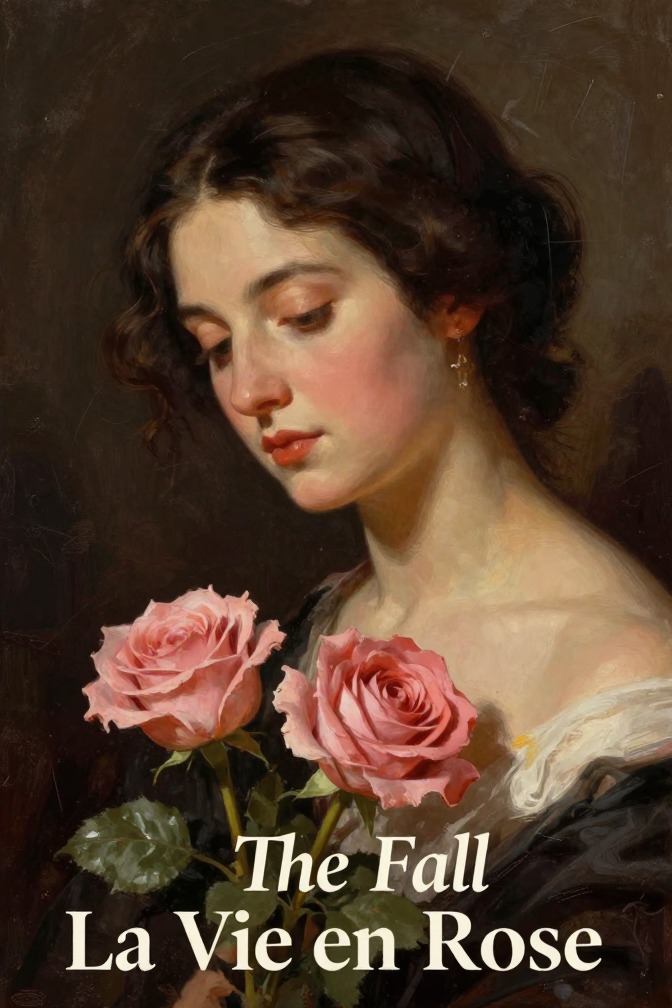
La Vie en rose is a popular French song that, in Albert Camus's The Fall, becomes a symbol of the protagonist Jean-Baptiste Clamence's profound aversion to love and romantic sentiment after his failed attempts at genuine emotional connection.
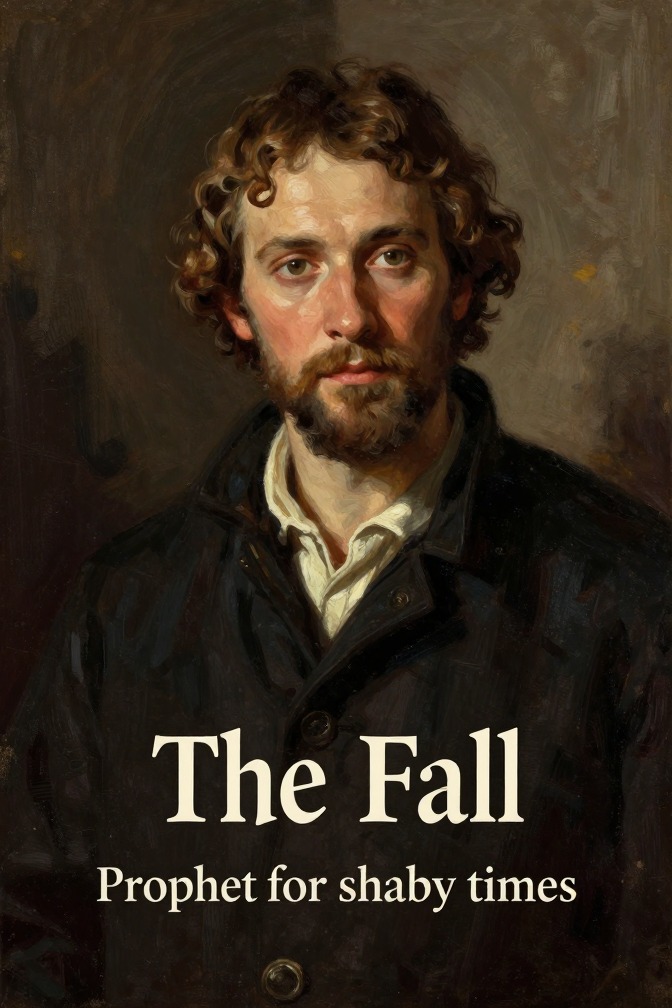
Jean-Baptiste Clamence, the narrator of Albert Camus's *The Fall*, describes himself as a 'prophet for shabby times'—an empty prophet without a messiah, who has taken refuge in a desert of stones, fogs, and stagnant waters in Amsterdam, where he practices the profession of judge-penitent. This self-designation encapsulates his final, ironic stance: a man who, having failed to live up to his own ideals and having discovered the universal guilt of humanity, now preaches a law of condemnation from a position of self-proclaimed superiority, yet without any genuine message of salvation or hope.
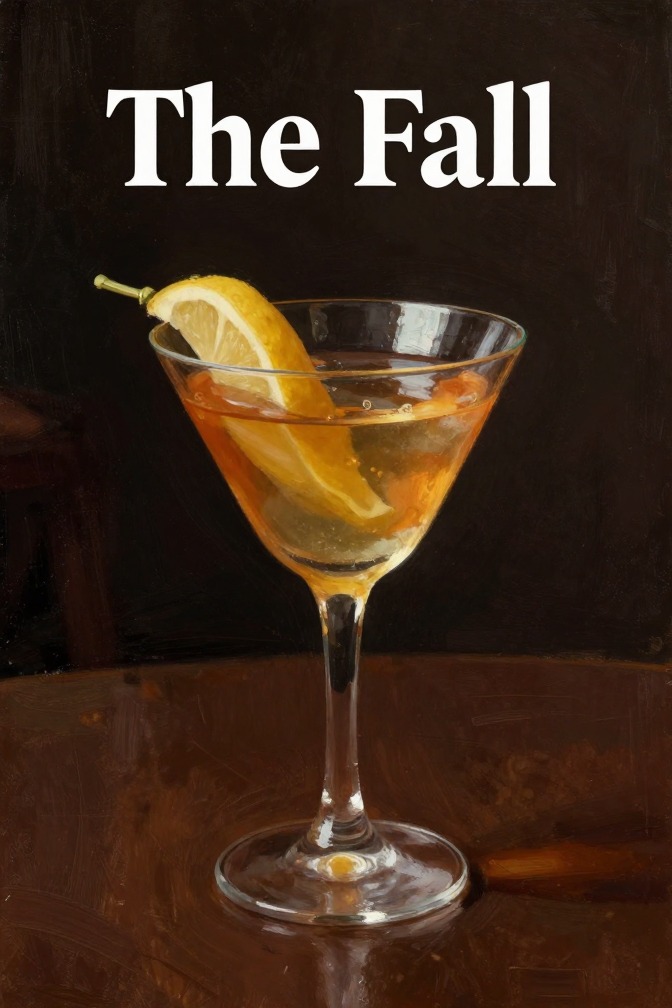
The apéritif is a recurring metaphor in Jean-Baptiste Clamence's monologue, representing the trivial, self-serving emotional stimulation that people seek from tragedy and death to break the monotony of their lives.
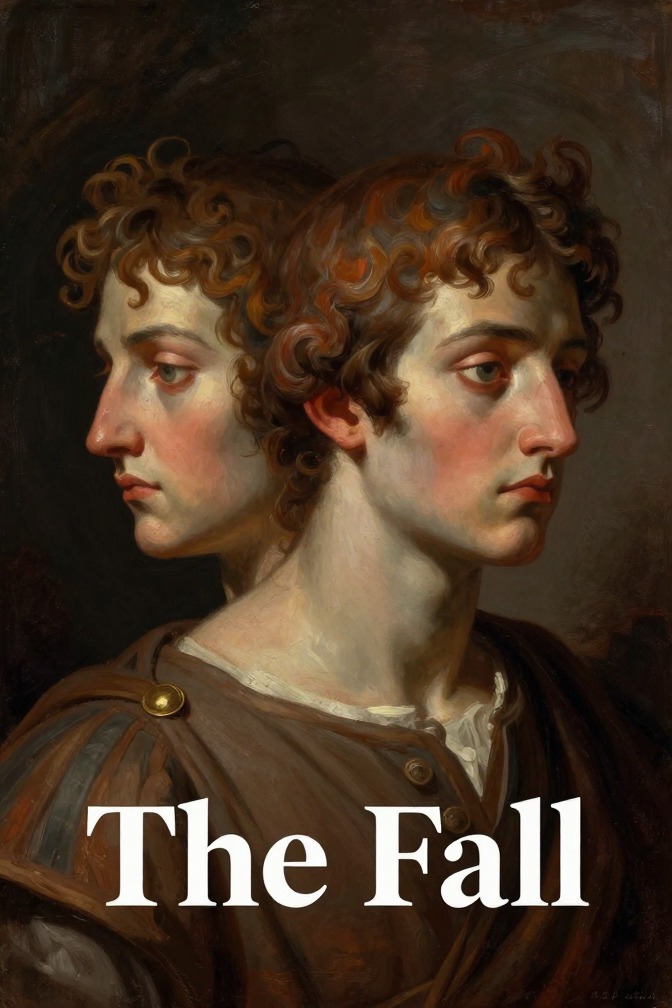
The double face, a charming Janus is the self-proclaimed motto and emblem of Jean-Baptiste Clamence, encapsulating his fundamental duplicity and the theatrical, two-sided nature of his identity as a judge-penitent.
The holy innocence of those who forgive themselves is a concept that Jean-Baptiste Clamence invokes near the end of his confession, representing a lost state of grace and self-acceptance that he contrasts with his own relentless self-condemnation and judgment of others.