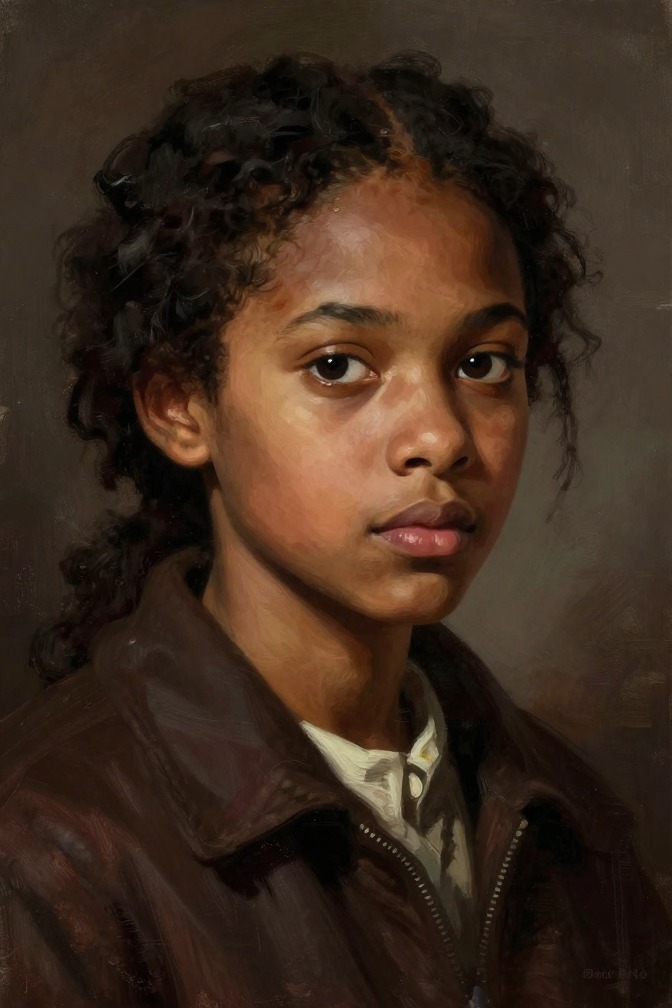
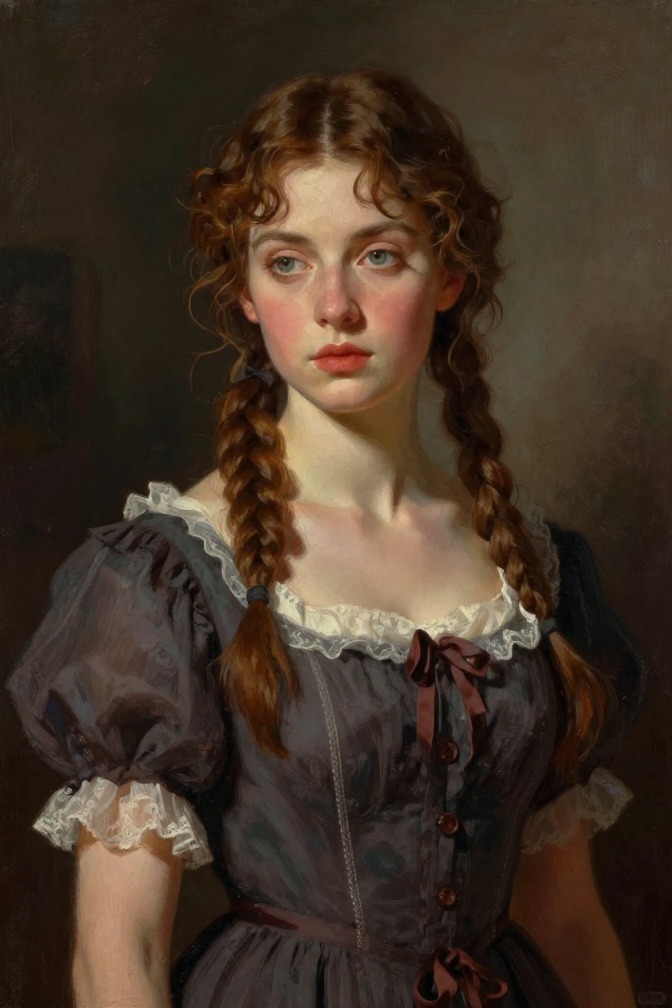
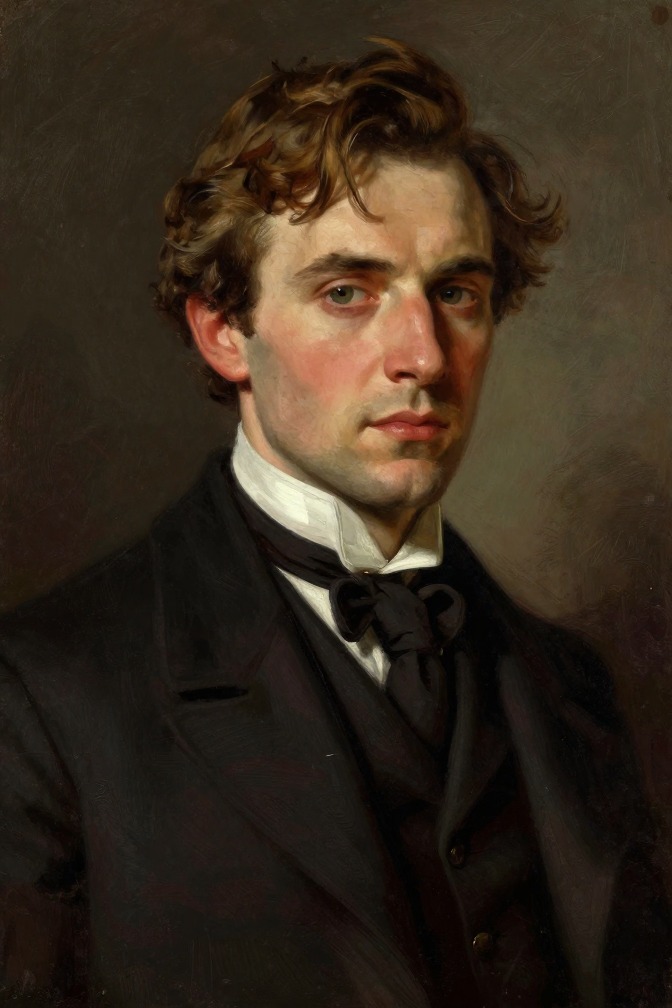
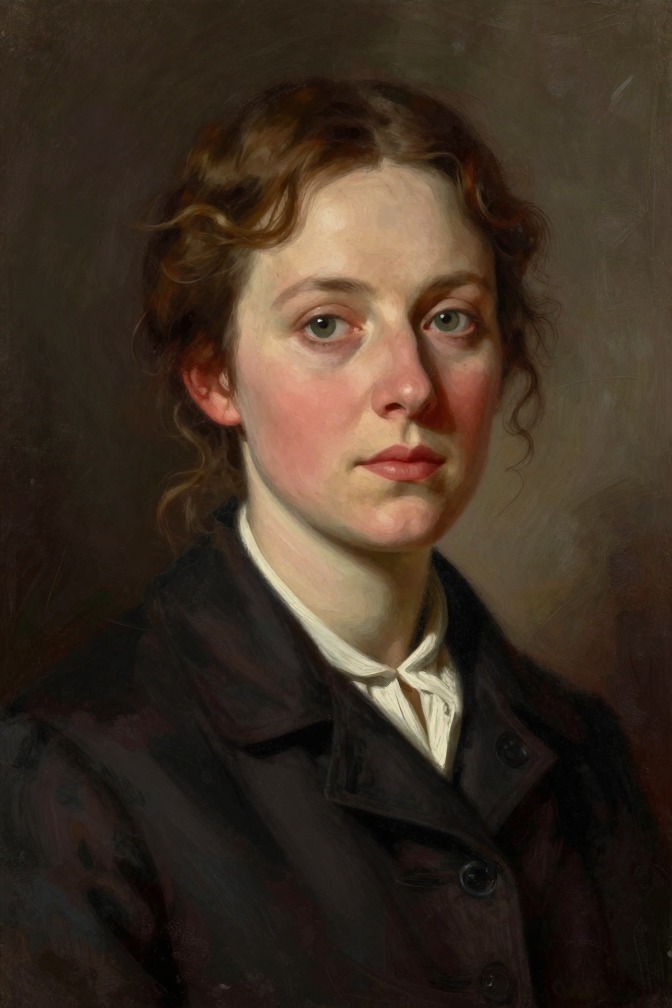
Denver is the youngest daughter of Sethe and Halle, born during her mother's escape from Sweet Home. She is the only child who remains with Sethe at 124 Bluestone Road, and her life is shaped by the haunting presence of her dead sister, Beloved. Denver's journey from a lonely, isolated girl to a self-sufficient young woman who seeks help from the community is central to the novel's themes of memory, trauma, and healing.
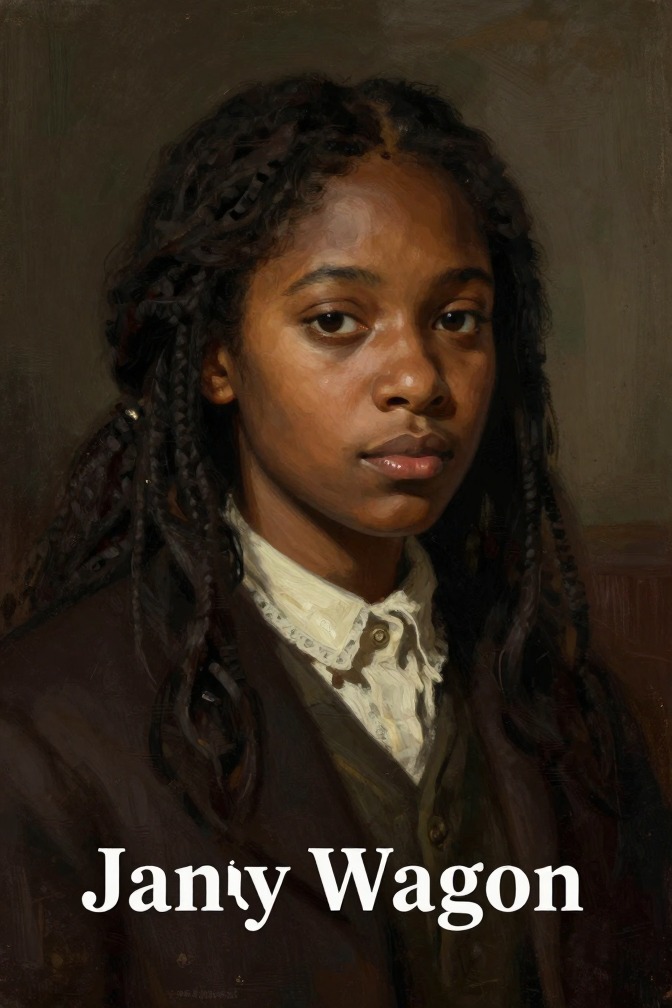
Janey Wagon is the Bodwins' longtime Black servant in Cincinnati, a minor but pivotal figure in Beloved who connects the novel's central household to the wider community and to the white abolitionist family that owns 124 Bluestone Road. She first appears as the young maid who welcomes Baby Suggs to the Bodwin house, and decades later she becomes the conduit through which Denver secures work and through which the community learns of Sethe's collapse, helping to set in motion the exorcism that frees 124.
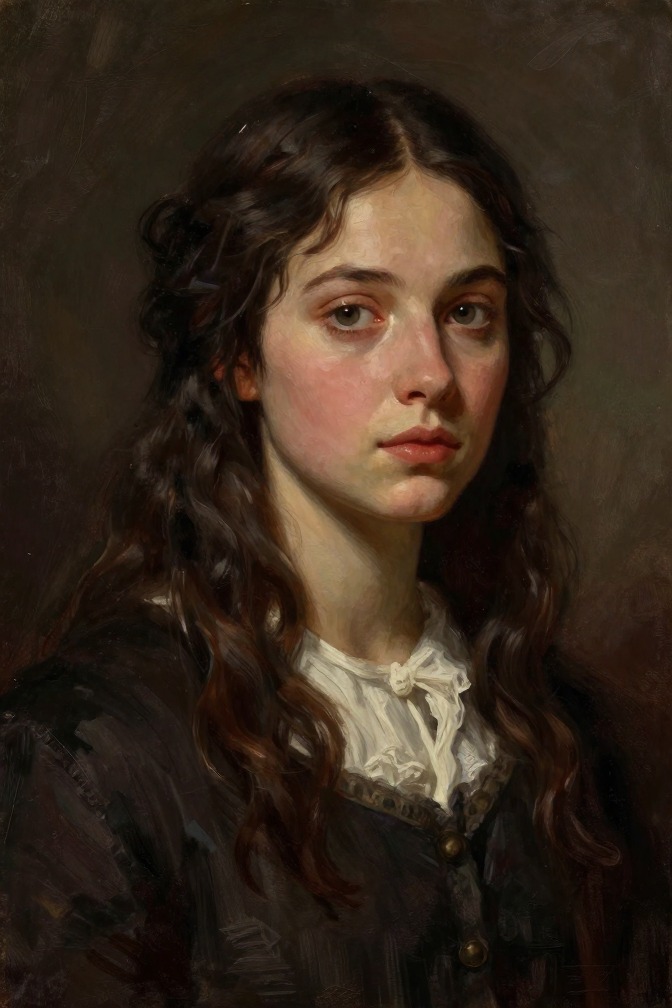
Miss Bodwin is a white abolitionist sister of Edward Bodwin who, with her brother, provides crucial support to the Black community in Cincinnati, including housing and employment for Baby Suggs and Sethe. Her Christmas gifts and her role in the community's memory of 124 Bluestone Road highlight her complex position as a benevolent yet distant figure in the lives of the formerly enslaved.
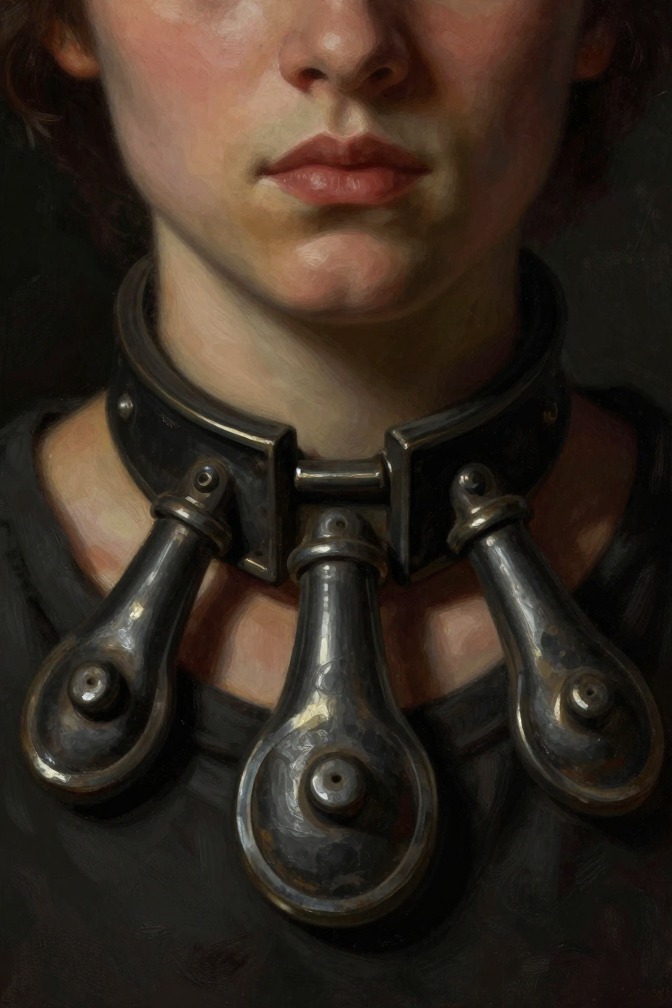
The three-spoke collar is an iron neck restraint that schoolteacher's men fit on Paul D after his capture during the failed Sweet Home escape, a device that embodies the dehumanizing reduction of a man to chattel and becomes a recurring emblem of his lost manhood and the shame he carries into his later life with Sethe.
Agnes Sheridan is a minor character from Dolores Haze's school in Ramsdale, mentioned in Humbert Humbert's diary as one of the girls in Dolores's class, and later recalled by Humbert during his interrogation of Lolita about her sexual history.
Bill Mead is a minor character who appears during Humbert and Lolita's stay in Champion, Colorado, where he serves as a tennis-playing foil whose presence inadvertently exposes the predatory network closing in on Humbert's relationship with Lolita.
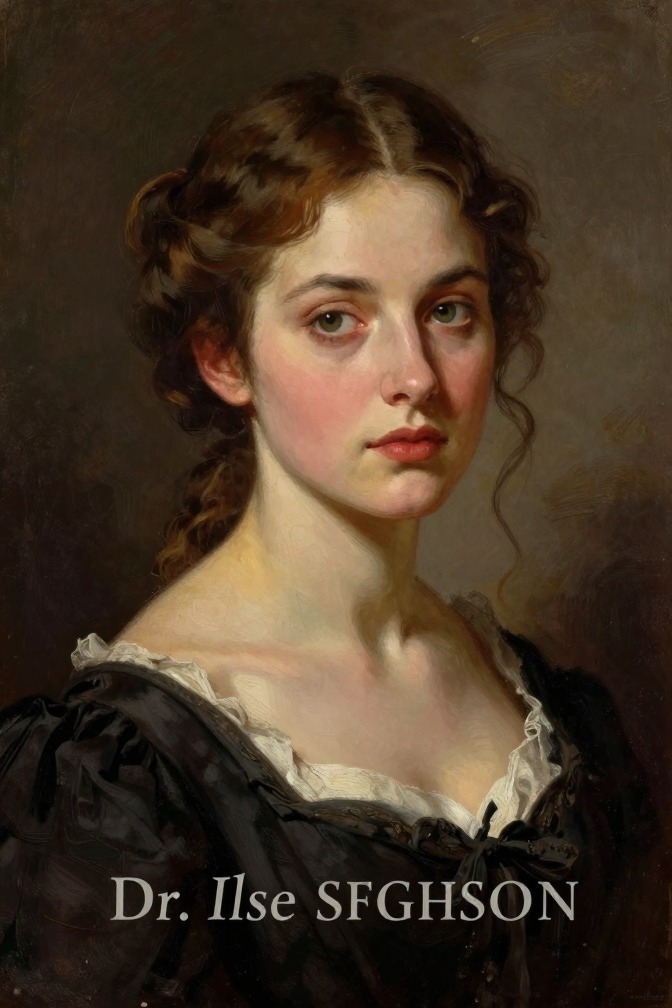
Dr. Ilse Tristramson is a minor but significant character in Vladimir Nabokov's Lolita, the physician who treats Dolores Haze during a serious illness in Elphinstone. Her brief appearance serves as a crucial narrative pivot: she is the medical professional who inadvertently facilitates the final separation between Humbert Humbert and his stepdaughter, as her diagnosis and treatment create the hospital stay during which Clare Quilty orchestrates Lolita's escape.
Dr. Molnar is the Beardsley dentist who performs a serious dental operation on Humbert Humbert, leaving him with only a few front teeth and a system of plates, and whose superior skill Humbert later uses as a pretext to confront Clare Quilty's uncle.
Fay Page is a minor character in Lolita, an actress who appears briefly during Humbert Humbert's cross-country journey with Dolores Haze. She is introduced as the companion of Bill Mead at a tennis court in Champion, Colorado, and later resurfaces in Dolores's account of her time with Clare Quilty, where she is depicted as a participant in the debauched activities at the Duk Duk Ranch. Her presence serves to underscore the predatory and theatrical world that Quilty inhabits and from which Dolores eventually escapes.
Ginny McCoo is a minor character in Lolita, a schoolmate of Dolores Haze in Ramsdale, whose lameness from polio and social marginalization are briefly noted by Humbert Humbert as he catalogues the children in his nymphet's class.
Harold Haze is the deceased first husband of Charlotte Haze and the biological father of Dolores Haze (Lolita). Though he dies before the novel's main events, his presence lingers through the household objects he left behind, the sexual habits Charlotte recalls, and the legal and emotional vacuum his death creates—a vacuum that Humbert Humbert exploits to insert himself into the family. Harold Haze functions as a spectral benchmark of normalcy, against which the grotesque parody of fatherhood that Humbert performs is measured.
Miss Cormorant is a teacher at Beardsley School whose reports and observations contribute to the institutional pressure on Humbert Humbert regarding his stepdaughter Dolores Haze, and whose assessments of Dolly's behavior—combined with those of other staff—ultimately force Humbert to allow Dolly to participate in the school play, a decision that sets in motion the final phase of his loss of her.
Mr. Swine is the pink, bald, porcine desk clerk at The Enchanted Hunters hotel who, along with his colleague Mr. Potts, mishandles Humbert Humbert's reservation on the night he arrives with Lolita, embodying the hotel's bumbling, indifferent bureaucracy and the farcical obstacles that delay Humbert's predatory plan.
The Philosopher's Stone and the Elixir of Life are the twin components of the Master Work in alchemy, representing the ultimate material and spiritual perfection. In Paulo Coelho's *The Alchemist*, they function as both a literal substance capable of transmuting base metals into gold and curing all illness, and as a symbol of the completed Personal Legend—the realization of one's destiny through action, love, and connection to the Soul of the World.
Vera Claythorne shoots Philip Lombard dead on the beach of Indian Island after tricking him into helping her move Dr. Armstrong's body and then picking his pocket for his revolver, an act that leaves her alone on the island and precipitates her own suicide.
Arthur Richmond is a British Army officer whose death in France during the First World War was deliberately engineered by his commanding officer, General Macarthur, after Macarthur discovered Richmond was having an affair with his wife, Leslie. Though Richmond appears only in Macarthur's memories and the gramophone accusation, his death is the central crime that drives Macarthur's guilt, his acceptance of death on Indian Island, and the novel's exploration of murder committed under the cover of war.
Hugo Hamilton is the young man whose love for Vera Claythorne and whose nephew Cyril's death form the emotional and moral core of Vera's past crime, and whose drunken confession to Lawrence John Wargrave on an Atlantic crossing provides the judge with the final piece of evidence needed to complete his list of victims for Indian Island.
Vera Elizabeth Claythorne is a young woman who arrives on Indian Island as a secretary, only to become one of the ten guests trapped and systematically killed by a mysterious judge. Her past—the drowning of a child she was governess to—is exposed, and she ultimately becomes the last survivor before being driven to hang herself.
Festubert is a small village in northern France that serves as a key waypoint in the pursuit of Milady de Winter after the poisoning of Constance Bonacieux, marking the location where the wounded servant accompanying Milady was forced to stop and where Athos and his companions gather crucial intelligence that leads them to her final refuge at Armentieres.
Touraine, a historic province in west-central France, serves as the final retreat for Athos after his years of service as a Musketeer. It is also the native region of the Comte de la Fere, whose ancestral lands and family history are rooted there, and it provides the backdrop for the tragic story of his marriage to the woman who became Milady.
Rue du Bac is a street in Paris that appears in Alexandre Dumas's *The Three Musketeers* as the location where Monsieur Bonacieux, having discovered the theft of his moneybag, runs crying "Thieves!" after d'Artagnan and Constance Bonacieux have fled to d'Artagnan's chambers. The street's brief but significant appearance marks the moment when the mercer's cowardice and his wife's betrayal of him become fully apparent, and it serves as a threshold between the domestic intrigue of the Bonacieux household and the wider political conspiracy that drives the novel's plot.
Roussillon is a province in southern France that serves as the final retirement destination for Athos, who, after years of service as a Musketeer, leaves the company in 1633 under the pretext of having inherited a small property there, marking the quiet end of his active life.
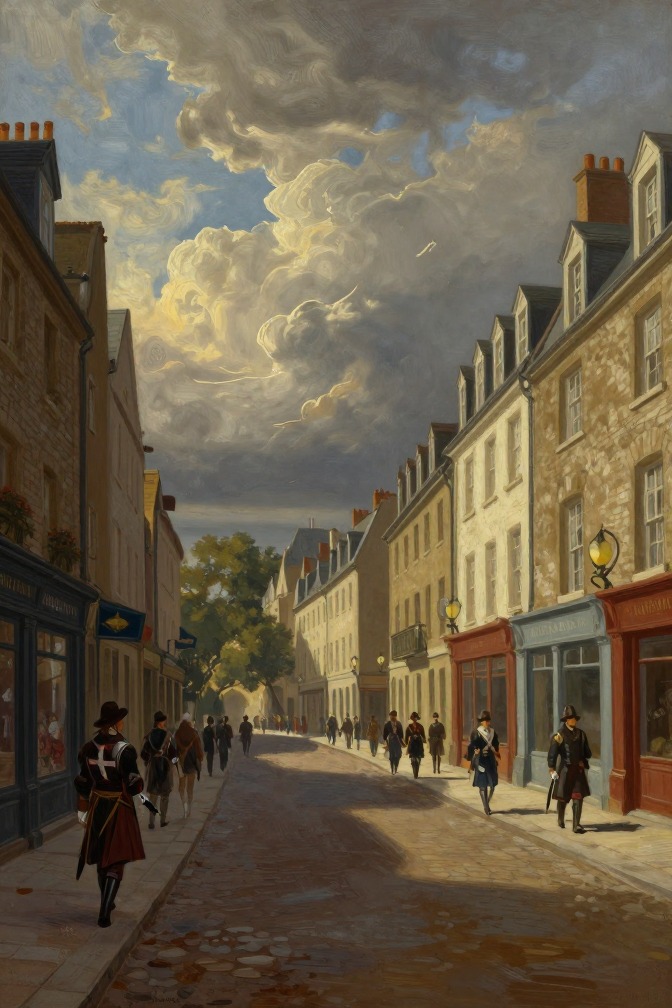
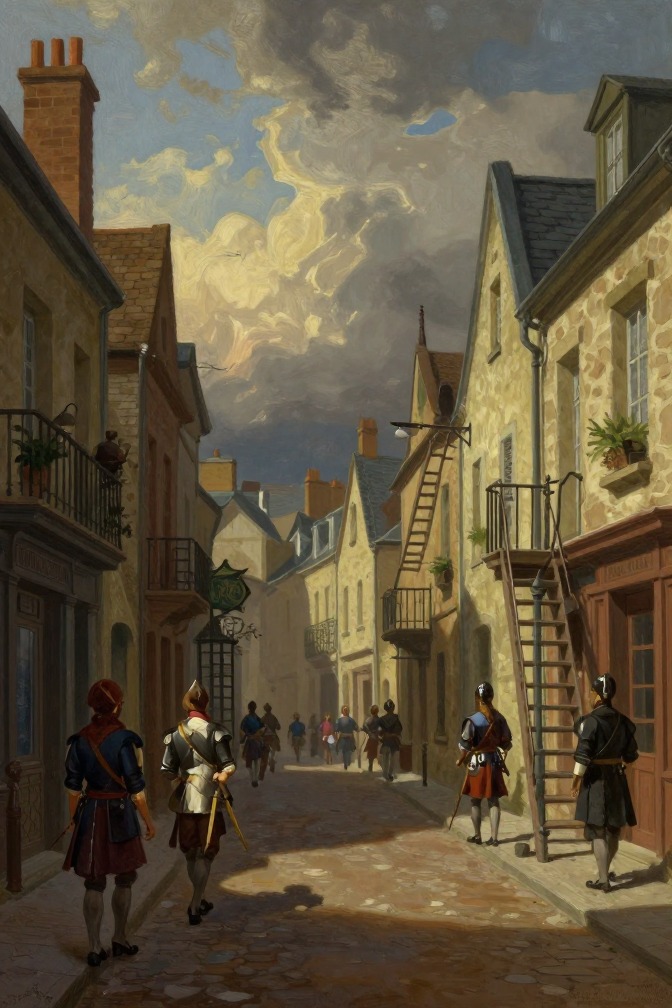
Rue de l'Echelle is a street in Paris that serves as a discreet entrance to the Louvre Palace, used by characters in Alexandre Dumas's The Three Musketeers for secretive and politically sensitive movements, most notably as the point of entry for the Duke of Buckingham's clandestine meeting with Queen Anne of Austria.
Fort l'Eveque was a prison in Paris where Athos was held after being mistaken for d'Artagnan, and where Milady was later confined by Lord de Winter in a remote castle that also bears this name in the narrative.
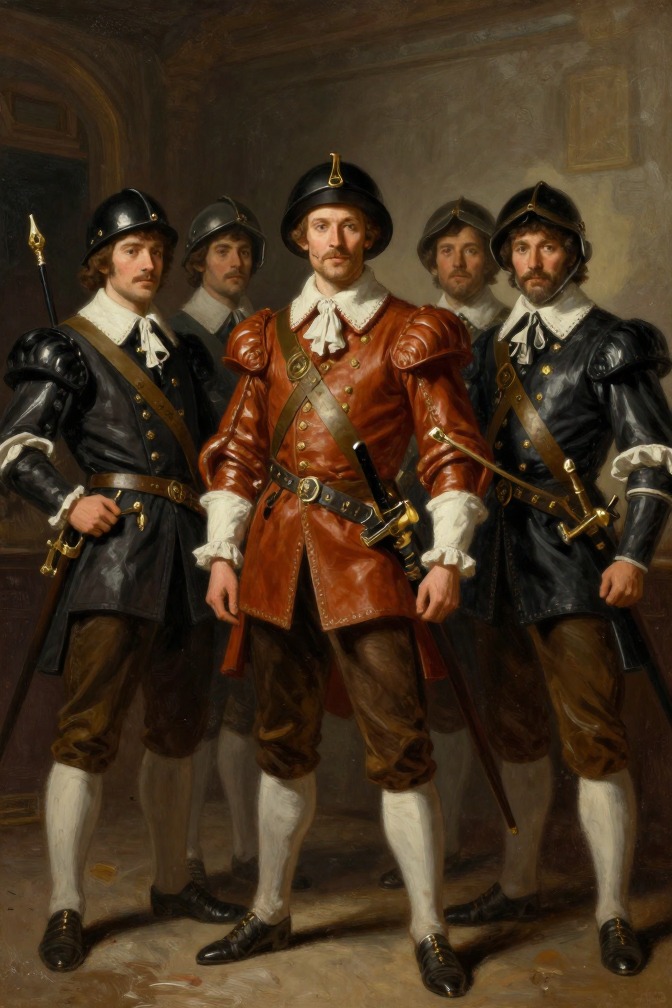
The Cardinal's Musketeers were a military corps created by Cardinal Richelieu as a personal guard to rival the King's Musketeers, serving as both a symbol of his power and a tool for enforcing his authority through constant rivalry and street brawls with the king's men.
The brotherhood between the Executioner of Lille and his brother, a young priest, forms the tragic backstory that explains the executioner's relentless pursuit of Milady and his role in her final judgment. The priest was seduced by a young nun—later revealed to be Milady—who persuaded him to steal sacred vessels from their convent. When they were caught, the priest was sentenced to branding and ten years' imprisonment, while Milady escaped. The executioner, bound by fraternal loyalty, branded his own brother and then swore to make Milady share that punishment, a vow that culminates in her execution on the banks of the Lys.
The enmity between d'Artagnan and the Comte de Rochefort is a persistent, antagonistic thread that runs through the novel, beginning with a violent encounter at Meung and culminating in a final, grudging reconciliation after the cardinal's intervention. Rochefort, the cardinal's trusted agent, repeatedly crosses d'Artagnan's path, acting as a physical embodiment of the cardinal's power and a personal nemesis who steals his letter of introduction, abducts Constance Bonacieux, and later arrests him. Their relationship evolves from open hostility to a wary, enforced peace, marking d'Artagnan's integration into the cardinal's circle.
The friendship between Lord de Winter and d'Artagnan begins in enmity, is forged in a duel where d'Artagnan spares the Englishman's life, and deepens through shared enmity toward Milady, culminating in their alliance to pursue and execute her.
The rivalry between the King's Musketeers and the Cardinal's Guards is a central, institutionalized conflict in Alexandre Dumas's *The Three Musketeers*, reflecting the broader power struggle between King Louis XIII and Cardinal Richelieu. This antagonism, which pervades the novel from its opening chapters, manifests in daily street brawls, duels, and open battles, and serves as the crucible in which the four heroes—d'Artagnan, Athos, Porthos, and Aramis—forge their bond and prove their loyalty to the crown.
Daenerys Targaryen, pregnant with Khal Drogo's child, undergoes the Dothraki ritual of eating a raw stallion's heart to ensure her son will be born strong, swift, and fearless. The ceremony, conducted by the crones of the dosh khaleen in Vaes Dothrak, culminates in a prophecy that her son will be the stallion who mounts the world, a conqueror destined to unite all people under his rule.