Orinco is a chemical fertilizer company whose trucks repeatedly traverse Route 15 in Ludlow, Maine, serving as a recurring symbol of the industrial threat that kills pets and, ultimately, Gage Creed.
The U.S. War Department is the federal executive department that, during World War II, managed the nation's military forces and the logistics of returning fallen soldiers' bodies to their families. In Stephen King's *Pet Sematary*, the War Department appears as a distant but consequential bureaucratic force, its procedures and records becoming entangled with the supernatural horror that overtakes the town of Ludlow, Maine, when a father attempts to resurrect his son from a cursed Micmac burial ground.
Louis Creed's relationship with Church, his daughter Ellie's cat, evolves from casual ownership to a fraught bond of guilt, revulsion, and responsibility after Church is killed on Route 15 and then resurrected through the Micmac burying ground. The cat's return transforms Louis's understanding of death and the supernatural, binding him to a secret that ultimately drives the novel's tragedy.
Louis and Gage's father-son relationship is the emotional core of Stephen King's *Pet Sematary*, a bond so profound that its rupture drives Louis to defy the laws of nature and morality. Louis's love for Gage is immediate, fierce, and protective, but it is also the catalyst for his descent into madness, as his inability to accept his son's death leads him to resurrect Gage through the dark power of the Micmac burying ground, with catastrophic consequences.
Don't go beyond is a central rule in Pet Sematary, first articulated by the ghost of Victor Pascow to Louis Creed in a dream. It warns against crossing the deadfall barrier that separates the Pet Sematary from the deeper Micmac burying ground, a place of ancient, dangerous power that can resurrect the dead but at a terrible cost. The rule is repeatedly violated, leading to the catastrophic returns of Church, Gage, and finally Rachel, each return more monstrous than the last, and ultimately to the destruction of Louis's family and his own sanity.
Jud Crandall's warning to Ellie Creed during the family's first walk to the Pet Sematary establishes a foundational rule of the novel: the woods beyond the path are dangerous, and straying from the path can lead to being lost. This seemingly simple caution, delivered with the weight of local knowledge, foreshadows the deeper, more sinister prohibitions that govern the land beyond the pet cemetery and the terrible consequences of ignoring them.
In the Pet Sematary, Jud Crandall warns Louis Creed never to speak to anything he might encounter in the woods beyond the deadfall, especially in the area of Little God Swamp. This rule is a survival directive rooted in the dangerous, sentient power of the Micmac burying ground, where the barrier between the living and the dead is thin and malevolent spirits may mimic voices to lure the unwary.
Resurrection in Stephen King's Pet Sematary is the central supernatural phenomenon that drives the novel's plot and thematic horror. It is the process by which the dead—first the family cat Church, then the toddler Gage Creed, and finally Rachel Creed—are brought back to life after being buried in the ancient Micmac burying ground beyond the Pet Sematary. The novel systematically reveals that this resurrection is not a miracle but a perversion: the returned beings are physically and spiritually diminished, often malevolent, and the act of resurrecting them is a corrupting, addictive force that destroys the living who attempt it.
1914 is the year Jud Crandall's dog Spot died of old age, the first animal Jud buried in the Pet Sematary, marking the beginning of his lifelong connection to the burial ground and its secrets.
1934 is the year referenced by Jud Crandall as the last time anyone local was lost in the North Ludlow Woods, a detail he shares during the Creed family's first walk to the Pet Sematary.
1965 is the year of Zelda Goldman's agonizing death from spinal meningitis, a traumatic event that shapes Rachel Creed's lifelong phobia of death and illness, and that reverberates through the Creed family's own tragedy nearly two decades later.
Christmas in the Creed household is a moment of fragile domestic peace, marked by the family's first holiday in their new Ludlow home. The celebration is shadowed by the lingering strangeness of Church, the cat who returned from the dead, and by Louis's growing awareness that the Micmac burying ground's power has not finished with him. The evening's warmth—Santa's boot-print trick, Rachel's sapphire necklace, the children's joy—is undercut by Church's predatory gifts and the cold, watchful presence of the resurrected animal, making this Christmas a turning point where love and horror begin to coexist.
Indian summer is a brief period of warm, hazy weather that occurs in late autumn, and in Stephen King's Pet Sematary it marks the fleeting, deceptive calm before the novel's horrors intensify. It arrives after the first hard frosts, bringing a temporary return of summer-like heat that seems to suspend the natural order, but it is immediately followed by a cold, driving rain that strips the leaves and ushers in the true winter. The season's transience and its ironic contrast with the coming darkness make it a potent symbol of the fragile, illusory peace that the Creed family experiences before their world collapses.
The Attempt to Pawn Blanket is a pivotal action in Part II of Knut Hamsun's *Hunger*, in which the starving narrator, desperate after a day of failed appeals, resolves to pawn Hans Pauli's blanket—the only bedding he has—only to be rejected by the pawnbroker and then overcome by shame, ultimately returning the blanket and reaffirming his commitment to honor.
The Confess to Shopkeeper is a pivotal action in Part III of Knut Hamsun's *Hunger*, in which the starving narrator, after stealing five shillings from a provision shop, returns to the shop to confess his crime, only to find the shopkeeper's boy too fearful to act, leading to a bizarre and morally ambiguous confrontation that deepens the narrator's self-loathing.
The narrator's first encounter with Ylajali occurs on a morning in Christiania when, after leaving the park to retrieve his pencil from a pawnbroker, he overtakes two ladies on the street and, in a state of disordered excitement, begins to follow them, inventing the name Ylajali and repeatedly addressing one of them with the cryptic phrase 'You are losing your book, madam,' an episode that establishes the obsessive, hallucinatory quality of his desire and the intersection of hunger, shame, and erotic fixation that will define their relationship.
The protagonist impulsively gives away the five shillings he stole from a shopkeeper to an old cake vendor, an act that briefly restores his sense of honor but leaves him penniless and hungry again.
Write Story is the central creative act through which the unnamed narrator of Knut Hamsun's Hunger attempts to survive, maintain his identity, and resist the collapse of his mind and body. It is not merely a profession but a desperate, recurring ritual of self-creation and self-destruction, a process that oscillates between ecstatic inspiration and crushing failure, and that ultimately defines his relationship to the world, to God, and to his own sanity.
Missy is a minor but recurring character in Knut Hamsun's *Hunger*, a dandified acquaintance of the unnamed narrator whose encounters with the protagonist consistently expose the narrator's desperate attempts to maintain a facade of respectability and success despite his extreme poverty.
Freedom of Will is a recurring intellectual preoccupation of the unnamed narrator in Knut Hamsun's *Hunger*, a concept he invokes as a potential subject for a lucrative newspaper article but which he ultimately proves unable to write, thereby dramatizing the collapse of his autonomous agency under the pressure of extreme poverty and starvation.
Inspiration in Knut Hamsun's *Hunger* is a volatile, quasi-divine force that descends upon the starving narrator in unpredictable bursts, enabling him to produce brilliant work but also driving him to the brink of madness. It is the sole counterweight to his physical decay, yet its arrival is capricious, often triggered by extreme deprivation and as quickly extinguished by the harsh realities of his existence.
The Departure on the Copégoro is the final event of Knut Hamsun's novel Hunger, in which the starving and broken narrator, after a long winter of destitution, signs on as an unskilled crewman aboard a Russian barque bound for Leith, Scotland, and leaves Christiania behind. This departure marks the end of his ordeal in the city and the novel's conclusion, offering neither a triumphant rescue nor a death, but a precarious, open-ended escape into an unknown future.
The First Encounter with Ylajali is the pivotal event in Part I of Hunger where the starving narrator, driven by a volatile mix of hunger, nervous excitement, and a sudden, inexplicable impulse, accosts a strange woman on the street, invents the name 'Ylajali' for her, and follows her to her home, establishing a haunting, obsessive connection that will recur throughout the novel.
The Night in the Guard-House is a pivotal event in which the starving narrator, locked out of his lodgings and homeless, reports himself to the police under a false name and spends a night in a cell, where he experiences a hallucinatory crisis of darkness, invents the word "Kuboa," and nearly succumbs to madness before the dawn restores him.
Philosophical Cognition is a three-volume dissertation that the protagonist of Hunger conceives during a moment of grand ambition, only to have its creation thwarted by the loss of his pencil, symbolizing the gap between his intellectual aspirations and the brutal reality of starvation.
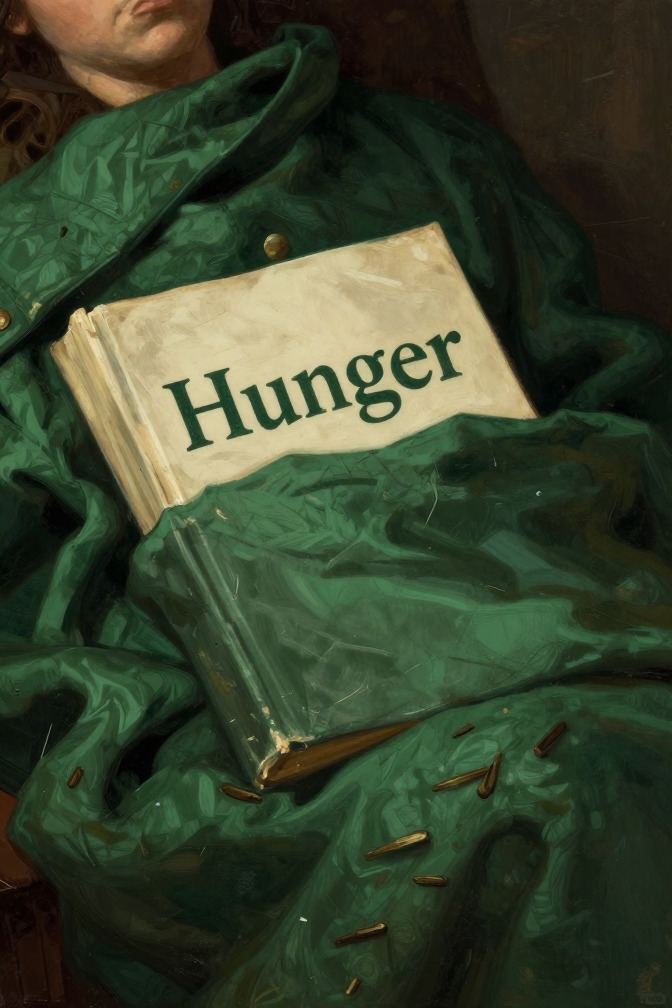
The green blanket, borrowed from Hans Pauli Pettersen, is a recurring object in Knut Hamsun's *Hunger* that embodies the protagonist's desperate poverty, his wavering moral integrity, and the constant temptation to commit theft for survival. It serves as a tangible symbol of his borrowed existence and the thin line between honor and degradation.
Dampkökken is a steam cooking kitchen and famous cheap eating-house in Christiania that appears in Knut Hamsun's novel Hunger as a recurring symbol of the nourishing, ordinary life from which the starving narrator is excluded.
The Grand Hotel in Christiania serves as a central landmark in Knut Hamsun's *Hunger*, a symbol of the social and economic divide that the starving narrator both observes and is excluded from. It is a place of warmth, light, and conviviality, a constant reminder of the life he cannot afford, and a site where his desperation and alienation are thrown into sharp relief.
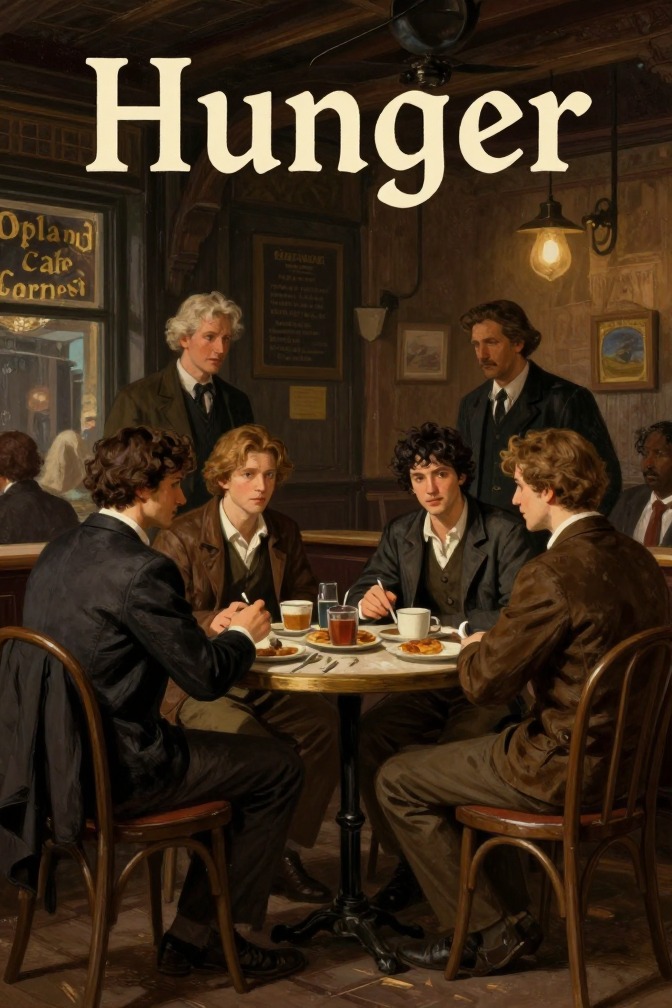
The Opland Café is a recurring location in Knut Hamsun's *Hunger*, serving as a site where the protagonist seeks out an acquaintance for financial help and, later, a place to buy a candle. It represents a fleeting hope for relief from his relentless poverty and hunger, but ultimately becomes another setting where his desperate circumstances are met with failure.
Kathe Detterick, one of the nine-year-old twin daughters of Klaus and Marjorie Detterick, was abducted, raped, and murdered in June 1932, a crime for which John Coffey was wrongfully convicted and executed. Her death, along with that of her sister Cora, forms the central injustice of the novel, and the circumstances of the crime—the killer's manipulation of the girls' love for each other to silence them—become a key revelation about the true nature of evil.