Inspiration
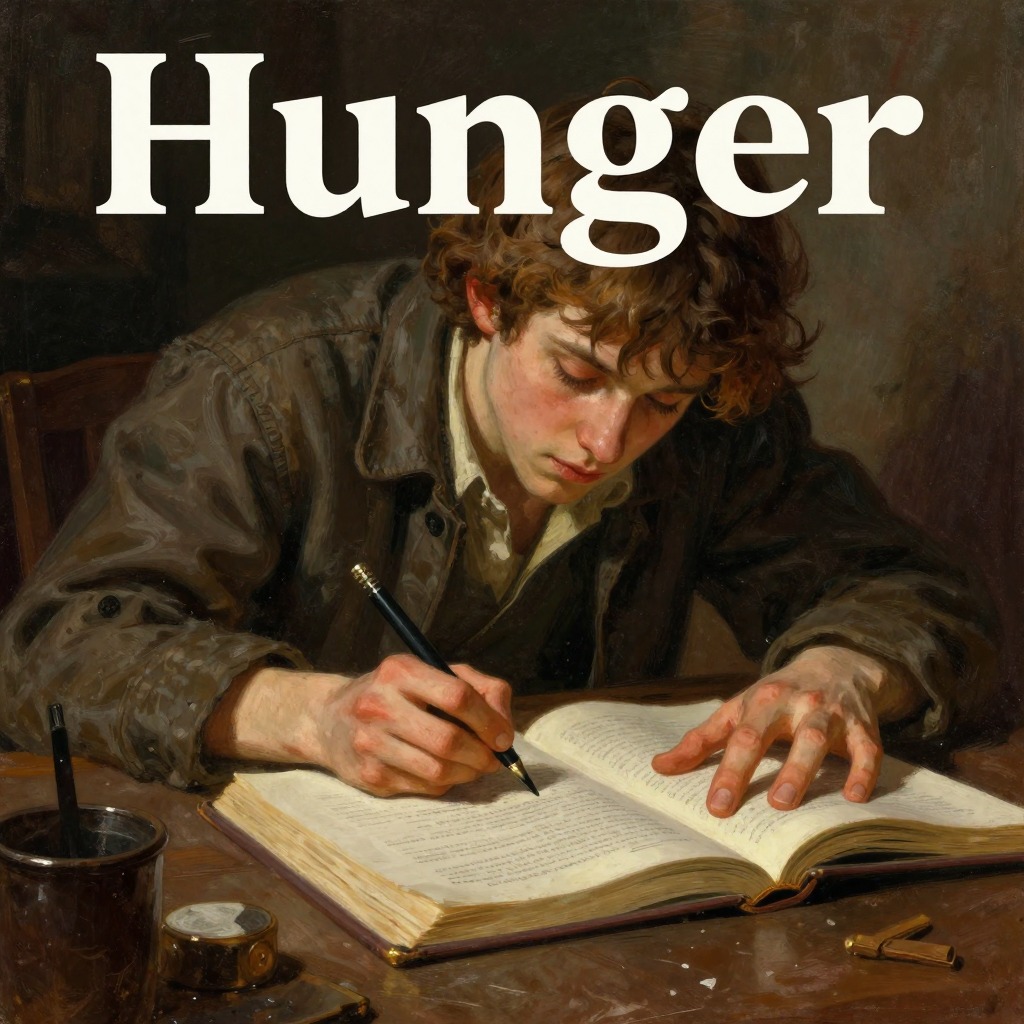
HungerIn Knut Hamsun's Hunger, inspiration is not a steady, controllable creative faculty but a violent, almost supernatural visitation that seizes the narrator during his most desperate moments of starvation. It functions as the sole, fleeting antidote to his physical and mental collapse, a paradoxical gift born of extreme deprivation that alternately saves and torments him. The novel charts inspiration as an erratic, physiological event, intimately tied to the body's decay, rather than a product of disciplined artistic will.
The Physiology of Inspiration
The narrator's creative surges are consistently preceded and accompanied by acute physical distress. He notes that after long periods of hunger, his brains seem to run gently out of his head, leaving a vacuum, and his head grows light and far off. Yet it is precisely from this hollowed-out, feverish state that inspiration erupts. On one occasion, after days of near-starvation, he wakes in the early morning and finds that a few good sentences strike him, followed by others that fit themselves together harmoniously. He writes as one possessed, filling page after page without a moment's pause, and the experience is described as a vein bursting within him. This creative torrent is inseparable from his bodily misery; the same hunger that empties his head also seems to prime it for a sudden, overwhelming influx of ideas. The narrator himself interprets this rapture as a miraculous heaven-brew in his spirit, a direct answer to his cries for aid, and he weeps with enthusiasm over his own words.
The Capriciousness of the Creative Spark
Inspiration in the novel is profoundly unreliable, arriving without warning and departing just as abruptly. The narrator's attempts to summon it through sheer willpower almost always fail. He sits in a park, desperate to write an article to pay his rent, and finds that after a few lines nothing seems to occur to him; his thoughts run in other directions, and he cannot pull himself together for any special exertion. He is distracted by the most trivial things—flies sticking to his paper, a couple of high clarionet notes from a bandstand. The creative flow is a matter of waiting for the right moment, and no one can tell the day or hour when the spirit may move one. This capriciousness makes inspiration a source of both ecstasy and profound despair. The narrator's confidence in his work is constantly shaken; after the initial euphoria of writing, he is plagued by doubt, wondering if his masterpiece is mediocre or even worthless, and he rushes to the editor's office in a panic, only to be told the piece has not yet been read.
Inspiration as a Counterforce to Despair
Despite its unreliability, inspiration is the narrator's primary weapon against total annihilation. It is the only force that can lift him out of the depths of his misery and restore a sense of purpose and worth. After a night spent in a police cell, tormented by hallucinations and the word "Kuboa," he is released into the morning light and, despite his hunger, feels a surge of creative energy. He returns to his room and works on an allegory about a fire, a profound thought upon which he intends to expend all his energy. This work becomes his sole reason for enduring, the promise of a finished article that will pay his debts and restore his standing. When inspiration fails, as it does when he cannot add up a simple grocery bill or finish a scene for his drama "The Sign of the Cross," he is plunged into the deepest despair, tearing his manuscript in two and trampling on his hat. The loss of inspiration is synonymous with the loss of hope itself.
The Relationship Between Inspiration and Madness
The narrator's inspired states blur the line between creative genius and insanity. During his most productive moments, he is acutely aware that he is talking at random, yet he gives utterance to no word without hearing and understanding it. He describes it as being like one who lies awake yet talks in his sleep. The intensity of his creative fever often leads to hallucinations and manic behavior. After writing a story that is accepted, he laughs and cries, takes to jumping and running down the street, and swears loudly and solemnly into space. Later, when working on his drama, he becomes so obsessed with the character of a magnificently fanatical harlot that his brain is absolutely inflated by this singular monstrosity of a creature. The creative process is a form of controlled delirium, a state where the narrator's rational mind is temporarily suspended, allowing a torrent of images and words to flow through him. This proximity to madness is the price he pays for the moments of transcendent clarity and productivity that keep him alive.
The Ultimate Failure of Inspiration
As the novel progresses, the narrator's capacity for sustained creative work deteriorates. The periods of inspiration become shorter and less productive, and the gap between his ambition and his ability widens catastrophically. He works on an allegory about a conflagration in a bookshop, intending to make a perfect Bartholomew's night of burning brains, but he cannot finish it. He then turns to a one-act drama, "The Sign of the Cross," but finds that the right local color will not tinge his words, and the bustle of the real world fits in so little with the atmosphere of the dim Middle Ages. His final attempt to force inspiration, by lying to himself that a new supreme moment has seized him, ends in failure. He breaks his pencil between his teeth, jumps to his feet, and tears his manuscript in two. This collapse of his creative powers coincides with his physical and spiritual exhaustion, leaving him with no alternative but to sign on as a sailor on the Copégoro, bound for Leith. Inspiration, which had once been his salvation, ultimately abandons him, forcing him to abandon the life of a writer altogether.