
Your reading list does not usually fail because the books are unimportant. It fails because reading keeps waiting for a quiet hour that never arrives. By evening, work has expanded, the screen has won, and the chapter you meant to begin is still closed.
A morning workout routine offers something that the reading plan often lacks: a dependable start. You already know when you will move, approximately how long the session will last, and which parts require your full attention. That makes it possible to give neglected books, permitted ebooks, articles, and personal documents a repeatable listening window instead of another vague promise to read later.
This is not an argument for forcing a lecture into every set or treating exercise as free study time. Physical effort and spoken information compete for attention. The practical goal is narrower: match the right material to the quieter parts of a workout, pause when movement becomes demanding, and return without losing your place.
Readify supports that workflow by turning supported PDF, EPUB, DOCX, TXT, MOBI, AZW, and webpage content into natural speech. Playback speed can change as the session changes, a text to speech timer can stop the audio automatically, and saved progress keeps the next morning from becoming a search for the last sentence.
Why a Morning Workout Routine Is a Better Reading Trigger Than "Later"
"I will read later" is not a plan. It has no start cue, no duration, and no definition of success. A workout is different. Shoes go on, the warm-up begins, and the session ends at a known time. Attaching audio reading to that existing sequence removes several decisions before they can become excuses.
The useful unit is not a chapter. It is a listening block. Ten attentive minutes of a memoir during an incline walk may be more sustainable than promising to finish forty pages after dinner. When the block ends, the reading can stop even if the chapter does not. Progress survives because the next session resumes from the saved position.
This matters especially for a person who identifies with an aural learning style or simply finds spoken explanation easier to start than silent reading. Audio lowers the physical requirement to hold a document, keep the eyes fixed on a page, and repeatedly relocate the sentence while moving. It does not make every text easy, but it can remove the first barrier between owning material and entering it.
The habit is strongest when it remains modest:
- one prepared document rather than a crowded queue;
- one predictable listening phase rather than an entire workout;
- one stopping time rather than a demand to complete a chapter;
- one short post-workout review for anything that needs visual attention.
What an Aural Learning Style Does - and Does Not - Tell You
The phrase aural learning style is useful when it describes a preference, not a fixed biological category. Some people remember a speaker's emphasis, follow an argument more easily when it has rhythm, or find that narration helps them continue through long prose. Those preferences can guide a routine. They do not prove that listening is always superior to reading or that a person should stop using text.
During exercise, the distinction becomes important. Narrative material often survives divided attention better than a page of formulas, citations, or unfamiliar names. A memoir, a familiar business chapter, a language-learning story, or a review of notes may remain coherent during steady movement. A methods section, legal clause, chart-heavy report, or new technical procedure may not.
An effective aural learner therefore does not ask, "Can this be spoken?" Almost any text can be spoken. The better question is, "What will I still understand while my body is doing this particular task?"
Use audio during a workout when the content mainly depends on sequence, explanation, voice, or story. Keep the original text available when exact wording, visual structure, equations, tables, or annotation matter. Readify keeps narration and source material connected, so listening during movement does not require abandoning close reading later. The broader comparison in Audiobooks vs Reading explains why switching modes is often more useful than choosing one permanently.
Build a 30-Minute Morning Workout Routine Around the Audio
The following structure is not a universal training prescription. It is a reading workflow that can be placed inside a workout you already know how to perform safely. Adjust the exercise itself according to your experience, health, equipment, and professional guidance.
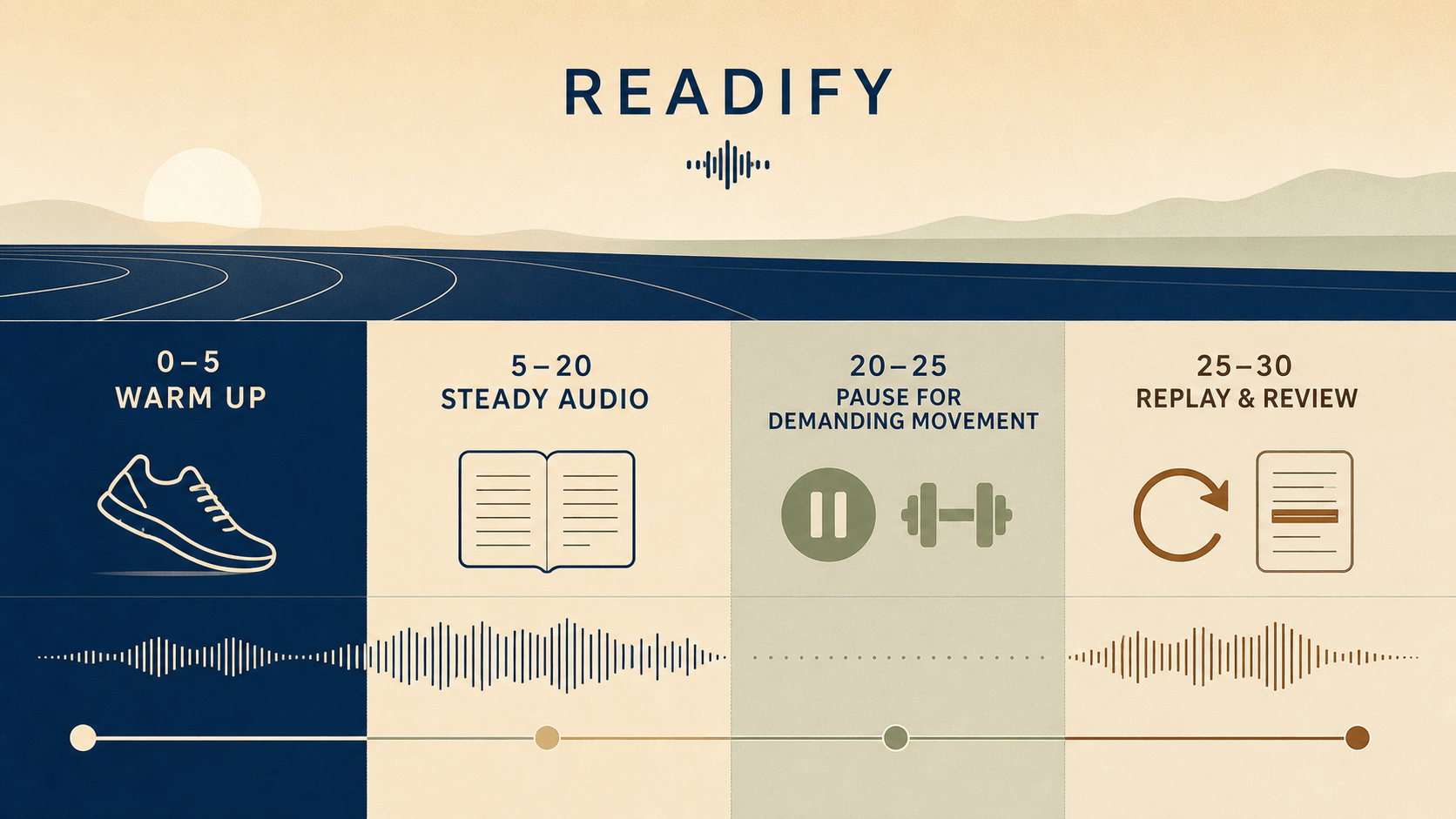
Minutes 0-5: Re-enter the Material During the Warm-Up
Open Readify before you begin moving. Choose the exact document and starting point, select a clear voice, and begin at a comfortable pace. During easy walking, mobility work, or another familiar warm-up, use the first minutes to recover context:
- Who is speaking?
- What question is the chapter addressing?
- What happened immediately before this section?
- Does this material feel simple enough for the next training block?
If the opening is dense, reduce the speed. If it is a recap you already know, increase it slightly. Readify's adjustable reading speed lets the pace change without regenerating the audio or leaving the reading view.
Minutes 5-20: Protect One Continuous Listening Block
Steady, familiar cardio is the strongest candidate for continuous audio. An easy treadmill walk, stationary bike, or elliptical session may leave enough attention for a story or an argument that does not require constant visual reference.
The key is continuity. Do not keep changing books, voices, or playback settings. Let one passage run long enough for its structure to emerge. For an aural learning style, this sustained section is where tone, dialogue, and verbal transitions can carry meaning that a series of two-minute fragments would lose.
Content density should remain below training demand. If breathing becomes harder, the environment changes, or comprehension starts collapsing, slow down the narration or pause. The audio serves the routine; the routine does not owe the audio a finished chapter.
Match narration to the part of the workout that can safely support it.
Minutes 20-25: Let Demanding Movement Interrupt the Book
New lifts, heavy sets, fast intervals, balance work, machine setup, coach instructions, and outdoor traffic deserve undivided attention. This is where old productivity advice becomes dangerous: "multitasking" is not a virtue when one task involves technique, equipment, or changing surroundings.
Pause before the demanding movement begins. Do not reach for the screen while equipment is active. Because Readify preserves reading progress, interruption is inexpensive; you do not need to keep listening merely to avoid losing your location.
Research supports this cautious boundary. A randomized crossover trial involving emergency-medicine residents found no meaningful difference in immediate or 30-day retention between listening to educational podcasts while doing continuous aerobic exercise and listening while seated. That result suggests simultaneous exercise and listening can be workable in a controlled setting, but it does not prove that every workout improves learning. A separate auditory dual-task experiment found that maintaining performance during cycling could consume additional cognitive resources even when the primary task score appeared stable. In other words, feeling capable of doing both does not mean attention is unlimited. See the studies on podcast learning during exercise and auditory attention under physical load.
Minutes 25-30: Replay During the Cooldown, Inspect After You Stop
Use the final easy minutes to recover the thread. Replay a missed paragraph, lower the speed for a difficult explanation, or listen to a short summary of the section. Once movement has stopped and you are safely away from active equipment, return to synchronized text, highlight a passage, or ask an AI-supported question about the document.
This separation is important. Audio can maintain contact with the material during movement; visual review restores precision afterward. A five-minute cooldown is not the place to solve every unfamiliar concept. It is the place to identify what deserves a closer look.
Use a Text to Speech Timer as a Boundary, Not a Race
A text to speech timer is most useful when it gives permission to stop. Without a boundary, listeners often choose material that is too long, continue into a training phase that needs attention, or judge the session by how many pages the voice covered. The result is faster playback with weaker comprehension.
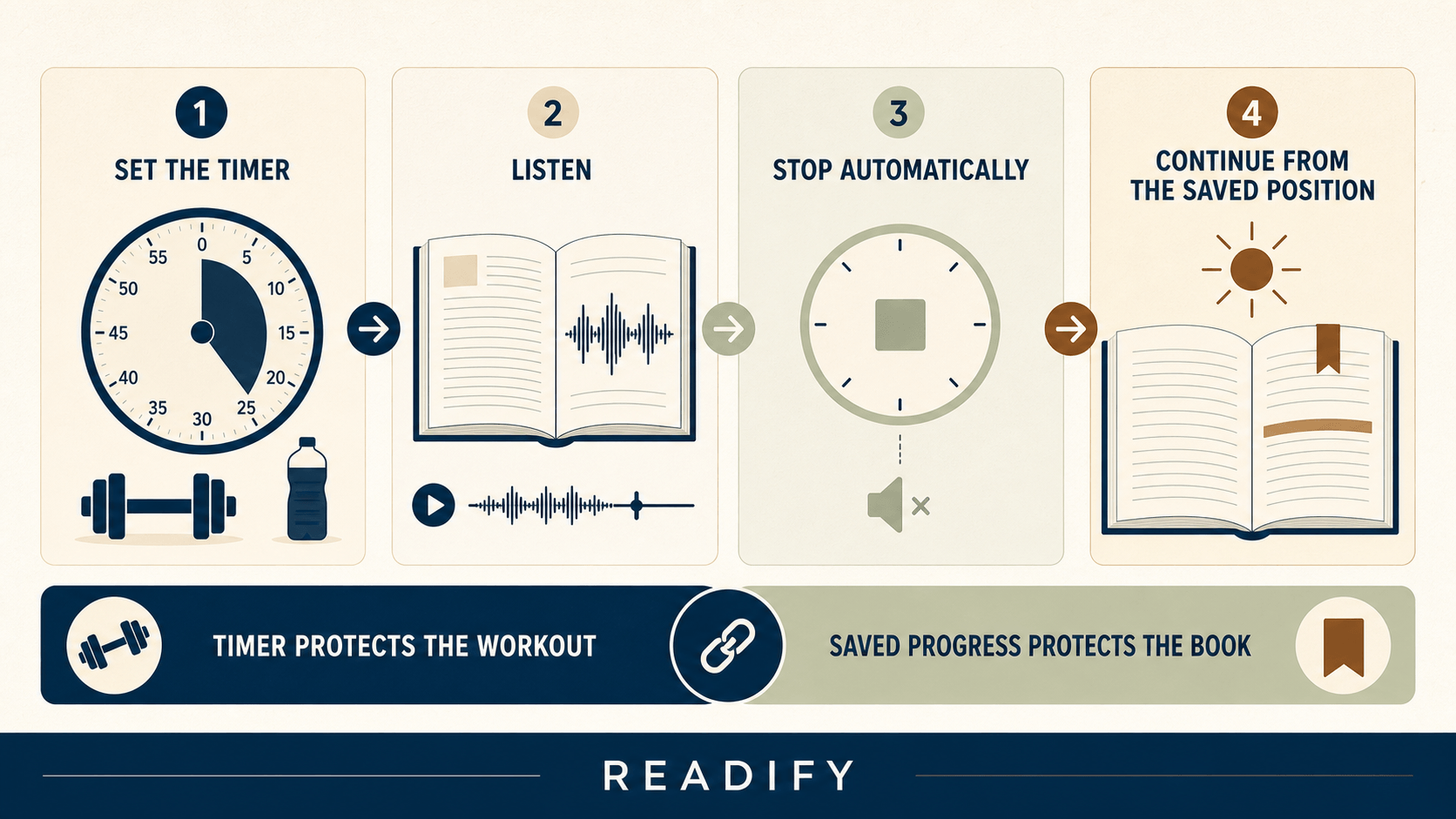
Readify's timer can stop playback automatically while preserving the reading position. Before the workout, set the timer to the portion that is genuinely suitable for listening - perhaps fifteen minutes of steady cardio rather than the full thirty-minute session. When it ends, let it end. The next morning can continue from the same place.
The timer protects the workout; saved progress protects the book.
A practical setup takes less than two minutes:
- Add one authorized file or compatible webpage to Readify.
- Open the exact chapter or passage before moving.
- Choose a voice that remains clear through headphones at a safe volume.
- Set the text to speech timer for the intended listening block.
- Start at a speed that preserves meaning, not the fastest speed you can tolerate.
- Pause early if technique, traffic, equipment, or comprehension requires it.
- Resume from saved progress during the cooldown or the next session.
The timer and saved position solve different problems. The timer protects the workout from expanding audio; saved progress protects the book from interruption. Together they make incomplete listening a normal part of the system rather than a failed session.
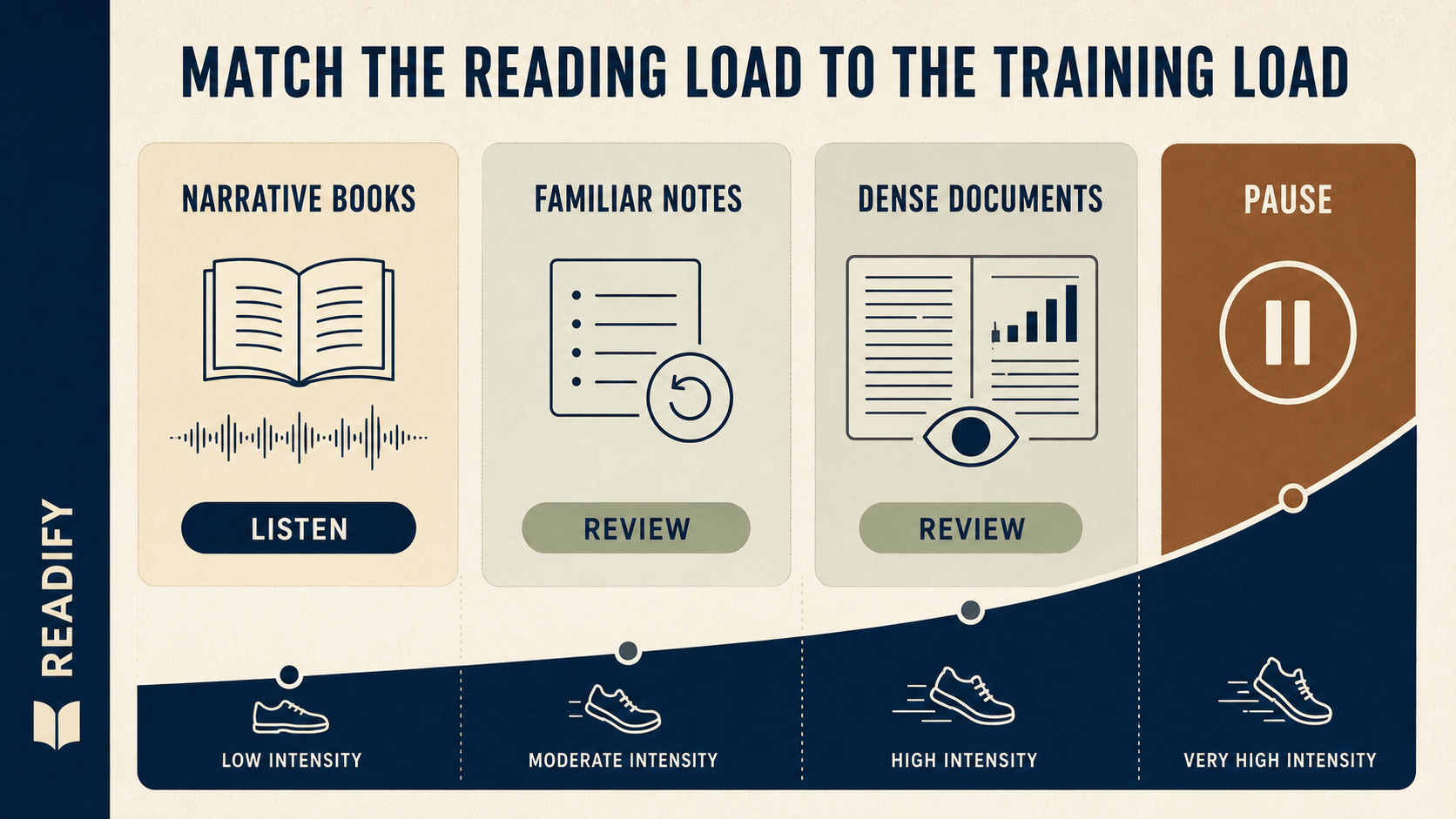
Match the Reading Load to the Training Load
One audio rule cannot cover every exercise. Build the queue according to attention demand.
Easy Walking or Low-Intensity Treadmill Work
This is the best place for longer narrative sections, familiar nonfiction, personal essays, or permitted language-learning material. The movement is repetitive and the stopping point is easy to control. If you want to use a morning workout routine to begin a neglected book, start here.
Stationary Cycling or Elliptical Training
Stable equipment can suit a continuous passage, provided the intensity remains moderate and the listener does not need to manipulate controls repeatedly. Prepare the document, voice, speed, and timer before starting.
Strength Training
Treat audio as a between-set option, not a soundtrack that must survive every repetition. Narrative continuity may suffer from frequent pauses, so choose short essays, familiar review, or a chapter you can resume easily. Pause during technically demanding sets and whenever a spotter or coach needs to communicate.
High-Intensity Intervals
New or complex information is a poor fit. Breathing, pacing, and rapid transitions already demand attention. If audio is used at all, keep it to familiar material during recovery intervals - or save the reading for the cooldown.
Stretching and Recovery
This is the point to slow the voice, replay a marked section, and reconnect speech with visible text. It also creates a natural bridge from movement to a brief period of focused reading.
As training demand rises, reduce the reading load - and pause at very high intensity.
Best Audiobook Apps or a Text-to-Speech Reader?
Searches for the best audiobook apps often mix two different needs. One reader wants a professionally produced performance of a published title. Another already owns an ebook, has a PDF from work or school, saved an article, or wrote personal notes - and wants that specific material to become listenable.
Catalog audiobook apps are usually the better choice for the first need. Human narrators, author performances, and full-cast productions can add interpretation that synthetic speech should not pretend to replace.
Document-oriented readers address the second need. Voice Dream Reader imports PDFs, EPUBs, Word documents, PowerPoint files, and webpages, with highlighting and playback controls. @Voice Aloud Reader supports PDFs, ebooks, webpages, documents, reading lists, progress tracking, and a sleep timer on Android. Both are relevant alternatives for readers who want personal text spoken aloud.
Readify's distinction is the connected workflow: supported books, files, and webpages enter one library; the listener selects a natural AI voice and pace; a text to speech timer defines the session; progress remains available across reading moments; and the user can return to synchronized text or ask about the document after movement stops. Its guide to turning personal reading into a listening library explains the broader bring-your-own-content model.
That makes Readify a candidate among the best audiobook apps for a specific kind of user: someone who needs more than a catalog and wants an audiobook-like routine for material they are authorized to use. It is not a source of permission to upload copyrighted files you do not own or have rights to use, and it cannot make chart-dependent or highly visual information safe to consume without looking.
A Two-Minute Readify Setup Before You Move
The success of the routine depends on preparation. If you make choices while already on the treadmill or under a loaded bar, the interface becomes another distraction.
Before the workout:
- Choose one book, article, or document.
- Import the supported file or open the compatible webpage.
- Check that the reading order makes sense, especially for a scanned or complex PDF.
- Select a voice whose rhythm fits the material.
- Choose a starting speed and test one paragraph.
- Set the timer for the low-demand portion of the workout.
- Put the device away before movement becomes demanding.
After the workout:
- Reopen any passage that became unclear.
- Follow the synchronized text while replaying it.
- Highlight or note the section that needs closer reading.
- Ask a document question only after stopping safely, and verify important answers against the original text.
- Leave the book at its saved position for the next morning workout routine.
This is where Readify offers more value than a generic promise to "listen while multitasking." The product supports a complete transition: prepare, listen, stop, inspect, and continue.
When the Audio Should Stay Off
No reading streak is worth reduced awareness. Turn the audio off when:
- learning an unfamiliar movement;
- lifting at an intensity that demands full concentration;
- using equipment that requires frequent adjustments;
- running or cycling near traffic;
- navigating a crowded gym;
- listening for a coach, partner, alarm, or warning signal;
- experiencing pain, dizziness, unusual breathlessness, or another sign that the body needs attention;
- noticing that you cannot explain the last few minutes of the text.
An aural learning style does not remove these limits. The most useful feature may be the confidence to pause because the app will remember where to continue.
Make the Habit Small Enough to Repeat Tomorrow
A productive morning workout routine does not need to finish a book before breakfast. It needs to make returning easy.
Start with one fifteen-minute listening block. Choose material whose meaning can survive movement. Use Readify's voice and speed controls to make it comfortable, set the text to speech timer before the workout begins, and let saved progress carry unfinished material into the next session. When a passage needs precision, stop moving and return to the text.
The result is not a claim that exercise turns every listener into a better learner. It is a practical way to give reading a reliable place in a day that already has structure.
Turn tomorrow's workout into the first listening block of your next book. Try Readify for free.
Frequently Asked Questions
Can I listen to audiobooks during a morning workout routine?
Yes, when the workout phase, environment, and material allow safe attention. Steady, familiar movement is generally more suitable than technical lifts, intense intervals, traffic-heavy routes, or situations requiring communication. Pause whenever exercise or surroundings need priority.
What content works best for an aural learning style?
People who prefer spoken input may find narrative books, familiar nonfiction, personal notes, language-learning stories, and previously reviewed material easier to follow. Text with formulas, charts, citations, or unfamiliar terminology often still requires visual inspection.
What is a text to speech timer?
A text to speech timer stops narration after a selected duration. In a workout routine, it can confine listening to the warm-up, steady-cardio block, or cooldown instead of allowing audio to continue into a demanding exercise phase.
Does Readify include a timer and saved progress?
Readify's published feature set includes timed playback and reading-progress support. The timer can stop the session, while the saved position makes it possible to continue later without searching for the last sentence.
What should I look for in the best audiobook apps for workouts?
Look for controls that can be prepared before movement: clear playback, a timer, reliable pause and resume behavior, progress saving, suitable offline or background playback, and support for the type of content you actually want to hear. For personal documents, also check supported formats and whether the original text remains accessible.
Can Readify turn my own PDF or ebook into workout audio?
Readify supports common document and ebook formats, including PDF, EPUB, DOCX, TXT, MOBI, and AZW, along with compatible webpages. Only upload content you own or are authorized to use, and return to the original document whenever layout or exact wording matters.
