Wartime press censorship
1919Wartime press censorship in U.S.A. is presented as a practical restriction on what a correspondent can see and report, not merely as an abstract policy. Through Jerry Burnham’s frustration and the novel’s documentary collage, censorship shapes the public account of war even as the surrounding scenes show how wartime authority reaches beyond newspapers into the lives of people treated as suspects or political threats.
Reporting Under Censorship
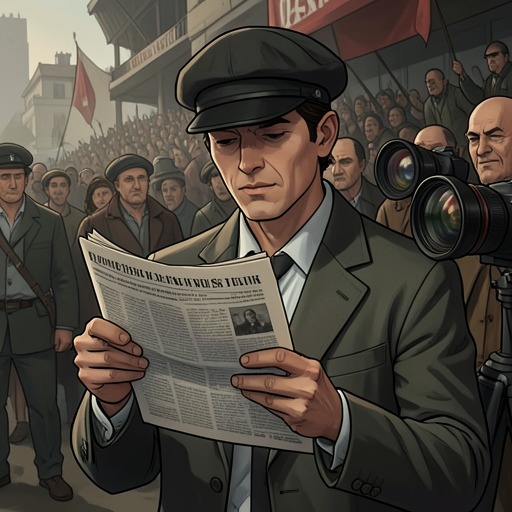
Jerry Burnham, a journalist working in Paris, visits Eveline Hutchins’s office every few days while covering Red Cross activities. Their conversations expose the limits placed on his work: he says correspondents can no longer get access to what is happening, that several layers of censorship constrain him, and that he has to send out prepared material he regards as false. The result, as he describes it, is professional disillusionment. He feels that repeated participation in this system has stripped a newspaperman of self-respect, and he longs to write a truthful account of the war if it ever ends.
Eveline tries to encourage him by suggesting that he write a book and tell the truth. Jerry counters that the war’s profitability makes its end seem uncertain, connecting censored reporting to the interests that benefit from continued conflict. His complaint links the control of information with the broader wartime economy and politics: the correspondent is not simply short of access but is made to circulate material that conceals what he believes should be reported.
Law, Suspicion, and Wartime Control
The novel also depicts the coercive legal environment surrounding wartime information controls. When Joe Williams arrives in Liverpool aboard the Argyle, a policeman takes him from the ship without allowing him to get paid off or say goodbye to his shipmates. During questioning, an inspector invokes the Defence of the Realm Act and warns Joe that the consequences will depend on his cooperation. The authorities examine the photographs and papers in his cigarbox and subject him to an extensive search while treating him as a possible spy. The scene is an interrogation rather than an instance of newspaper censorship, but it shows how wartime law can convert suspicion into detention and invasive scrutiny.
A separate episode involving Ben Compton marks another boundary of the subject. After Ben speaks at a public meeting against the war and is arrested, detectives hold and question him for three days. His case concerns the suppression of political dissent rather than censorship of a newspaper report. Read alongside Jerry’s account, it shows a wider climate in which both the circulation of information and the expression of opposition encounter official pressure; the novel does not equate these forms of control, but places them within the same wartime setting.
Newsreels and the Public Record
The Newsreels interrupt the novel with actual newspaper headlines, fragments of news stories, advertising slogans, and popular song lyrics. Their rapid, discontinuous arrangement gives the reader a crowded public landscape in which news shares space with commercial messages and popular culture. This collage does not establish that every item has been censored. Rather, beside Jerry’s testimony about prepared copy and restricted access, it makes the construction and circulation of public information part of the book’s subject.
The contrast is between the fragmented record available to the reader and the correspondent’s account of what he cannot report freely. Jerry’s experience gives censorship a human and professional cost; the Newsreels show how scraps of public language accumulate into an image of the period. Together, these forms make the distance between events and their authorized or publishable account visible without presenting the news collage as a transparent, complete record.