Freedom of speech
1919Freedom of speech is a constitutional promise that the novel places under pressure from employers, police, and wartime government. Workers invoke it to justify meetings and public protest, but the scenes repeatedly show how quickly authorities can restrict access, disperse crowds, or detain speakers. The principle matters not as an abstract guarantee alone, but as a contested right whose practical reach depends on who controls the hall, the street, and the machinery of arrest.
A right claimed in the strike movement
After Christmas, Webb Cruthers becomes involved in a textile strike in New Jersey. At the mills, police and special deputies occupy the area, while strike organizers distribute handbills from a crowded headquarters. Ben Compton asks Webb to speak at a meeting, urging him to connect the workers’ struggle with the larger question of democracy in industry. Webb is hesitant, but agrees to try. The request makes public speech part of the movement’s work: communicating the meaning of a strike is treated as a necessary form of participation, not merely an opportunity for an individual to address a crowd.
The meeting cannot be held in the mill town because, as the strikers understand it, the mills control the town and no hall can be rented there. It is arranged in a neighboring town instead. When Webb and Anne Elizabeth Trent arrive, mounted police prevent people from entering, saying the hall is full. The crowd outside includes thousands of workers and their families, while the strikers believe that only about forty people are inside. The dispute is therefore not simply over the content of a speech. Control of the meeting place and access to it determines whether the workers can assemble and hear one another at all.
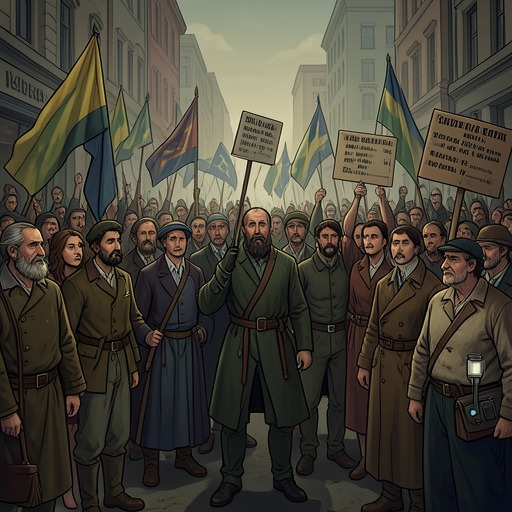
Ben Compton addresses the crowd from a lamppost. He presents the exclusion from the hall as an insult to working people and points to the discrepancy between the small number admitted and the claim that the venue is full. Police drag him away as the crowd reacts and then begins to move off under the pressure of mounted officers. Webb takes up the protest from a hydrant, arguing that the strikers had permission to use the hall and should not be kept out. His brief intervention asserts the right to speak in public and challenges the authority that has made the meeting inaccessible. The sequence shows speech emerging where formal access has been denied, while also exposing how police control can turn a meeting into a confrontation over whether any public appeal may be heard.
Picketing and the costs of participation
Days later, Webb invites Anne Elizabeth Trent to join a picket line. They arrive in the early morning among workers whose protest includes songs, shouted warnings, and jeering calls directed at strikebreakers. When the crowd breaks apart, Anne Elizabeth sees a young woman fall and steps toward her. Police intervene; Anne Elizabeth strikes at one of them and is taken away in a police wagon. The scene links public dissent to the bodily risk of joining a demonstration, without making her action a speech or treating the right as a protection against arrest. In the novel’s account, the ability to gather and voice solidarity exists alongside police power to break up the gathering and seize participants.
Everett: constitutional language against local force
The conflict becomes still more direct when Ben Compton and Bram Hicks travel with other members of the Industrial Workers of the World to Everett, Washington, to support a free-speech meeting. Deputies armed with rifles and revolvers wait at the dock, and the workers are arrested as they step off the boat. They are taken away from town and confronted by armed officials. Ben hears a threat that some of the workers may die if they return, a warning that makes the limits imposed on their speech unmistakable.
One worker states that the group has come to make no disturbance and wants only its constitutional rights of free speech. The appeal distinguishes the workers’ stated purpose from the authorities’ treatment of them: they claim the right to speak, while local officials answer with threats and force. Ben is then beaten along with the other workers. He attempts to keep walking rather than run, and eventually reaches safety with a small group of fellow workers after they cross the county line. From there, the group makes its way toward a trolley station; the most seriously hurt are helped to obtain tickets to Seattle. The episode presents constitutional language as a clear and shared claim, but one that does not prevent officials from suppressing the meeting before it can take place.
Surveillance and arrest at the Empire Casino
A later gathering in the Bronx turns the same conflict toward federal authority. The meeting at the Empire Casino is organized to send greetings from American workers to Russia’s new workers’ and peasants’ government. Federal agents sit in the front row with a stenographer, recording the proceedings. Police close the doors after the first couple of hundred people have entered, while officers disperse the crowd outside. Uniformed soldiers and sailors enter the gallery and watch the speakers. The meeting can proceed only under surveillance, with the possibility of interruption visible inside and outside the hall.
The chairman opens by acknowledging the government representatives and the audience gathered to support the Russian workers. The room rises in response, while people outside cheer and singing can be heard. When Ben speaks, he signals that the agents’ presence limits what he is prepared to say, then argues that capitalist governments are driving workers into an unnecessary war for the benefit of bankers and munitions makers. He frames the audience’s class position as a basis for understanding his meaning even where he withholds some of his intended words. The speech is thus both an expression and a negotiation with surveillance: Ben speaks, but he does so while accounting for the officials listening.
Authorities interrupt the meeting, and Ben and other organizers are arrested. Men of conscription age must show their registration cards before leaving, bringing state classification and documentation into the enforcement of a political gathering. Ben is held for three days in a federal building and repeatedly questioned. Morris Stein later tells him that charges can be quashed if he promises to report for military training. Ben refuses to exchange his release for silence about the war, saying he will continue to oppose it and will be arrested again if necessary. He is released on bail under an assurance that he will not agitate until trial. The outcome makes the constraint explicit: the state’s response reaches beyond the immediate meeting, using detention, prosecution, and conditions of release to limit future political speech.
Meaning and limits
Across the strike scenes, Everett, and the Empire Casino, free speech is bound to assembly: workers need a hall, a street, or a meeting space in which to address one another. The repeated obstruction of those spaces shows that a formally stated right may be curtailed before a speech is finished—or before a meeting begins. Webb’s protest over the rented hall, the workers’ constitutional appeal in Everett, and Ben’s refusal to abandon antiwar advocacy each give the principle a concrete speaker and circumstance.
The novel also distinguishes different kinds of pressure. Local police and deputies use exclusion, dispersal, and violence; federal authorities monitor a political meeting and pursue arrest and prosecution. Joe Williams’s detention in Liverpool and the interrogation conducted under the Defence of the Realm Act provide a related wartime contrast: official questioning and security powers can restrict an individual even when the central issue is not a public speech. Taken together, these episodes do not portray speech as absent. They show it recurring—in a crowd outside a closed hall, in a constitutional claim, and in a speech shaped by the knowledge that officials are listening—while leaving open how much protection the right can offer against institutions prepared to enforce their own authority.