Institute of Forensic Anatomy
2666The Institute of Forensic Anatomy is the destination for bodies and skeletal remains requiring forensic examination in Santa Teresa. Its examiners turn physical evidence into findings about cause of death, injuries, and identity, yet their work does not guarantee certainty or accountability. Across the women’s murders, the institution’s reports make violence legible in official terms while also recording how much remains unknown.
Role in the Investigations
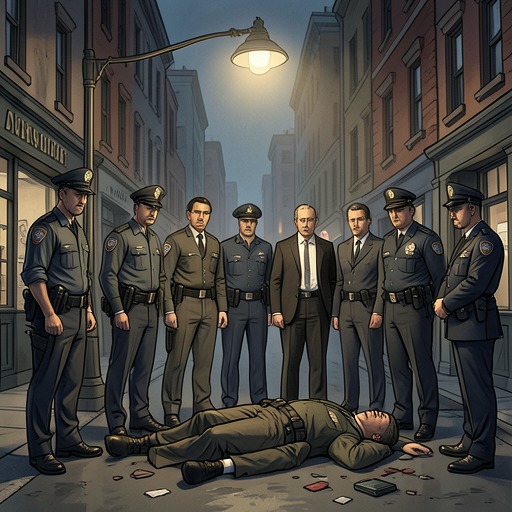
When Estefanía and Herminia Noriega are found dead, the medical examiner describes the evidence to Inspector Juan de Dios Martinez before the bodies are taken to the Institute. The examination distinguishes between the sisters’ deaths: both had been subjected to repeated abuse, but the causes were not equally clear. The following day, the completed autopsies revise and specify the initial assessments. Herminia, the examiner confirms, died of a heart attack brought on by the abuse, not from the bullet lodged in her head. The sequence shows forensic work as an unfolding process: observations at a scene become provisional explanations, then are reconsidered through examination.
The Institute also receives remains whose condition sharply limits what an examination can establish. At the end of March, scavenger children find a body in the El Chile dump, already completely decomposed. The remains are transferred to the Institute, where examiners estimate that the victim was between fifteen and twenty years old. They conclude that she had been dead for more than twelve months, but cannot determine how she died. The report narrows some uncertainties while leaving the central question unanswered.
Identification and the Limits of Certainty
In the case of the El Chile victim, identification becomes possible through dental evidence and cooperation between authorities in different places. The girl’s family in Guanajuato recognizes the possibility that the remains could be those of their missing daughter, Irene Gonzalez Resendiz. After the Guanajuato police request the Santa Teresa forensic report, comparison of the dental evidence confirms her identity. Irene had disappeared after a quarrel with her family in January 1996. The identification connects an anonymous body to a particular person and a known disappearance, but it comes more than a year after her death.
Other examinations clarify cause and circumstances without supplying a name. In an early case, an autopsy finds that thirteen-year-old Esperanza Gomez Saldana had been strangled and establishes evidence of severe violence. At the Santa Teresa hospital, another unidentified woman is examined after being found in a dump beside waste from the maquiladoras: the assistant medical examiner reports that she was strangled, raped, and five months pregnant. These findings are specific, but neither medical precision nor a recorded cause of death by itself resolves the broader questions of responsibility and recognition.
The Institute’s reports also mark the boundary between what can be concluded and what must remain provisional. A woman’s skeleton discovered in a shallow grave on a farming cooperative’s land is identified as belonging to a woman, and the absence of clothing or other material in the grave supports the conclusion that she was murdered. But decomposition makes the time and manner of death difficult to establish; the medical examiner declines to give a definitive date and notes that more exact analysis would require sending the bones elsewhere. The investigation’s official statement then advances a possible account involving a driver and a hitchhiker, without demonstrating that explanation. Forensic caution and police speculation occupy sharply different evidentiary ground.
Examiners and the Workday
The Institute’s work is carried by three medical examiners whose contrasting routines place forensic labor within the ordinary life of Santa Teresa. Emilio Garibay, the oldest, was born in the city and taught at its medical school; the volume of deaths left him little time for other pursuits. Juan Arredondo, from Hermosillo, also combined examination work with teaching at the University of Santa Teresa. Rigoberto Frias, thirty-two, had worked in Mexico City before moving to Santa Teresa two years earlier; his colleagues regarded him as meticulous and skillful. These details do not turn the examiners into a unified institutional voice: they are distinct professionals, joined by a demanding workload and by the cases that pass through their hands.
Their occasional breakfasts at Runaway, an American-style coffee shop open through the night, make that workload visible through repetition and silence. After meeting there, one examiner would return to the Institute while the other two left for the underground garage and drove away separately. Their quiet ritual offers no resolution to the cases; it is a pause between examinations, after work that the narrative presents as both technically exacting and persistently unfinished.
Forensic Practice in a City of Unequal Attention
The Institute’s findings exist alongside a broader investigative system in which some deaths receive no autopsy, some evidence disappears, and official explanations can outrun what has been established. After radio reporter Isabel Urrea is murdered, the killing is publicly framed as a robbery, but no autopsy is performed at the family’s request, and the ballistic analysis is eventually lost in transit between Santa Teresa and Hermosillo. The contrast matters: forensic examination may clarify the limits of what is known, but the Institute cannot provide findings when the process that would produce them is withheld or fails.
The institution’s work also takes place amid entrenched disregard for the women whose deaths it documents. The narrative sets the medical examiners’ quiet, professional routines against police officers’ breakfast jokes that reduce women to sexual objects and targets of violence. That juxtaposition does not establish that the Institute itself shares the police culture; instead, it locates forensic expertise within a city where careful examination coexists with habits of contempt and institutional inaction. Its reports preserve bodily evidence, but documentation alone neither prevents further killings nor ensures that every victim will be named or every case pursued.
Institutional Reach and Its Limits
The Institute’s evidentiary role is not confined to autopsies: its findings can enter investigations, support identification across jurisdictions, or expose the limits of a local inquiry. In the shallow grave case, the Santa Teresa medical examiner could establish that the remains belonged to a woman and that the circumstances supported murder, but could not determine a reliable date or manner of death. The report indicated that more exact dating would require the bones to be examined elsewhere, at the Institute of Forensic Anatomy in Hermosillo or, preferably, in Mexico City. The police statement that followed offered a possible account of a driver killing a hitchhiker and burying her far from where she died, but the examination itself did not establish that scenario. The contrast makes the boundary between forensic conclusion and official conjecture especially clear.
The Institute’s reports also move through institutions whose attention is uneven. Following the discovery of the El Chile remains, dental evidence and a request from Guanajuato authorities made it possible to identify Irene Gonzalez Resendiz, who had vanished after a family quarrel. Elsewhere, the murder of reporter Isabel Urrea produced no autopsy at the family’s request, and the ballistic analysis was later lost between Santa Teresa and Hermosillo. Together these cases distinguish the Institute’s capacity to preserve and interpret evidence from the wider systems that determine whether examinations happen, records survive, and cases are pursued. Its work can restore a name or delimit what can be known; it cannot by itself ensure recognition, accountability, or protection from further violence.