Event 1
1994 Bremen German Literature Conference
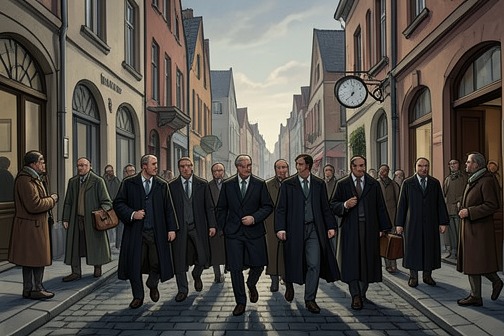
The [1994 Bremen German Literature Conference](entity:event-recall-event-1994-bremen-german-lite-fbefcd753022) is the turning point at which a dispute among scholars of [Benno von Archimboldi](entity:character-recall-character-benno-von-archimbol-b19f141ab3bf) becomes the beginning of a four-person friendship. [Jean-Claude Pelletier](entity:character-recall-character-jean-claude-pelleti-ee4823274bfc), [Piero Morini](entity:character-recall-character-piero-morini-acc20fe2b7b1), and [Manuel Espinoza](entity:character-recall-character-manuel-espinoza-5c3d56673a24) confront the German critics who had dominated the debate; [Liz Norton](entity:character-recall-character-liz-norton-631dcc4863dc) arrives as a formidable ally, and their later calls extend the conference’s brief solidarity into an enduring network of care.
## The conference as intellectual contest
Pelletier, supported by Morini and Espinoza, takes the offensive against the German Archimboldi scholars. The narrative likens his assault to Napoleon at Jena: Pohl, Schwarz, and Borchmeyer are routed from the conference into [Bremen](entity:location-recall-location-bremen-23077ba6214d)’s cafés and taverns. The young German professors, initially bewildered, cautiously side with the visitors, while students who have traveled from Göttingen by train or van are swept up in Pelletier’s uncompromising interpretations and the festive, Dionysian vision of exegesis he and Espinoza advance. Scholarly disagreement is thus staged as a struggle over authority and allegiance, with its rhetoric spilling beyond the lecture room into the social life of the city.
Two days later, Schwarz and his allies counterattack by comparing Archimboldi with Heinrich Böll, Günter Grass, and Friedrich Dürrenmatt, attaching to those comparisons the virtues of suffering, civic duty, and humor. Morini regards Borchmeyer’s appeal to humor as galling. Norton then appears and dismantles the counterattack. A blond English scholar who speaks excellent German at almost excessive speed, she ranges across Grimmelshausen, Gryphius, and Paracelsus, showing that the conference’s contest is not simply between national camps: her expertise and her forceful reading reshape the balance of the debate.
## Norton joins the circle
That night the four critics eat together in a long, narrow tavern near the river, reached down stairs made wet by drizzle. Norton thinks the place could hardly be worse, yet the evening is agreeable. The friendliness of Pelletier, Morini, and Espinoza puts her at ease; she knows much of their work, and is pleasantly surprised to discover that they know some of hers. The exchange that began in public combat turns into reciprocal recognition among scholars who had previously encountered one another through their publications and reputations.
Their conversation unfolds in stages. They laugh over Norton’s attack on Borchmeyer and his growing dismay as she presses it, then discuss future conferences, including a supposedly enormous gathering at the University of Minnesota that Morini suspects may be a hoax. They return to the subject that brought them together, reviewing anecdotes and fragmentary gossip about Archimboldi, whose life and whereabouts remain obscure. Each contributes what is known, and the four compare old, vague information yet again, speculating over the absent writer as people repeatedly analyze a favorite film. Their shared scholarly pursuit is therefore bound to a shared uncertainty: the more they discuss Archimboldi, the clearer it becomes that the central object of their attention cannot be firmly located.
## From professional acquaintance to friendship
As the four walk through Bremen’s wet streets, whose intermittent brightness the narration compares to a machine jolted by powerful electric charges, they turn from Archimboldi to themselves. All are single and live alone, although Norton sometimes shares her [London](entity:location-recall-location-london-420923d4a60a) flat with her brother, who works for an NGO and returns to England only a few times a year. Their career positions are unequal: Pelletier and Espinoza have doctorates and chair their departments, Morini is also an established scholar, while Norton is still preparing her dissertation and does not expect to head her university’s German department. Their intellectual affinity crosses these differences in seniority and institutional standing.
Pelletier’s recollection before sleep settles not on the conference quarrels but on the walk beside the river: Norton walking with him, Espinoza pushing Morini’s wheelchair, and all four laughing at the small animals of Bremen, which watch them—or their shadows—as they perch on one another’s backs. The image gathers the conference’s larger change into a single scene. The critics who had met through the competitive language of interpretation are now moving together through the city, their different bodies and positions part of a shared moment rather than an obstacle to it.
## The conference’s afterlife
From that day or night onward, not a week passes without the four calling one another, sometimes at odd hours and without concern for the telephone bill. The narrative makes this repeated contact the conference’s most consequential outcome: the meeting is not merely a memorable episode in academic life but the origin of a routine of attention that continues outside the formal world of conferences and publications.
That routine becomes especially visible when Norton worries that Morini seemed depressed. She contacts Espinoza, who passes her concern to Pelletier; Pelletier immediately calls Morini and asks how he is. Morini avoids speaking seriously about his condition, and Pelletier later reassures Norton that he is, as far as can be hoped, fine, normal, and stable. The cycle of calls resumes soon afterward, often occupied by weather, film recommendations, and recent books. These exchanges may sound soporific or listless, but Espinoza attends to them with an enthusiasm that may be genuine, feigned, or simply fondness, while Morini treats the conversation as if his life depended on it. The conference’s legacy is therefore intimate and practical: a circle formed through criticism keeps itself alive through repeated, ordinary acts of checking in.
Event 2
Archimboldi’s Frisian reading
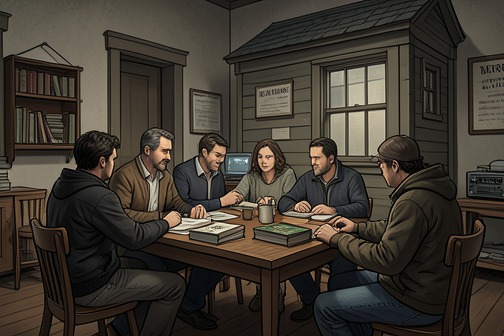
[Archimboldi’s Frisian reading](entity:event-recall-event-99cdd2426036) is a postwar literary evening remembered by [the Swabian cultural promoter](entity:character-recall-character-the-swabian-cultura-b17c028af2a1) who hosted it: a modest appearance that offers an unusually concrete glimpse of the young writer before his later disappearance from public view. The episode joins a reading from an unfinished novel to a dinner-table riddle about hospitality, extravagance, and a horse race, then closes with Archimboldi gone by morning. Its facts arrive not as a direct scene but through a story told years later to four critics searching for him in [Amsterdam](entity:location-recall-location-amsterdam-68440c77c10d).
## Invitation and setting
The Swabian had met Archimboldi while serving as cultural promoter in a small Frisian town. The work involved bringing writers to a place that was far-flung or forgotten but interested in culture. In the years just after the war, visiting writers were offered a room at the town’s only boardinghouse and a small amount of money toward their return train journey. Those who read could sometimes sell books afterward, but the postwar event differed from a contemporary reading in one telling respect: the books on the table were self-published rather than supplied by publishing houses.
The Swabian remembered Archimboldi as a writer of the stature of Gustav Heller, Rainer Kuhl, or Wilhelm Frayn, though he later looked up those names in an encyclopedia of German authors without finding them. Archimboldi was about twenty-nine or thirty. His first novel had appeared in [Hamburg](entity:location-recall-location-hamburg-83eba4856d4b) that year, but he did not read from it. Instead, he brought a copy with him as evidence that it existed: a short, roughly one-hundred- to one-hundred-and-twenty-five-page book with a dull, creased cover. He read two chapters from his second novel, which was still in progress.
## The reading and the black jacket
The Swabian went to meet Archimboldi at the train station and accompanied him to the boardinghouse, talking with him about the bad weather. He then brought him to the town hall, where Archimboldi read the two chapters. He did not set up a table to sell books. The recollection therefore preserves the reading less as a public launch than as a spare encounter: a young novelist, a work unfinished, and an audience in a town where cultural life depended on the efforts of a local organizer.
The Swabian remembered Archimboldi’s clothes more clearly than the novel he carried. His black leather jacket had a high collar, horizontal pockets on both sides, and four buttons sewn on with something like fishing line. It was loose enough to wear over heavy sweaters. The jacket brought the Swabian to mind of those worn by some Gestapo officers, though he also noted that black leather jackets were fashionable then and that people wore them without necessarily considering what they suggested. That qualification makes the remembered garment an uneasy historical detail rather than proof of any political affiliation: it links an ordinary piece of clothing to the unresolved associations of the postwar moment.
## The riddle at dinner
After the reading, the Swabian went with Archimboldi to the local tavern, along with a teacher and a widow whose knowledge of the arts exceeded that of the people around the table. Dinner was sausages, potatoes, and beer; neither the town’s means nor the times allowed for anything more extravagant. The widow steered the conversation. She recounted an ocean crossing to [Buenos Aires](entity:location-recall-location-buenos-aires-f4be140f43ae) in 1927 or 1928, when she had been wealthy and married, and described seeing ships loaded with meat. Her story turned on a riddle associated with a horse race at a ranch: her husband, a former cavalry captain, had won the first race, while the rancher and his son had arranged the next two so that he would win.
When the widow asked whether anyone could solve the riddle, Archimboldi answered quietly, without lifting his head from his meal. He said the staged hospitality explained the arrangement: the rancher and his son expected her husband to lose the first race, then rigged the second and third in his favor. The widow pressed him on why her husband had won the first race. Archimboldi reasoned that the rancher’s son, though probably the better rider and mounted on the better horse, had yielded at the last moment. The son’s selflessness became an extravagant gesture, and the celebrations that he and his father had arranged required even victory to be squandered. Archimboldi also distinguished the people who understood this improvised generosity from the little gaucho, who, he suggested, might have responded with violence if the widow had remained with him longer. The widow laughed, thanked the company, and left.
## Departure and later recollection
A few minutes after dinner, the Swabian walked Archimboldi back to the boardinghouse. When he returned the next morning to take him to the station, Archimboldi had already left. The account does not explain where he went or why he departed without his host. That unexplained absence gives the reading its narrative endpoint: an appearance preserved in detail, followed by an immediate refusal of closure.
Years later, the Swabian recounted the episode during a discussion in Amsterdam, where he had been invited as a little-known German writer. Archimboldi’s name surfaced in his reminiscence about work as a journalist, arts-page editor, interviewer, and cultural promoter. The four critics—[Jean-Claude Pelletier](entity:character-recall-character-jean-claude-pelleti-ee4823274bfc), [Manuel Espinoza](entity:character-recall-character-manuel-espinoza-5c3d56673a24), [Piero Morini](entity:character-recall-character-piero-morini-acc20fe2b7b1), and [Liz Norton](entity:character-recall-character-liz-norton-631dcc4863dc)—listened closely and tried to encourage him to say more, but he had already told what he intended to tell. Their careful attention heightened his shyness and reserve rather than opening the story further. The frame thus makes the account both valuable and limited: it supplies a witnessed meeting with Archimboldi while emphasizing how little can be extracted from the person who remembers it.
## Significance within Archimboldi’s story
The episode places Archimboldi in a sequence of uncertain public appearances and absences. Much later, the critics’ search in [Mexico](entity:location-recall-location-mexico-6f79111cb935) prompts speculation that the elderly writer might be a Nobel candidate, a tourist, or someone fleeing; they cannot establish why he has traveled there. Against that larger uncertainty, the Frisian reading is a rare, specific record of his earlier life as a working writer: he had published a first novel, carried it with him, and was already writing a second. The fact that the Swabian’s account leaves the next morning unexplained makes the small departure resonate without turning it into an established cause or pattern.
The dinner story also gives the episode an interpretive counterpoint to its documentary details. Archimboldi does not merely identify the race arrangement; he understands its logic as a performance of hospitality in which a planned outcome is overturned by generosity, and even winning is surrendered. The scene’s own form echoes that instability: the reading is recalled through another speaker, the riddle arrives inside a dinner anecdote, and the writer at its center vanishes before the narrative can follow him onward. The episode therefore enlarges Archimboldi’s portrait while preserving the limits of what the witnesses know.
Event 3
Norton begins romantic relationships with Pelletier and Espinoza
Norton begins romantic relationships with [Jean-Claude Pelletier](entity:character-recall-character-jean-claude-pelleti-ee4823274bfc) and [Manuel Espinoza](entity:character-recall-character-manuel-espinoza-5c3d56673a24) through separate encounters that gradually become a shared, unsettled arrangement. The shift follows the men’s recognition that their pursuit of [Benno von Archimboldi](entity:character-recall-character-benno-von-archimbol-b19f141ab3bf) cannot by itself give their lives the intimacy they want; it also tests whether their intellectual and personal friendship can survive their love for the same woman.
## From the search to intimacy
While walking around [Sankt Pauli](entity:location-recall-location-sankt-pauli-eb90d75743af) and later visiting [Mrs. Bubis](entity:character-recall-character-mrs-bubis-ad40de826c52), Pelletier and Espinoza conclude that studying Archimboldi cannot fill their lives. The author remains distant, and the deeper the critics go into his work, the more it seems to consume them. They realize they want to make love, not war. At the airport, as they wait for separate flights, they speak about love and the need for it. Espinoza imagines a life with Norton in [Madrid](entity:location-recall-location-madrid-8acd4123f416), sharing an apartment and work in the German department; the imagined domestic future gives concrete shape to an attraction that had been partly a private possibility.
Pelletier acts first. Three days after meeting Archimboldi’s publisher, he arrives in [London](entity:location-recall-location-london-420923d4a60a) without warning, tells Norton the latest news, and invites her to dinner in Hammersmith. The elaborate meal includes goulash, chickpea purée with beets, fish with lemon and yogurt, vodka, and Bordeaux. Its expense and theatrical excess help make the evening an occasion rather than a routine meeting. Norton invites Pelletier to her home ostensibly to discuss Archimboldi and what Mrs. Bubis had disclosed, including critic Schleiermacher’s contemptuous judgment of Archimboldi’s first book. Their conversation turns to laughter and then to a kiss initiated by Pelletier. Norton responds with greater ardor, and they spend the night together.
## Espinoza’s relationship with Norton
Pelletier’s first night with Norton becomes a memory Espinoza must reckon with when Norton accepts his invitation to Madrid. One Saturday he invites her as his guest, praising the city and mentioning a Francis Bacon retrospective. Norton surprises him by saying she will arrive the next day. Espinoza becomes excited and insecure, but the Sunday goes well: they spend the day together and go to bed that night.
Espinoza has so many questions that he asks none. Norton tells him that she and Pelletier are lovers, though she uses an ambiguous term, perhaps describing them as friends or saying they have been seeing each other. She says she has always had many friends, without making clear whether she means friends or lovers, and describes her view of relationships through her own history. She also reveals that she was once married and is now divorced. Her disclosures do not settle what she wants with Espinoza; instead, they make clear that he cannot assume he understands her simply because they are close.
After feeling unsettled by what he has learned, Espinoza tries to reassure himself that he will not take the relationship further. Four days later, he calls Norton and asks to see her. She chooses Madrid. During her next visit, they drive to El Escorial, attend a flamenco show, and spend the night together. Norton appears happy to Espinoza, who is glad to see her so. On the return journey, he asks whether she has seen Pelletier. She says that Pelletier has been in London and that she has told him about her relationship with Espinoza. Espinoza becomes nervous and concentrates on driving before asking what Pelletier thought.
## The friendship pact
The relationships develop alongside a near-crisis in Pelletier and Espinoza’s friendship. After an encounter involving [Alex Pritchard](entity:character-recall-character-alex-pritchard-ead26fd704f6), the three dine together at Jane & Chloe. The meal and wine ease their initial reserve, and they return home laughing. Pelletier and Espinoza do not press Norton to explain who Pritchard is, and she offers no account that would clarify the young man’s identity. Instead, they talk about how close they came to destroying their friendship.
Pelletier and Espinoza agree that sex should not be allowed to damage a bond grounded in both emotional and intellectual affinity. They tell Norton that, ideally, she may eventually choose either one of them or neither. They place the decision in her hands and say she may make it whenever she wishes—or defer it indefinitely. Their declarations of patience do not remove the competition between them, but they attempt to prevent that competition from becoming a demand imposed on Norton or a permanent rupture between the men.
Norton tests the logic of their pact by asking what would happen if one of them fell in love with someone else while she was still deciding. Pelletier and Espinoza call that possibility extremely remote, but maintain that Norton remains free to choose as she likes, even to choose neither of them. The arrangement therefore has no promised resolution: the two men accept uncertainty rather than set a deadline or claim an automatic right to Norton’s affection. Their friendship pact transforms the triangle from a concealed rivalry into an openly acknowledged, though still unstable, relation among all three.
## Significance and unresolved choice
The beginning of the relationships changes the critics’ search for Archimboldi without bringing that search to an end. Their earlier realization in Sankt Pauli—that literary study cannot substitute for shared life—now takes shape in private encounters, travel, meals, and conversations about love. Yet Archimboldi remains a subject they discuss even as intimacy develops: Pelletier’s visit to London is prompted by news from the publisher, and his stated reason for going home with Norton is to discuss the novelist and Mrs. Bubis’s revelations.
The episode’s central consequence is not a settled pairing but an agreement to live with an open choice. Norton is candid about her involvement with both men, while the men try to preserve their friendship and acknowledge that she may choose neither. The arrangement offers a way to continue, not certainty about its outcome; its emotional stakes lie in the attempt to hold together desire, respect for Norton’s freedom, and a friendship each man fears losing.
Event 4
London taxi driver assault
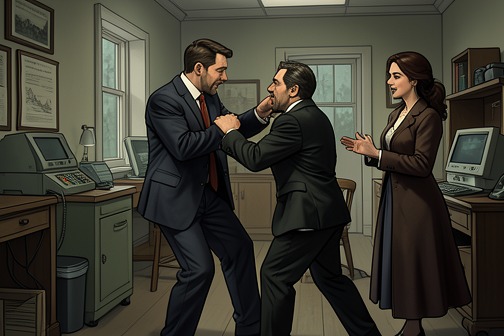
The [London taxi driver assault](entity:event-recall-event-cc3ee9bc9bf6) is a violent rupture in the relationship among [Jean-Claude Pelletier](entity:character-recall-character-jean-claude-pelleti-ee4823274bfc), [Manuel Espinoza](entity:character-recall-character-manuel-espinoza-5c3d56673a24), and [Liz Norton](entity:character-recall-character-liz-norton-631dcc4863dc). After a Pakistani driver challenges the trio’s conversation and insults them, Espinoza and Pelletier attack him on a [London](entity:location-recall-location-london-420923d4a60a) street while Norton pleads with them to stop. The driver survives with serious injuries, but survival does not undo the men’s choice: the episode turns their talk about jealousy and violence into an act for which they feel remorse, yet continue to blame their victim.
## Causes and Background
Earlier that evening, Norton, Pelletier, and Espinoza had talked over dinner about jealousy: its destructive consequences, its supposed inevitability, and even its appeal. Their conversation continued in the taxi. The driver listened in silence before speaking in his own language; when Norton told him he had lost his way and suggested streets, he acknowledged that London’s streets had confused him. Espinoza then joked that the driver had inadvertently echoed Jorge Luis Borges’s description of London as a labyrinth. Norton replied that Charles Dickens and Robert Louis Stevenson had used the same comparison earlier.
The driver answered that he might not know those writers, but he knew decency and dignity. He condemned Norton with misogynistic insults and called the two men pimps and hustlers. His speech transformed the argument from a literary joke into a direct confrontation. The insult provides the immediate occasion for the violence, but the ensuing attack is the men’s choice: the driver’s offense does not account for its duration or severity.
## The Attack
The group told the driver to stop and got out on the street. He pulled over, put the meter on, and told them what they owed. While Norton and Pelletier were still recovering from the exchange, Espinoza opened the driver’s door and pulled him from the cab. He began kicking the man; Pelletier joined in when Espinoza flagged. Norton shouted for them to stop and argued that violence would only deepen the driver’s hatred of the English. The men ignored her and continued the assault after the driver was down.
Their abuse invoked Islam, Salman Rushdie, feminists in [Paris](entity:location-recall-location-657453741ed3) and [New York](entity:location-recall-location-75b9ea4bd176), and Valerie Solanas. These references did not turn the attack into a principled intervention: they became taunts delivered while the men kicked a helpless person. The episode’s contrast between public language and private conduct is stark. The men had been discussing jealousy as if it were an idea to examine; now they acted violently and attached cultural and political slogans to their actions.
After the beating, the trio experienced a brief, disturbing calm. Pelletier and Espinoza thought they might have killed the driver. Norton bent over him and checked his pulse. She found that he was alive and breathing. Espinoza took the wheel, and the three drove away. Across the Thames, near Old Marylebone, they left the cab and walked for a while. They wanted to explain themselves to Norton, but she would not let them take her home.
## Immediate Aftermath
The next morning, Pelletier and Espinoza searched newspapers and tabloids for news of the driver and found none. They later learned from Norton that a group of people, probably those she had seen coming from Garden Row, had found him and called the police. A local television report said he had four broken ribs, a concussion, a broken nose, and had lost his upper teeth; he was in hospital. The absence of an immediate report in the papers had not meant that the assault had gone unnoticed or that the victim had escaped its consequences.
At their meeting that afternoon, Norton let the two men speak about their fears concerning [Alex Pritchard](entity:character-recall-character-alex-pritchard-ead26fd704f6) and the Gorgon before saying that the previous night’s events were what she could not explain. When they asked about the driver, she gave them the news of his injuries. Espinoza said the insults had made him lose control and that the assault was his fault. Norton told both men it would be best not to see one another for a while because she needed to think. Pelletier agreed. Espinoza said it seemed fair for her to stop seeing him but not Pelletier; Pelletier quietly rebuked him, and Espinoza recognized that his distinction was foolish.
## Remorse and Self-Justification
For several days, Pelletier and Espinoza felt remorse independently. Espinoza wondered whether his behavior showed him to be a violent, xenophobic reactionary. Pelletier focused on having kicked the driver after he was already on the ground, which he regarded as unsportsmanlike and unnecessary. Their different accounts identify different aspects of the same act: Espinoza questions what the violence says about his character, while Pelletier isolates the point at which an already violent response became plainly excessive.
The guilt did not produce a settled acknowledgment of responsibility. During a long telephone conversation, the men expressed their fears and comforted each other, then returned to blaming the driver as the true reactionary, misogynist, violent, and intolerant party. They believed he had provoked them so thoroughly that he had, in effect, asked for the attack. The narration makes this defense especially troubling by adding that, if the driver had appeared before them again at such a moment, they might have killed him. Their remorse and their continued hostility coexist rather than cancel each other out.
## Consequences and Narrative Significance
The assault changes the terms of the trio’s relationship. Norton’s request for distance interrupts the arrangement among her and the two men; the attack is no longer merely something they can debate together, because she has witnessed their violence and must decide how to respond to it. Pelletier and Espinoza’s shared guilt later draws them into private consolation, but that intimacy also helps preserve their shared account of the driver as the real offender.
For a time, the men forgot their weekly trips to London, their concern about Pritchard and the Gorgon, and even their pursuit of [Benno von Archimboldi](entity:character-recall-character-benno-von-archimbol-b19f141ab3bf). Their academic papers became perfunctory, with much of the work left to assistants recruited through vague promises of jobs or better pay. Elsewhere, while a colleague lectured on Archimboldi and shame in postwar German literature, Pelletier and Espinoza went to a brothel in [Berlin](entity:location-recall-location-769cdeac2511); similar visits in other cities eventually became routine. The assault therefore has consequences beyond the immediate police and medical aftermath: it remains a recurring source of guilt while the men try to resume their lives through distraction and habit.
The episode also sits within a wider narrative concern with which deaths become socially visible and which are absorbed into the background. A later discussion contrasts the public attention once given to particular murders with the relative silence around mass death, including deaths on slave ships and in the [Paris Commune](entity:event-recall-event-09d927942b3a). In [Santa Teresa](entity:location-recall-location-fc0da48b1b60), women’s killings are counted from January [1993](entity:time-recall-time-1993-d7b93468ef23), though the narrative allows that earlier victims may have gone unrecorded, disappeared, or been buried without identification. These episodes are not equivalent to the taxi assault, but their juxtaposition sharpens a recurring distinction between a named, reportable incident and accumulated violence that society can overlook. The driver’s beating is witnessed, reported, and discussed; the broader pattern of women’s deaths repeatedly meets failures of recognition. The assault’s place in that design is unsettling: the critics who search for a vanished writer can recognize violence in a London street and still turn their own wrongdoing into a story of provocation.
Event 5
Edwin Johns cuts off his right hand

[Edwin Johns](entity:character-recall-character-edwin-johns-d14cd3f940e1)’s self-amputation—cutting off the right hand he painted with, having it embalmed, and attaching it to a multiple self-portrait—shapes both his public identity and the encounter in which [Piero Morini](entity:character-recall-character-piero-morini-acc20fe2b7b1) asks why he did it. At the [Auguste Demarre Clinic](entity:location-recall-location-auguste-demarre-clin-c2abaf9ce81a), the visitors confront not a completed explanation but a body bearing an absent hand and a remarkably lifelike prosthesis. Johns’s gesture turns a question about artistic motive into a test of what the observers expect an artist, a damaged body, and a work of art to mean.
## The Act and Its Artistic Afterlife
In [Manuel Espinoza](entity:character-recall-character-manuel-espinoza-5c3d56673a24)’s account of a trip to Switzerland, the painter’s mutilation is the reason the three critics went to visit him. The decision had been Piero Morini’s: Morini had learned that a painter he regarded as one of the most disturbing artists of the twentieth century lived at the Auguste Demarre Clinic. Even the reported circumstances carry uncertainty. Espinoza is unsure whether Morini described Johns in precisely those terms, but the central fact is plain: Johns had severed his right hand, the one he used to paint, embalmed it, and made it part of a multiple self-portrait.
The act binds bodily injury to artistic production without making its meaning transparent. Johns’s hand is at once the instrument of painting, a severed body part, and material incorporated into an artwork. Yet the narrative does not provide the procedure, the circumstances in which it occurred, or a definitive account of Johns’s motive. The visitors arrive with the spectacular fact already attached to the painter’s reputation; the encounter will show how little that fact, by itself, explains.
## The Visit to the Clinic
The story reaches the critics during a later meeting between Norton, Espinoza, and Pelletier. Norton finds their silence oppressive and describes her teaching, then the days that followed, until conversation falters again. Espinoza fills the quiet with a story of Switzerland: after the work that brought the friends together was finished, the three traveled by train into the countryside, hired a car, and drove along a winding, carefully paved road to a clinic named for a nineteenth-century Swiss politician or financier. Behind the respectable name, the institution was a discreet asylum.
The approach establishes a tension between welcome and confinement. The iron gate seems to rise in greeting while also barring exit and discouraging unwanted visitors. From the road, the asylum appears like a fifteenth-century fortress—not because of its architecture, but because of its immobility. The setting frames Johns’s body before he appears: the visitors have entered a place organized around containment, and they have come to meet a man whose missing hand has become both a public image and a mystery.
## The Missing Hand Made Visible
When Johns enters, Morini notices first that his right hand is missing. The discovery is immediately complicated: from the jacket cuff emerges a plastic hand so skillfully made that only a careful, informed observer could identify it as artificial. The scene makes the body legible in stages. Morini looks toward the place where the hand should be, expects emptiness, and instead sees a replacement that almost passes for the original. Johns, meanwhile, notices Morini’s wheelchair with an expression of pleasant surprise, as if concrete bodily difference were more welcome than an abstraction.
That exchange does not equate the two men’s conditions. Morini uses a wheelchair; Johns has lost the hand with which he painted and wears a prosthesis. What the encounter establishes is a mutual, immediate awareness of bodily difference, followed by the uneasy movement from seeing a body to interpreting it. Morini has come with a question about Johns’s self-mutilation, while Johns takes in the visitors and asks whether Morini owns any of his work. Morini says he does not, because he cannot afford it. The artist’s work is thus present both as something that brought a critic to the clinic and as something beyond that critic’s means.
The surrounding room supplies another interruption. A nurse, seated by a window, reads an anthology of twentieth-century German literature, apparently oblivious to Johns and his guests. Pelletier asks whether [Benno von Archimboldi](entity:character-recall-character-benno-von-archimbol-b19f141ab3bf) is included; she answers yes. At the sound of a crow, Johns blinks, closes his eyes, and runs his prosthetic hand over his face. The gesture makes the substitute hand visible not as a neutral repair but as a material presence in the room: it can touch the face, even as it directs attention back to the hand that is gone.
## Morini’s Question and Johns’s Reversal
Morini eventually leans so far forward in his wheelchair that Espinoza and Pelletier fear he will fall. In a low voice, he asks the question that brought him there: why did Johns mutilate himself? Johns listens without visible agitation, as if he has encountered this question from other visitors before. Rather than answer, he asks whether Morini is going to publish their conversation. The exchange shifts attention from the artist’s act to the critic’s purpose: a request for explanation may also be a bid to turn a private encounter into public material.
When Morini says he wants to hear Johns say it himself, Johns slowly and, to Pelletier, almost rehearsedly raises his right hand and holds it close to Morini’s expectant face. He asks whether Morini thinks he is like him. Morini answers that he is not an artist. The gesture does not supply the missing explanation. Instead, the prosthetic hand brings the physical fact of the amputation into the space between them, while Johns tests the category through which Morini might understand him. His question makes likeness itself unstable: shared exposure to bodily difference does not make the two men equivalent, and Morini’s answer identifies artistic vocation as the distinction he can name.
## Repetition, Memory, and the Limits of Explanation
The scene is told twice in different circumstances. First, Espinoza recounts the Swiss visit to Norton, who laughs unexpectedly when she realizes that neither man had told her this story. She presses for the rest, but Espinoza hands the narration to Pelletier, who was also there. The clinic encounter is therefore not delivered as a detached report: it resurfaces within the critics’ present conversation, where silence, storytelling, and the repeated transfer of the tale shape how it reaches another listener.
Later, after a phone call, Norton says she will call the person she is speaking with the next day; neither can hang up for several seconds. That night, she thinks of Johns’s hand, imagining it displayed in his retrospective and recalling the sanatorium orderly who could not grasp it to prevent Johns’s fall. She recognizes that this image is too obvious, a false representation of what Johns had actually been. More real to her is the Swiss landscape the others saw and she did not: mountains and forests, iridescent stones and waterfalls, deadly ravines, and reading nurses. Her recollection does not solve the mystery of the amputation. It marks instead the gap between a hand turned into a public emblem and the particular place and lives through which the story was encountered.
Johns’s self-amputation remains decisive because it produces a question the narrative refuses to close. The preserved hand makes the artist’s body part of his art, while the prosthesis complicates the image of simple absence. Morini seeks an answer, but Johns redirects the encounter toward publication and likeness; Norton later recognizes that the most obvious retrospective image falsifies rather than captures him. The act is thus both the center of Johns’s notoriety and the limit of what notoriety can explain.
Event 6
Critics visit Auguste Demarre’s clinic
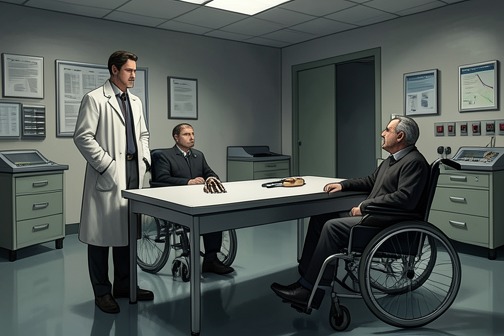
The critics’ visit to the [Auguste Demarre Clinic](entity:location-recall-location-auguste-demarre-clin-c2abaf9ce81a) is a meeting with the painter [Edwin Johns](entity:character-recall-character-edwin-johns-d14cd3f940e1), but it also becomes an encounter with the limits of what the visitors can learn from him. [Piero Morini](entity:character-recall-character-piero-morini-acc20fe2b7b1) has brought [Jean-Claude Pelletier](entity:character-recall-character-jean-claude-pelleti-ee4823274bfc) and [Manuel Espinoza](entity:character-recall-character-manuel-espinoza-5c3d56673a24) to see a painter who cut off his own right hand, the hand he used to paint, preserved it, and incorporated it into a multiple self-portrait. Morini eventually asks Johns why he mutilated himself. Johns does not answer in front of the group: he bends toward Morini and tells him privately. By the next morning Morini has disappeared from the hotel, carrying the encounter’s answer out of public view.
## A visit arranged around Edwin Johns
The episode reaches the reader as a story told by Espinoza and then continued by Pelletier. In the framing conversation, [Liz Norton](entity:character-recall-character-liz-norton-631dcc4863dc) is surprised that neither man has told her about the visit before. Espinoza explains that Morini had learned Johns was living at the clinic and proposed going to see him; Pelletier and Espinoza accompanied Morini. The account itself hesitates over the details of what Morini had said about Johns, preserving the uncertainty of a recollection retold among friends rather than presenting the visit as a settled report.
Their journey leads from [Montreux](entity:location-recall-location-montreux-ab89f676917e) toward a rest clinic named for a nineteenth-century Swiss politician or financier. The institution’s respectable name conceals what the visitors understand to be a discreet psychiatric asylum. They complete the formal procedures and are led by a nurse through the extensive grounds, without seeing any of the patients. The scale and arrangement of the grounds matter to the visit: Pelletier pushes Morini’s wheelchair down sloping land that he thinks would not be calming for patients who are severely disturbed. Johns is not encountered in the main institution, but in a separate cottage at the rear.
## The cottage and its contradictions
The cottage complicates the visitors’ expectations of institutional life. It is comfortable and furnished rather like an English country house: armchairs, a fireplace, an oak table, a partly filled bookcase, a Turkish divan, and a bathroom with a shower. A computer and modem have their own table. The books are mostly in German and French, with some in English. Espinoza’s comment that the residents do not have it too badly follows this inventory, but the scene does not establish that the cottage’s comforts explain or undo the institution’s restrictions.
The visit is framed by the clinic’s iron gate and railings, which appear both to welcome visitors and to block passage. From outside, the asylum’s inert bulk suggests a fortress. Pelletier recalls an odd idea that arose during the journey: that the American continent might never have been discovered, without disturbing Switzerland’s economic, demographic, or democratic development. He describes the thought as pointless, like the kinds of ideas people exchange on a manifestly pointless trip. This brief digression gives the journey an atmosphere of dislocation before the visitors reach Johns: ordinary assumptions about history and progress are made to seem contingent, while the clinic itself remains materially imposing.
## Morini’s question and Johns’s private answer
At the cottage, conversation turns to chance, order, and the possibility of redemption. Johns’s account sets faith in humanity and in the order of painting and language against coincidence, which he characterizes as lawless freedom. Pelletier and Espinoza sense that Morini has come in search of a particular answer. Morini leans so far forward in his wheelchair that they fear he may fall, and asks Johns directly why he mutilated himself.
Johns listens without visible agitation and asks whether Morini intends to publish their conversation. Morini admits that he does not know. As dusk settles, the nurse seems ready to turn on the light, but Pelletier signals her to wait. The narrative fixes on the visitors’ shoes—white, black, brown, and white—before darkness overtakes the cottage and the surrounding Alps. In that pause, Johns says he will explain. For the first time, his stiff, martial posture relaxes; he bends toward Morini and speaks into his ear. The explanation is withheld from Pelletier, Espinoza, and the reader. The scene therefore makes the answer consequential without supplying it: the central question is asked aloud, but the response becomes private knowledge shared only with Morini.
Afterward, Johns politely shakes hands with Espinoza and Pelletier, then leaves with the nurse. Espinoza points out that Johns did not shake Morini’s hand at either the beginning or the end of the interview; Pelletier confirms that he noticed. Morini says nothing. The asymmetry of the exchange remains visible after its content has been concealed: Morini receives the private explanation, yet Johns withholds the ordinary gesture of a handshake from him. The visitors are escorted out and told that a car is waiting at the gate.
## The morning after
The three return to Montreux and spend the night at the [Hotel Helvetia](entity:location-recall-location-hotel-helvetia-37faa3e7c622). Although they initially decide not to go out, Espinoza later calls Pelletier because he is hungry, and the two men leave for food. Pelletier asks whether Espinoza has called Morini; Espinoza says that no one answered. They assume that Morini has gone to sleep.
The next morning, however, Morini is not in his room. The hotel clerk reports that the computer shows he settled his bill and left at midnight, while Pelletier and Espinoza were at dinner. Morini had come to reception and requested a car. The clerk cannot say where he went. The departure follows immediately after the private conversation with Johns, but the narrative does not state that the conversation caused it, explain Morini’s destination, or disclose what Johns told him. The visit’s outcome is thus a paired withholding: Johns’s answer remains unknown, and Morini’s whereabouts become unknown as well.
Event 7
Morini disappears and secretly travels to London
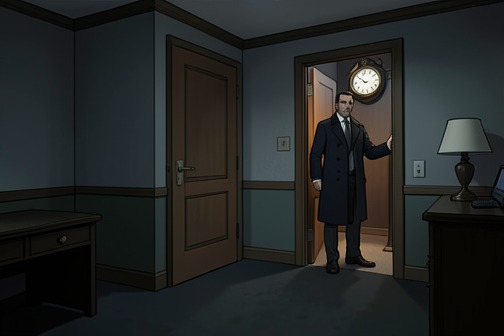
Morini’s disappearance and secret journey to [London](entity:location-recall-location-london-420923d4a60a) place friendship under the strain of uncertainty: Pelletier and Espinoza fear that something has happened to him, while Morini chooses solitude and asks Norton to keep his whereabouts from them. The episode begins with an empty hotel room and a midnight departure, then moves through the friends’ increasingly anxious attempts to find him before finally revealing that he has been in London, alone and on his own terms.
## Departure from [Montreux](entity:location-recall-location-montreux-ab89f676917e)
After visiting [Edwin Johns](entity:character-recall-character-edwin-johns-d14cd3f940e1), Pelletier, Espinoza, and Morini return to Montreux and spend the night at the [Hotel Helvetia](entity:location-recall-location-hotel-helvetia-37faa3e7c622). The three are tired and initially decide not to go out to dinner. Later, Espinoza calls Pelletier from his room because he is hungry and plans to look for somewhere open. Pelletier joins him and asks whether he has tried Morini. Espinoza says that he called, but no one answered. They conclude that Morini must have gone to sleep.
The next morning, Morini is absent from his room. The hotel clerk reports that the computer records him as having paid his bill and left at midnight, while Pelletier and Espinoza were eating at an Italian restaurant. Morini had come down to reception and asked for a car. The clerk cannot say where he went. This unexplained departure is the first concrete sign that Morini has not merely missed a meeting: he has left the hotel deliberately, without telling his companions his destination.
## The Search and Its Restraint
Pelletier and Espinoza check hospitals in and around Montreux before traveling by train to Geneva. From the airport, they call Morini’s apartment in [Turin](entity:location-recall-location-turin-7d5a70373e49), but reach only the answering machine. They leave and return to their respective cities without an answer. Once back in [Madrid](entity:location-recall-location-madrid-8acd4123f416), Espinoza calls Pelletier; both men continue leaving short messages, increasingly hopeless in tone, on Morini’s machine.
By the second day, their worry has deepened into anguish. They consider flying to Turin and notifying the authorities if they cannot find him, but hold back because they do not want to act rashly or appear foolish. The third day brings more calls and deliberation rather than new information. They weigh Morini’s mental health against their knowledge of his maturity and common sense, yet neither consideration tells them where he is or whether they should intervene.
On the fourth day, Pelletier calls the [University of Turin](entity:organization-recall-organization-70819e717b37). The young Austrian who answers the phone has no idea where Morini might be and says that the department secretary has gone out for breakfast. Pelletier relays the exchange to Espinoza, who calls the department as well. He reaches a German literature student, but the office is empty and the secretary is still absent. The repeated dead ends make their search feel both urgent and faintly absurd: even the ordinary routines of the university become obstacles to finding a friend.
After another conversation, Pelletier and Espinoza agree to wait a few days rather than give in to what they call vulgar hysteria. They remind one another that Morini is free to do what he chooses and that there is nothing they can, or should, do to prevent it. The decision brings them a night of good sleep, but it does not end their concern. The next morning Espinoza again calls the German department, without success; later, Pelletier raises whether they should tell Norton. They decide to protect Morini’s privacy until they have more concrete information.
## Contact and the London Revelation
Two days later, Pelletier calls Morini’s apartment almost reflexively. This time someone answers: it is Morini. Pelletier’s astonished response gives way to delight and relief, as though the friends have woken from a bad dream. Morini’s voice sounds as it always has. Pelletier says he must inform Espinoza immediately, but the conversation does not disclose where Morini has been.
The answer comes later, when Norton tells Pelletier and Espinoza that Morini had been in London during his disappearance. He spent his first two days there alone and did not call her. When he eventually did, he invited her to lunch. The revelation explains the unexplained departure without turning it into a rescue story: Morini has been away, but he has been moving through the city by choice and has remained beyond his friends’ reach because he did not contact them.
Morini describes visiting museums and wandering through unfamiliar neighborhoods. He compares their atmosphere to Chesterton stories, while insisting that the neighborhoods no longer have anything to do with Chesterton, though the spirit of Father Brown still seems to hover over them in a nonreligious way. His account makes his solitude a period of walking, reading, and observation rather than a disclosed emergency. Norton, however, imagines him spending long hours in a hotel room, reading and looking out at the backs of buildings. The difference between what Morini reports and what Norton pictures preserves an uncertainty around the private experience of his absence.
## Norton, London, and Secrecy
When Norton meets Morini, he is sitting in his wheelchair in a hotel lobby with a package on his lap. They go to a Brazilian vegetarian restaurant in Notting Hill that Norton has recently discovered. She asks what he has been doing and why he did not call. Morini says London accommodates disabled people better than Turin, where wheelchair users encounter obstacles. The contrast gives his choice of London a practical dimension as well as a personal one: the city offers a different experience of moving through public space.
His London days include secondhand bookshops, where he buys several books without naming them, and two visits to Sherlock Holmes’s house. Baker Street, he says, seems timeless to him as a middle-aged Italian reader of detective stories. He also gives Norton a book about Brunelleschi, illustrated with photographs. The gift becomes part of their renewed contact, but it does not erase the fact that he spent two days in the city without calling her.
They meet again the following day outside a theater. Morini has bought two tickets at the hotel, and they see a comedy that Norton finds vulgar and bad but that makes them laugh. Morini cannot follow some of the cockney slang; Norton later explains the parts he missed. Their subsequent outings include dinner and Morini’s visits to [Kensington Gardens](entity:location-recall-location-kensington-gardens-5d3ca3a004f6) and the Italian Gardens in [Hyde Park](entity:location-recall-location-hyde-park-5f19a81c3522). His account of exploring London remains inseparable from his limited access to its streets and conversations, while Norton’s imagined picture of him sitting quietly in the park shows how little she can know of his time alone.
## Departure and Aftermath
The next day, Morini tells Norton that he must leave, and she drives him to the airport. There, speaking casually, he offers an interpretation of why Edwin Johns cut off his right hand: Johns did it for money. Norton then asks, for the first time, how Pelletier and Espinoza are. Morini replies that he would prefer them not to know he is in London. Norton accepts the condition and promises that his secret is safe, asking only that he call when he reaches Turin. He says he will.
That request recasts the disappearance as more than a failure of communication. Morini has resumed contact with Norton while deliberately keeping Pelletier and Espinoza outside the circle of people who know where he has been. His friends’ anguish and their careful decision not to violate his freedom coexist with his direct wish for secrecy. The episode ends not with an explanation of his motive for leaving, but with a bounded promise to call after reaching Turin. The immediate fear is relieved; the silence between Morini and his friends remains part of the event’s outcome.
Event 8
Archimboldi and El Cerdo meet in Mexico City
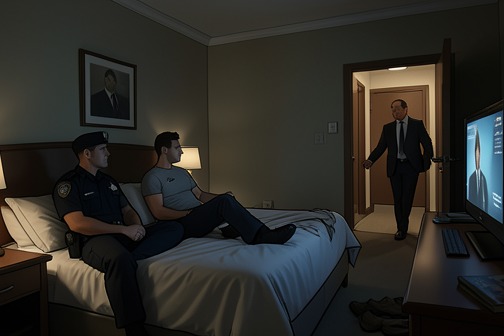
[Archimboldi and El Cerdo meet in Mexico City](entity:event-recall-event-dfa31a05b3ba) when the vanished German writer is detained by local police and El Cerdo is summoned to intervene. Their night together turns an abstract literary disappearance into a brief physical encounter, yet offers no explanation for Archimboldi’s absence or destination: after hours in the city, he boards a flight north and disappears from El Cerdo’s life as abruptly as he had appeared.
## The Call and the Hotel
El Cerdo’s account begins with a midnight telephone call and a short conversation in German. He dresses, drives to a hotel near the [Mexico City](entity:location-recall-location-mexico-city-78f19f654410) airport, and arrives after one in the morning. In a third-floor room he finds two policemen and an old German sitting barefoot on the bed in a gray T-shirt and jeans, his hair uncombed, as though the police had interrupted his sleep. El Cerdo identifies himself as a senior government official and accompanies the officers upstairs.
The encounter is not presented as a formal arrest or a literary reception. One policeman is watching television; another leans against the wall smoking. When the officer who brought El Cerdo turns off the television and orders the policemen to leave, the second objects, only to be told to keep quiet. Before the officers go, El Cerdo asks Archimboldi whether they have stolen anything. Archimboldi says they wanted money but took nothing. El Cerdo’s response is that this is progress, a small, dry measure of the conditions surrounding the encounter.
Once the officers have left, El Cerdo sits beside the television and apologizes. Archimboldi says nothing, gets up, and goes into the bathroom. El Cerdo describes him as enormous—at least six foot six, nearly seven feet tall—and notices that, when he comes back, he has put on his shoes. The detail gives the encounter an unceremonious scale: the elusive writer is not introduced through his books or reputation, but through a room, a police interruption, and the practical signs of a person preparing to leave.
## A Night Across Mexico City
El Cerdo offers Archimboldi a drive or a drink, adding that he will leave immediately if the older man is tired. Archimboldi replies that his flight is at seven in the morning. It is already after two, and El Cerdo is at a loss for what to say. He knows little of Archimboldi’s work; the Spanish translations have appeared in [Spain](entity:location-recall-location-spain-336a02c89dc7) and arrived late in [Mexico](entity:location-recall-location-mexico-6f79111cb935). Three years earlier, while running a publishing house, he had tried to publish *The [Berlin](entity:location-recall-location-769cdeac2511) Underworld*, only to find that the rights belonged to a [Barcelona](entity:location-recall-location-barcelona-c4abb0c424bd) publisher. The thought of how Archimboldi obtained his number, and who had given it to him, fills him with a happiness that seems to vindicate him as both a person and a writer. He agrees to go out.
Wearing a leather jacket over his gray T-shirt, Archimboldi follows El Cerdo to [Plaza Garibaldi](entity:location-recall-location-plaza-garibaldi-4c7bddb5a635). The square is nearly empty of tourists; the remaining company consists of drunks, night owls, people going to supper, and mariachi bands discussing the latest soccer match. Shadowy figures watch the two men on the streets approaching the plaza. Since entering government work, El Cerdo has begun carrying a pistol, and he fingers it as they pass. In the bar, El Cerdo orders pork tacos, while Archimboldi drinks tequila and beer.
The meal draws El Cerdo into thoughts about how his standing has changed. Less than ten years earlier, speaking German in that bar with a tall old man might have provoked an insult or a fight; he would have had to apologize, explain, or buy drinks to prevent trouble. Now, he thinks, the gun beneath his shirt and his position high in government give him an authority that even the killers and drunks recognize. The episode places his new public power beside the everyday threat of violence, without making the danger disappear.
Over the meal El Cerdo weighs whether to leave Mexico for a diplomatic post in Europe. An ambassadorship, or at least a cultural attaché position, might allow him to write again; he imagines living in Italy or near it and spending long stretches in Tuscany and Rome on an essay about Piranesi’s imaginary prisons. He also considers the cost: distance from power, which he has learned is never advantageous. These reflections are his, not Archimboldi’s. The older man’s presence occasions them, but remains largely unreadable.
At some point El Cerdo asks whether Archimboldi was supposed to have disappeared. Archimboldi looks at him and smiles politely. The question makes the encounter’s central contradiction explicit: the writer is present, but his presence does not resolve the disappearance. No explanation follows, and the smile supplies no answer.
## From the Historic Center to the Airport
After eating, the two walk around the Zócalo, past the plaza and Aztec ruins that El Cerdo describes as stone flowers amid wasteland. They continue toward Plaza Santo Domingo, whose arches by day shelter scribes with typewriters ready to prepare letters and legal claims. They also drive around the Angel on Reforma, but it is dark, so El Cerdo can only describe it to Archimboldi, who looks up from the open window of the car. The route carries them through landmarks and civic histories, while the late hour repeatedly limits what can actually be seen.
They return to the hotel at five in the morning. El Cerdo waits in the lobby, smoking, while Archimboldi comes down in the same gray T-shirt and jeans with one small suitcase. The streets toward the airport are empty, and El Cerdo runs several red lights. He struggles to find conversation. He has already asked whether Archimboldi has visited Mexico before; Archimboldi says this is his first time, an answer El Cerdo finds unusual for a European writer. As traffic thickens near the airport, Archimboldi tries to say goodbye, but El Cerdo insists on carrying his suitcase. It has wheels and is so light that it hardly weighs anything.
The destination changes in the final stretch. El Cerdo understands that Archimboldi is flying to [Hermosillo](entity:location-recall-location-4f7f0d63ba67), the capital of [Sonora](entity:location-recall-location-sonora-c839a79bc3dc) in northwestern Mexico. When he asks about Hermosillo, Archimboldi corrects him: he is going to [Santa Teresa](entity:location-recall-location-fc0da48b1b60), a city El Cerdo has never visited. El Cerdo knows Hermosillo from earlier literary talks and describes Santa Teresa as large, industrial, and troubled, not a pleasant place. Archimboldi says he thinks it is a big city; El Cerdo confirms that it is.
## The Card and the Disappearance
Using his identification, El Cerdo accompanies Archimboldi to the departure gate. Before they part, he gives him a government contact card in case he runs into trouble. Archimboldi thanks him. They shake hands, and El Cerdo never sees him again. The card is a modest practical gesture, but it marks the limit of what their meeting can provide: access and protection are offered, while the reason for Archimboldi’s journey remains unstated.
El Cerdo later recounts the encounter to [Rodolfo Alatorre](entity:character-recall-character-rodolfo-alatorre-7cee8c4824b3), who repeats it to the European critics [Jean-Claude Pelletier](entity:character-recall-character-jean-claude-pelleti-ee4823274bfc), [Manuel Espinoza](entity:character-recall-character-manuel-espinoza-5c3d56673a24), and [Liz Norton](entity:character-recall-character-liz-norton-631dcc4863dc). The chain of retelling frames the meeting as a report passed between people rather than a direct account from Archimboldi himself. The critics decide not to tell others what they know, reasoning that discretion is preferable to raising false hopes. Archimboldi’s appearance has therefore made the rumor of his disappearance more concrete without making him available to the public or to the scholars seeking him.
## Santa Teresa and the Wider Narrative
The encounter’s destination links Archimboldi’s private itinerary to the novel’s account of Santa Teresa. During their later drive through the city, the critics see unpaved western streets and makeshift housing, neglected central plazas, wealthier eastern neighborhoods, abandoned factories to the north, and poor districts extending beyond them. To the south are rail lines, shantytown soccer fields, a garbage-filled gully, and the distant industrial warehouses of the maquiladoras. The city seems to expand continuously; at its northern edge, a fence divides Mexico from the [United States](entity:location-recall-location-united-states-2f533bc8d0b9) and the [Arizona](entity:location-recall-location-arizona-99fb276bcc30) desert beyond. Black vultures stand in barren fields at the outskirts.
That setting gives weight to the otherwise unexplained choice of destination. El Cerdo has warned that Santa Teresa has factories and problems, while the critics’ later tour makes visible an uneven urban landscape shaped by industrial growth, poverty, and the border. Much later, the novel’s account of the killings identifies the Uribe family’s cross-border business connections: Pedro Uribe’s more than one hundred cargo trucks carry goods from maquiladoras in Hermosillo and Santa Teresa across the border, while property and family ties extend into Arizona. These later details do not explain Archimboldi’s purpose, but they place his arrival in a city where industrial, political, and cross-border networks converge.
The meeting is consequently both a rare contact and a withheld answer. Archimboldi is seen eating, walking, riding in a car, and boarding a plane, but the narrative gives no account of what he intends to do in Santa Teresa. He departs with a single light suitcase and a card from a government official; El Cerdo is left with the memory of the night and a story that passes onward. The encounter narrows the distance between the missing writer and those who seek him, then restores that distance at the departure gate.
Event 9
European critics search for Archimboldi in Santa Teresa
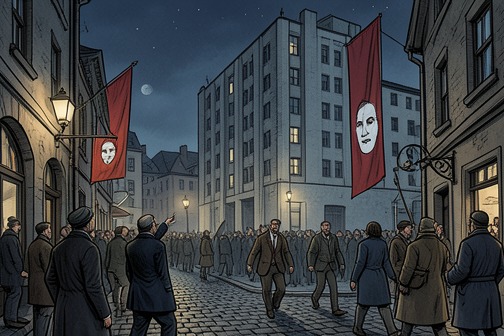
[Jean-Claude Pelletier](entity:character-recall-character-jean-claude-pelleti-ee4823274bfc), [Manuel Espinoza](entity:character-recall-character-manuel-espinoza-5c3d56673a24), and [Liz Norton](entity:character-recall-character-liz-norton-631dcc4863dc)’s search for [Benno von Archimboldi](entity:character-recall-character-benno-von-archimbol-b19f141ab3bf) in [Santa Teresa](entity:location-recall-location-fc0da48b1b60) turns a literary pursuit into an encounter with the city’s scale, its border economy, and the killings of women that its visitors initially struggle to comprehend. The critics arrive with a lead from [Mexico City](entity:location-recall-location-mexico-city-78f19f654410), but every practical method—hotel records, newspapers, local contacts—fails to locate the writer. Their final certainty that Archimboldi is present does not resolve the mystery; it sharpens the distance between knowing that someone may be near and being able to find him.
## The decision to search
Archimboldi’s possible Nobel candidacy gives the critics’ pursuit an added urgency. They hear that he has again entered the year’s prize pool and may be on the short list. According to Dieter Hellfeld, someone associated with the [Swedish Academy](entity:organization-recall-organization-f93fd2ead947) has contacted the publisher to ask how Archimboldi might respond to the award. The prospect prompts speculation about what the prize could mean to a man past eighty, without a public face or heirs. [Mrs. Bubis](entity:character-recall-character-mrs-bubis-ad40de826c52) is said to believe he would be delighted, though the others question whether she is thinking of the publisher’s sales. The Nobel discussion makes the possibility of a sudden public appearance vivid, but it also foregrounds the contradiction at the heart of the search: a writer can be widely discussed, even considered for the world’s most prominent literary prize, while remaining inaccessible.
The group decides to keep what it knows to itself. They tell themselves that silence is discretion, not betrayal, and that announcing Archimboldi’s possible whereabouts would only create false hope. This restraint does not end their interest; instead, it allows the search to proceed without turning their tentative knowledge into a public claim. Their decision also gives the journey a private, almost furtive quality, in contrast to the public attention that the Nobel speculation might otherwise attract.
Pelletier, Espinoza, and Norton travel from [Paris](entity:location-recall-location-657453741ed3) to Mexico City, where El Cerdo is waiting. The three academics spend the night in a hotel and fly to [Hermosillo](entity:location-recall-location-4f7f0d63ba67) the following morning. El Cerdo is pleased to host such distinguished European visitors, though disappointed that they decline to give a lecture at Bellas Artes, UNAM, or the Colegio de [Mexico](entity:location-recall-location-mexico-6f79111cb935). The refusal keeps their visit focused on the missing writer rather than on the public appearances their status might invite.
## Following the Mexico City lead
During their night in Mexico City, Pelletier and Espinoza accompany El Cerdo to the hotel where Archimboldi had stayed. The clerk allows them to inspect the computer record. El Cerdo scrolls through the names under the date of his meeting with the writer, and the visitors find the entry [Hans Reiter](entity:character-recall-character-hans-reiter-71edfa723a3e). The record shows a single night, paid for in cash, with no credit-card charge or minibar purchase. The name connects the elusive public figure to the identity he used at the hotel, but it supplies no onward address or explanation of what happened after his stay.
The next morning, the three critics and El Cerdo fly to Hermosillo. They call the rector of the [University of Santa Teresa](entity:location-recall-location-university-of-santa-56c6018a72ed) from the airport, rent a car, and drive toward the border before turning into the city. Their arrival is framed by the intensity of [Sonora](entity:location-recall-location-sonora-c839a79bc3dc)’s light, which seems to Norton to invite travel while also making a person want to endure hunger to its end. Santa Teresa appears to the visitors like a vast, temporary encampment, ready to move at the slightest prompting. They take three rooms on the fourth floor of the [Hotel Mexico](entity:location-recall-location-hotel-mexico-4cc750e47edf). The rooms are nominally identical but bear different marks: Espinoza’s has a large desert painting with mounted men; Norton’s has two mirrors positioned to face one another; Pelletier’s bathroom contains a toilet with a missing half-moon-shaped piece. These details do not identify Archimboldi, but they establish a setting in which the ordinary and the unsettling share the same close quarters.
The search begins with the university and the city’s hotels. At breakfast, the group concludes that Archimboldi did not visit the Faculty of Arts and Letters, and that there is no German consulate in Santa Teresa to pursue. Amalfitano offers to obtain a list of local hotels from the reception desk. The critics then divide the work: Norton and Espinoza call from Espinoza’s room, while Amalfitano and Pelletier call from Pelletier’s. After an hour, none has found a registration under Hans Reiter. They continue for another hour before giving up, with only a few hotels and outlying motels left to check. Amalfitano points out that many motels rent rooms by the hour or operate as brothels, places where a conventional picture of a German tourist would not seem to fit. Espinoza answers that they are looking for Archimboldi, not a German tourist. The distinction keeps their search open to the possibility that the writer’s presence would not conform to an ordinary travel record.
## A city without a trace
The critics widen their search beyond hotel records. At the reception desk they obtain a list of the city’s hotels, and later they visit every newspaper office in Santa Teresa with Amalfitano. They examine papers spanning the month before El Cerdo encountered Archimboldi in Mexico City through the previous day. They look first at death notices, then at society and politics, and even at agriculture and livestock. One paper has no arts section; another gives books and cultural events only a page each week. The newspaper search yields no indication that Archimboldi has passed through the city. Their failure is not simply a lack of literary coverage: they find no trace in any of the categories through which the local press records public life.
The next day they visit the [Santa Teresa crafts market](entity:location-recall-location-santa-teresa-crafts-92e67c12efea), originally intended as a regional trading place for craftspeople, peasants, cattlemen, and horse dealers. By this point it serves mainly American tourists arriving from [Phoenix](entity:location-recall-location-f2569f84debb), who leave before nightfall. The market offers the critics a contrast between its broader regional origins and its present orientation toward short-term visitors. Pelletier buys a small clay figure of a blond man sitting on a stone and reading a newspaper, with two small horns on his forehead. Espinoza buys an Indian rug after speaking with the seller, a local high-school student who hopes to become a nurse. Neither purchase advances the search, but the encounter with the young woman locates the visitors’ passage through Santa Teresa within the lives of people who live and study there, rather than only within the itinerary of foreign academics.
They also drive through the city without a specific destination, as if chance might bring them face to face with a tall, elderly German man. The landscape they cross is sharply divided but continuous: poor western neighborhoods with unpaved streets and houses assembled from scrap; an old, neglected center with arcaded plazas; more affluent eastern districts with pruned trees, playgrounds, shopping centers, and the university; and, to the north, abandoned factories, small hotels, bars, and souvenir shops. Farther out lie additional poor neighborhoods, while rail lines and informal soccer fields mark the south. They pass a gully used as a garbage dump, vacant terrain, industrial warehouses, and the horizon of the maquiladoras. On the northern edge they see the fence separating Mexico from the [United States](entity:location-recall-location-united-states-2f533bc8d0b9) and look beyond it toward the [Arizona](entity:location-recall-location-arizona-99fb276bcc30) desert. The industrial parks, too, are being surrounded by slums.
The city seems to be growing by the second. Black vultures walk through barren fields on its outskirts, and the critics note that where vultures are present there are no other birds. Their tour brings them into sight of the physical and economic geography of the border: factories and labor, shantytowns and infrastructure, highways and the fence, all within a city that appears to expand beyond any settled boundary. The search for an individual who leaves no record unfolds amid a landscape whose scale makes individual location increasingly difficult.
## The killings enter the search
The critics do not arrive intending to investigate the killings of women, but the subject becomes impossible to keep outside their account of Santa Teresa. During their stay, Espinoza recalls that a boy had told them more than two hundred women had been killed. The figure is difficult for the visitors to take in. Espinoza reflects that the expression of disbelief can itself exaggerate a report, turning acknowledgment into a performance of astonishment. But he also recognizes that the number is not a recent total limited to a short interval: the killings have continued from [1993](entity:time-recall-time-1993-d7b93468ef23) or [1994](entity:time-recall-time-1994-2c6f52c72808) to the present, and the actual count might be 250 or 300. The boy says in French that no one will ever know. He has read a book by Archimboldi in Pelletier’s translation, a connection that links the local account of the killings back to the object of the critics’ search.
The account does not remain an abstract statistic. [Chucho Flores](entity:character-recall-character-chucho-flores-c7aa829c6aaf) later describes the way the killings periodically return to public attention: the numbers rise, reporters discuss them, the story grows, and then attention recedes as people return to work. He compares the killings to a brutal strike, a comparison that unsettles [Fate](entity:character-recall-character-fate-343c24ffca57) because it makes the violence sound like an interruption of ordinary labor and then, by implication, like something the city learns to absorb. Chucho describes Santa Teresa as a large city with factories, maquiladoras, low unemployment, a cocaine cartel, workers arriving from other cities, Central American immigrants, and infrastructure unable to support demographic growth. There is money and poverty, violence and a desire for peace; what the city lacks, he says, is time. His description gives the visitors’ search a social frame that the hotel registers and newspaper files could not provide.
The cross-border setting is not merely scenery. On the American side, Fate crosses through Adobe, a former adobe-factory town whose houses and appliance stores line a main street leading to the border post. An American customs officer asks whether he is coming to write about the killings; Fate says he is there to cover a boxing match. At the Mexican checkpoint he must leave the car, open his suitcase, and show his papers. The border is at once a passage for travelers and a site of questioning and divided jurisdiction. Elsewhere, [Klaus Haas](entity:character-recall-character-klaus-haas-a06ea2613d1a) uses a press conference to identify the Uribe family and its connections: Pedro Uribe’s more than one hundred cargo trucks carry goods from maquiladoras in Hermosillo and Santa Teresa across the border every half-hour or hour; the family also has property in Phoenix and [Tucson](entity:location-recall-location-tucson-01e85518a44a). Haas describes the Uribe sons as associates of a narco and connected to Santa Teresa police and criminal networks. This information belongs to the larger account of the city’s killings, not to a discovery made by the European critics, but it clarifies the world through which their search passes: legal commerce, criminal power, and the border’s frequent traffic are entangled.
## Departure and unresolved presence
Norton’s relationship to the search changes before the men’s conviction does. She feels insulted when [Piero Morini](entity:character-recall-character-piero-morini-acc20fe2b7b1) decides not to travel with them, saying that his doctor has forbidden it and that he will write every day. Norton responds briefly and sweetly before ending their call; afterward, they do not call one another again. Morini’s refusal is presented alongside his movement toward an unusual resignation, a state in which his sense of self seems gradually to dissolve. Although this is not part of the search’s practical itinerary, it shadows the expedition with another form of absence: the group has left one of its members behind, and the distance between Norton and Morini remains unresolved during the journey.
In Santa Teresa, Norton eventually tells Pelletier and Espinoza that she is leaving the next day. They are not surprised. Her flight departs from Tucson, and despite her plan to take a taxi, her friends decide to drive her. The route requires them to cross into the United States, follow a dirt road through woods and streams, reach [Sonoita](entity:location-recall-location-1b1f073ea1fc), and continue on Route 83 and Interstate 10 to Tucson. At the airport they have time for coffee and talk about meeting again in Europe. Norton boards for [New York](entity:location-recall-location-75b9ea4bd176), where she will connect to [London](entity:location-recall-location-london-420923d4a60a). Pelletier and Espinoza return to Santa Teresa by way of [Nogales](entity:location-recall-location-e4822a3881a1) and the Arizona side of the border, entering Mexico again near Lochiel. Their long drive makes the trip’s transnational shape literal: the search has moved between cities and countries, yet the crossings have not brought the target closer.
After Norton leaves, the search continues in a reduced pair. One night, Pelletier and Espinoza sit by the hotel’s pool and tennis court. Pelletier says they will not find Archimboldi. Espinoza replies that he has known this for days. Yet Pelletier insists that Archimboldi is in Santa Teresa. He gestures toward the sauna, hotel, court, fence, and distant brush, giving the claim no precise address. Espinoza believes him. Pelletier then states the paradox that closes the search: Archimboldi is there, and they are there, and this is the closest they will ever be to him. The line makes proximity a form of failure rather than discovery. The critics have followed a name, a hotel record, and a trail across the border into a city they have begun to see more clearly, but the writer remains unseen. Their search ends not with proof of his location, but with an intuition that proximity itself is the final limit of what they can know.
Event 10
Norton and Morini reunite and begin living together
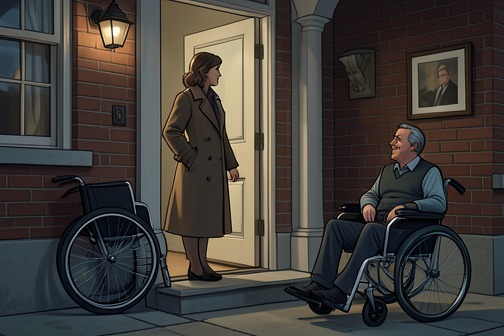
[Norton and Morini reunite and begin living together](entity:event-recall-event-09ea8c464af3) when [Liz Norton](entity:character-recall-character-liz-norton-631dcc4863dc) leaves [London](entity:location-recall-location-london-420923d4a60a) for [Turin](entity:location-recall-location-turin-7d5a70373e49) and asks [Piero Morini](entity:character-recall-character-piero-morini-acc20fe2b7b1) to let her stay. What begins as an unplanned arrival becomes an intimate domestic reunion: conversation, tea, a meal, and a nighttime misunderstanding give the two a way to name a love that had gone unrecognized. Norton’s letter closes the episode without promising permanence; happiness, rather than certainty, is the commitment they share.
## The Journey to Turin
The day before leaving, Norton tidies her apartment and puts her papers in order, finishing sooner than she expects. She goes to a film, but afterward cannot reconstruct its plot or remember who acted in it. That evening she has dinner with a friend and goes to bed early, although midnight passes before she falls asleep. The next morning, without a ticket, she goes to the airport and books a seat on the next flight to Italy.
Her journey takes her from London to Milan and onward by train to Turin. When Morini opens his door, she tells him she has come to stay and leaves the choice of a hotel or his home to him. He does not answer verbally: he moves his wheelchair aside and asks her in. The small gesture settles the immediate question of where she will stay, while leaving the deeper question of what their reunion means to be answered through their time together.
## Hospitality and Conversation
Norton washes her face in the bathroom. When she returns, Morini has made tea and put three small biscuits on a plate. She tastes one, finds its pistachio-and-fig filling delicious, eats all three, and drinks two cups of tea. Morini makes a phone call, then listens as she talks, occasionally stopping her to ask questions she is glad to answer. Their welcome takes the form of attentive conversation as much as food and shelter.
They talk for hours about the Italian Right, the resurgence of fascism in Europe, immigrants, Islamic terrorists, and British and American politics. The subjects are depressing, yet Norton says she feels better and better as they talk. When she asks Morini for another of the biscuits, he looks at the clock, observes that it is only natural she is hungry, and offers something more substantial: he has reserved a table at a restaurant in Turin and will take her to dinner. The exchange turns care into action, carrying their reunion beyond the threshold of his home.
The restaurant stands in the middle of a garden with benches and stone statues. Norton pushes Morini’s wheelchair as he shows her the figures: some represent mythological characters, others ordinary peasants apparently lost in the night. Other couples stroll through the park; Norton and Morini sometimes cross their paths and sometimes glimpse only their shadows. In that setting, they talk about Pelletier and Espinoza. Norton tells Morini that the lead placing Archimboldi in northern [Mexico](entity:location-recall-location-mexico-6f79111cb935) was false and that he has probably never set foot in the country. She also recounts their Mexican friend El Cerdo, and the two laugh together. Norton again describes herself as feeling better.
## The Nighttime Misunderstanding
Norton spends the first hours of her first night in Turin in Morini’s guest room. A thunderclap, which may be real or part of a dream, wakes her. She thinks she sees Morini’s wheelchair at the end of the hallway and Morini himself in the sitting room, turned away from her. At first she tries to ignore the sight, but then gets up, grabs an ashtray, and turns on the light. The hallway and sitting room are empty.
Norton goes to Morini’s room. His wheelchair is beside the bed, and Morini is lying there breathing steadily. She whispers his name; when he does not move, she raises her voice, and he answers by asking what is wrong. Norton says she saw him in the hallway. Morini asks when, and she says it was a minute earlier, when she heard the thunder. He asks whether it is raining, and she replies that it must be.
The sight unsettles Norton beyond the immediate question of whether she has mistaken a dream for waking life. She tells Morini that the wheelchair had seemed to be watching her while he stood there, cool and turned away. Morini asks her to calm down, but she rejects the instruction and insists he understand what she saw. The scene gives their conversation a sharper emotional edge: Norton is not merely describing an apparition but accusing him of being distant from her.
Morini props himself on his elbows and considers what she has said. He understands her perception as a split between himself and the chair: the wheelchair seemed to watch while he ignored her. In that reading, both the chair and Morini seemed bad to Norton, because the chair was watching her and he was not. Norton then laughs and tells him that, as far as she is concerned, neither he nor the wheelchair could be bad, since the chair is so useful to him. The perceived separation between Morini and the wheelchair becomes a way to articulate the separation between his attention and her need to be seen.
## Love Named and a Shared Life
The rest of the night, Norton and Morini spend together. She tells him to move over and make room for her, and he obeys without a word. The movement from the guest room to his bed gives the reunion its decisive turn: they are no longer treating her stay as a practical arrangement whose terms remain open.
Afterward, Norton asks Morini how it could have taken her so long to realize that he loved her, then asks how it could have taken her so long to realize that she loved him. Morini answers that it is his fault, because he is hopeless at such things. His reply accepts her recognition while also acknowledging his difficulty in expressing himself. The affection that had remained unspoken is now mutual and explicit, but the scene does not suggest that either person has mastered the uncertainties of intimacy.
In the morning, Espinoza gives rugs and serapes he has accumulated to the hotel clerks, guards, waiters, and the women who clean his room. He places the last serape, patterned in red, green, and lavender geometric shapes, in a bag and asks the clerk to send it to Pelletier. Espinoza calls it an anonymous gift. This gesture belongs to the surrounding sequence of the critics’ stay in Mexico, not to Norton and Morini’s new household, but it preserves the other emotional thread of the reunion: Norton has arrived from a relationship with Pelletier and Espinoza, and the change in her life occurs while Pelletier remains nearby.
## Happiness Without a Guarantee
Norton’s letter does not turn the reunion into a promise of lasting security. She says she does not know how long she and Morini will last together, and adds that the uncertainty does not matter to either of them, as far as she can tell. What matters is that they love one another and are happy. She trusts Pelletier and Espinoza to understand.
The episode therefore resolves an emotional uncertainty without resolving the future. Norton’s sudden journey, Morini’s quiet welcome, their hours of conversation, and the exchange in the dark culminate in a shared life whose duration neither can guarantee. The letter’s form keeps that ending measured and personal: the reader receives Norton’s own account, including her uncertainty, rather than an external assurance that the relationship will endure.
Event 11
Edwin Johns accidentally falls to his death
[Edwin Johns accidentally falls to his death](entity:event-recall-event-8fd001e11d85), but the event reaches [Liz Norton](entity:character-recall-character-liz-norton-631dcc4863dc) first as belated news: at a retrospective, she discovers from a poster that the artist she imagined still living in Switzerland has been dead for months. Her later account to Morini supplies the circumstances of his fall, turning an understated accident near a sanatorium into a scene that binds Johns’s art, bodily vulnerability, and the shock of learning that an imagined life has already ended.
## The news at the retrospective
Norton’s account begins with her decision to enter a gallery showing a retrospective of Johns’s work. She had not felt in the right state of mind to visit an exhibition, but Johns’s name drew her in. After waiting across the street while the crowd gradually dispersed, she entered and stopped before an early Surrey landscape. The painting seemed sad and sweet, profound without grandiloquence; after looking at it, she thought she had seen enough and was about to leave.
A waiter approached with a single glass of wine on his tray and offered it without speaking. Norton accepted it. Only then did she notice the exhibition poster across the room: it reproduced the painting with the severed hand, identified as Johns’s masterpiece, and printed his dates of birth and death. The poster, rather than a person’s announcement, disclosed what Norton had not known. She had thought Johns was still alive in Switzerland, in a comfortable asylum, laughing at himself and at those who had followed his career.
The realization makes the gallery scene change abruptly in meaning. Norton remembers the glass falling from her hands; a tall, thin couple turned from a painting to look at her, as though they were watching someone who had just received news of a painter’s death. She left without looking back and walked for a long time. She was not crying, she says in her letter; rain had soaked her. That night she did not sleep. The restraint of this description—the distinction between tears and rain—does not lessen the shock; it records it through what her body and surroundings do instead.
## The account of the fall
Unable to sleep, Norton called Morini late at night, turning out the light in her room as if darkness could keep him from seeing her face. Morini answered immediately. When she asked whether he knew that Johns was dead, he said that Johns had died a few months earlier. Norton had learned the news only that evening; Morini had assumed she already knew. Her question about how Johns died leads the gallery’s discovery into a second account, related over the telephone from [Turin](entity:location-recall-location-turin-7d5a70373e49).
Morini describes the death as an accident during a walk near the sanatorium. Johns had wanted to sketch a small waterfall. He climbed onto a rock, and, while the nurse sat on a stump pretending to read at his request, began drawing with his left hand, which he had become quite proficient at using. His sketch included the waterfall, mountains, rock outcroppings, forest, and the nurse reading at a distance. Johns then stood on the rock and slipped. The orderly, who had climbed up after him, tried to catch him, but Johns fell into the ravine.
Morini gives the fall a stark measure: Johns’s body was found at the bottom, one hundred and fifty feet below. The nurse and orderly were with him, so this was not a solitary walk without supervision. Yet their presence could not prevent the accident. The scene’s ordinary details—a requested seat on a stump, a nurse pretending to read, the familiar work of sketching—sit beside the suddenness and finality of the fall. Johns is not shown choosing death or staging a final gesture; the account insists on a slip and a failed attempt to catch him.
## From public image to private loss
The two accounts are joined by Johns’s left hand. At the gallery, Norton recognizes his masterpiece through the image of the severed hand; in Morini’s retelling, Johns is drawing with his left, the hand with which he had learned to work proficiently. The hand is both part of the artist’s public image and a practical detail in the last scene described to Norton. The narrative does not explain the history of the amputation here, but its recurrence gives the news of Johns’s death a material link to the art that first drew Norton into the gallery.
The mode of disclosure also matters. The retrospective’s poster supplies only the fact of death and its dates; Norton’s telephone call supplies the cause and circumstances. Between those moments, her understanding shifts from imagining Johns alive in Switzerland to hearing Morini reconstruct his last walk. The event therefore comes to the reader in stages: first as a visual interruption in an exhibition, then as reported speech within a letter, and finally as a sharply particularized accident. Its emotional force lies not in a mystery about the fall, which Morini calls an accident, but in the discrepancy between Johns’s actual death and Norton’s uncorrected belief that he was still alive.
## The silence after the story
After Morini finishes, Norton says that this was all. They remain quiet for a time before he breaks the silence by asking how things had gone in [Mexico](entity:location-recall-location-mexico-6f79111cb935). The exchange does not turn the death into a prolonged explanation or a grand farewell. Instead, it places the account of Johns’s fall inside an intimate conversation that moves, after a pause, toward another subject. The silence marks what the bare facts cannot resolve: Norton has only just received news that Morini had carried for months.
As an event, Johns’s death is at once simple in cause and consequential in narration. He climbs to draw a waterfall, slips from a rock, and falls into a ravine despite the orderly’s attempt to catch him. But the reader encounters that sequence through Norton’s delayed recognition, her sleepless call, and Morini’s precise recollection. The landscape Johns set out to draw survives in the account as a list of elements—waterfall, mountains, rocks, forest, nurse—while the artist himself disappears from it. The scene gives no final interpretation of his life; it makes the fact of his death newly present to Norton, and leaves the call suspended in silence before ordinary conversation resumes.
Event 12
Lola leaves Amalfitano to search for the poet
[Lola](entity:character-recall-character-lola-2f3bbe3e3fd0) leaves [Oscar Amalfitano](entity:character-recall-character-oscar-amalfitano-1ba3b4a6beaa) to search for the poet she has made the center of an increasingly consuming fascination, taking her friend [Inmaculada](entity:character-recall-character-inmaculada-38e0ca9f7dc4), whom she calls [Imma](entity:character-recall-character-imma-69732fb9b582), with her. The departure is both an intimate family rupture and the threshold of an unsettled journey: Lola promises she will return soon, but her letters from the road disclose a life shaped by unstable work, political histories, and repeated failure to reach the man she seeks. [The poet](entity:character-recall-character-the-poet-8c85330ec66c) remains behind the walls of the [Mondragón asylum](entity:location-recall-location-mondrag-n-asylum-1f060e0280df), while Lola’s account travels back to the husband and daughter she has left at home.
## Background and Departure
Lola has carried a weapon since before [Rosa](entity:character-recall-character-rosa-3b5c8c047120) was born: a stainless-steel, spring-loaded switchblade she never went anywhere without. Once, at an airport, an officer asked why she had it. Lola said it was for peeling fruit— oranges, apples, pears, kiwis—and the officer let her go after looking at her for a long time. A year and a few months later Rosa was born; two years after that, Lola left, still carrying the knife. The remembered details make the departure feel less like a sudden break than a life already equipped for movement, though the knife’s stated purpose remains an ordinary excuse rather than an explanation of what Lola intends to do.
Her stated reason for going is to visit her favorite poet, who lives in the asylum in Mondragón, near [San Sebastián](entity:location-recall-location-san-sebasti-n-76ff7817b68a). Amalfitano listens through the night as she packs and promises that she will soon come back to him and Rosa. Lola claims she once met the poet at a wild party in [Barcelona](entity:location-recall-location-barcelona-c4abb0c424bd), where they supposedly slept together. Amalfitano knows this story is false: the poet is gay, and Lola first learned of him from one of Amalfitano’s books. Afterward she bought everything else the poet had written and gravitated toward friends who called him a genius, an alien, or God’s messenger—some of them recently released from the Sant Boi asylum or recovering from repeated stays in rehabilitation. Amalfitano expects that she will make her way to San Sebastián sooner or later, so he does not argue. He offers part of his savings, asks her to come back in a few months, and promises to care for Rosa.
The night before the journey is also a scene of failed communication. Lola makes coffee and waits silently for dawn while Amalfitano tries to find subjects that might interest her or help pass the time. At six-thirty the doorbell rings. Lola says that they have come for her, but does not get up; Amalfitano answers the intercom and hears a weak voice insist that it is there. When the visitor arrives, the small Inmaculada walks past him directly into the kitchen, as if she knows Lola’s habits better than he does. Lola does not wake Rosa to say goodbye, explaining that it is better not to disturb her. She kisses Amalfitano on both cheeks, and she and Imma leave.
## The Journey in Lola’s Letters
A week later, Amalfitano receives Lola’s first letter, postmarked Pamplona. She says the trip has contained both pleasant and unpleasant experiences, then reflects that Imma has lived through the unpleasant kind already. The pair have worked for two days at a roadside restaurant in Lerida, whose owner also has an apple orchard. Green apples are already growing on the trees, and the owner asks them to stay until the harvest. While Lola reads one of the poet’s books beside their Canadian tent, pitched under the orchard’s only poplar near an unused garage, Imma goes to speak with the owner. She returns without explaining the arrangement he proposed. The next day, the two women leave for the highway and hitchhike away without saying goodbye to anyone.
In Zaragoza they stay with one of Imma’s old university friends. Lola, exhausted, goes to bed early and hears laughter, loud voices, and scolding in her dreams. Most of the conversation is Imma’s, with some from the friend; they speak of their youth, the struggle against Franco, and the women’s prison in Zaragoza. Their talk moves through images and histories that Lola relays without clarifying their connection: a deep pit from which oil or coal might be extracted, an underground jungle, and a female suicide commando. The letter abruptly turns from these remembered conversations to Lola’s insistence that she is not a lesbian and does not know why she is telling Amalfitano so. She describes homosexuality as violence imposed in adolescence, says Imma knows this, and then writes that Imma is a lesbian and can only help. Her account shifts between confession and disorientation; the recurring image of herds of cows being sacrificed and crossing a valley makes the letter’s emotional unease part of the journey rather than a settled explanation of it.
A later letter, sent from San Sebastián, brings the search directly to the asylum. Lola and Imma go to visit the poet, described as raving and demented, but the guards—whom Lola calls priests disguised as security guards—refuse to let them in. They plan to stay with Edurne, a Basque friend of Imma’s who had been an ETA commando and abandoned armed struggle when democracy came. Edurne allows them only one night because she has a great deal to do and her husband, Jon, dislikes unexpected guests. Lola describes Jon as visibly nervous: he shakes, turns red, sweats, moves constantly, and seems close to shouting, though he never speaks. Edurne, by contrast, is relaxed and works almost full-time as a street educator with families affected by addiction and homeless people who gather on the steps of San Sebastián’s cathedral. The couple’s little boy stays out of sight; Jon always finds a reason to keep Lola and Imma from entering his room.
The women leave the next day for a cheap boardinghouse Edurne has told them about, then hitchhike back to Mondragón. They still cannot enter the asylum. Instead, they study it from outside, memorizing the dirt and gravel roads, gray walls, rises and curves of the land, and the routes taken by inmates and caretakers. They watch curtains of trees appearing at intervals they cannot interpret and notice brush where they imagine inmates, or perhaps a worker, may urinate after dark. Afterward they sit by the roadside and eat cheese sandwiches brought from San Sebastián. The visit ends not in contact with the poet but in observation from a distance, as the asylum’s fractured shadows extend across its surroundings.
## Family Separation and Narrative Form
Lola’s departure leaves Amalfitano responsible for Rosa, but it also reveals how the family’s separation has already been rehearsed in smaller scenes of movement. Rosa is Spanish, while Amalfitano is Chilean; in earlier travels, they have had to use different customs lines, one for European Union citizens and one for non-EU citizens. Once Rosa cried and refused to be separated from her father; on another trip, the lines moved at different speeds and she became lost, taking Amalfitano half an hour to find her. Against that history of a daughter who once resisted being parted from him, Lola’s decision not to wake Rosa for a goodbye becomes especially stark. The journey begins with a deliberate separation, not a departure witnessed by the child.
The narration gives the departure first through Amalfitano’s memory and then through letters written by Lola. The change in source does not resolve the gap between the two spouses. Amalfitano supplies what he believes about the poet, the invented Barcelona encounter, and the emotional distance in the kitchen; Lola’s letters supply the roadside restaurant, the conversations in Zaragoza, and the failed visits to the asylum. Neither account provides a complete explanation of her desire. Instead, the story makes the reader move between the husband left at home and the traveler whose written account is vivid but unsettled.
## The Asylum as Destination and Barrier
The asylum is the journey’s fixed destination, but its gates make it a place the women can approach only from the outside. Lola’s stated aim is to see the poet she reveres; the first visit ends with the guards refusing entry, and the return trip brings no change. On the second attempt, the women turn their attention to roads, walls, paths, trees, and shadows, studying the institution’s perimeter in place of its inhabitants. The poet’s confinement therefore shapes the journey even though Lola and Imma never reach him: access is denied, and the search continues as an act of watching and remembering.
This blocked encounter also sets the journey beside the novel’s other spaces of confinement and unease. In Morini’s nightmare, a swimming pool becomes an immense dark expanse without [Liz Norton](entity:character-recall-character-liz-norton-631dcc4863dc); the [Santa Teresa](entity:location-recall-location-fc0da48b1b60) prison appears to [Guadalupe Roncal](entity:character-recall-character-guadalupe-roncal-d2b1bcefcb37) like a living, mutilated woman containing its prisoners; and the lavish bathroom in [Charly Cruz](entity:character-recall-character-charly-cruz-cc38059bb690)’s house unsettles [Oscar Fate](entity:character-recall-character-oscar-fate-3ff30603f701) with objects that seem almost alive. These scenes are not episodes in Lola’s trip, but their shared attention to thresholds and spaces that resist ordinary use sharpens its spatial pattern: doors, rooms, walls, and boundaries determine who can enter, who must remain outside, and what can be known. Lola reaches the asylum twice, but the decisive encounter is with its perimeter.
## Significance of the Departure
The departure opens a journey without a confirmed return in the evidence of these scenes. Lola promises to come home soon, and Amalfitano asks her to return in a few months, but her letters carry the narrative onward from Pamplona to Zaragoza and San Sebastián, then back to the asylum, without reporting a reunion. Her search combines an idealized attachment to a poet she has never truly met with the material facts of travel: borrowed hospitality, a roadside job, a tent beneath a lone poplar, hitchhiking, and the refusal of asylum guards to admit her.
The contrast between Lola’s declared destination and the experiences accumulated along the way gives the episode its unsettled force. She goes to find a writer who remains inaccessible, while her letters reveal the people, memories, and political histories accompanying her. At home, Amalfitano holds those letters and cares for Rosa; on the road, Lola moves with Imma through places where the past persists in conversations and the desired meeting remains just beyond reach. The departure is thus not simply a journey toward the poet, but a separation whose meaning keeps changing as Lola’s account continues and the distance between intention, memory, and arrival widens.
Event 13
Lola’s attempt to free the poet from Mondragon
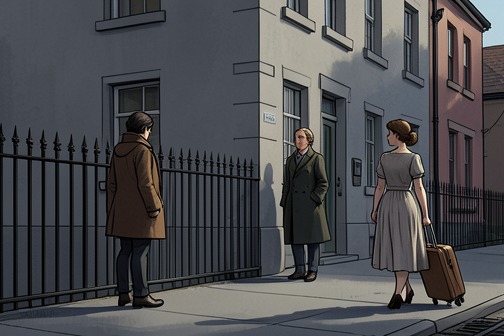
[Lola](entity:character-recall-character-lola-2f3bbe3e3fd0)’s attempt to free the poet from the [Mondragón asylum](entity:location-recall-location-mondrag-n-asylum-1f060e0280df) is an episode of determined planning without a completed escape. She and [Imma](entity:character-recall-character-imma-69732fb9b582) devise a way to visit him, and Lola presents a future in [France](entity:location-recall-location-france-f5cafc8a8ad4) in which he would leave the institution, resume writing, and live with her. Yet the asylum’s gates remain the fixed point of the story: after their plan is stated, Imma leaves to seek money, Lola loses her lodging, and her visits become solitary acts of waiting rather than steps toward liberation.
## Failed visits and a way inside
Lola and Imma first travel to [San Sebastián](entity:location-recall-location-san-sebasti-n-76ff7817b68a) and try to see the poet at the asylum in Mondragón, where he is being held. The guards refuse them entry. They return after finding a cheap place to stay and hitchhiking back, but again cannot get inside. Instead, they study the institution from outside: its gray walls, dirt and gravel roads, the movements of inmates and caretakers, and the land around it. Their attention to the grounds does not yield access, but it gives their failed visit a kind of reconnaissance, as if close observation might make the boundary more permeable.
For their third attempt, they arrange an appointment. Imma claims to be a reporter for a [Barcelona](entity:location-recall-location-barcelona-c4abb0c424bd) newspaper, while Lola presents herself as a poet. This time they are admitted and led through long, blue-and-white corridors to a plain room. The asylum’s staff appear familiar with the poet, who is treated as a known patient and goes to the garden and to receive tranquilizers. The visit makes clear that he is not simply out of reach by accident: he is embedded in the institution’s daily routine.
## The escape plan
Alone with the poet, Lola tells him she has missed him and explains that she had watched over the philosopher’s apartment in the Ensanche without finding him again. She insists that her failure to reach him was not for lack of effort. [The poet](entity:character-recall-character-the-poet-8c85330ec66c) asks for a cigarette; Imma gives him one, then stands beside the bench reading as Lola speaks. This small arrangement places the two women differently in the conversation: Lola addresses the poet directly, while Imma remains present, attentive, and essential to the practical scheme.
Lola’s proposal is explicit. She says she knows the poet is a prisoner and wants to escape, and that she has come to help him leave the asylum for France. When he asks what will happen to Imma, Lola says Imma will help them and that the plan was hers originally. They would cross the mountains as pilgrims, reach Saint-Jean-de-Luz, and take a train to [Paris](entity:location-recall-location-657453741ed3). There, Lola and Imma would find work cleaning or caring for children in wealthy neighborhoods while the poet wrote. The arrangement gives the hoped-for escape a route, a livelihood, and a future: it is not merely a request that he leave, but an imagined life organized around travel, work, and poetry.
Lola extends the plan beyond the journey. She imagines living modestly in Paris, then returning to [Spain](entity:location-recall-location-spain-336a02c89dc7) when she is six months pregnant, crossing back through La Jonquera or Port Bou rather than Irun. The poet listens with interest, but the narrative does not show him agreeing to flee or the proposed route being attempted. The plan’s detail therefore sharpens the distance between the future Lola can describe and the action the asylum’s constraints permit.
## Separation and life outside the gates
After the visit, Lola and Imma return, but the poet is repeatedly unavailable, first because he is on bed rest. Their money runs out, and Imma decides to travel south to [Madrid](entity:location-recall-location-madrid-8acd4123f416) to ask her brother for a loan. Lola is not strong enough to travel and stays behind, expecting Imma to return in a week. On the ninth day, the boardinghouse owner evicts her. She sleeps in a railway station, an abandoned warehouse, or outdoors near the boundary between the asylum and the surrounding world. Once she spends the night in an empty cemetery niche, then decides to wait there because it is peaceful and close to the institution.
Lola continues to visit the asylum grounds. From outside the fence, she sees the poet among other patients and tries to signal to him. She watches an altercation between him and another inmate, then sees him return to the bench and sit between two men. The episode offers no sign that her messages reach him; in a letter to Amalfitano, Lola herself allows that what she perceived may have been her own madness laughing. The scene leaves her in the role of witness, able to watch the poet but unable to determine what he understands or intends.
## An unresolved attempt
[Larrazabal](entity:character-recall-character-larrazabal-0c24f58e41ac) eventually offers Lola a place to stay, drives her to the asylum, and gives her money without asking for anything in return. He proposes marriage, but she reminds him that she is already married. His help changes her immediate circumstances without resolving her purpose: she visits the asylum less often and no longer expects to see the poet, yet she continues looking for a sign she knows she may not understand until much later. She eventually tells Larrazabal she plans to leave and asks him for train fare; he offers to give her what he has but says he cannot give her money to go away.
The attempted rescue thus ends without a depicted escape or reunion. Its central tension is between the clarity of Lola’s imagined itinerary and the repeated deferral of its first necessary step. The asylum is approached, studied, and briefly entered, but it continues to determine the limits of the encounter. Lola’s effort remains consequential as a record of attachment and persistence, while its outcome stays open: she seeks a route out for the poet, but the evidence does not establish that he leaves Mondragón with her.
Event 14
Lola’s departure for France
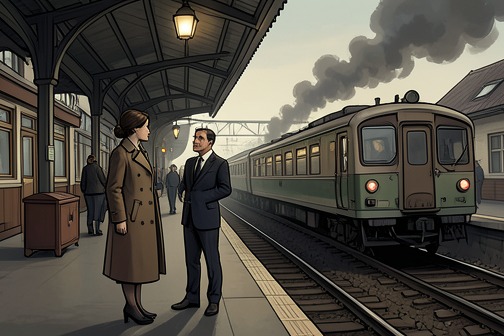
[Lola’s departure for France](entity:event-recall-event-lola-s-departure-for-fr-15a7f02284f4) ends her period of refuge with [Larrazabal](entity:character-recall-character-larrazabal-0c24f58e41ac) and begins a wandering journey in which care for others and uncertainty about [Imma](entity:character-recall-character-imma-69732fb9b582) shape her movements. Recounted in a final letter to Amalfitano, the episode moves from the relative shelter of Larrazabal’s home to train stations and improvised sleeping places, tracing both [Lola](entity:character-recall-character-lola-2f3bbe3e3fd0)’s independence and the growing fatigue of life on the road.
## Background and departure
The account reaches Amalfitano in the next and final letter he receives from his wife. It has no postmark, though its stamps are French, and Lola uses it to recount her conversation with Larrazabal. During her stay in [San Sebastián](entity:location-recall-location-san-sebasti-n-76ff7817b68a), Larrazabal has offered her a place in his apartment and a daily drive to the [Mondragón asylum](entity:location-recall-location-mondrag-n-asylum-1f060e0280df), where the poet is studying osteology. He also gives her money without asking for anything in return, takes her to the movies, and accompanies her to the boardinghouse to ask whether there has been news of Imma.
Larrazabal’s hospitality becomes a close personal attachment. One night, after they have spent hours together, he proposes marriage. Lola reminds him that she is already married, and he accepts the reminder without taking offense. Yet when she later says she plans to leave and asks him for train money, his generosity reaches a limit: he says he will give her everything he has, but cannot finance a departure that would mean never seeing her again. Lola does not press him. She manages to scrape together enough for a ticket by means she does not explain to Amalfitano, and leaves by train at noon.
## A life in transit
Lola’s route does not take her directly to a settled destination. She spends time in Bayonne, leaves for Landes, returns to Bayonne, and is also in Pau and [Lourdes](entity:location-recall-location-lourdes-6739a4edd094). The account presents travel not as a clean break followed by arrival but as a series of movements between places, with no described home or stable plan at the end of them.
At one station, Lola sees a train carrying people who are ill or disabled, alongside other travelers needing assistance. Without knowing how it begins, she finds herself helping them: directing people toward buses waiting outside the station or into queues. The work expands as trains arrive from Italy and northern [France](entity:location-recall-location-france-f5cafc8a8ad4). She moves repeatedly through the station, whose rooms have been converted into first-aid and resuscitation posts, with a separate room serving as an improvised morgue for people who do not survive the journey. This brief, practical role makes Lola part of the station’s response to the travelers’ needs, even as she remains a wanderer herself.
## Shelter and exhaustion
Her lodging is as precarious as her itinerary. In Lourdes she sleeps in trash compartments inside a modern building, entering them through a small door. At other times she remains at the station, including its bar, after the trains’ disruption has subsided. There, older men buy her coffee and talk with her about movies and crops. These encounters offer temporary company, but not a lasting refuge.
The strain of her days becomes increasingly apparent. Lola moves slowly, her fatigue weighing on her, and the narration describes her as going back and forth through the station like a sleepwalker. The contrast is striking: she helps direct people through an urgent and crowded transit system while her own life has no clear destination. Her care is real, but it does not resolve the instability or exhaustion of her journey.
## Imma and the departure from Lourdes
In Lourdes, Lola thinks she sees Imma step off a train from [Madrid](entity:location-recall-location-madrid-8acd4123f416), accompanied by a group of people with disabilities. The resemblance is specific: the woman is Imma’s height, wears long black skirts like her, and has a similarly mournful Castilian face. But Lola does not call out. She stays still until the woman has passed, then, five minutes later, pushes out of the station and walks out of Lourdes toward the highway. Only there does she try to hitch a ride.
The possible sighting remains uncertain; the letter does not establish that the woman is Imma. Its consequence is nevertheless concrete: Lola leaves the station and the town without confirming what she saw. The episode closes not with a reunion or a secure destination, but with Lola on the highway seeking passage onward. Her departure from Larrazabal has thus widened into an open-ended movement through France, carried forward by unresolved separation and the uncertain possibility of finding Imma.
Event 15
Lola returns to see Amalfitano and Rosa
[Lola returns to see Amalfitano and Rosa](entity:event-recall-event-lola-returns-to-see-ama-0daa89767dbb) seven years after leaving them, turning an absence that has lasted for years into a short, unsettled reunion. She finds her former family in [Sant Cugat](entity:location-recall-location-sant-cugat-a9b734d38778), tells [Rosa](entity:character-recall-character-rosa-3b5c8c047120) she is her mother, and reveals to Amalfitano that she has [AIDS](entity:state-recall-state-aids-d9fc10c34f2a) and expects to die. Yet the return does not become a restoration: after five mornings together, [Lola](entity:character-recall-character-lola-2f3bbe3e3fd0) leaves to check on Benoit, her young son in [France](entity:location-recall-location-france-f5cafc8a8ad4). The episode holds reunion and departure together, ending not with certainty about Lola’s future but with the image Amalfitano carries of her setting off alone.
## The search and the reunion
Lola comes back two years after sending Amalfitano her last letter, seven years after abandoning him and Rosa. She spends three weeks asking at old addresses for their whereabouts. The search is marked by misrecognition and distance: some people do not know who she is or have forgotten her, others keep her at the doorway, and some offer her a drink she does not accept because she is intent on finding her family. At night she stays in a boardinghouse near Las Ramblas, among foreign workers in crowded rooms. The city has changed, though she cannot name what is different.
An ex-student of Amalfitano’s recognizes Lola and takes her in. On their second evening, he embraces her; she allows it briefly, then says something quietly to him, and he withdraws to a corner of the living room. They remain apart for hours. This encounter offers shelter but does not divert her from her search. In the following days, she and the ex-student make renewed efforts to locate Amalfitano.
When Lola finally sees him, she recognizes him from a distance but notices that he has grown heavier and lost some of his hair. He is sitting beneath a larch, smoking and looking absent. She tells him he has changed; he recognizes her at once and replies that she has not. They leave together. Their exchange is brief, but its contrast captures the years between them: Lola has returned with the purpose of finding him, while for Amalfitano she remains recognizable despite the changes time has made to him.
## Rosa and the disclosure
At the time of the reunion, Amalfitano lives in Sant Cugat and teaches philosophy at the [Autonomous University of Barcelona](entity:organization-recall-organization-a09b084517a8). Rosa attends the local public elementary school, leaving in the morning and returning at five. Lola tells her that she is her mother. Rosa screams, embraces her, and almost immediately runs to hide in her bedroom. The response makes their relationship real in an instant, but also registers how difficult the sudden return is for a daughter who has lived apart from her mother.
That night, Lola tells Amalfitano she is very ill and will probably die; seeing Rosa once more was the reason she came. He offers to take her to a hospital, but Lola refuses, saying she trusts French doctors more than Spanish ones. Instead, she produces papers in French that state plainly that she has AIDS. Her disclosure changes the visit from a search for family into a meeting under the pressure of serious illness and anticipated death.
The next day, Amalfitano sees Lola and Rosa walking hand in hand near the station. He follows at a distance rather than interrupting them. When he gets home, they are watching television together. Later, after Rosa is asleep, he asks Lola about Benoit. Lola pauses to recall the boy’s features and gestures, then describes him as intelligent and sensitive, and says he was the first to understand that she would die. He recognized it by looking at her, she explains. Amalfitano reflects that such knowledge is terrible for a child; Lola answers that lying to children is worse. The exchange links the two children through Lola’s illness, while showing her insistence that they should not be shielded by falsehood.
## A visit bounded by departure
On the fifth morning, with the medicine she brought from France nearly gone, Lola says she must leave. Benoit is little and needs her, she says, then qualifies the claim: perhaps he does not need her, but he is still little. She admits that she does not know who needs whom; what she knows is that she must go and see how he is. Her reason for leaving is not a rejection of Rosa or Amalfitano so much as an obligation to another child and another life that has continued elsewhere.
Amalfitano leaves a note and an envelope containing much of his savings, expecting Lola to have gone by the time he returns from work. Instead, she is still there, reading a book about Greece while the television plays silently. They eat together. After Rosa has gone to bed, Amalfitano takes her to her room and tucks her in; Lola waits in the living room with her suitcase packed. He urges her to stay the night, claiming that no trains to [Barcelona](entity:location-recall-location-barcelona-c4abb0c424bd) are running. Lola tells him she is going to hitchhike, and he bows his head and lets her go. She kisses him on the cheek before leaving.
The following morning, Amalfitano gets up at six and turns on the radio to check whether a hitchhiker on a nearby highway has been murdered or raped. He hears nothing. The detail does not confirm what happens to Lola; it reveals instead the anxiety that follows her departure and the limits of what Amalfitano can know or do. Her exit remains open-ended.
## The return’s unresolved shape
The reunion briefly restores contact among Lola, Amalfitano, and Rosa, but it does not undo the years of separation or settle Lola’s place between the family she left and the son she must return to. Rosa’s embrace and retreat, the walk with Lola near the station, and the quiet dinner are moments of renewed closeness; the packed suitcase and hitchhiking plan turn them back toward separation. Even Amalfitano’s offer of savings cannot change the decision she has made to leave.
The episode’s final force comes through Amalfitano’s later memory rather than a confirmed account of Lola’s journey. He remembers her as walking along a road out of Sant Cugat with her suitcase, while acknowledging that he did not actually see her go that way. What persists is an image of departure, not reliable knowledge of her destination or safety. In that sense, Lola’s return makes her briefly present without making her fully recoverable: she comes back to be seen by her daughter and former husband, and then disappears from their immediate lives once more.
Event 16
Amalfitano hangs Dieste’s geometry book on the clothesline

[Oscar Amalfitano](entity:character-recall-character-oscar-amalfitano-1ba3b4a6beaa)’s decision to hang Rafael Dieste’s geometry book on a clothesline becomes an improvised, uneasy counterpart to Marcel Duchamp’s [Unhappy Readymade](entity:expression-recall-expression-unhappy-readymade-d567566647ab). The book has appeared among Amalfitano’s possessions without a clear history; rather than resolve that uncertainty, he suspends the treatise outdoors, where weather and dust can act upon it. The gesture gives physical form to his questions about memory, ownership, nature, and the possibility of leaving [Santa Teresa](entity:location-recall-location-fc0da48b1b60).
## The unexplained book
While opening boxes of books in his study, Amalfitano finds [Testamento geometrico](entity:object-recall-object-testamento-geometrico-fe4a093b75ad), a volume he does not remember buying or receiving. Published in 1975 by Ediciones del Castro, it is arranged in three parts: an introduction to Euclid, Lobachevsky, and Riemann; a section on the geometry of motion; and a final section on three proofs of the V Postulate. Amalfitano knows little about geometry and has no intention of learning what the V Postulate means. The book is thus present as an object before it is useful to him as a text.
The volume’s publication details deepen that sense of dislocation. Its dedication lists the friends who supported Dieste’s work, with their surnames printed in capitals while the honored author’s name appears in lowercase. The cover describes the three parts as independent yet correlated, and presents the work as the culmination of Dieste’s reflections on space. Amalfitano recalls that Dieste was a poet, but cannot explain how the book reached his boxes in Santa Teresa.
He asks his daughter [Rosa](entity:character-recall-character-rosa-3b5c8c047120) whether it is hers. She first denies recognizing it, then briefly entertains the possibility before insisting that she has never seen it. Amalfitano tells her that it must have arrived among the books he sent from [Barcelona](entity:location-recall-location-barcelona-c4abb0c424bd), but the shipment offers no certain explanation. A stamp on the first page identifies Libreria Follas Novas in Santiago, Galicia. He considers whether he might have bought it in a Barcelona bookstore that had acquired another shop’s stock, perhaps through a clerk’s mistake, but each possible account remains conjecture. His search does not recover a memory; it multiplies possible stories about its absence.
## From uncertainty to the clothesline
The scene shifts from the study to Amalfitano’s yard, which he surveys in shirtsleeves as though he were a feudal lord inspecting land. The comparison is deliberately at odds with the setting: the yard is humble, barren, and dusty, in a city standing against the desert on the [Sonora](entity:location-recall-location-sonora-c839a79bc3dc)–[Arizona](entity:location-recall-location-arizona-99fb276bcc30) border. The next-door walls are topped with broken glass, a practical sign of boundaries and protection. Against this landscape, the book’s mysterious arrival remains a small but persistent disturbance.
After Rosa says she is going to the movies with a friend, Amalfitano hears her leave through the gate and head toward the bus stop. He looks out into the street but cannot see her or a car. Still holding the book, he notices the moon despite the daylight, then returns to the backyard. He pauses, looking around for his shadow and failing to see it. The clothesline gives the scene its next point of focus: four rows of cord run from a crossbar supported by posts to hooks on the house. A few of Rosa’s clothes and towels are already hanging there.
Amalfitano goes into the small brick laundry hut and takes three clothespins from a supermarket bag. He calls them perritos, the Chilean word he has persisted in using. With the pins he fastens Dieste’s book to one of the cords and leaves it exposed. The action is modest and deliberate: instead of discovering where the book belongs, he changes the conditions under which it exists, putting it between a household object and the weather.
## Duchamp’s model and Rosa’s objection
The narrator identifies the idea as Duchamp’s. In the account of the earlier work, Duchamp instructed his sister Suzanne and her husband, Jean Crotti, to hang a geometry book by strings from their [Paris](entity:location-recall-location-657453741ed3) balcony so that the wind could pass through it, select problems, and turn or tear pages. Duchamp called it an Unhappy Readymade. The work did not survive exposure to the elements; its photographic record shows an open hook left hanging, while Suzanne later painted an image of the arrangement. Duchamp’s stated interest in bringing the categories of happiness and unhappiness into readymades, and in subjecting a serious treatise to the facts of life, supplies Amalfitano with a precedent—but not a guarantee that his own gesture has the same meaning.
That night, after Rosa returns from the movies, Amalfitano explains that he hung the book to see how it would withstand nature and the desert climate. He tells her not to take it down and asks her to behave as though it does not exist. Rosa is concerned that he may be losing his mind. In a later conversation, she calls the hanging an experiment; he resists the literal label and describes the idea instead as leaving the geometry book exposed to see whether it can learn something about real life. Rosa replies that nature will destroy it, while Amalfitano distinguishes between harming the volume himself and allowing the elements to act upon it. Her concern is also social: neighbors may see what is happening in the yard. Amalfitano answers that worse things are happening in the city. Their disagreement leaves the gesture unresolved between playful experiment, neglect, and a challenge to the usual respect accorded a book.
## Watching, weather, and departure
The clothesline does not remain a one-time spectacle. On mornings before going to the [University of Santa Teresa](entity:location-recall-location-university-of-santa-56c6018a72ed), Amalfitano watches the book while finishing his coffee. He observes that it is printed on good paper and that its binding is holding up. Its sturdy construction recalls the materials chosen for Dieste’s tribute edition, which Amalfitano reads as an early farewell from one circle of learned men to another. The book’s physical endurance becomes something he can check, even when the story of its arrival remains unknowable.
His attention to the volume is set against his thoughts about whether to make the yard livable. He considers planting grass, buying a small tree, and putting flowers along the fence, but then concludes that the work may be pointless because he does not expect to remain long in Santa Teresa. He asks himself why he came to the city and whether he ought to return, without reaching a settled answer. The hanging book remains in view, now held by two clothespins and beginning to collect ocher dust. He feels an urge to remove it and wipe it clean, but does not dare.
The act therefore does not solve the mystery that started it or settle the question of Amalfitano’s future. Instead, it gives those uncertainties a continuing material form: an unfamiliar treatise stays suspended in a yard he may soon leave, surviving for the moment while dust accumulates on it. The experiment’s force lies in that tension. Amalfitano subjects a book of geometric principles to unpredictable conditions, but the gesture also exposes how little control he has over memory, place, or what will happen next.
Event 17
Amalfitano begins hearing the voice
[Oscar Amalfitano](entity:character-recall-character-oscar-amalfitano-1ba3b4a6beaa) begins hearing the voice on the night before an excursion, and the encounter turns an ordinary night at home into a test of what he can trust: his senses, his reasoning, or the voice’s claim to kinship. [The voice](entity:character-recall-character-the-voice-1304c58c0aea) first frightens him, then draws him into conversation, finally sending him back to the small tasks of caring for his household. The event remains unresolved as either a supernatural visitation or a crisis of perception, while its aftermath unfolds against the continuing violence and civic unrest of [Santa Teresa](entity:location-recall-location-fc0da48b1b60).
## First Encounter
The voice speaks to Amalfitano for the first time the night before the excursion. He allows that he might have heard it earlier and mistaken it for part of someone else’s conversation or for a dream, but this time he is certain it addresses him. It greets him by name and tells him not to be afraid. The reassurance has the opposite effect: he is afraid enough to hurry to [Rosa](entity:character-recall-character-rosa-3b5c8c047120)’s room, check the window latch, and wake her by switching on the light.
Amalfitano does not tell Rosa what he has heard. He says only that he is nervous and thought he heard a noise. After kissing her cheek and stroking her hair, he leaves the room with the light still on. He goes into the yard to look for someone, but finds no one. The geometry book he has hung on the clothesline is there with socks and Rosa’s pants; the gate and street reveal only a dog heading toward Avenida Madero. Returning inside, he locks the doors and windows, takes a short kitchen knife from a drawer, and sits at the table beside a history of German and French philosophy. His bodily precautions precede any explanation: he searches, secures the house, and arms himself while still trying to decide whether the experience is real.
## A Conversation About Fear and Kinship
The voice returns with an apology and asks Amalfitano not to treat the encounter as an invasion of his freedom. He is startled by that formulation and opens a window to look outside, but sees no source for the voice. Its manner is at once intimate and evasive: it offers reassurance, yet speaks as if it too faces difficulty and needs forgiveness.
In a later exchange, the voice asks Amalfitano to be a man and uses homophobic language. It then insists that it is speaking figuratively and claims admiration for certain poets, painters, and government clerks. The episode does not make this contradiction disappear; the voice’s stated detachment from the insult sits uneasily beside its repeated use of it. Amalfitano remains in his office rather than fleeing or waking Rosa, and eventually tells the voice that he is listening.
The voice proposes that Amalfitano treat it as his grandfather and call it “nono.” It asks personal questions but also tells him that he is free not to answer. Amalfitano answers that he will not run away. The voice admits that it can barely see and says it is managing to keep one foot in Amalfitano’s house. It calls this the first day of what it hopes will be a long, mutually beneficial relationship. The language establishes a relationship without establishing the speaker’s actual identity: the voice offers a familial role, but its account of where it comes from remains uncertain.
## Calm, [Madness](entity:state-recall-state-madness-6fe6f6f940d7), and the Voice’s Advice
The conversation turns on the voice’s insistence that calm is the one thing that will not let Amalfitano down. It declares that ethics, duty, honesty, curiosity, love, bravery, and art can all fail him. Amalfitano objects that bravery and love for one’s children do not. The exchange makes calm less a settled answer than a disputed principle: Amalfitano is frightened, but he pushes back rather than accepting the voice’s bleak account of human attachments.
He asks whether calm is the opposite of madness. The voice says no and reassures him that he has not lost his mind, describing their encounter as an ordinary conversation. Its assurance cannot settle the question for him. The next day, Amalfitano considers the possibility that he is going mad and recognizes that the prospect does not extinguish his happiness or excitement. At the same time, he imagines the consequences for Rosa if his condition worsens: she might return to [Barcelona](entity:location-recall-location-barcelona-c4abb0c424bd) with enough money to make a start there, while he might be confined in an asylum in Santa Teresa or [Hermosillo](entity:location-recall-location-4f7f0d63ba67). His speculation keeps the uncertainty concrete, connecting a frightening possibility to his responsibilities as a father.
The voice also directs Amalfitano toward mundane action. It tells him to check that the doors and windows are shut and to do something useful, suggesting that he wash the dishes. Amalfitano follows the instruction: he cleans the dishes and kitchen surfaces, drinks water from the tap, and puts dirty clothes into the washing machine at five in the morning. He looks again at the geometry book hanging motionless in the yard, then finds nothing else to tidy and sits down, answering the voice in fragments. The household routine gives the conversation a practical consequence: instead of resolving the voice’s identity, it channels his alarm into work that benefits himself and Rosa.
## Explanation, Aftermath, and Setting
When Amalfitano directly asks whether the voice is his grandfather’s ghost, it rejects that explanation and calls itself the spirit of his father. It adds that his grandfather no longer remembers him, whereas his father will never forget him. This is a claim, not proof. The voice gives no account of how it arrived, and it asks Amalfitano to accept its reassurance that he has nothing to fear. Its advice remains plain and domestic: wash, secure the house, and go to sleep.
Amalfitano does as instructed, falls asleep after six, and wakes at nine when Rosa calls him. Although he feels unusually well, he finds his morning classes incomprehensible. At lunch he avoids Professor Perez and other colleagues, chooses a distant table, and thinks over the night. He is surprised that the possibility of madness does not diminish his excitement. His first encounter with the voice therefore changes neither his uncertainty nor his ability to continue ordinary life; it leaves both uneasily in place.
He rejects belief in ghosts on materialist grounds, while recalling the supernatural beings people discussed during his childhood in southern Chile. He does not rule out a ghost, but tries other explanations first. He considers a lost soul, a seer in Hermosillo, and the possibility of his father’s spirit, then reasons that the voice’s Mexican vocabulary does not sound like his father’s, even though its homophobic streak seems more plausible to him. The scene does not confirm any of these possibilities. Instead, its movement between philosophical skepticism, memory, and speculation preserves the voice as an unresolved presence.
The episode also places Amalfitano’s private fear in a city marked by public violence. During the same night, the Santa Teresa police find another teenage girl’s body. The following afternoon, as Amalfitano walks through the central plaza, he sees women protesting outside the town hall, demanding an end to impunity and corruption and transparency in the investigation of women’s disappearances and killings. Professor Perez invites him to a dinner for three feminists from [Mexico City](entity:location-recall-location-mexico-city-78f19f654410); Rosa accepts, and Amalfitano does not object. The voice’s warnings and the public protest are not connected by an explanation, but their juxtaposition sets domestic vulnerability beside the city’s unresolved crisis.
## Narrative Significance
The first conversation establishes the voice through speech and action rather than through a verified supernatural source. It names Amalfitano, adopts the language of family, contradicts itself, and makes practical demands. Its authority is therefore provisional: Amalfitano listens and obeys some instructions, but questions its claims and weighs them against his own beliefs and obligations.
The episode’s tension rests on the gap between sensation and explanation. Amalfitano reacts before he can interpret: he checks Rosa’s room, searches outside, locks the house, and takes a knife. Later, he can entertain the possibility of madness without surrendering either his skepticism or his happiness. The geometry book on the clothesline recurs as a fixed object within this unsettled night, visible first during his search and again while he carries out the voice’s instructions. The experience ends not with a revelation about who is speaking, but with sleep, the next day’s work, and the continuing questions of how Amalfitano can protect Rosa—and what kind of world surrounds them.
Event 18
Edna Miller’s death and funeral
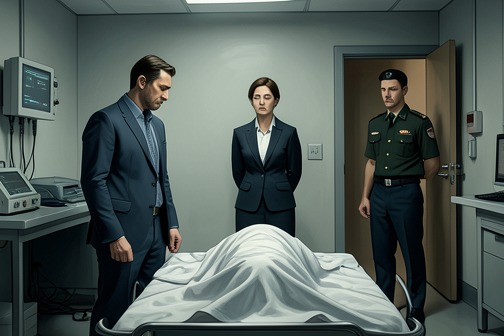
[Edna Miller’s death and funeral](entity:event-recall-event-edna-miller-s-death-and-12f02e86a784) mark a private rupture in the life of her thirty-year-old son, Quincy Williams. The episode follows him from a confused telephone call to the sight of his mother’s prepared body, then through the practical arrangements and a brief, businesslike cremation ceremony. Its decisive force lies in the mismatch between the intimacy of loss and the impersonal forms through which Quincy encounters it: he is her son, yet arrives amid people whose names, faces, and histories he scarcely knows.
## The Call and the Arrival
A neighbor calls Quincy at work and tells him that Edna is dead. He asks when she died and how it happened, but receives no clear explanation. He hangs up, calls his mother’s number, and hears an angry woman asking who is calling. After he identifies himself as Edna Miller’s son, another woman comes to the phone. She says the neighbor has had a heart attack and that an ambulance is expected. Quincy does not dare ask about his mother. Voices overlap, a man curses in the hallway, and the women scold him; Quincy waits for someone to explain what is happening, then ends the call and leaves work.
The scene gives him fragments rather than a coherent account. At his desk, when a colleague asks whether anything is wrong, Quincy raises a hand as if listening to something important and shakes his head. At the apartment, the only person waiting for him is a fifteen-year-old girl, tall and very thin, watching television on the couch. Her jeans are covered by a loose black dress with yellow flowers. She tells him that his mother is in the bedroom.
Edna lies on the bed with her eyes closed, dressed as if she were going out. Someone has put lipstick on her; only her shoes are missing. Quincy looks first at her feet, noticing corns on both big toes and thick calluses on the soles. He remembers that she regularly went to the same podiatrist on Lewis Street, Dr. Johnson, and wonders whether those painful-looking calluses had bothered her as much as they seemed to. Her face, by contrast, looks to him as if it has been carved from wax. The ordinary details of her body remain visible even as death has made her face unfamiliar.
## Arrangements and Uncertain Belonging
When the girl prepares to leave, Quincy tries to give her twenty dollars. She initially refuses, but he insists, and she finally puts the bill in her jeans pocket, hitching the dress up at the hip to do so. He privately thinks she looks like a nun or someone from a dangerous cult. She gives him a paper with the number of a neighborhood funeral home. The exchange is practical, but it also places Quincy in a network of local care that he has not been part of: a teenager has remained with his mother and has helped make sure he knows whom to call.
At the funeral home, Quincy speaks first to Tremayne, who consults his notes, offers condolences, and transfers the call to Lawrence. Lawrence asks what kind of ceremony he wants. Quincy requests something simple and intimate, repeating the wish for emphasis. They settle on cremation and a ceremony at the funeral home the following evening at seven; Lawrence expects it to be over by seven forty-five, barring unforeseen circumstances. Quincy asks whether it can happen sooner, but it cannot. When he asks whether the police or hospital should be called, Lawrence explains that Miss Holly has already taken care of it. Quincy does not recognize the name until Lawrence identifies her as his late mother’s neighbor.
Their conversation briefly turns to religion, revealing another gap in Quincy’s knowledge. He thinks his mother belonged to the Christian Church of Fallen Angels, then corrects himself uncertainly. Lawrence supplies the name Christian Church of Angels Redeemed. Quincy confirms it and says he has no religious leanings of his own; a Christian ceremony will suffice. His inability to recall the church’s name is not presented as a discovery about Edna so much as a measure of the distance between the living son and the life his mother had among others.
## The Night, the Coffin, and the Ceremony
Quincy sleeps on the couch in his mother’s house and enters her room only once to look at the body. In the morning, funeral-home workers arrive and carry a pine coffin down the stairs. Quincy lets them in, gives them a check, watches them take the coffin away, and returns to the couch to sleep. The sequence is starkly procedural: the body is removed, payment is made, and Quincy withdraws into sleep rather than into conversation or communal mourning.
Before the ceremony, he returns to the apartment, takes out the garbage, opens a window, and sits before the television. He considers looking through videotapes on a shelf but abandons the thought, assuming they were recordings of programs his mother watched later at night. He cannot organize his thoughts into a pleasant memory or a list of tasks. When he knocks on the neighbor’s door, nobody answers. The small domestic actions do not restore the apartment to normal; they expose how little he can make himself do with what remains of his mother’s life.
The funeral itself is simple and businesslike. Quincy signs papers and writes another check. He sees the tall girl again, dressed as before in jeans and the black dress with yellow flowers, and tries to wave in a friendly way, but she is not looking toward him. Most of those attending are women and strangers to Quincy, whom he assumes must have been his mother’s friends. Two approach him afterward and say words he cannot understand, whether consolation or rebuke. At the end, Lawrence asks if the service was satisfactory, and Quincy leaves carrying the urn of Edna’s ashes.
## The Urn and the Aftermath
Quincy walks back to the apartment and sets the urn beside the videotapes. The apartment no longer smells bad, and the building is silent, as though everyone has gone out on urgent business. From the window he watches teenagers repeatedly stop their play to gather and talk, then return to playing. He cannot tell whether their pauses belong to the game or mean that they do not know its rules. The scene offers no comfort or explanation; even other people’s patterns of behavior appear opaque to him.
The funeral’s outcome is concrete: Edna has been cremated, and Quincy brings her ashes home. Yet the ceremony does not resolve his separation from her neighborhood or give him a settled account of her final hours. The phone calls have yielded confusion, the people at the service remain unfamiliar, and even the young girl who helped him is someone he can describe more readily by appearance than by name. By ending with the urn beside the tapes and the silent building beyond the window, the episode makes bereavement less a single declaration of grief than a series of encounters with objects, procedures, and people whose meanings Quincy cannot fully recover.
Event 19
Santa Teresa protest against impunity and corruption
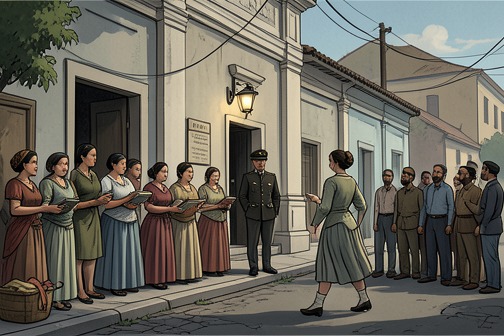
The [Santa Teresa protest against impunity and corruption](entity:event-recall-event-santa-teresa-protest-ag-31775020a0ac) is a public demonstration demanding transparency in the investigation of women’s disappearances and killings. Seen by [Oscar Amalfitano](entity:character-recall-character-oscar-amalfitano-1ba3b4a6beaa) as he crossed the central plaza, it gives a visible civic form to a crisis that official explanations repeatedly fragmented, delayed, or left unresolved.
## The Demonstration and Its Demands
A group of women gathered in front of the town hall. Their posters stated, “No to impunity” and “End the corruption.” Uniformed [Santa Teresa](entity:location-recall-location-fc0da48b1b60) police watched from beneath the arches of the colonial building. The women were protesting the handling of the disappearances and killings of women, not an isolated incident: Professor Perez explained that the demonstrators sought transparency in the investigations.
The scene places protest directly before the institutions whose accountability it questioned. The officers were present, but the account does not describe an arrest or confrontation. Instead, the demonstration’s demands were made legible through its posters and its location at the town hall, while Amalfitano passed through the plaza and encountered Professor Perez and her daughter across the street.
## Local Action and Wider Advocacy
The protest was connected to a broader network of feminist activism. Professor Perez said that three feminists from [Mexico City](entity:location-recall-location-mexico-city-78f19f654410) were staying at her home and that she planned a dinner for them that evening; she invited Amalfitano and [Rosa](entity:character-recall-character-rosa-3b5c8c047120) to attend. The conversation links the street demonstration to an effort to gather and exchange views beyond the immediate crowd, though the account does not establish that the visitors organized this particular protest.
Later accounts show organized advocacy continuing in Santa Teresa. In July, Women of [Sonora](entity:location-recall-location-sonora-c839a79bc3dc) for Democracy and Peace, a feminist organization headquartered in [Hermosillo](entity:location-recall-location-4f7f0d63ba67) with only three members in Santa Teresa, staged the first protests described in connection with the killings. By January 1996, its local branch had grown to twenty activists and supporters. The group held a press conference on the degrading treatment of victims’ families and displayed letters it intended to send to the state governor and the attorney general; the letters received no response. These later actions echo the earlier protest’s demand for accountability while documenting how little institutional answer the activists received.
## The Institutional Context
The demand for transparency is set against investigations repeatedly weakened by procedural failure. After radio reporter Isabel Urrea was murdered, competing explanations circulated, no autopsy was performed out of deference to her family, and the ballistic analysis was never made public before being lost in transit between the courts of Santa Teresa and Hermosillo. In the case of Emilia Mena Mena, police pursued her boyfriend as the main suspect, but he could not be found; the case remained open and was soon forgotten.
Investigative attention was also diverted. [Juan de Dios Martinez](entity:character-recall-character-a321f3f58023) was ordered to leave the stalled Penitent investigation and handle armed robberies, while officers assigned to watch churches were reassigned to cases deemed more urgent for public security. In May, the American consul received permission for a representative to examine photographs of unidentified women found dead in the city, but the search did not identify any of them. These circumstances show why calls for transparency mattered: the problem extended beyond identifying individual perpetrators to whether institutions preserved evidence, sustained investigations, and treated victims’ families as deserving of answers.
## Significance
The protest stands against a city where violence and institutional weakness coexist with rapid growth. Santa Teresa is described as expanding across poor neighborhoods, industrial parks, and the horizon of the maquiladoras; [Chucho Flores](entity:character-recall-character-chucho-flores-c7aa829c6aaf) characterizes it as a place with factories, labor migration, a cocaine cartel, and infrastructure unable to keep pace with demographic growth. Against that setting, the women’s signs insist that the killings cannot be treated as an ordinary background condition or allowed to disappear into administrative delay.
The demonstration does not resolve the cases, and the evidence gives no account of an immediate official response to this particular gathering. Its importance lies instead in making a collective demand visible: investigations into women’s disappearances and deaths should be open to scrutiny, and corruption and impunity should not determine which victims receive attention. The subsequent unanswered letters of Women of Sonora for Democracy and Peace sharpen the contrast between public insistence and institutional silence.
Event 20
Barry Seaman’s lecture in Detroit
[Barry Seaman’s lecture in Detroit](entity:event-recall-event-barry-seaman-s-lecture-8689070081c3) is a five-part address that joins political testimony to ordinary things—cars, money, food, and stars—while recounting the costs of his life as a Black Panther and the death of his friend [Marius Newell](entity:character-recall-character-marius-newell-8aebccc9ad15). [Oscar Fate](entity:character-recall-character-oscar-fate-3ff30603f701) encounters Seaman in a [Detroit](entity:location-recall-location-detroit-c63f400ec324) neighborhood and follows him to a church, where Seaman’s memories give the speech its deepest force: a public account of survival shaped by prison, loss, and the work of beginning again.
## Setting and occasion
In Detroit, [Fate](entity:character-recall-character-fate-343c24ffca57) rents a car and drives to the neighborhood where Seaman lives. A boy directs him to Pete’s Bar, where Fate asks after Seaman and identifies himself as a reporter from [Black Dawn](entity:organization-recall-organization-black-dawn-86c4697bc602). The search is not a formal appointment neatly separated from the city around it: Fate moves through a neighborhood of older residents, young people on the corners, cared-for cars, and a vacant lot where weeds and wildflowers grow over a demolished building. A mural nearby represents twelve stages in Detroit factory production, with a small, recurring figure appearing in each scene. The industrial setting gives the encounter a material frame before Seaman begins to speak about money, labor, and how people might use what they have for their communities.
Fate eventually reaches Seaman’s building and finds him waiting on the landing. They leave together in Fate’s rental car for [Rebecca Holmes Park](entity:location-recall-location-rebecca-holmes-park-95f3e6abd971), about twenty blocks away. The park’s playground is empty; rats scatter, hip-hop plays from a boom box beside a dried-up pond, and Seaman comments on the music. The walk is an interval before the public address, but it also introduces the lecture’s central practice: Seaman treats cultural judgments and personal recollection as matters that must be examined rather than accepted as slogans. From the park they cross the street and enter a church.
## The five-part address
The Reverend Ronald K. Foster introduces Seaman, whose familiarity with the church is apparent. Seaman announces five subjects, in order: danger, money, food, stars, and usefulness. Before he resumes, the choir sings a hymn about Moses and the captivity of the Israelites in Egypt. Seaman raises a hand, the singing stops, and the church becomes quiet. The sequence places his testimony within a setting of religious language and communal listening, without turning the speech into a simple sermon: its subjects range from car safety and prison economies to cooking and the uncertain status of what people see in the night sky.
Seaman begins with danger by comparing the relative closeness of life in apartment buildings with the distances associated with houses and cars. He cites statistics about fatal car accidents in a county of Detroit and a county of Los Angeles, then recalls learning to drive at thirteen. After using an inhaler, he identifies himself as one of the founders of the Black Panthers, alongside Marius Newell. The move from transportation to his political past shifts the speech from practical risk to the dangers that shaped the lives of its speakers and comrades.
The account of Newell becomes the personal center of this first section. Seaman recalls that Newell was killed in [Santa Cruz, California](entity:location-recall-location-santa-cruz-californi-b89da7dc8b65), after returning there despite Seaman’s warning that police there were hostile to them. Newell had spoken of the Pacific and dreamed of breathing its air while the two men were in prison. Seaman says that reports attributed the killing to a debt, but he doubts that explanation; he suspects Newell was targeted because he opposed the local drug trade, while also acknowledging that he was imprisoned and does not know the facts. In his recurring mental image, Newell stands by the sea with their young comrades, and Seaman approaches him to urge him to leave. The remembered scene ends in fear and the thought that the danger is the sea. The ocean that drew Newell toward [California](entity:location-recall-location-california-fd5bbc3f2eb4) thus becomes, in Seaman’s account, inseparable from the violence that found him there.
Money, the second subject, is presented as necessary but relative rather than absolute. Seaman recalls that the value of a cigarette differed from prison to prison: at Folsom it was worth one-twentieth of a small jar of strawberry jam, at Soledad one-thirtieth, and at Walla-Walla as much as a jar. These comparisons make economic value depend on the needs and habits of the people living within each institution. Seaman calls money a mystery, then turns from its abstract value to the conduct he believes should follow when poor people acquire it. He condemns conspicuous personal spending and argues that wealth should support neighbors, education, adopted children, people in prison, and small businesses whose profits return to the community. His examples make economic responsibility a social practice rather than an individual display.
## Food, survival, and a changed life
Food is where Seaman most directly recounts how he survived after prison. He describes returning to a changed political landscape: the Panthers had ceased to exist, Newell was dead, some comrades had died in prison, and others had publicly apologized and begun new lives. Seaman had spent years in prison and, after release, felt that he had little future or useful knowledge to rely on. His older sister gave him a place to stay in Detroit. He remembers her care and the ordinary rhythm of those days, even as he describes the uncertainties and bleakness that accompanied his release.
A parole officer’s conversations also belong to this period. The officer asked Seaman about his past, including violence and political figures, while keeping a gun in his desk. Seaman responded by talking about people he had encountered and places he had visited, including China, where he met Lin Piao. These conversations could last for hours. The narrative gives them as a peculiar exchange between a former revolutionary under supervision and an officer who pressed him for an account of his past, without resolving how much of the officer’s conduct was provocation or threat.
Seaman eventually recognized that he had not forgotten how to cook. With his sister’s help, he wrote down recipes: his mother’s, dishes he had made in prison, and food he had prepared for his sister at home. He took the finished book to publishers in [New York](entity:location-recall-location-75b9ea4bd176), and one accepted it. The book returned him to public life and let him combine cooking with history and with the gratitude and bewilderment he felt toward people who had helped him. Yet he insists that success with recipes for ribs cannot be the whole answer. Change requires turning oneself around and learning how to look even when the object of attention is not yet known. To demonstrate this, he gives a detailed recipe for duck à l’orange, listing its ingredients and explaining its preparation step by step. The recipe is at once practical instruction and part of a larger account of how a skill, preserved through a period of dislocation, could become a means of rebuilding a life.
## Stars, metaphor, and the lecture’s afterlife
In the section on stars, Seaman distinguishes among stars in the night sky, athletes, and movie performers, whose careers unfold on very different timescales. A traveler changing a tire on Route 80 between Des Moines and Lincoln may look up at the Milky Way without knowing whether the visible stars are still alive or have been dead for millions of years. Seaman places stars and dreams in the realm of [semblance](entity:expression-recall-expression-semblance-1fa2041b20f3): what appears in the sky cannot necessarily be separated from what the observer imagines. A meteor on a collision course with Earth, he says, is different from a star. The distinction turns the speech’s reflective imagery back toward danger, but leaves open the relation between appearance, reality, and impending harm.
Newell returns to this discussion through his attention to starfish on California beaches. He could distinguish the dead from the living, leaving the former in place and returning the latter to the sea. Once, he brought a starfish home and kept it in a tank, then went with Seaman and Nelson Sanchez to steal a pump for it. The starfish nevertheless died a week or two later. Seaman uses the episode to clarify that talk of stars is figurative: calling someone a movie star or describing a sky full of stars relies on metaphor. The small story of Newell’s care, and of its failure to preserve the animal, echoes the larger account of a friend who loved the ocean but was killed after going to it.
The lecture’s significance lies in its movement between public argument and personal witness. Seaman’s positions on money, danger, and community are not detached propositions: they emerge from prison, political work, and a life restarted through his sister’s support and his own cooking. His five subjects do not settle into a tidy program. Instead, each opens onto a contradiction—wealth is necessary but morally insufficient; a successful return to public life still demands change; the stars may be present or already gone; the sea can invite a person toward beauty while also marking the place where danger arrives. Through Fate’s attendance and note-taking, the speech also enters the book as a recorded act of testimony: Seaman’s account preserves his understanding of Newell’s death while openly marking the limits of what he knows.
Event 21
Marius Newell’s murder in Santa Cruz
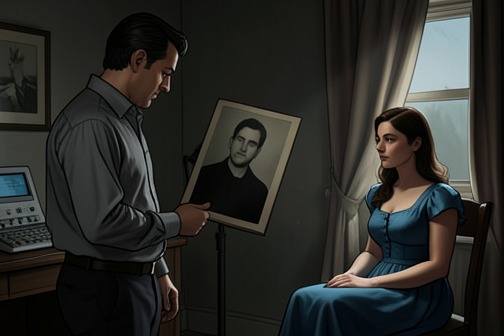
[Marius Newell’s murder in Santa Cruz](entity:event-recall-event-marius-newell-s-murder-959a0ec3b227) is presented through [Barry Seaman](entity:character-recall-character-barry-seaman-e1051ee4da56)’s recollection during a church speech, rather than as a directly witnessed crime scene. Seaman describes Newell as his friend and fellow founder of the Black Panthers, remembers warning him not to return to [California](entity:location-recall-location-california-fd5bbc3f2eb4), and suspects that Newell’s opposition to the drug trade may have made him a target. But Seaman was in prison and cannot establish who arranged the killing or why. The account holds personal certainty about the loss beside uncertainty about its cause, turning a murder into a story of political memory, friendship, and a journey toward the sea.
## The killing and its uncertain cause
Seaman says that Newell was killed one night while walking down a street in [Santa Cruz, California](entity:location-recall-location-santa-cruz-californi-b89da7dc8b65). Newell had gone there for a few days; he did not live in the city. Seaman reports that a Black man killed him and that people said the motive was money: Newell supposedly owed the man. He finds that explanation difficult to believe, however, and offers another possibility. At the time, Newell was fighting the drug trade in town, and someone may have hired the killer because of that opposition. Seaman immediately limits the force of his own theory: he was still in prison and does not really know. He has too many theories, he admits, while the circumstances of the murder remain unresolved.
The distance between reported fact and speculation is central to the account. Seaman is sure that Newell died in Santa Cruz, where he had gone only temporarily, and says it is hard to imagine that the killer lived there. From this he concludes that the killer followed Newell. Yet neither the alleged debt nor the possible connection to the drug trade is confirmed. The murder is therefore recounted through a mixture of remembered friendship, hearsay, inference, and acknowledged ignorance—not as a solved case.
## A shared political history
Seaman places the loss against the history he and Newell made together. During his speech, he identifies himself and Newell as founders of the Black Panthers. He recalls that they took whatever jobs they could find and bought firearms for the people’s self-defense. Their political work, he says, helped bring change: there were more Black police officers in California, and Newell recognized that the Panthers had contributed to the difference. Seaman describes their contribution modestly, as a grain of sand or a dump truck, but insists it mattered.
Newell’s later decision to return to California gives that history a personal consequence. He wanted to live out the rest of his life there in peace, out of harm’s way, and perhaps start a family. Seaman had advised him not to go back, believing there were too many police officers there who wanted to get them. Newell nevertheless liked California and chose to return. The contrast between his hope for a peaceful life and his eventual death gives the warning its retrospective weight, without making it proof that Seaman could have foreseen what would happen.
## Friendship, loss, and an imagined future
Seaman’s grief is sharpened by the future Newell did not reach. Newell had said he would name his first son Frank, after a friend who had died in [Soledad Prison](entity:location-recall-location-soledad-prison-56e63070bec9). Seaman observes that Newell would have needed many children—or several children bearing multiple names—to honor all the friends taken from him. Instead, he had no children: he was killed before beginning the family life he had contemplated. The detail of the proposed name makes remembrance concrete, while the scale of the imagined tributes points to the many losses surrounding the two men.
Seaman says he thinks about Newell more often than he wants to. He pictures them as young Panthers, none yet twenty-five, at a winter lookout above the California coast. In this imagined scene, they have left their weapons in the car; Newell stands looking toward the sea, smiling, and gestures toward it because he cannot put what he feels into words. Seaman approaches him and urges him to leave, then feels afraid even though the friend beside him is like a brother. The scene does not claim to reconstruct Newell’s last moments. It is a recurring image through which Seaman gives form to attachment, foreboding, and the knowledge that the friend he remembers is gone.
## The ocean and the form of remembrance
The Pacific is not incidental to Seaman’s account. He remembers that Newell liked the rocky beaches and the air by the sea, and that, while the two men were imprisoned, Newell sent postcards describing dreams of breathing that air. Seaman says that Black people may like the sea less than others, then defers his theory about why. That unfinished explanation leaves the ocean as both a particular refuge Newell longed for and a larger, unexplained presence in the speech.
Seaman imagines Newell’s return to California as a path leading toward the coast: perhaps Big Sur, perhaps Monterey, reached along Highway 1. The imagined beach is not offered as the site of the murder. Rather, it is the place where Seaman can picture his friend alive, looking outward and communicating through a gesture. That vision stands against the account of Newell being followed and killed in Santa Cruz. The sea offers an image of longing, but does not resolve the violence that interrupts the hoped-for peaceful life.
## The speech as testimony
The murder enters the novel through public remembrance. Seaman’s speech has moved from a discussion of car accidents to his history with the Panthers; at the mention of Newell, the narrative describes the shift as though Newell’s ghost had entered the church. Seaman then turns to Newell’s mother, Anne Jordan Newell, before recounting the killing. This movement places political comradeship within a wider network of family and loss, rather than allowing the death to remain a detached statistic.
The speech also preserves the limits of testimony. Seaman can name his warning, describe Newell’s plans, repeat what others said about money, and explain why he suspects an order connected to the drug trade. He cannot verify the killer’s motive, and his imprisonment kept him from knowing the events directly. His imagined coastal scene offers no forensic answer; it is a form of mourning. The murder’s significance lies partly in this unresolvedness: Newell’s death is remembered with specificity, while the explanation for it remains uncertain.
Event 22
Santa Teresa femicides
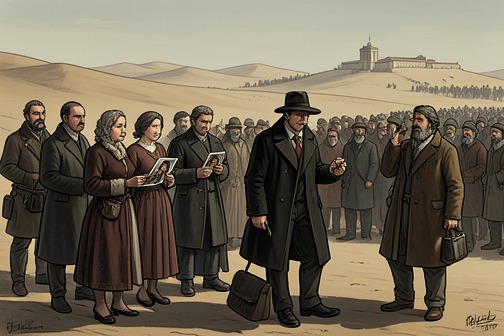
The [Santa Teresa femicides](entity:event-recall-event-santa-teresa-femicides-8873810d129a) are a sustained series of killings and disappearances that exposes the distance between the accumulation of women’s deaths and the institutions’ ability—or willingness—to treat them as a connected crisis. The victims include young workers from the maquiladoras, but their cases repeatedly become isolated files: identities remain unknown, evidence goes missing, investigations stall, and official explanations shift. The pattern is not only the violence itself, but also the public forgetting and administrative dispersal that follow it.
## Background and Pattern
The killings are counted from January [1993](entity:time-recall-time-1993-d7b93468ef23), when thirteen-year-old Esperanza Gomez Saldana was found in a vacant lot in [Colonia Las Flores](entity:location-recall-location-b67a0a40c0af). The date becomes an administrative starting point, not a guarantee that she was the first victim: the narration allows that women may have died in 1992 or earlier, never entered into a list, never found, or buried anonymously in the desert. Counting begins where the record begins, while the deaths themselves may exceed the record.
The crimes do not present a stable pattern that can be confidently assigned to one perpetrator. In conversation with [Oscar Fate](entity:character-recall-character-oscar-fate-3ff30603f701), [Chucho Flores](entity:character-recall-character-chucho-flores-c7aa829c6aaf) says that many victims are young women employed in maquiladoras, but their long hair is not a distinguishing clue in a city where long hair is common. The popular account imagines a single killer who will never be caught; Flores estimates that more than two hundred women have been killed, while acknowledging that he does not know the exact number. He describes the victims as disappearing and their bodies later turning up in the desert. The uncertain count and uncertain authorship coexist with the stark recurrence of the deaths.
The crisis becomes visible in waves. When the numbers rise, reporters return to the story and people talk; then, Flores observes, attention melts away and everyone goes back to work. He compares the killings to a brutal strike, a metaphor that makes the violence seem like a stoppage imposed on the city while also underscoring how quickly public attention resumes its ordinary rhythm. For women working shifts and walking through poorly lit industrial districts, the danger is bound to the geography and routines of labor; for the wider public, the crisis repeatedly recedes from view.
## Investigations and Institutional Failure
The first cases show how quickly a death could be made legible as an individual file while its relation to other killings remained uncertain. After Esperanza Gomez Saldana was found, police and a judge examined her before an autopsy confirmed that she had been killed. Yet the initial inquiry did not identify her; her name was established only later. The official record could describe a particular death, but that precision did not by itself produce a wider account of the pattern.
Other investigations ended in missing evidence or untested explanations. The killing of radio reporter Isabel Urrea was publicly attributed to a failed robbery, with other theories also circulating, but there was no autopsy and the ballistic analysis was lost while being transferred between courts. In the case of Emilia Mena Mena, police pursued her missing boyfriend and detained members of his family, but found no trace of him at the address they were given; the case remained open and was soon forgotten. These outcomes differ, but both leave the deaths without a settled, publicly demonstrable answer.
The institutional retreat also shaped which cases received attention. [Juan de Dios Martinez](entity:character-recall-character-a321f3f58023) was reassigned from the stalled Penitent investigation to armed robberies in Colonia Centeno and Colonia Podesta. He was told the earlier case was not closed, but that the suspect had vanished, the inquiry was at a standstill, and limited staffing required investigators to prioritize other matters. Officers who had been watching churches around the clock were redirected to work considered more urgent for public security. The reassignment did not formally end the investigation; it narrowed the effort available to pursue it.
The treatment of unidentified women exposes another limit of the record. In one 1993 case, a woman found at a school field was never identified. The medical examiner could only estimate her age, place her death several days earlier, and state that the evidence did not establish a single cause with certainty. In January [1995](entity:time-recall-time-1995-64c2ba2a169b), a skeleton found in a cooperative’s field was judged to be a woman’s and likely a murder victim, but the time and manner of death could not be determined; the police then offered a speculative possibility that she had been killed elsewhere and buried there at random. In October, a girl with no identification was found dead near railroad tracks, and none of the women reported missing matched her description. Across these cases, uncertainty is not an incidental gap: it governs whether a victim can be named, connected to a disappearance, or attached to a prosecutable account.
Public scrutiny did not reliably correct those failures. When the [United States](entity:location-recall-location-united-states-2f533bc8d0b9) consul arranged for Rory Campuzano, an assistant to the missing [Huntsville](entity:location-recall-location-f2a55c927b94) sheriff, to review photographs of unidentified bodies found in [Santa Teresa](entity:location-recall-location-fc0da48b1b60), he identified none. The police chief had permitted the review as a courtesy, while the consul accepted that the sheriff might have been in the city as a tourist rather than on official business. The episode supplied no resolution to the search and left the unidentified dead unresolved.
The novel repeatedly sets forensic detail beside procedural weakness. An examination may establish a likely cause of death, as in the skeleton case, while leaving the date unknown; a victim may be described carefully yet remain unnamed; or a physical analysis may disappear from the legal process altogether. The resulting archive is uneven: some facts are recorded, others remain conjectural, and the accumulation of reports does not automatically become accountability.
## Public Response and Competing Explanations
As the killings continued, activists and journalists tried to keep them from being absorbed into the city’s periodic cycles of attention and forgetfulness. In January 1996, the Santa Teresa branch of Women of [Sonora](entity:location-recall-location-sonora-c839a79bc3dc) for Democracy and Peace held a press conference about the degrading treatment of victims’ families, and prepared letters to the state governor and the attorney general. The letters received no reply. The branch grew from three members to twenty activists and supporters, but its expanded presence did not bring an institutional answer.
On April 2, [Florita Almada](entity:character-recall-character-florita-almada-33b4e966c45d) appeared on [Reinaldo](entity:character-recall-character-reinaldo-1d410a68cb05)’s television program with WSDP activists, who described the climate of impunity, police laxity and corruption, and the rising number of dead women since 1993. They appealed to the governor to address what they called an unsustainable situation in a country that professed respect for human rights and the law. The broadcast immediately exposed the costs of making the issue public: the station head nearly suspended Reinaldo, called him an agitator, and the program’s producer had to urge him to proceed cautiously. The activists’ appeal reached viewers, but it also met pressure within the media institution carrying it.
A separate television appearance in [Mexico City](entity:location-recall-location-mexico-city-78f19f654410) widened the dispute. Women in Action demanded that federal investigators be sent to Santa Teresa, arguing that the Sonora police could not manage the case or might be complicit. They questioned whether a serial killer—or several—was responsible, described [Klaus Haas](entity:character-recall-character-klaus-haas-a06ea2613d1a) as a likely scapegoat, and challenged the host to identify evidence against him. They also defended the local WSDP activists while dismissing the seer who had appeared with them on regional television. The debate thus turned not only on who had committed the crimes, but on whose account, expertise, and public voice would be trusted.
Official statements offered a sharply different kind of closure. After members of Los Bisontes were arrested, police suggested that the gang had carried out murders for hire and that Haas had paid for the deaths of women resembling his supposed victims. The mayor, Jose Refugio de las Heras, then announced on television that the serial killings had been solved and declared that crimes from then on would be ordinary offenses in a growing city. The declaration drew a boundary around the crisis: it presented a solution even as the continuing deaths and contested evidence kept that solution in question.
The novel makes that contradiction explicit through questions raised in the Mexico City press after the March deaths: if the murderer, or his alleged accomplices, were in prison, who had killed the other women? Were Los Bisontes a genuine gang or partly a police creation? Why had Haas’s trial been repeatedly postponed, and why had federal authorities not appointed a special prosecutor? On April 4, [Sergio Gonzalez](entity:character-recall-character-3f3e38d17323) was sent back to Santa Teresa to report on the killings. The return of investigative attention registered the failure of the earlier claims to settle the matter.
## Accusation, Recurrence, and the Limits of Closure
Klaus Haas’s public interventions further unsettled the official account. In January 1996, while imprisoned, he asked reporters how killings could continue if the killer was behind bars. He drew attention to identical knots in the ropes used on Michelle Requejo and [Estrella Ruiz Sandoval](entity:character-recall-character-estrella-ruiz-sando-81faf5c46b7c), and said that Estrella was the only victim who had had direct contact with him, through her interest in computers. His challenge did not establish who was responsible, but it made the continued deaths a test of the claim that his imprisonment had solved the crimes. That month, no women’s bodies were found in the city or desert, a temporary pause that offered no lasting resolution.
In June, Haas convened another press conference, telling six reporters that he had obtained information he had previously lacked and wanted to make public. He named [Antonio Uribe](entity:character-recall-character-antonio-uribe-05d75144d870) as the killer of women in Santa Teresa and the surrounding area, claiming to have met him once. The announcement shifted suspicion toward a named man, but the available account does not resolve the accusation into a demonstrated answer. Haas’s earlier question—how killings could persist while the supposed killer was imprisoned—remains a measure of the uncertainty that surrounds every proposed solution.
The pattern continued to resist closure. After arrests of Los Bisontes, the mayor announced that the serial killings had been solved, yet Mexico City papers soon asked who was responsible for the deaths occurring after the alleged killer and his supposed accomplices were detained. On April 6, the body of Michele Sanchez Castillo was found beside a bottling plant; she had no identification, and the investigation did not establish her identity. Later, an unidentified girl found near railroad tracks bore signs of torture, but none of the missing women matched her description. Repeated discoveries therefore undermined the neat division between a solved series and ordinary crimes: the deaths continued, while the identities, links between cases, and responsibility for them remained uncertain.
Event 23
Count Pickett vs. Merolino Fernandez boxing match

[Count Pickett vs. Merolino Fernandez boxing match](entity:event-recall-event-count-pickett-merolino-a1dc505daede) is the bout that brings [Oscar Fate](entity:character-recall-character-oscar-fate-3ff30603f701) to [Santa Teresa](entity:location-recall-location-fc0da48b1b60) on assignment: Pickett knocks Fernandez out in the second round, and the fight is over in less than a minute. For [Fate](entity:character-recall-character-fate-343c24ffca57), the contest is both a straightforward sporting result and an awkwardly bounded story, staged in a city where the killings of women remain in the background of almost every encounter.
## Assignment and Arrival
Fate crosses into [Mexico](entity:location-recall-location-mexico-6f79111cb935) with a press ID and tells the American customs officer that he is not there to write about the killings; he has come to cover Saturday’s fight. At the Mexican crossing he presents his documents and completes forms while exhausted officials process him. The contrast is pointed: his professional purpose is a boxing match, while the murders are close enough to shape the questions he is asked at the border.
A clerk gives Fate a carefully drawn map to the Arena del Norte, described as resembling a theater from 1900, with the ring at its center. At the stadium offices, Fate collects his credentials and learns that Pickett has not yet arrived. He joins reporters planning to interview Fernandez; at the hotel press conference, Fernandez says he believes he can beat Pickett and, when asked whether he has seen him fight, answers that the important thing is to trust his own strength.
## The Fighters and the Publicity
When Pickett arrives, Fate finds him in the ring wearing a suit and tie, smiling as photographers take pictures and reporters call questions to him. They ask about a possible championship bout, another fighter’s supposed fear, why he has come to Santa Teresa, and a possible elopement in Las Vegas. Pickett’s manager, Sol, handles most of the questions, speaking Spanish with Mexican reporters and answering the American press as well. The press event places the fight inside a noisy exchange of celebrity, prediction, and promotion before the actual contest has begun.
The bout carries a larger local context than its sporting billing suggests. Santa Teresa is described as a fast-growing city with factories, maquiladoras, low unemployment, incoming workers and Central American immigrants, alongside a cocaine cartel and infrastructure unable to keep pace with demographic growth. [Chucho Flores](entity:character-recall-character-chucho-flores-c7aa829c6aaf) characterizes the killings as comparable to a brutal strike. That description ties the city’s violence to its economic and social life without making the boxing match a solution or a direct explanation of the murders.
## The Bout and Its Immediate Outcome
The fight is short. Pickett enters to polite applause and some boos; Fernandez receives a thunderous welcome. They assess one another in the first round. In the second, Pickett goes on the offensive and knocks Fernandez out in less than a minute. Fernandez does not recover in the ring; his seconds carry him to his corner, and medics take him to the hospital. Pickett raises an arm without much enthusiasm and leaves with his entourage as the audience begins to file out.
The outcome settles the contest decisively: Pickett wins, while Fernandez’s confidence at the press conference gives way to defeat. The available account records the immediate response but does not establish what happens to Fernandez afterward. The scene’s sharp shift from crowd spectacle to a subdued departure leaves the victory less like a triumphant climax than a result quickly absorbed into the city’s larger unease.
## Fate’s Story and the City Around It
After the fight, Fate considers leaving the gathering around him and returning to the [Sonora Resort](entity:location-recall-location-9071561fca7d) to write his report, or continuing toward the border and [Tucson](entity:location-recall-location-tucson-01e85518a44a) to finish it before flying to [New York](entity:location-recall-location-75b9ea4bd176). He judges the athletic result simple: Pickett knew how to fight and Fernandez did not. Yet he follows the others’ convoy around Santa Teresa instead, uncertain about the purpose of the invitation to eat together and increasingly conscious of the city as unfamiliar terrain. The match therefore supplies his assignment’s central fact, but not the understanding of Santa Teresa he has sought.
The city’s geography gives that unresolved feeling a material frame. Santa Teresa stretches from poor western neighborhoods and neglected central plazas to wealthier districts, abandoned factories, industrial parks and crowded settlements; roads lead toward the border, while the maquiladoras mark the horizon. The boxing stadium is only one stop within this expansive landscape. Fate’s report can record who won and how, but the bout’s brief, legible conclusion stands against a city whose violence and growth resist such neat closure.
Event 24
Scottsboro case
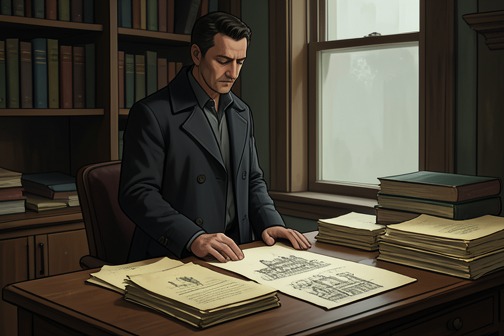
The [Scottsboro case](entity:event-recall-event-acf3af24523f) is listed as an event associated with the novel, but the available evidence does not narrate the case itself. It supplies no account of the people involved, the legal proceedings, or the case’s outcome, so those details cannot be established here.
## Evidence and Limits
The supplied passages focus on violence against women in and around [Santa Teresa](entity:location-recall-location-fc0da48b1b60), including discoveries of unidentified victims, investigations, and public responses. They do not mention Scottsboro or explain why it appears in the event record. A substantive description or comparison would therefore go beyond what the text provided supports.
## Relation to the Novel’s Documented Events
The surrounding evidence presents the Santa Teresa killings through fragmented reports, police actions, forensic findings, and accounts of institutional inaction. These passages show how victims may remain unidentified and how investigations can stall or lose evidence. They do not, however, make an explicit connection between those patterns and the Scottsboro case. Any such connection remains unsubstantiated by the available material.
Event 25
Jack the Ripper murders
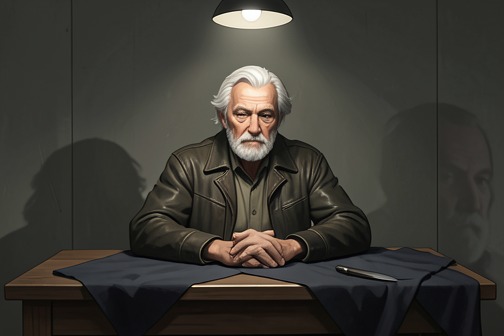
The [Jack the Ripper murders](entity:event-recall-event-eaa6215c4720) enter [2666](entity:time-recall-time-2666-76934e943b8e) not as a separate investigative plot but as a historical reference point in a discussion of crime, social attention, and the limits of language. The case is described as famous yet unresolved: no one knew the killer’s identity. Its importance lies in the contrast between a murder that becomes narratable and deaths that society barely recognizes.
## The Case as Historical Reference
A white-haired man recalls Jack the Ripper while arguing that extreme violence was not invented by modern society. He says that people in earlier centuries also committed terrible crimes, including serial killings, but that the archetypes of cruelty and madness persist even as public sensibilities change. The Ripper case anchors this claim in a crime familiar enough to be called the most famous of its day, but whose perpetrator was never identified.
The recollection broadens from the unresolved case to the historical uses of language. In the man’s account, words once filtered death, trimming reports to fit society’s fears. They could make a crime legible, but they could also serve avoidance rather than revelation. The reference therefore does not offer a solution to the Ripper murders; it shows how a famous unsolved crime can be remembered while the social meaning of violence remains unsettled.
## Legibility and Unequal Attention
The comparison turns on who is counted as part of society. The speaker contrasts deaths largely ignored in public accounts—people who died during the [Paris Commune](entity:event-recall-event-09d927942b3a) and enslaved people who died during transport—with individual murders that drew extensive attention. He argues that the latter deaths could be written about because their victims and perpetrators were socially legible. The Ripper case belongs to this history of crime rendered memorable through public narration, even though the killer himself remained unknown.
This contrast gives the reference a critical function in the novel’s treatment of violence. Being widely reported or remembered does not mean that crime has been explained, and the presence of words does not guarantee revelation. The case stands beside the broader question of why some deaths become stories that disturb society while other deaths remain outside its field of concern.
## Relation to the [Santa Teresa](entity:location-recall-location-fc0da48b1b60) Killings
The Ripper reference resonates with the killings in Santa Teresa, where the number of dead women is discussed in uncertain terms and the possibility that the total is higher remains open. One young man tells [Jean-Claude Pelletier](entity:character-recall-character-jean-claude-pelleti-ee4823274bfc) and [Manuel Espinoza](entity:character-recall-character-manuel-espinoza-5c3d56673a24) that more than two hundred women have died since [1993](entity:time-recall-time-1993-d7b93468ef23) or [1994](entity:time-recall-time-1994-2c6f52c72808); he suggests the figure might be two hundred and fifty or three hundred, but says no one will ever know. The passage juxtaposes that uncertainty with the historical fame of a case whose killer also remained unidentified, while shifting attention from the notoriety of an individual murderer to the accumulation of women’s deaths.
Elsewhere, [Chucho Flores](entity:character-recall-character-chucho-flores-c7aa829c6aaf) describes a recurring cycle: rising numbers briefly make the killings news again, public talk grows, and then attention fades as people return to work. This pattern sharpens the contrast with the enduring cultural recognition of the Ripper case. In the novel, the historical comparison helps expose how public memory can preserve a famous criminal mystery even as ongoing violence becomes ordinary, disputed, or forgotten.
Event 26
Paris Commune
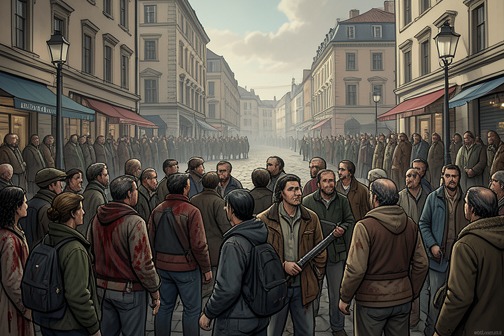
The [Paris Commune](entity:event-recall-event-09d927942b3a) is invoked as a historical contrast in the novel’s examination of how violence becomes publicly visible—or disappears into the background. The discussion sets the mass deaths of 1871 against crimes involving socially legible individuals, showing that public attention does not follow the scale of suffering alone.
## Historical Reference
The Commune appears in a reflection on the history of crime and its representation. A speaker recalls that thousands were killed during the Paris Commune of 1871, yet the scale of the deaths did not provoke the same public response as particular murders reported in [France](entity:location-recall-location-france-f5cafc8a8ad4) and elsewhere in Europe. The comparison concerns not only how many people died, but whose deaths could be recognized as a public event.
## Visibility and Social Legibility
The account explains the contrast through social exclusion: those killed in the Commune were treated as outside society, while victims of individual crimes could be understood as people whose stories were fit to tell. Their deaths were therefore more readily recorded and circulated. In this argument, what becomes legible is not simply what happened; it is what a society permits itself to see and narrate.
The speaker also places the Commune beside deaths on slave ships, whose victims likewise failed to produce comparable public alarm. Against these large-scale losses, a double murder in Virginia and a French provincial crime attracted extensive attention. The examples suggest that public language can sort lives into those whose deaths count as news and those whose deaths remain unremarked.
## Narrative Significance
The Commune is not developed as a continuous historical episode. Instead, it enters through retrospective commentary and through Boris [Ansky](entity:character-recall-character-2b3d034ca5c5)’s account of Gustave Courbet, who took an active part in the Commune and was imprisoned after its repression. Ansky recounts that the state accused Courbet of encouraging the destruction of the Vendôme Column, while acknowledging uncertainty about that charge. Courbet’s public responsibility for protecting Parisian monuments becomes an irony against the events that followed: he was arrested, imprisoned, and had his assets seized before leaving for Switzerland.
Together, these references make the Commune a measure of the distance between mass violence and its public narration. The historical deaths remain present in the novel not as a fully reconstructed battle or chronology, but as a challenge to the categories through which societies decide whose suffering is reportable, memorable, and worthy of response.
Event 27
Fall of the Berlin Wall

The [Fall of the Berlin Wall](entity:event-recall-event-da794ef99550) is mentioned as a historical event that reaches [Benno von Archimboldi](entity:character-recall-character-benno-von-archimbol-b19f141ab3bf) indirectly: he learns of it from a letter written by the [Baroness Von Zumpe](entity:character-recall-character-baroness-von-zumpe-c8d14720d126), who was in [Berlin](entity:location-recall-location-769cdeac2511) that night. Rather than narrating the fall itself, the novel makes the event part of the private history between two people whose lives have largely unfolded apart.
## How Archimboldi Learns of It
Archimboldi does not follow current affairs through television, radio, or newspapers. The baroness’s letter is how he hears that the Berlin Wall has fallen, making their correspondence his channel to a major public event. Her presence in Berlin gives the news a personal point of origin, but the passage offers no account of what she witnessed or of Archimboldi’s immediate response.
## A Public Event in a Private Correspondence
For years, the baroness and Archimboldi have maintained their most lasting connection through letters. Their written exchanges range across her social life and sexual relationships, famous figures and events, and religious subjects. The report of the Wall’s fall thus arrives within an established, intimate correspondence rather than a political or journalistic narrative. The event is named, but its meaning is not explained or debated between them in the passage.
## Distance, Fame, and the Wish to Return
The letter also belongs to a conversation about Archimboldi’s absence from [Germany](entity:location-recall-location-a3c24dd56e42). The baroness sometimes asks him to return; he answers that he has already come back, while she presses him to come back for good and notes that he is now famous. She suggests a press conference or an interview with a leading cultural reporter, and he rejects the latter possibility in writing. Against this exchange, the news from Berlin marks a moment of historical change that reaches Archimboldi without drawing him back into public life. The novel’s restrained reference keeps the event at the edge of the scene: history changes, while his connection to it remains mediated by the baroness and the letters that sustain their relationship.
Event 28
Collapse of the Eastern Bloc

The [Collapse of the Eastern Bloc](entity:event-recall-event-959608fb2c4e) has no directly narrated scene in this passage. Its place in the book’s historical horizon is instead approached obliquely: during a drive toward [Santa Teresa](entity:location-recall-location-fc0da48b1b60), [Oscar Fate](entity:character-recall-character-oscar-fate-3ff30603f701) is drawn into a childhood memory of a landscape changing from the built-up outskirts of [New York](entity:location-recall-location-75b9ea4bd176) to open country. The remembered scene offers no political explanation or historical account; its force lies in the uncertain passage between worlds and in the lonely figure glimpsed at their boundary.
## A Night Journey Toward Santa Teresa
After asking for water, [Fate](entity:character-recall-character-fate-343c24ffca57) goes to drink by a window. The desert begins to disappear, and he drives for two hours along dark roads, listening to a [Phoenix](entity:location-recall-location-f2569f84debb) jazz station. He passes houses, restaurants, yards with white flowers, and crookedly parked cars. No lights are on in the houses; the scene seems emptied of its inhabitants, while the description leaves a lingering impression of blood in the air.
The route does not offer a reliable sense of direction. Fate gets lost twice, and once considers turning back toward the restaurant or [Tucson](entity:location-recall-location-tucson-01e85518a44a). At a gas station in Patagonia, a boy gives him the easiest way to Santa Teresa. Leaving town, Fate sees a black horse in his headlights. He stops and waits; the horse lifts its head, looks at him, then moves away and vanishes into darkness. The pause yields no explanation, only a brief encounter with an animal that resists being held in view.
## The Remembered Landscape
The road takes Fate past what he takes to be a mesa, enormous and flat-topped, perhaps three miles long. Beside the road, he gets out of the car, leaves its lights on, and urinates in the cool night air. Beyond a slope, a valley strikes him as gigantic. In its far corner he thinks he sees a glow, but cannot tell whether it is a slow convoy of trucks, the first lights of a town, or simply his desire to escape the darkness.
That uncertainty opens into a memory from somewhere between childhood and adolescence. Fate recalls dreaming of a landscape like this one, though less dark and less desertlike. In the dream, he is on a bus with his mother and one of her sisters, traveling from New York to a nearby town. Buildings and highways fill the view until the bus suddenly reaches the country. The sun is setting; a small wood appears larger to the child looking out the window.
## The Solitary Figure and Historical Resonance
At the edge of the wood, Fate thinks he sees a man walking in long strides, as if trying to stay ahead of night. His shirt and swinging arms distinguish him from a mere shadow. The man’s loneliness is so great that Fate wants to look away and cling to his mother, but he keeps watching until the bus leaves the woods and buildings, factories, and warehouses return beside the road.
The recalled image is not an account of the political collapse named by this entry, and it does not establish a direct causal or symbolic link to it. Its relevance is formally indirect: the passage sets a remembered transition from city to countryside beside a present journey through the desert, and places a solitary figure at the point where darkness threatens to overtake the visible world. History, like the glow Fate glimpses in the valley, remains distant and indistinct; the narrative gives the reader an image of uncertainty rather than a settled explanation.
Event 29
September 11 attacks
The [September 11 attacks](entity:event-recall-event-386102a65454) are a recent, contested reference point in [2666](entity:time-recall-time-2666-76934e943b8e): they heighten the shock of a [Harlem](entity:location-recall-location-792a51fee13c) group marching with Osama bin Laden’s image, then become the focus of an interview in which its spokesman replaces public explanations with elaborate conspiracy claims. The episode also throws into relief the book’s treatment of attention and violence: while the attacks command immediate notice, the killings of women in [Santa Teresa](entity:location-recall-location-fc0da48b1b60) repeatedly fade from public view, and [Oscar Fate](entity:character-recall-character-oscar-fate-3ff30603f701)’s effort to report on them meets editorial resistance.
## Public Shock and the Harlem Demonstration
Less than six months after the attack on the World Trade Center, [Fate](entity:character-recall-character-fate-343c24ffca57) sees the [Mohammedan Brotherhood](entity:organization-recall-organization-78bffff46dd2) at a pro-Palestine demonstration in Harlem. The group is small, but its members march beneath a large poster of bin Laden, turning their presence into an unmistakable provocation. Television crews and newspaper photographers take notice; the image magnifies the group’s visibility, and the demonstration becomes a scene of public confrontation rather than an ordinary march.
Fate follows the group after its members leave in a planned maneuver, then arranges to meet them. At a basement gathering, he asks [Khalil](entity:character-recall-character-khalil-f5b8914d9b1c) why they carried bin Laden’s portrait. Khalil presents bin Laden as someone who understood the nature of their struggle and describes the Holy War as a voice for people who have lost the power of speech. The attack therefore appears not as an isolated historical reference but as material the group uses to frame its own politics and grievances.
## Conspiracy Claims in Fate’s Interview
Khalil disputes the accepted account of the attacks. He suggests that the destruction benefited people with incriminating papers or interests in arms sales, questions whether Mohamed Atta was aboard one of the planes, and claims Atta and the other alleged perpetrators were killed and their bodies destroyed. When Fate asks who flew the planes, Khalil proposes a succession of alternative perpetrators, including people recruited from mental hospitals or volunteers who had been brainwashed.
These claims belong to Khalil’s account, not to the novel’s confirmed explanation of the attacks. Their importance lies in how the interview stages a conflict over knowledge: Fate presses for names and explanations, while Khalil’s answers widen the conspiracy rather than establish verifiable facts. His account draws on disappearance, secrecy, and distrust of institutions, making the attacks an occasion for a broader theory of hidden power.
## Competing Claims on Attention
The attacks’ prominence contrasts with the persistent, less visible violence in Santa Teresa. During his stay there, Fate learns of the killings of women and tries to persuade his editor that the story merits more than his assigned boxing coverage. He proposes investigating the possibility that one or two people committed the crimes, alongside drug trafficking, the border, police corruption, and the city’s rapid growth. His editor refuses to change the assignment, insisting that Fate is there to cover a boxing match.
The book also shows how attention to the [Santa Teresa murders](entity:event-recall-event-900707b53c09) rises and recedes. [Chucho Flores](entity:character-recall-character-chucho-flores-c7aa829c6aaf) tells Fate that each increase in the numbers brings renewed news coverage and public discussion, but that the story swells and then disappears as people return to work. In an earlier conversation, a boy tells [Jean-Claude Pelletier](entity:character-recall-character-jean-claude-pelleti-ee4823274bfc) and [Manuel Espinoza](entity:character-recall-character-manuel-espinoza-5c3d56673a24) that more than two hundred women have been killed since [1993](entity:time-recall-time-1993-d7b93468ef23) or [1994](entity:time-recall-time-1994-2c6f52c72808), perhaps many more; Espinoza reflects on their initial disbelief. These accounts do not make the two kinds of violence equivalent. Instead, their juxtaposition emphasizes how public recognition is shaped by spectacle, news cycles, and the limits placed on reporting.
## The Attacks as a Contested Narrative Reference
The September 11 attacks are not narrated as a direct action scene in the supplied passages. They are recalled through Fate’s reporting and through Khalil’s claims, with the distance between public event and disputed account left visible. Fate’s questions expose the instability of the interview without resolving it: Khalil’s increasingly elaborate assertions remain assertions, and the narrative offers no confirmation of them.
That uncertainty sharpens the contrast at the center of Fate’s assignment. The attacks are immediately legible as a world-historical shock and become a powerful symbol in the Brotherhood’s rhetoric; Santa Teresa’s killings, despite their scale, are repeatedly treated as a story whose visibility can expire. Fate’s attempt to redirect his work toward those killings is blocked by the magazine’s priorities. The episode thus connects a global catastrophe to the novel’s broader concern with what gets reported, whose account is heard, and which ongoing violence is allowed to recede.
Event 30
Santa Teresa female serial killings
The [Santa Teresa female serial killings](entity:event-recall-event-e54ab2bfd4c4) are not presented as a single solved crime but as a widening pattern whose victims are counted unevenly, whose identities are sometimes lost, and whose investigation repeatedly stalls. The first officially counted case dates to January [1993](entity:time-recall-time-1993-d7b93468ef23), but the narrative stresses that women may have been killed before then, and that the true number may never be known. Across the cases, ordinary routes through the city—home from work, school, or a night out—meet weak infrastructure and failed institutional response.
## Beginning of the Count
The first woman counted in 1993 was thirteen-year-old Esperanza Gomez Saldana. Children found her body in a vacant lot in [Colonia Las Flores](entity:location-recall-location-b67a0a40c0af) and alerted their parents; police arrived about half an hour after a mother called. Two women were kneeling nearby in prayer. They told an officer that they did not know the girl and believed she was not from the neighborhood. The setting already establishes a pattern of distance: the victim is physically present, but her identity and place in the community are unknown.
The narrative dates the beginning of the count to January 1993, while cautioning that this is an administrative beginning, not necessarily the beginning of the violence. Other girls and women may have died in 1992 without being listed, found, or identified. Some, the account suggests, could have been buried in unmarked desert graves or otherwise disappeared from any recoverable record. The list therefore marks what authorities could count, not the full extent of what happened.
## Forensic Records and Uneven Identification
The first case demonstrates both the reach and the limits of official procedure. After the girl’s body was taken to a police station, a judge and several officers examined and photographed her; the police chief, [Pedro Negrete](entity:character-recall-character-67aa9b8b3951), then conferred with them before the body was transferred to the city hospital morgue. The medical examination established that she had been strangled and raped, but the authorities initially did not know who she was. An orderly placed her in a freezer after the autopsy, while the case entered a system capable of recording physical findings but not yet restoring the victim’s identity.
Five days later, sixteen-year-old Luisa Celina Vazquez was found strangled in her home, where she lived with her partner, Marcos Sepulveda. Police arrested Sepulveda and his associate Ezequiel Romero; during an overnight interrogation, Romero confessed to an intimate relationship with Luisa Celina and said he had killed her after she ended it. Sepulveda was released two days later, while Romero remained in custody. Investigators then shifted their attention from resolving Luisa Celina’s murder to trying to connect Romero to Esperanza’s death. The transition shows how a confession in one case could become a route toward closing another, even though the evidence described does not establish that the two killings had the same perpetrator.
## Expanding Cases and Missing Records
The murders did not fit a single geography or a single profile. In May 1993, an unidentified pregnant woman was found dead in a dump where refuse from nearby slums mingled with waste from maquiladoras. A manager at [Multizone-West](entity:organization-recall-organization-multizone-west-bfaba886f212) had reported the body. Company executives waited for police, and one examined the victim’s neck while an officer warned him not to touch her. The officer later accepted money from an executive. An autopsy found that the woman had been strangled and raped; she was about five months pregnant. Her identity remained unknown, and the suggestion that she was a migrant traveling north was an assumption rather than an identification.
Three days after that discovery, Guadalupe Rojas, a twenty-six-year-old worker at the File-Sis maquiladora, was shot outside her apartment building. Her boyfriend was arrested while trying to flee; investigators attributed the killing to jealousy. The contrast between the cases is sharp: Rojas was named and her suspected killer detained, while the pregnant woman remained an unidentified body, treated amid an apparent exchange between police and factory management. Together, the cases show how the record could alternate between a specific suspect and a conjecture about a victim’s migration, without resolving the broader pattern.
## A Year-End Case Without a Pattern
The final recorded violent death of a woman in 1993 occurred on December 20, at home rather than in a vacant lot, dump, or desert. Felicidad Jimenez Jimenez, fifty, worked at the Multizone-West maquiladora. Neighbors found her at home, and her son, [Ernesto Luis Castillo Jimenez](entity:character-recall-character-81a794bfb127), admitted killing her. He said he was the Penitent, a church desecrator; when questioned about his actions, he became incoherent and was transferred to the city hospital. After his release from the psychiatric hospital, he was taken to [Santa Teresa](entity:location-recall-location-fc0da48b1b60) prison, where he was talkative and repeatedly sought company. Police tried to connect him to other unsolved murders, but [Juan de Dios Martinez](entity:character-recall-character-a321f3f58023) doubted he was the Penitent and believed he had killed only his mother. The account closes the year’s list while stressing that the killings had not yet been proved to be related, and that the case against one mentally unstable son did not resolve the wider series.
## Beyond the Count: A City of Routes and Gaps
The killings unfold in a city growing faster than its infrastructure. Santa Teresa stretches from unpaved western neighborhoods and neglected central plazas to wealthier eastern districts, abandoned factories in the north, and rail lines, shantytowns, and industrial warehouses to the south. Roads and highways connect the maquiladoras to residential areas, but some routes are poorly lit, unpaved, or without drainage; the city’s outskirts blur into vacant lots, garbage dumps, and desert. The geography does not identify a common killer, but it places women’s journeys through work and home within a landscape where distance, darkness, and inadequate services recur.
The novel also sets this local landscape inside a cross-border economy. Santa Teresa’s factories, migrant labor, and traffic in goods coexist with the border fence and [Arizona](entity:location-recall-location-arizona-99fb276bcc30) beyond it. A visiting journalist crosses from the American town of [El Adobe](entity:location-recall-location-bcb39cd61ef1) into [Mexico](entity:location-recall-location-mexico-6f79111cb935) through separate inspections, presenting the border as both a point of movement and a division between authorities. City residents describe factories, maquiladoras, a cocaine cartel, and rapid population growth alongside an urban infrastructure unable to keep pace. In this setting, the women’s deaths are neither detached from daily economic life nor explained by it: the narrative shows the routes and conditions around the crimes while leaving their larger pattern unresolved.
## Public Attention and Institutional Delay
The killings enter public discussion in bursts rather than as a sustained emergency. In March, after reporter Isabel Urrea was shot outside her car, her station and newspaper covered the murder for three days before it was explained as a failed robbery, an act by a disturbed person or drug user, or the work of a Central American war veteran trying to reach the [United States](entity:location-recall-location-united-states-2f533bc8d0b9). No autopsy was performed, and the ballistic analysis was never made public; it was later lost while being transferred between the courts in Santa Teresa and [Hermosillo](entity:location-recall-location-4f7f0d63ba67). These explanations did not establish a connection to the wider killings, but the missing examination and lost evidence narrowed what could later be known.
The rhythm of attention is described more directly by [Chucho Flores](entity:character-recall-character-chucho-flores-c7aa829c6aaf), who tells [Oscar Fate](entity:character-recall-character-oscar-fate-3ff30603f701) that whenever the numbers rise, the murders briefly become news and conversation; then the story swells and recedes, and people return to work. He compares the killings to a brutal strike, a figure that makes the violence sound like an interruption to the city’s labor routine even as it exposes how readily that routine resumes. His account of Santa Teresa places factories, maquiladoras, a cocaine cartel, incoming workers and Central American immigrants beside wealth, poverty, bureaucracy and an infrastructure unable to support rapid population growth. For him, the city lacks time: the crisis unfolds within a place changing faster than its public systems can accommodate.
## Misclassification, Delay, and Public Advocacy
As the count continued, official attention shifted among cases, and that shifting focus left investigations vulnerable to delay. When the Penitent seemed to have vanished and the inquiry had stalled, Juan de Dios Martinez was reassigned to armed robberies in Colonia Centeno and Colonia Podesta. Authorities said the Penitent investigation remained open, but the officers watching churches around the clock were redirected to what were considered more urgent matters. The decision did not formally close the case; in practice, it reduced the effort devoted to it, illustrating how limited police resources could make an unresolved investigation recede without being solved.
The same instability shaped public claims about responsibility. In May [1995](entity:time-recall-time-1995-64c2ba2a169b), the American consul arranged for Rory Campuzano, an assistant to a sheriff from [Huntsville](entity:location-recall-location-f2a55c927b94), to review photographs of unidentified bodies found from November [1994](entity:time-recall-time-1994-2c6f52c72808) onward. None could be identified as the missing sheriff. Santa Teresa’s police chief treated the sheriff as a tourist among the many visitors passing through the city, while the consul ultimately agreed not to press the matter. The search produced no identification and no resolution, leaving the cross-border inquiry as another effort constrained by uncertainty and official reluctance to stir up the issue.
Women’s organizing made the recurring deaths harder to keep at the margins. After two women were found dead in July, the Women of [Sonora](entity:location-recall-location-sonora-c839a79bc3dc) for Democracy and Peace staged its first protests; its Santa Teresa branch had only three members at the time. By January 1996, the branch had grown to twenty activists and supporters and held a press conference about the degrading, inconsiderate treatment of victims’ relatives. The group displayed letters it planned to send to the state governor and the attorney general of the republic, but neither letter received a reply. The contrast between the organization’s growth and the unanswered appeals gives the public response its own measure: concern could gather strength without securing an answer from the authorities.
## Cross-Border Investigation and the Limits of Identification
The murders also expose the difficulties of tracing people across a border that serves both as a route for movement and as a division between jurisdictions. In May 1995, after a sheriff from Huntsville had disappeared and reports placed his last known whereabouts in Santa Teresa, the American consul, Abraham Mitchell, visited the mayor and police chief. The police chief asked whether the sheriff had been in the city on official business or as a tourist; the consul answered that he was a tourist, and the chief pointed out that hundreds of tourists passed through. Mitchell ultimately agreed not to press the issue. As a courtesy, however, permission was granted for Rory Campuzano, an assistant to the sheriff, to review photographs of unidentified bodies found in Santa Teresa from November 1994 onward. None was identified as the missing sheriff. The review yielded no answer, while the decision not to stir up the matter left the disappearance unresolved.
## Competing Explanations and a Public Name
The growing count did not produce a settled account of who was responsible. In January 1996, [Klaus Haas](entity:character-recall-character-klaus-haas-a06ea2613d1a) addressed reporters from prison and asked how murders could continue if the killer—himself, as the authorities claimed—was behind bars. He pointed to matching knots in the ropes used to bind Michelle Requejo and [Estrella Ruiz Sandoval](entity:character-recall-character-estrella-ruiz-sando-81faf5c46b7c), and said Estrella was the only dead woman who had had direct contact with him, through her interest in computers. His challenge placed the persistence of the killings against the official case: the accusation had not explained the continuing deaths. A novice crime reporter was sent from [La Razón](entity:organization-recall-organization-la-raz-n-1317ade9f613) to cover Haas’s press conference, but [Sergio Gonzalez](entity:character-recall-character-3f3e38d17323), who had written about the case, declined his editor’s invitation to go to Santa Teresa and remained in [Mexico City](entity:location-recall-location-mexico-city-78f19f654410) working on an article about contemporary Mexican and Latin American fiction.
Haas then named two men as the serial killers: Antonio and Daniel Uribe, sons of wealthy, cross-border business families and protégés of the drug trafficker [Fabio Izquierdo](entity:character-recall-character-fabio-izquierdo-24665344265d), who worked for [Estanislao Campuzano](entity:character-recall-character-estanislao-campuzan-6ffaa0b01e9c). He described a network joining money, transport, hotels, coffee shops, police, and drug traffickers. Antonio’s father, Pedro Uribe, owned more than a hundred cargo trucks carrying goods from maquiladoras in Hermosillo and Santa Teresa across the border every half hour or hour; his uncle, Joaquin Uribe, owned hotels in Sonora and Sinaloa and a chain of coffee shops in Santa Teresa. Haas said the men’s associates included other millionaires’ children, police officers, and traffickers, and concluded that they were the killers. The claim transformed the account from a pattern of unconnected deaths into a specific accusation, but it remained Haas’s allegation, voiced from prison rather than established in the passage as a judicial finding.
## Misclassification, Delay, and Public Advocacy
As the count continued, official attention shifted among cases, leaving investigations vulnerable to delay. When the Penitent seemed to have vanished and the inquiry had stalled, Juan de Dios Martinez was reassigned to armed robberies in Colonia Centeno and Colonia Podesta. Authorities said the Penitent investigation remained open, but the officers watching churches around the clock were redirected to cases considered more urgent. The decision did not formally close the inquiry; in practice, it reduced the effort devoted to it, showing how limited police resources could make an unresolved case recede without solving it.
The same instability shaped efforts to establish responsibility across the border. In May 1995, the American consul, Abraham Mitchell, arranged for Rory Campuzano, an assistant to the sheriff from Huntsville, to review photographs of unidentified bodies found in Santa Teresa from November 1994 onward. None was identified as the missing sheriff. The police chief framed the sheriff as a tourist among the many visitors passing through the city, and Mitchell ultimately agreed not to press the matter. The review yielded no identification, leaving the cross-border inquiry unresolved.
Women’s organizing made the recurring deaths harder to keep at the margins. After two women were found dead in July, Women of Sonora for Democracy and Peace staged its first protests; its Santa Teresa branch then had only three members. By January 1996, the branch had grown to twenty activists and supporters and held a press conference about the degrading treatment of victims’ relatives. The group displayed letters intended for the state governor and the attorney general of the republic, but neither received a reply. Its growth registered rising public concern without securing an official answer.
## Accusations and the Limits of a Solution
The competing explanations sharpened in January 1996, when Klaus Haas convened reporters from prison and asked how women could still be murdered if the authorities’ supposed killer was already behind bars. He pointed to identical knots in the ropes used to bind Michelle Requejo and Estrella Ruiz Sandoval, adding that Estrella was the only victim who had had direct contact with him, through her interest in computers. The press conference made the continuing deaths a direct challenge to the official accusation. La Razón sent a novice crime reporter to Santa Teresa, while Sergio Gonzalez, who had written about the case, declined his editor’s invitation to go and stayed in Mexico City to work on an article about contemporary Mexican and Latin American fiction.
Haas named Antonio and Daniel Uribe as the serial killers and described their connections to wealthy business families, police officers, and traffickers. He identified them as protégés of Fabio Izquierdo, who worked for Estanislao Campuzano. Antonio’s father, Pedro Uribe, owned more than one hundred cargo trucks carrying goods from maquiladoras in Hermosillo and Santa Teresa across the border every half hour or hour; his brother, Joaquin Uribe, owned hotels in Sonora and Sinaloa and a chain of coffee shops in Santa Teresa. Haas said Antonio and Daniel moved among other millionaires’ children, police, and traffickers, and concluded that they were responsible for the killings. This named accusation supplied a possible network where the record had repeatedly left gaps, but the account presents it as Haas’s claim from prison, not as a judicial finding that settled the series.
## The City, the Border, and the Recurring Count
The killings are set within a city expanding faster than its streets and services can accommodate. In the west, unpaved roads run among makeshift houses; the neglected center gives way eastward to wealthier neighborhoods, while the north holds abandoned factories and the south rail lines, shantytowns, and industrial warehouses. Beyond the maquiladoras, the city’s edges open onto vacant lots, garbage dumps, and desert. This geography supplies no single explanation for the crimes, but it repeatedly places women’s journeys through work and home beside poorly served, isolated spaces.
The city’s growth is also bound to cross-border movement. A journalist entering from El Adobe passes through separate American and Mexican inspections, with the long fence visible between them. Residents describe Santa Teresa as a place of factories, maquiladoras, cartel activity, migration, and rapid population growth, but also of infrastructure unable to keep pace. The killings take place amid these ordinary economic and civic conditions; the narrative shows the routes and pressures surrounding them without reducing the violence to a single cause.
Public attention rises and falls with the reported numbers. Chucho Flores tells Oscar Fate that the killings briefly become news and conversation when the count increases, then the story recedes and people return to work. His comparison of the murders to a strike links the interruption of daily labor to the public’s quick return to routine. The recurrence is not only in the deaths but in this cycle of notice and forgetting, as the city continues to expand while its institutions struggle to respond.
## Accusations and the Limits of a Solution
The competing explanations sharpened in January 1996, when Klaus Haas convened reporters from prison and asked how murders could continue if the authorities’ supposed killer was already behind bars. He pointed to identical knots in the ropes used to bind Michelle Requejo and Estrella Ruiz Sandoval, and said Estrella was the only dead woman who had had direct contact with him, through her interest in computers. The press conference turned the continuing deaths into a challenge to the official accusation. La Razón sent a novice crime reporter to Santa Teresa, while Sergio Gonzalez, who had written about the case, declined his editor’s invitation to go and stayed in Mexico City to work on an article about contemporary Mexican and Latin American fiction.
Haas named Antonio and Daniel Uribe as the serial killers and described their connections to wealthy business families, police officers, and traffickers. He identified them as protégés of Fabio Izquierdo, who worked for Estanislao Campuzano. Antonio’s father, Pedro Uribe, owned more than one hundred cargo trucks carrying goods from maquiladoras in Hermosillo and Santa Teresa across the border every half hour or hour; his brother, Joaquin Uribe, owned hotels in Sonora and Sinaloa and a chain of coffee shops in Santa Teresa. Haas said the brothers moved among other millionaires’ children, police, and traffickers, and concluded that they were responsible for the killings. The accusation offered a named network where the record had repeatedly left gaps, but it remained Haas’s claim from prison, not a judicial finding that settled the series.
## Public Attention and Institutional Delay
The killings enter public discussion in bursts rather than as a sustained emergency. In March, after reporter Isabel Urrea was shot outside her car, her station and newspaper covered the murder for three days before explanations circulated that it had been a frustrated robbery, the work of a disturbed person or drug user, or an act by a Central American war veteran trying to reach the United States. None of these theories established a link to the wider killings. No autopsy was performed, at the family’s request, and the ballistic analysis was never made public; later, it was lost in transit between the courts of Santa Teresa and Hermosillo. The missing examination and lost evidence narrowed what could be known about the killing even as public explanations multiplied.
Chucho Flores describes the recurring cycle to Oscar Fate: when the numbers rise, the murders become news and conversation again; the story grows, then recedes, and people return to work. He compares the killings to a brutal strike, an image that casts them as an interruption to the city’s labor routine while exposing how readily that routine resumes. His portrait of Santa Teresa sets factories and maquiladoras beside a cocaine cartel, incoming workers and Central American immigrants, wealth and poverty, bureaucracy, and infrastructure unable to support rapid population growth. The city has money and work, yet lacks time to keep pace with its own expansion; the murders persist within that mismatch, while attention to them ebbs.
## Competing Explanations and a Named Accusation
The killings never settle into a single, publicly verified explanation. In January 1996, Klaus Haas convened reporters from prison and asked how murders could continue if the authorities’ alleged killer—Haas himself—was already behind bars. He pointed to matching knots in the ropes used to bind Michelle Requejo and Estrella Ruiz Sandoval, and said Estrella was the only victim who had had direct contact with him, through her interest in computers. His challenge made the continuing deaths a test of the official accusation. La Razón sent a novice crime reporter to Santa Teresa; Sergio Gonzalez, who had written about the case, declined his editor’s invitation and stayed in Mexico City to work on an article about new Mexican and Latin American fiction.
At the same press conference, Haas named Antonio and Daniel Uribe as the serial killers, describing connections that joined wealthy business families, police, and traffickers. He said the brothers were protégés of Fabio Izquierdo, who worked for Estanislao Campuzano. Their family networks also crossed the border through commerce: Antonio’s father, Pedro Uribe, owned more than a hundred cargo trucks transporting goods from maquiladoras in Hermosillo and Santa Teresa, with trucks crossing every half hour or hour. Antonio’s uncle, Joaquin Uribe, owned hotels in Sonora and Sinaloa and a chain of coffee shops in Santa Teresa. Haas said the brothers’ associates included other millionaires’ children, police officers, and traffickers, and declared them responsible for the killings. The accusation supplied names and a network where the investigations had left uncertainty, but it remained a claim made by Haas from prison, not a judicial finding that resolved the series.
## Accusations and the Limits of a Solution
The killings never settle into a single, publicly verified explanation. In January 1996, Klaus Haas convened reporters at the prison and asked how women could still be murdered if the authorities’ alleged killer—Haas himself—was behind bars. He pointed to identical knots in the ropes used to bind Michelle Requejo and Estrella Ruiz Sandoval, and said Estrella was the only victim who had had direct contact with him, through her interest in computers. His challenge made the continuing deaths a test of the official accusation. La Razón sent a novice crime reporter to Santa Teresa; Sergio Gonzalez, who had written about the case, declined his editor’s invitation to go and stayed in Mexico City to work on an article about new Mexican and Latin American fiction.
At the same press conference, Haas named Antonio and Daniel Uribe as the serial killers, describing connections that joined wealthy business families, police, and traffickers. He said the brothers were protégés of Fabio Izquierdo, who worked for Estanislao Campuzano. Their family networks also crossed the border through commerce: Antonio’s father, Pedro Uribe, owned more than one hundred cargo trucks transporting goods from maquiladoras in Hermosillo and Santa Teresa, with trucks crossing every half hour or hour. Antonio’s uncle, Joaquin Uribe, owned hotels in Sonora and Sinaloa and a chain of coffee shops in Santa Teresa. Haas said the brothers’ associates included other millionaires’ children, police officers, and traffickers, and accused them of responsibility for the killings. The allegation supplied names and a network where investigations had left uncertainty, but remained a claim made by Haas from prison, not a judicial finding that resolved the series.
Event 31
法特与罗莎逃离圣特雷莎
[Fate](entity:character-recall-character-fate-343c24ffca57) and [Rosa Amalfitano](entity:character-recall-character-rosa-amalfitano-f27e06c6346f)’s escape from [Santa Teresa](entity:location-recall-location-fc0da48b1b60) is a hurried crossing from a city that seems to expand without limit into a [United States](entity:location-recall-location-united-states-2f533bc8d0b9) that is not simply a refuge, but another guarded side of the same borderland. A motel clerk’s warning sends them into the night; [Rosa](entity:character-recall-character-rosa-3b5c8c047120)’s father, [Oscar Amalfitano](entity:character-recall-character-oscar-amalfitano-1ba3b4a6beaa), then directs Fate to get her out of the city and onward to [Barcelona](entity:location-recall-location-barcelona-c4abb0c424bd). The journey offers temporary safety rather than resolution, placing personal flight against Santa Teresa’s industrial growth, cross-border commerce, and pervasive uncertainty.
## The city they leave
The escape acquires its force from the landscape Fate and Rosa are leaving behind. Santa Teresa stretches from poor western streets, many unpaved and lined with makeshift homes, through an old and neglected center to more prosperous eastern neighborhoods. Elsewhere, abandoned factories, crowded settlements, rail lines, shantytown soccer fields, garbage-filled gullies, and industrial warehouses mark a city whose edges are still being made. The horizon of the maquiladoras is not separate from the neighborhoods around them: industrial expansion and poverty appear in the same urban frame.
The city’s growth seems almost instantaneous. Beyond the more established districts, slums and vacant lots press against industrial parks; to the north, a fence separates [Mexico](entity:location-recall-location-mexico-6f79111cb935) from the [Arizona](entity:location-recall-location-arizona-99fb276bcc30) desert. The critics who survey Santa Teresa see it as endless and growing by the second. This setting makes departure more than a change of address. It is a crossing out of a place where the built environment, economic activity, and social vulnerability have expanded faster than the infrastructure meant to contain them.
That imbalance is also voiced by [Chucho Flores](entity:character-recall-character-chucho-flores-c7aa829c6aaf), who describes Santa Teresa as a large, fully urban city with factories, maquiladoras, low unemployment, a cocaine cartel, constant migration, and infrastructure unable to support demographic growth. He sets money beside poverty, bureaucratic systems beside imagination, and violence beside the wish to work in peace. His conclusion is that the city has no time. The line gives the escape a wider pressure: individual movement takes place inside a society that feels unable to pause or catch up with its own transformation.
## The warning and the decision to move
Fate’s departure becomes immediate when the motel clerk tells him that someone has called to ask whether he is staying there. The clerk has already said that Fate is present but has left, and Fate recognizes the call as the sign he has been waiting for. He wakes Rosa, tells her to put on her shoes, gathers the few things he unpacked, and loads his suitcase into the car. His urgency is practical: he does not wait to learn who is looking for him.
As they leave, Fate tells Rosa that the police are looking for him. Rosa points out that the caller could instead have been Corona or Chucho; Fate also considers [Charly Cruz](entity:character-recall-character-charly-cruz-cc38059bb690) or [Rosa Mendez](entity:character-recall-character-rosa-mendez-4cf27a0479c8) as possibilities. The identity of the caller remains uncertain, and the uncertainty itself drives the action. Rather than settle the question, Fate chooses not to wait for an answer. He and Rosa circle the block to check whether anyone is watching, park beneath a tree, cross away from the streetlights, and climb a fence into the backyard of her family home.
The scene briefly brings the wider novel’s separate strands into contact. While Rosa searches for her keys, Fate touches the geometry book hanging from the clothesline and asks what its title means. The object belongs to the household’s ordinary life, but here it is encountered during a covert return, in a pause between flight and the next decision. Fate’s attention to it does not alter their immediate purpose; the book instead marks the odd domestic ground on which the escape passes through.
## Amalfitano’s plan
At the house, Fate meets Oscar Amalfitano, who has risen and is watching the street. Rosa recounts the night’s events, from the boxing match to leaving Fate’s motel, while her father asks for explanations. When a call to the motel receives no answer, Amalfitano tells them they should go. He asks whether Fate can take Rosa into the United States, bring her to an airport, and put her on a plane to Barcelona. Fate agrees.
Amalfitano gives Rosa a roll of money for the ticket and her first few days in Barcelona, then tells her to find her passport and pack a suitcase. Rosa says she does not want to leave. Her father acknowledges that he knows this, but insists that she take the money and hurry. His care takes the form of a decision made under pressure: he cannot make the departure emotionally easy, but he can provide its immediate means. He returns to the window, where he sees the black [Peregrino](entity:object-recall-object-peregrino-8e60911da0a7) he has been watching for.
Fate asks what is happening. Amalfitano tells him to get Rosa out of the city and then to forget everything—or, reversing himself, not to forget anything, only to take her away. The correction leaves the purpose of the journey deliberately unsettled. It is at once an urgent removal from danger and a refusal to let what has happened disappear from memory. Amalfitano’s instruction links protection to witness, without explaining every threat or resolving the larger crisis.
## Crossing the border
Rosa and Fate cross into the United States with [Guadalupe Roncal](entity:character-recall-character-guadalupe-roncal-d2b1bcefcb37) driving ahead of them. During the drive, Rosa speaks warmly about Mexicans as hardworking, curious, brave, generous, and hospitable, and says that she will miss her father and the people. Her departure is therefore not a rejection of the place she is leaving. She distinguishes the danger surrounding her from the attachments and human qualities she values there.
At the border, the crossing is subject to official scrutiny. Fate has already encountered the two-stage geography of the boundary: on the American side, the settlement of Adobe runs along a main street toward a brightly lit lot and the U.S. post; after that comes the Mexican checkpoint, where he must leave the car, open his suitcase, show his vehicle papers, passport, and press identification, and fill out forms. The Mexican officials appear exhausted, and Fate notices four birds perched on the dividing fence. The procedural details make the border a place of inspection and waiting as well as passage.
On the American side, an officer scrutinizes Fate and Rosa and wonders what a white woman is doing with a Black man. Fate meets his gaze; Rosa smiles, and the officer’s frustration becomes apparent. The exchange exposes how the crossing is shaped not only by passports and jurisdiction but by racial assumptions. Once their car pulls away, the flag disappears from view, leaving the fence and warehouses surrounded by walls. The border permits movement while making the travelers legible to its authorities through documents, appearance, and suspicion.
## Departure without resolution
The escape concludes with movement out of Santa Teresa, not with a settled account of what awaits. Rosa has a passport and the money her father provided; Fate has agreed to take her toward an airport and Barcelona. But the original warning never identifies who called, and Amalfitano’s sighting of the black Peregrino underscores that the family’s departure is made under a continuing threat. The route offers distance, not proof that the danger has ended.
The contrast between the two sides of the border is correspondingly incomplete. Santa Teresa is defined by the strain between maquiladora growth, migration, poverty, organized crime, and inadequate infrastructure; the U.S. checkpoint, meanwhile, subjects the escapees to surveillance and racial judgment. The crossing does not dissolve those pressures. It converts them into a journey whose immediate objective is clear—Rosa must leave the city—while its longer consequences remain open.
In that open ending, the escape also preserves two different responses to Santa Teresa. Amalfitano wants his daughter removed from danger but warns Fate not to forget what is happening; Rosa leaves while affirming her affection for her father and for the people she is leaving behind. The journey therefore carries both separation and obligation. Getting away is necessary, but it does not make the city’s violence, its missing time, or its unresolved story vanish.
Event 32
Santa Teresa femicide wave
The [Santa Teresa femicide wave](entity:event-recall-event-santa-teresa-femicide-w-aa2ee6e08088) is not presented as a single crime with a settled beginning or resolution, but as an accumulation of killings whose victims are repeatedly found in the spaces between the city’s homes, factories, highways, schools, and dumps. The cases expose a widening gap between the scale of the violence and the institutions’ capacity—or willingness—to recognize a connected crisis: deaths receive temporary attention, investigations lose force, and the city returns to work while the bodies and unanswered questions accumulate.
## Urban and economic setting
[Santa Teresa](entity:location-recall-location-fc0da48b1b60)’s geography gives the killings a landscape of sharp contrasts. Its center contains neglected plazas and old buildings; the western neighborhoods are poor and crowded, while the east has more affluent districts, public playgrounds, shopping centers, and the university. To the north lie abandoned factories, bars, small hotels, and further neighborhoods; to the south, rail lines, slum soccer fields, and a garbage-filled gully. Industrial warehouses mark the horizon of the maquiladoras. The city seems to be growing continually, with industrial parks themselves being encircled by slums and the built-up areas giving way to hills, dry riverbeds, vacant land, and the [Arizona](entity:location-recall-location-arizona-99fb276bcc30) desert beyond the border fence.
This arrangement matters to the pattern of discovery. Bodies appear in vacant lots, ravines, roadsides, dumps, and fields beside schools—places tied to the city’s ordinary movement and expansion, but not reliably watched or protected. The factory economy supplies work to many victims, while the routes between workplaces, neighborhoods, and nightlife place their lives within a city whose infrastructure, as [Chucho Flores](entity:character-recall-character-chucho-flores-c7aa829c6aaf) observes, cannot keep pace with demographic growth. He describes Santa Teresa as a place of factories, maquiladoras, low unemployment, a cocaine cartel, migrating workers, and poverty alongside money; its defining shortage, he says, is time. His account makes the murders part of a strained urban order rather than a disturbance outside it.
## A widening pattern of cases
The evidence of a sustained wave reaches beyond any single investigative sequence. One account places the killings from [1993](entity:time-recall-time-1993-d7b93468ef23) or [1994](entity:time-recall-time-1994-2c6f52c72808) onward and reports that more than two hundred women had died, with the true number possibly much higher. The estimate comes to the visiting European critics through a local boy, and its scale is initially difficult for them to accept. The uncertainty is itself significant: the figures suggest the magnitude of the crisis without offering a complete or authoritative count.
The catalog of victims is concrete, but no single profile contains them. In October 1994, an unidentified girl, estimated to be fifteen to seventeen, was found at a vast dump south of the [El Ojito ravine](entity:location-recall-location-424a61f6e3ec). A ring bearing the name of a language academy did not lead to her identification; after photographs in two newspapers produced no result, her body was sent to the [University of Santa Teresa medical school](entity:location-recall-location-51aa814d2854). In November, fifteen-year-old Silvana Perez Arjona, a maquiladora machine operator, was found in a vacant lot near her workplace. She had left school for financial reasons and lived with family members who also worked in the city’s factories.
The cases continued through changing locations and incomplete identifications. In August [1995](entity:time-recall-time-1995-64c2ba2a169b), Aurora Munoz Alvarez, a twenty-eight-year-old waitress, was found beside the [Santa Teresa-Cananea highway](entity:location-recall-location-41afb960b5fc). Witnesses had seen her enter a black Peregrine with two men she seemed to know; her boyfriend was investigated and jailed, then released a month later for lack of evidence. In the same month, Emilia Escalante Sanjuan, a thirty-three-year-old maquiladora worker and mother of two, was found in Colonia Trabajadores. The medical examiner and the police report gave different causes of death, while the police described her in terms that reduced her to a moral judgment rather than treating her death as a serious case.
The disappearance of seventeen-year-old Marisa Hernandez Silva ended with the discovery of her body at the entrance to the illegal dump [El Chile](entity:location-recall-location-299877d0b5bb) in September 1995. She had vanished while on her way to school in July. The mayor ordered the dump closed, then recast the order as a plan to dismantle and remove it after being told that the site had never formally been opened. A guard and a limited removal effort followed, but the work was soon abandoned as too large for the available personnel and resources. In November, fifteen-year-old Adela Garcia Estrada, who worked at the EastWest maquiladora, was found in the El Ojito ravine after disappearing a week earlier.
Fourteen-year-old Michelle Requejo, a HorizonW&E worker, was found in a vacant lot near Morelos Preparatory School in December 1995. Her family’s work and school routines place her within the same ordinary economy that shapes many of the victims’ lives. Investigators noticed that the rope used to bind her hands had been knotted in the same way as the rope used on [Estrella Ruiz Sandoval](entity:character-recall-character-estrella-ruiz-sando-81faf5c46b7c), but the connection did not settle who was responsible. The prior case that Inspector [Juan de Dios Martinez](entity:character-recall-character-a321f3f58023) recalled involved another woman found in a field beside the school who had never been identified. The resemblance between cases deepened suspicion while also revealing how much of the record remained incomplete.
## Investigations and institutional failure
Individual cases repeatedly lose coherence as they pass through official channels. After Isabel Urrea, a radio reporter, was murdered, competing explanations described the killing as an attempted robbery or the act of a mentally ill person or drug addict; another theory blamed a Central American veteran seeking money to cross into the [United States](entity:location-recall-location-united-states-2f533bc8d0b9). There was no autopsy, at the family’s request, and the ballistic analysis was never made public and was eventually lost in transit between the Santa Teresa and [Hermosillo](entity:location-recall-location-4f7f0d63ba67) courts. The range of speculation did not produce a reliable account of the crime, while the disappearance of the forensic record foreclosed a potentially important line of inquiry.
Investigators’ time and attention were also redirected. Juan de Dios Martinez was ordered off the Penitent investigation and assigned to armed robberies in Colonia Centeno and Colonia Podesta. Officials said the Penitent had vanished, the inquiry was stalled, and the city had too few investigators; officers watching churches around the clock were reassigned to work regarded as more useful to public security. The explanation framed the decision as a matter of limited resources, but it also left a stalled investigation further diminished as the killings continued.
Other inquiries produced suspects without durable conclusions. The boyfriend identified as the main suspect in Emilia Mena Mena’s killing had left before police arrived. Officers detained his father and two brothers, then pursued a lead to Ciudad Guzman, where he could not be found. The case remained open and was soon forgotten. In the Aurora Munoz Alvarez case, an arrest based on her boyfriend’s lack of an alibi did not withstand the absence of evidence. In Michelle Requejo’s case, the shared knot with Estrella Ruiz Sandoval’s binding offered a possible connection, but even the investigators did not have an identified victim or a complete set of prior cases with which to establish its reach.
The treatment of unidentified women makes the limits of the record especially visible. The girl found at the dump remained nameless despite the ring, the academy inquiries, and newspaper photographs; her body was ultimately transferred for medical students’ use. The woman found in the November vacant lot was not claimed, and police were told that the relevant worker lists had been lost or mislaid. An executive then handed investigator [Efrain Bustelo](entity:character-recall-character-efrain-bustelo-474a15a014a0) an envelope of cash, after which he abandoned the inquiry into the missing records. In this world, administrative gaps and compromised investigators do not merely delay answers: they help determine whether a victim can be traced at all.
## Public attention, denial, and interruption
The wave periodically becomes news as the numbers rise, but public attention proves temporary. Chucho Flores compares the recurring cycle to a snowball: reporters and residents speak about the killings until the story melts away and everyone returns to work. His comparison captures a repeated social rhythm—renewed alarm followed by routine—rather than a resolution of the danger. The city’s daily labor continues alongside the deaths, and the news cycle’s return to ordinary subjects makes the crisis easier to treat as background.
Official and public responses can also redirect attention without establishing accountability. When the [Huntsville](entity:location-recall-location-f2a55c927b94) sheriff disappeared, Santa Teresa’s police chief asked whether he had been in the city on official business or as a tourist. After the consul confirmed that he had been a tourist, the chief argued that there was little he could be expected to know about one visitor among many. The consul obtained permission for an American representative to review photographs of unidentified bodies found from November 1994 onward, but none identified the sheriff. Meanwhile, the police chief and his colleagues speculated about the missing man’s fate. The episode brings cross-border concern into the same evidentiary landscape as the killings, where access to records is possible but produces no certainty.
Women of [Sonora](entity:location-recall-location-sonora-c839a79bc3dc) for Democracy and Peace, initially represented by only three members in Santa Teresa, began protesting as the killings continued. In January 1996 its local branch held a press conference on the degrading treatment of victims’ families and announced letters to the state governor and the attorney general. The letters received no reply, though the branch grew from three to twenty activists and supporters. Its growth marks a change in organized public response, but the unanswered correspondence shows the distance between making a demand visible and obtaining institutional action.
There are intervals without discovered victims, but they do not amount to a secure ending. No woman was killed in Santa Teresa in May or June 1995, and October brought no newly reported death in the city or surrounding area. In January 1996, after the December discovery of Michelle Requejo, no bodies of women were found in vacant lots, on the outskirts, or in the desert. Such pauses temporarily change the city’s immediate record; they do not establish that the pattern has been solved or that the conditions surrounding it have disappeared.
## Wider structures and narrative significance
The killings unfold alongside the city’s cross-border economy. Santa Teresa’s factories and maquiladoras, the flow of workers from other cities and Central America, and its position beside the United States connect local employment and movement to the border. The boundary is both a visible barrier and a route: a visitor can drive through Adobe to an American border post, then cross into [Mexico](entity:location-recall-location-mexico-6f79111cb935) and face a second inspection, while goods from maquiladoras cross frequently in commercial trucks. The novel sets that regulated movement of people and merchandise beside victims whose identities, evidence, and cases fail to travel smoothly through the institutions responsible for recognizing them.
The case material also reveals how official classifications can fragment a repeated pattern. A death may be called an attempted robbery, an overdose, or an isolated crime; a woman may remain unidentified, and evidence may be withheld, lost, or abandoned. Such decisions narrow the public meaning of each case even as the recurrence of bodies, places, and methods invites comparison. The narrative gives readers both the particular circumstances of individual victims and the gaps that prevent those circumstances from assembling into a complete account.
That gap is the wave’s central significance. Santa Teresa presents industrial growth and ordinary work beside persistent violence, while reporting, police procedure, forensic records, and public protest offer partial forms of knowledge that repeatedly fail to become justice. The murders do not resolve into a single explanation or a closed investigation. Their accumulation instead exposes how a city can register many deaths yet continue to treat each one as separate, briefly newsworthy, and ultimately forgettable.
Event 33
La Vaca’s murder
[La Vaca’s murder](entity:event-recall-event-la-vaca-caa2d6643547), recorded in August [1994](entity:time-recall-time-1994-2c6f52c72808), becomes more than a case closed by the police: it is a measure of how little the people around a victim may know, and of how easily one death can be filed away amid [Santa Teresa](entity:location-recall-location-fc0da48b1b60)’s continuing killings of women. The novel returns to the case through an official follow-up interview with La Vaca’s friends, while setting it against other deaths and disappearances whose circumstances remain uncertain.
## The Case and Its Immediate Resolution
La Vaca’s death is mentioned among the killings that accumulated in Santa Teresa: the narration dates her murder to August 1994. The supplied account does not give a full reconstruction of the crime itself. Instead, it records that her two musician friends, El Mariachi and El Cuervo, were imprisoned after a fight in which La Vaca died, and that the case was declared closed.
The inspector’s later visit makes that apparent resolution less conclusive as an account of La Vaca’s life. [Juan de Dios Martinez](entity:character-recall-character-a321f3f58023) visits the musicians in the penitentiary and brings cigarettes and magazines. He offers to help them if they provide information, explicitly framing his questions around their friendship with her. The exchange shifts attention from the police conclusion to what the surviving witnesses can—and cannot—say about the dead woman.
## What Her Friends Knew
Martinez asks whether either man had slept with La Vaca. Both deny it. El Mariachi explains that she did not like men and was already macho enough herself. When asked for her full name, he admits that he does not know it: they called her Vaca. The inspector’s pointed return to the claim that they were close friends underscores the gap between emotional proximity and knowledge of a person’s identity.
The same limit appears in the questions about her money and contacts. El Cuervo says they had wondered where her money came from, since they would have liked to earn extra pesos, but she never discussed it. El Mariachi recalls one occasion when La Vaca pointed out a woman working in a downtown coffee shop and asked whether he had ever seen such a pretty woman. He says he did not know the woman’s name and had never been introduced to her. The interview leaves La Vaca’s finances and wider social world unexplained, even as it preserves small details of how she moved among her friends.
## A Larger Pattern of Uncertainty
The murder is placed within a chronology in which deaths, missing persons, and incomplete identifications recur. Earlier in [1993](entity:time-recall-time-1993-d7b93468ef23), the first woman counted on the list of killings was identified as Esperanza Gomez Saldana, though the narrative warns that there may have been earlier victims who were never found or recorded. The police and medical examiner established that Esperanza had been strangled, but identification and investigation proceeded through a series of institutional steps that did not resolve the wider pattern.
Other accounts make the conditions around disappearance concrete without offering a single explanation for it. Margarita Lopez Santos, a sixteen-year-old maquiladora worker, vanished after a night shift and was found more than forty days later; poor lighting and inadequate roads shaped her walk home, but the narrative does not claim that these circumstances identify a killer. Lucy Anne Sander disappeared during a night out in Santa Teresa after her friend lost sight of her in the city center. These cases differ in their known circumstances, but together they show how ordinary routes—work, travel, and nightlife—can end in uncertainty.
The official handling of an unidentified girl found at the city dump further sharpens that contrast. Although investigators photographed her and sought recognition through an English academy and newspaper notices, she remained unidentified and was eventually sent to the [University of Santa Teresa medical school](entity:location-recall-location-51aa814d2854). The record preserves some facts about her, but not her name. Against these accounts, the questions about La Vaca’s full name and unknown income make the limits of what can be known part of the event’s significance.
## Attention, Reporting, and Aftermath
The novel also shows how attention to the killings rises and falls. [Chucho Flores](entity:character-recall-character-chucho-flores-c7aa829c6aaf) describes the pattern to [Oscar Fate](entity:character-recall-character-oscar-fate-3ff30603f701) as a recurring cycle: numbers increase, the murders become news, and discussion grows until it fades and people return to work. His comparison of the killings to a brutal strike captures the interruption they impose on everyday life, while the return to work marks how quickly that interruption can be absorbed and forgotten.
[Fate](entity:character-recall-character-fate-343c24ffca57) tries to redirect his assignment from a boxing match to the killings, naming the possible involvement of one or two serial killers, drug trafficking, the border, police corruption, and Santa Teresa’s rapid growth. His editor refuses the proposed story and instructs him to complete the sports assignment and return to [New York](entity:location-recall-location-75b9ea4bd176). That rejection places the case within a system of limited journalistic attention as well as limited police resources.
By January 1996, [Klaus Haas](entity:character-recall-character-klaus-haas-a06ea2613d1a) is publicly asking how murders can continue while the supposed killer is in prison. He points to similarities between the ropes used on Michelle Requejo and [Estrella Ruiz Sandoval](entity:character-recall-character-estrella-ruiz-sando-81faf5c46b7c) and notes that Estrella had direct contact with him through her interest in computers. His press conference reopens doubt about the adequacy of the official account; it does not establish who killed La Vaca or connect her murder to those later cases. The event’s lasting force lies instead in the discrepancy between closure as an administrative declaration and the unanswered questions that continue to surround the women’s deaths.
Event 34
Florita Almada’s first televised prophecy in a trance

[Florita Almada](entity:character-recall-character-florita-almada-33b4e966c45d)’s first televised trance is a public warning about the killings of women and girls in [Santa Teresa](entity:location-recall-location-fc0da48b1b60). During a [Sonora TV](entity:organization-recall-organization-sonora-tv-2be85b116332) broadcast, she moves from describing a vision of a desert and a northern city to naming Santa Teresa, accusing its police of inaction, and demanding that the governor be informed. The scene makes a private, involuntary revelation into a televised challenge to official silence, while refusing to explain how Florita knows what she says.
## The broadcast and the vision
Florita is on television for the first time when she appears alongside a ventriloquist and his dummy. She has been impressed by the performer and, despite [Reinaldo](entity:character-recall-character-reinaldo-1d410a68cb05)’s discreet signals that she should disregard him, asks about his health and recommends that he consult an acupuncturist familiar with craniopuncture. Only afterward does she turn to her own vision: dead women and girls, a desert, an oasis, and a city where little girls are killed.
As she tries to recall the vision precisely, Florita senses that a trance is coming on. She is concerned because her trances can become physically disruptive, and this is her first television appearance. Reinaldo asks whether she is all right and offers water, but the studio glare and the attention of the audience cannot stop the experience. Florita keeps her eyes open and her mouth shut for a time, afraid that closing her eyes will expose her to what the possessing spirit sees. The delay makes the eventual disclosure feel less like a prepared statement than a struggle to hold back what is arriving.
## Naming Santa Teresa
Florita enters the trance, closes her eyes, and repeats the vision: a large desert, a large city in the north of the state, and girls and women being killed. She asks herself what city it is, then names Santa Teresa. Her account becomes an appeal for the killings to be acknowledged: she says women are being killed there and cries that the victims are her daughters. The language shifts from vision to accusation, making the missing women a collective concern rather than an isolated subject of supernatural sight.
In another voice, Florita says the police do nothing and asks what they are watching. Reinaldo tries to bring her under control, but she rebukes him and insists that the governor must be informed. She calls for the silence to be broken and says that the killers must not go unpunished. Her address to the governor and her insistence that the city is beautiful and hardworking place the violence against a specific community whose public image cannot be separated from its hidden deaths.
## The interruption of television decorum
The episode becomes increasingly difficult for the broadcast to contain. Florita says that some girls are driven away in black cars but that killings happen anywhere; then, in a normal voice, she asks that virgins at least be left in peace. She leaps from her chair and drops to the floor. Reinaldo and the ventriloquist try to help her, but she tells them not to touch her and insists that they have not understood what she has said. A moment later she stands, turns to the audience, asks Reinaldo what happened, and apologizes directly to the camera.
The abrupt return to ordinary conduct does not resolve the scene. Instead, the televised image holds together an urgent warning, a public collapse, and Florita’s apparent uncertainty about what has just taken place. The cameras capture the event, but the broadcast offers no independent confirmation of the vision. Its force lies in the contrast between the recognizable setting of a television program and the claim breaking through its entertainment conventions.
## Relation to the killings
The warning resonates with the novel’s accounts of women found dead, unidentified, or separated from their names by gaps in police knowledge. In January [1993](entity:time-recall-time-1993-d7b93468ef23), thirteen-year-old Esperanza Gomez Saldana is found in a vacant lot and becomes the first victim counted on the list for that year, although the narration allows that other girls and women may have died earlier without being recorded or found. A later woman discovered in a field is never identified. Her death is recorded through uncertain estimates and a medical examiner’s qualified conclusions, while her name remains unknown.
The pattern continues beyond the first reports. In [1995](entity:time-recall-time-1995-64c2ba2a169b), a woman’s skeleton is found in a shallow grave on farmland; the police issue a statement that avoids responsibility by proposing a possible connection to a driver and a killing elsewhere. In October, a teenage girl is discovered near railroad tracks with no identification, and the police scene is described as having been wiped clean. These episodes do not verify Florita’s supernatural explanation, but they give concrete weight to the substance of her warning: violence recurs, identities remain obscure, and official accounts can stop short of explaining what happened.
## Narrative significance
Florita’s prophecy changes the register in which the killings are discussed. The dead and missing women are not presented only as individual cases for police records; through her repeated claim that they are her daughters, they become the subject of a public and moral demand. Her insistence that the governor be told and that the silence be broken turns the studio into a temporary forum for an accusation that institutions have not adequately voiced.
The scene preserves uncertainty rather than converting the vision into a solution. Florita names the city and denounces police inaction, but she provides no perpetrator, evidence, or investigative method, and her trance does not halt the killings. Its narrative importance lies in the collision of revelation and unresolved fact: a warning is broadcast, yet the women’s deaths continue to emerge in records marked by anonymity, conjecture, and failure to account for them.
Event 35
Harry Magana discovers a corpse at Francisco Diaz’s residence
[Harry Magana discovers a corpse at Francisco Diaz’s residence](entity:event-recall-event-harry-magana-francisco-a5cfaf415721) while following a lead connected to missing women in [Santa Teresa](entity:location-recall-location-fc0da48b1b60). After learning that a telephone number associated with [Miguel Montes](entity:character-recall-character-9e60e7cf0ca9) was registered to Francisco Diaz, Magana breaks into Diaz’s house and surprises a man dragging a plastic-wrapped bundle from beneath a bed. The encounter ends not with an arrest or an explanation, but with Magana facing the man and two other figures entering the hallway.
## From a Failed Search to a Lead
Before reaching the house, Magana tries to trace several contacts linked to his inquiries. Calls to Miguel Montes and other names yield little: one person refuses any further connection to Santa Teresa, while two listed numbers have been disconnected. The information operator identifies Francisco Diaz as the subscriber to Montes’s number, giving Magana a specific address to pursue.
The discovery follows an ordinary pause in the investigation. Magana eats breakfast, makes calls, and later naps at Demetrio Aguila’s home. After waking, he obtains Diaz’s address and drives to Calle Portal de San Pablo as evening falls. The neighborhood’s older middle-class houses, now interspersed with adolescents moving quickly through the streets, set the approach within a city where signs of everyday life coexist with urgency and unease.
## The House on Calle Portal de San Pablo
Magana waits in his car until dark, crosses the street unseen, and uses a knife to force the wooden front-door lock. Inside, a long hallway leads toward a small yard, and the house appears badly disordered. Hearing a grunt, he realizes he is not alone and regrets leaving his gun behind.
In the first bedroom, a short, broad-backed man pulls a bundle from beneath a low bed and drags it into the hallway. The bundle is wrapped in plastic. The man looks at Magana without surprise; his black zip-up overall appears to be a maquiladora uniform. For a moment they stand still, neither explaining the scene nor retreating from it. The man’s lack of surprise makes the discovery feel less like an interruption of an ordinary household than an encounter already absorbed into the house’s hidden business.
## The Confrontation and Its Unfinished Outcome
A voice from the front of the house calls to the man. He answers that he is there with their friend, and Magana hears footsteps and sees two shadowy figures coming down the hallway. His anger rises, and he wants to attack the man, but he is now confronted by more than one person and has no gun. He lunges as he glances toward the approaching figures.
The episode stops at the point of confrontation. It does not identify the corpse, establish who the man is, or report what happens to Magana after his lunge. The scene’s disclosure is therefore concrete but incomplete: a body is being moved inside a private residence, yet the people and circumstances behind it remain beyond the account’s reach.
## The Wider Pattern of Disappearance
The house scene gains force from the surrounding record of women’s deaths and missing persons, but it does not establish that this particular corpse belongs to any named victim. Earlier accounts show how often identification and cause remain uncertain. A woman found on a school field is never identified; an examiner can only estimate her age and cannot settle the precise cause of death. In another case, a young woman’s body is found more than forty days after she disappeared, after a walk home from a night shift through poorly lit streets near maquiladoras. These accounts make the unidentified bundle part of a broader landscape of unresolved loss without proving a direct connection.
That uncertainty is also institutional and public. The police can classify remains as a murder while leaving the time and method undetermined, and in one case issue a statement that diverts responsibility toward a hypothetical killer from elsewhere. Meanwhile, reporting on the killings rises and fades: [Chucho Flores](entity:character-recall-character-chucho-flores-c7aa829c6aaf) compares the cycle of attention to a snowball that melts, after which people return to work. Magana’s entry into Diaz’s house breaks through that cycle only momentarily. It brings the concealed evidence into view, but leaves its meaning—and the fate of the investigator who has found it—unresolved.
Event 36
March 1996 wave of killings of women in Santa Teresa
The [March 1996 wave of killings of women in Santa Teresa](entity:event-recall-event-1996-3-6800da2ae680) is marked not only by the six bodies discovered in a single month, but by the way each death becomes an isolated administrative problem. The victims were found in valleys, beside highways, near industrial parks, and in a vacant lot; some were never identified, and several cases were quickly closed. The episodes unfold against a city expanding across factories, poor neighborhoods, highways, and the border, where violence repeatedly enters ordinary routes and official attention repeatedly falls short.
## Background and Urban Setting
The March deaths belong to the continuing sequence of killings in a city whose growth has outpaced its infrastructure. [Santa Teresa](entity:location-recall-location-fc0da48b1b60)’s industrial warehouses and maquiladoras stand at the horizon of neighborhoods assembled from scrap; rail lines, highways, a garbage-filled gully, and industrial parks ring the city. Its outskirts are not empty wilderness but an unevenly connected urban landscape of workplaces, roads, informal settlements, and vacant ground. The victims’ discovery sites—valleys, highway margins, industrial edges, and open lots—make that geography part of the event rather than a neutral backdrop.
The cases also sit within a system that has already shown how readily a woman’s death can be explained away or left unresolved. In the earlier case of Isabel Urrea, a radio reporter, authorities circulated a frustrated-robbery explanation and other speculation, while no autopsy was performed and the ballistic analysis was lost in transit between Santa Teresa and [Hermosillo](entity:location-recall-location-4f7f0d63ba67). In the Emilia Mena Mena investigation, police pursued her absent boyfriend and detained members of his family, but found no trace of the suspect; the case remained open and was soon forgotten. These episodes establish a pattern of uncertainty and institutional attrition that shadows the March investigations without proving that the cases had a single perpetrator.
## Six Victims in a Single Month
The first March victim described in the sequence was a girl of about ten, found in a valley near the [Casas Negras highway](entity:location-recall-location-7b8d6894e529). Her sandals, hair, and approximate height are recorded, but no one came forward to claim her. An official statement said she had not lived in Santa Teresa, while leaving unanswered how she had arrived there. Her description was faxed to police stations around the country; Inspector [Angel Fernandez](entity:character-recall-character-angel-fernandez-cdee00fea953) handled the investigation, which was soon closed. The administrative record preserves details of her appearance while failing to establish her name or history.
A few days later, another girl, approximately thirteen, was found in the same valley area, on the opposite side of the highway. She, too, carried nothing that could identify her. The medical examiner estimated that she had been dead at least four days, prompting speculation that the two bodies might have been left on the same day. [Juan de Dios Martinez](entity:character-recall-character-a321f3f58023) considered the practical difficulties of that possibility and the different routes by which the bodies might have been brought to the valley or the nearby settlement of [El Obelisco](entity:location-recall-location-8fc6b26b683e). These were investigative questions, not answers: the sequence offers no resolution of how the two girls came to be there.
A week after the thirteen-year-old’s discovery, a girl of about sixteen was found near the [Cananea highway](entity:location-recall-location-df7bcb368751). She was unidentified, and the police suggested that she might have been a hitchhiker assaulted on the way to Santa Teresa. That explanation remained a supposition; attempts to establish her identity failed, and the case was closed. At nearly the same time, another girl of roughly sixteen was found on the slopes of Cerro Estrella, many miles from the first girl’s discovery site. Some police officers thought the two resembled twin sisters. The local press adopted that resemblance as a story of cursed or ill-fated twins, although neither girl was identified and the comparison did not establish a family connection. Inspector Carlos Marin handled the Cerro Estrella case, which was filed as unsolved.
As March ended, two more victims were found on the same day. Beverly Beltran Hoyos, sixteen, worked at a maquiladora in the General Sepulveda industrial park and had been missing for three days. Her mother, Isabel Hoyos, went to a downtown police station, waited five hours, and had to press for her report to be processed. Children found Beverly on open ground west of the industrial park, in a place difficult to reach by car. Inspector [Lino Rivera](entity:character-recall-character-lino-rivera-618d8759e397) questioned her coworkers and searched for a boyfriend who did not exist; no one systematically examined the scene or made casts of the numerous tracks around it.
The other victim found that day was estimated to be between eighteen and twenty. Her body lay in a vacant lot west of [Colonia Remedios Mayor](entity:location-recall-location-7de2da83faec), near the [El Chile dump](entity:location-recall-location-79b02157dfb9) and south of the General Sepulveda industrial park. She had no identification, and no one came to claim her. Inspector [Jose Marquez](entity:character-recall-character-jose-marquez-466664a43d46) was assigned the case. After a waiting period, she was buried in a public grave, a final disposition that recorded her presence while leaving her name and circumstances unknown.
## Investigations, Records, and Their Limits
The sequence gives the reader fragments of official knowledge—approximate ages and heights, clothing, locations, medical estimates, and investigators’ names—alongside persistent gaps. For the first girl, police circulated a description but did not discover where she came from. For the second, the shared discovery area generated theories about when and how the bodies had been deposited, but no account was confirmed. The two unidentified sixteen-year-olds were linked in newspaper language by resemblance, while the cases themselves remained separate and unresolved. In Beverly’s case, the inquiry narrowed to coworkers and an imagined boyfriend while leaving the tracks at the scene unrecorded. The unidentified woman at month’s end was eventually placed in a public grave without anyone establishing her identity.
These differences matter. The event is not presented as a single investigation that steadily accumulates evidence toward a solution. Instead, each case passes through its own chain of discovery, report, conjecture, and closure or neglect. The uncertainties are explicit: a police theory about a hitchhiker is not established fact, the apparent resemblance between two victims does not prove kinship, and the possibility that two bodies were left together remains an investigator’s puzzle. The narrative’s attention to those limits shows how incomplete records can preserve an outline of violence without making its victims fully knowable.
## Institutional Response and Public Significance
The March sequence also coincides with growing public criticism. On April 2, [Florita Almada](entity:character-recall-character-florita-almada-33b4e966c45d) appeared on [Reinaldo](entity:character-recall-character-reinaldo-1d410a68cb05)’s program with activists from Women of [Sonora](entity:location-recall-location-sonora-c839a79bc3dc) for Democracy and Peace. The activists condemned impunity, police laxity and corruption, and the rising number of dead women since [1993](entity:time-recall-time-1993-d7b93468ef23); they appealed to the state governor to address a situation they described as unsustainable. The station head nearly suspended Reinaldo for airing the intervention, and the exchange exposed pressure around public discussion even as the killings continued.
Read beside that protest, the six March cases reveal a widening distance between the scale of the crisis and the capacity—or willingness—of institutions to respond. The deaths occur in a city shaped by maquiladora employment, inadequate infrastructure, and cross-border movement, but the individual inquiries repeatedly fail to connect a victim’s last route to an accountable explanation. The sequence does not identify a common killer or resolve the cases. Its force lies instead in the accumulation: six women and girls become six separate files, while unanswered questions, unexamined evidence, and unidentified bodies make the pattern increasingly difficult to treat as a collection of unrelated accidents.
Event 37
Linda Vasquez's murder and the capture of Los Caciques members
Linda Vasquez’s murder and the capture of Los Caciques members is one of the few killings in [Santa Teresa](entity:location-recall-location-fc0da48b1b60)’s wider crisis to generate a swift, traceable chain from witnesses to arrests and confessions. The case briefly looks solvable: two accounts identify a young man waiting with Linda, a gang insignia links him to Los Caciques, and [Jesus Chimal](entity:character-recall-character-jesus-chimal-dac25115b6e9) admits to the killing and names the others involved. Yet the arrests do not resolve the city’s broader pattern of violence, where cases can be lost, abandoned, or forgotten even as women continue to die.
## Discovery and the first accounts
Linda was sixteen. Her parents said she had gone to the movies with her seventeen-year-old classmate, Maria Clara Soto Wolf, to see a Tom Cruise film. Afterward, Maria Clara offered to drive her home, but Linda said she was meeting her boyfriend. Maria Clara left Linda near the theater entrance, where the teenager waited among the posters for coming attractions. When Maria Clara passed the theater again, Linda was still there. It was not yet fully dark.
Linda’s body was later found in an alley behind the theater. Her wounds indicated that she had resisted. Investigators [Juan de Dios Martinez](entity:character-recall-character-a321f3f58023) and [Efrain Bustelo](entity:character-recall-character-efrain-bustelo-474a15a014a0) first pursued the boyfriend, sixteen-year-old Enrique Sarabia, who denied arranging to meet her. His parents, the household maid, two friends, and two couples visiting his father all supported his account that he had spent the day at home, playing on a computer and swimming. That account redirected attention from the boyfriend to the people seen with Linda near the theater.
The ticket taker remembered a girl waiting outside and a boy who approached her, but could offer little more: when she was not selling tickets, she read in her booth. A photo-shop owner provided a fuller description. He had seen Linda with a boy as he was closing up; fearing they might attack him, he hurried to lock the shop and leave. He recalled the boy’s height and clothing—a denim jacket with an insignia, black jeans, and cowboy boots—and thought the jacket emblem resembled a skull.
## From description to arrest
Martinez showed the photo-shop owner a book of more than twenty insignias assembled by the youth gang task force. The owner recognized the emblem on the boy’s jacket without hesitation. That identification gave the investigators a specific lead: that night, police rounded up two dozen members of Los Caciques.
The ticket taker and the photo-shop owner both identified Jesus Chimal in a lineup. Chimal was eighteen, had a record of minor offenses, and worked intermittently at a motorcycle repair shop in [Colonia Ruben Dario](entity:location-recall-location-d945d78054ef). The police chief personally joined [Epifanio Galindo](entity:character-recall-character-bec4b53bf7b9) and Inspector [Ortiz Rebolledo](entity:character-recall-character-ortiz-rebolledo-c92528cc1282) in questioning him. Within an hour, Chimal confessed to killing Linda. The narrative thus turns on ordinary, partial observations—a girl waiting, a brief encounter, a remembered emblem—being assembled into a concrete identification.
## Chimal’s account and the gang arrests
Chimal said that he and Linda had been dating for three weeks after meeting at a rock concert outside [El Adobe](entity:location-recall-location-bcb39cd61ef1). He described himself as having fallen in love with her, and said they had kept the relationship secret from her parents. Twice, he had visited her home while they were away in [California](entity:location-recall-location-california-fd5bbc3f2eb4). On the evening Linda was killed, he invited her to a concert at El Arenas, a club that also hosted boxing matches. She declined, and they walked together before turning into the alley.
According to Chimal, four men and a woman were waiting there in a recently stolen black [Peregrino](entity:object-recall-object-peregrino-8e60911da0a7). Linda knew the woman and two of the men. The group talked about the concert and an abandoned house; Linda refused to go there. After an argument, she wanted to leave, but Chimal prevented her. He asked her to get into the car and have sex; she refused. Chimal said that he and the others then assaulted her and killed her with a knife so that she would not tell her parents. His confession describes the killing as a group crime emerging from a concealed relationship and a refusal, not as an attack by an unknown stranger.
Chimal’s information enabled police to arrest the others that same night, except for one person whose parents said had left Santa Teresa hours after the killing. Everyone arrested pleaded guilty. The sequence gives the case an unusually legible procedural outcome: witnesses identify a suspect, the suspect confesses, his account directs police to accomplices, and those arrested admit guilt. But that resolution concerns Linda’s murder and the people implicated in it; it does not establish that the city’s other killings have been explained.
## A case against a background of impunity
The speed of the arrests contrasts with other cases in the same setting. Isabel Urrea’s murder was publicly attributed to a possible robbery, a drug user or lunatic, or a fugitive from the Central American wars. Her family was spared an autopsy, while the ballistic analysis was never made public and eventually disappeared between the courts of Santa Teresa and [Hermosillo](entity:location-recall-location-4f7f0d63ba67). Emilia Mena Mena’s boyfriend was treated as the principal suspect, but he had left before police arrived; the case remained open and was soon forgotten. When investigators ran short of personnel, Juan de Dios Martinez was reassigned from the Penitent investigation to armed robberies, although officials said the earlier case was not formally closed.
Such procedural gaps give Linda’s case significance beyond the arrest itself. Across the city, a woman’s death might be assigned a convenient explanation, rendered uncertain by missing evidence, or displaced by more urgent police work. The account of Linda’s murder instead preserves a chain of testimony and action, while also showing how violence could be carried out by people connected to the victim and known to one another. A confession and guilty pleas close one investigative sequence; they do not close the larger crisis.
The wider pattern is also shaped by how killings enter public attention. Espinoza recalls hearing that more than two hundred women had been killed since [1993](entity:time-recall-time-1993-d7b93468ef23) or [1994](entity:time-recall-time-1994-2c6f52c72808), perhaps more, and reflects on the way disbelief can become a polite response to an unbearable figure. [Chucho Flores](entity:character-recall-character-chucho-flores-c7aa829c6aaf) describes a recurring cycle: rising numbers briefly become news, public talk enlarges the story, and then attention recedes as people return to work. Against that cycle, Linda’s case stands out not as proof that the system works, but as a rare instance in which the investigation advances decisively from witness recollection to arrests. Its apparent clarity sharpens, rather than removes, the contrast with the killings that remain unresolved or pass out of view.
Event 38
WSDP publicly denounces murders of women and police failure on television
[WSDP publicly denounces murders of women and police failure on television](entity:event-recall-event-wsdp-d4de3b72b57a) when members of Women of [Sonora](entity:location-recall-location-sonora-c839a79bc3dc) for Democracy and Peace appear on [Reinaldo](entity:character-recall-character-reinaldo-1d410a68cb05)’s program on April 2. [Florita Almada](entity:character-recall-character-florita-almada-33b4e966c45d) introduces the activists, who identify impunity, police laxity and corruption as part of a worsening crisis. The appearance carries their appeal beyond a small local organization, but its immediate institutional response is pressure on the broadcaster rather than an answer to their demands.
## The broadcast and its demands
Florita says she has come only to introduce the women, who have something important to say. The WSDP activists then describe the climate of impunity in [Santa Teresa](entity:location-recall-location-fc0da48b1b60), criticize the police, and point to the number of women killed, which, they say, has risen steadily since [1993](entity:time-recall-time-1993-d7b93468ef23). They call on the state governor, Jose Andres Briceno, to find a solution to what they characterize as an unsustainable situation in a country claiming to respect human rights and the law. Their statement connects the killings to failures of public responsibility rather than presenting them as unrelated crimes.
The appeal ends with thanks to the audience and to Florita, but the broadcast’s reach is wider than the activists’ limited local organization might suggest. The Santa Teresa branch of WSDP had grown from three members to twenty activists and supporters by January 1996, when it held a press conference about the degrading treatment of victims’ relatives and sent unanswered letters to the governor and the attorney general. The April program gives their criticism a television audience, making public speech itself a form of intervention in a case repeatedly obscured by institutional delay.
## Institutional response and Reinaldo
The station head reacts by calling Reinaldo and coming close to suspending him. Reinaldo has a nervous fit and tells his superior to fire him if that is what he has been ordered to do. The station head calls him a troublemaker and an agitator. Reinaldo withdraws to his dressing room and speaks by telephone with people in Los Angeles who want to hire him, so the broadcast places his employment and future at risk as well as putting the activists’ claims on air.
The station’s producer urges the station head to go easy on Reinaldo. When the head and producer later ask him to forget the incident and stay, Reinaldo does not immediately agree; he says he will think about it and notes that he has other offers. His response leaves the dispute unresolved, while making clear that the cost of broadcasting the activists’ criticism may fall on the presenter rather than the authorities they challenge.
## After the program
The broadcast is seen by many people, including [Elvira Campos](entity:character-recall-character-bd7d7681f735), director of the Santa Teresa psychiatric hospital, who mentions it to [Juan de Dios Martinez](entity:character-recall-character-a321f3f58023), and Don [Pedro Rengifo](entity:character-recall-character-pedro-rengifo-f15c02af8a0e), who watches from his ranch without discussing it. El Tequila sees it in the penitentiary and tells [Klaus Haas](entity:character-recall-character-klaus-haas-a06ea2613d1a). Haas dismisses the activists’ criticism, insisting that the killer continues to kill while he remains imprisoned. His response turns the broadcast into another occasion to press the contradiction between his confinement and the continuing murders, but offers no resolution to the women’s appeal.
That night, Reinaldo calls Florita, who says she had been dreaming about him. She describes a boy watching meteors fall on a beach in Sonora as the waves reach his shins. The private conversation follows the public confrontation, shifting from the activists’ demand for accountability to an image of Reinaldo in Florita’s dream. The juxtaposition leaves the broadcast’s political consequences open: the women have spoken publicly, the program has reached a broad audience, and yet the official failures they denounce remain in place.
## Significance
The scene sets public testimony against the routine workings of institutions. WSDP names the rising deaths and police failures directly; the station head’s first response is to threaten the presenter, while the activists’ earlier letters to state authorities have gone unanswered. Across these episodes, visibility is gained through media exposure, but visibility does not by itself produce investigation or redress.
The wider narrative reinforces that gap through repeated cases in which evidence is lost, investigations are neglected, or attention shifts elsewhere. Isabel Urrea’s killing is publicly explained through competing theories, while the autopsy is not performed and the ballistic analysis disappears in transit between courts. In the Emilia Mena Mena case, the principal suspect is not found, the investigation remains open and soon forgotten, and another woman’s body is discovered five days later. Against this record, the activists’ appearance is significant not because it solves the crimes, but because it gives a collective voice to a pattern the institutions continue to treat inadequately.
Event 39
Women’s Action questions the Santa Teresa investigation on Mexican television

Women in Action’s television appearance in [Mexico City](entity:location-recall-location-mexico-city-78f19f654410) turns the [Santa Teresa murders](entity:event-recall-event-900707b53c09) from a series of local crime reports into a public challenge to the institutions responsible for investigating them. The group questions whether the [Sonora](entity:location-recall-location-sonora-c839a79bc3dc) police can address the continuing deaths, contests the case against [Klaus Haas](entity:character-recall-character-klaus-haas-a06ea2613d1a), and draws attention to the activists pressing for justice in [Santa Teresa](entity:location-recall-location-fc0da48b1b60). Its intervention also makes visible how official explanations and investigative procedures can fragment a continuing pattern into separate, unresolved cases.
## Background: A Crisis That Recedes from View
The television discussion takes place against a backdrop of killings repeatedly returning to the news and then falling out of public attention. [Chucho Flores](entity:character-recall-character-chucho-flores-c7aa829c6aaf) describes a cycle in which rising numbers prompt renewed reporting and conversation, but the story loses momentum and people return to work. His comparison of the killings to a strike captures both their effect on ordinary life and the way public attention can treat them as a temporary interruption rather than a sustained emergency.
That pattern is reinforced by the city’s material setting. Santa Teresa is expanding amid factories and maquiladoras, migration, poverty, drug trafficking, and infrastructure unable to keep pace with population growth. The distant industrial warehouses mark an economy integrated with cross-border movement, while the surrounding neighborhoods and vacant spaces show a city whose rapid growth has outstripped its capacity to protect its residents. In this setting, the murders are not isolated from ordinary work and urban life: they persist alongside them.
## Investigations Marked by Loss and Delay
The cases discussed in the novel show why the investigation became a target of public criticism. After the murder of radio reporter Isabel Urrea, explanations circulated that it had been a failed robbery, the act of a mentally ill person or drug user, or an attack by a Central American war veteran seeking money to reach the [United States](entity:location-recall-location-united-states-2f533bc8d0b9). No autopsy was performed at the family’s request, and the ballistic analysis was never made public and was later lost while being transferred between the courts of Santa Teresa and [Hermosillo](entity:location-recall-location-4f7f0d63ba67). The possible explanations remained competing accounts, not established findings.
The case of Emilia Mena Mena provides another example of investigative failure. Her boyfriend was treated as the main suspect, but he had disappeared before police sought him. His family’s account that he had taken a bus led investigators to an address in Ciudad Guzman, where the police found no trace of him. The case remained open and was soon forgotten. Five days after Mena Mena’s body was found, another woman’s body was discovered on school grounds—an immediate reminder that the unresolved case belonged to a continuing sequence, not a concluded episode.
Investigative resources were also redirected. [Juan de Dios Martinez](entity:character-recall-character-a321f3f58023) was ordered to leave the Penitent investigation for a series of armed robberies. He was told that the case was not closed, but that the suspect’s apparent disappearance, the stalled inquiry, and the limited number of investigators required other priorities. Officers who had been watching churches around the clock were reassigned to work considered more beneficial to public security. The distinction between keeping a case nominally open and actively pursuing it becomes central to the novel’s account of institutional neglect.
Other procedures deepen the sense of delay and uncertainty. When the American consul sought help identifying unidentified bodies, Santa Teresa’s police chief agreed to allow a representative to examine photographs of bodies found from November [1994](entity:time-recall-time-1994-2c6f52c72808) onward. The missing [Huntsville](entity:location-recall-location-f2a55c927b94) sheriff was not identified among them. Later, forensic studies of an unidentified teenage victim were filed and then lost. These episodes show how identification, evidence, and jurisdictional cooperation can fail to produce answers even when formal procedures are undertaken.
## The Television Challenge
On a Mexico City program, Women in Action denounces the continuing deaths and asks the government to send investigators from the capital, arguing that the Sonora police are unable to handle the situation or may be complicit. The program’s host raises the possibility of one, two, or three serial killers and mentions Haas, who is imprisoned but has not yet received a trial date. The exchange thus places the unresolved question of who is responsible beside another question: whether the authorities investigating the murders can be trusted.
Women in Action challenges the implication that Haas’s imprisonment settles the matter. The group calls him a likely scapegoat and asks the host to identify a single piece of evidence incriminating him. The criticism does not establish who committed the murders; instead, it exposes the danger of treating the arrest and detention of one suspect as a resolution while killings and uncertainties persist.
The program also recognizes the Santa Teresa branch of Women of Sonora for Democracy and Peace (WSDP) as comrades pursuing justice in especially adverse circumstances. WSDP had held a press conference in January about the degrading treatment of victims’ families and displayed letters it planned to send to the state governor and the attorney general of the republic. Neither letter received a reply. Though the Santa Teresa branch grew from three members to twenty activists and supporters, its increasing numbers did not bring an institutional response.
## Disputed Credibility and Significance
Women in Action’s intervention includes skepticism toward the seer who had appeared with WSDP on a regional television program. The group dismisses her as an old woman apparently seeking to exploit the crimes. That judgment introduces a tension within the campaign for public attention: while the activists challenge official accounts and demand that women’s deaths be taken seriously, the credibility of one public voice associated with the movement is itself disputed.
The episode’s significance lies in how it connects media attention to accountability without making either sufficient on its own. The killings can become a national television subject, the police can be accused of incompetence or complicity, and a suspect can be publicly questioned; yet lost evidence, stalled cases, unanswered letters, and recurring deaths remain. The program gives Women in Action a platform to contest the official framing, while the novel leaves the underlying crimes unresolved and makes that unresolved condition part of the indictment.
Event 40
Los Caciques members are massacred in prison
The prison massacre of members of Los Caciques turns the killing of Linda Vazquez into a spectacle of retaliation inside the [Santa Teresa](entity:location-recall-location-fc0da48b1b60) penitentiary. After [Jesus Chimal](entity:character-recall-character-jesus-chimal-dac25115b6e9) and three other suspects are admitted to the prison, inmates attack them in the laundry room while guards watch and take photographs. The subsequent news report names no perpetrators or motive; [Klaus Haas](entity:character-recall-character-klaus-haas-a06ea2613d1a)’s account instead connects the attack to the gang’s killing of a wealthy man’s daughter and to the prison’s wider economy of intimidation, complicity, and silence.
## Background and Arrival
In October, Jesus Chimal, whom the narrative identifies as responsible for Linda Vazquez’s death, arrives at the prison with three others arrested in the case. His admission stirs unusual anticipation among the inmates. Haas senses a charged expectation in the cell blocks, though prisoners do not speak about it directly: their ordinary conversations about sports, family, and imagined nightlife carry an awareness that Chimal is coming. Some inmates who are usually disruptive behave better, as if they want to be worthy in someone’s eyes.
The former members of Los Caciques are the exception to this general suspense. They keep their distance from the drama, but when Chimal arrives, they alone come out to greet him. Chimal and his three companions remain close together, even when moving around the prison. One of the gang members already inside slips Chimal a steel shiv; another passes him amphetamines. Chimal carries both the weapon and the capsules, sleeping with the shiv in his hand and treating the drugs like a talisman. The gifts offer a small measure of protection, but they also place the new arrivals visibly within the prison’s existing gang networks.
## The Laundry-Room Attack
On the eighth day of their imprisonment, Chimal and his three companions are forced into the laundry room. Guards disappear from the immediate scene, while four inmates keep watch at the door. When Haas arrives, the watchers let him enter as though he belongs to the group; he accepts the invitation tacitly but continues to despise those responsible. Inside, the four Caciques are restrained and silenced. Some of the attackers have already stripped two of them, and Haas sees one shaking. He watches Chimal’s eyes and thinks that, if allowed to speak, Chimal might address or harangue his captors.
The guards have not simply abandoned the room. They look down from a window, and one carries a camera. Their presence turns the attack into a witnessed event: they can observe and record it, yet do not intervene. When Haas notices that they have removed their caps, he registers the detail without fully interpreting it. His attention stays on the spectacle and its audience, including the other inmates gathered to watch.
Ayala leads the assault with Farfan, while Gomez also takes part; other prisoners hold the victims in place. The violence is rendered through Haas’s perspective, whose response unsettles him: he watches to the end and finds that it does not make him sick. That reaction becomes part of the event’s significance, not evidence that the violence is ordinary or harmless. Haas later tells his lawyer that Chimal begged to be killed and that the attackers paused so the guards could take photographs. He estimates that six men initially restrained the victims, revises the number to twelve, and then includes the entire cell block among those responsible because they watched without acting.
## Deaths and the Public Account
A short newspaper report describes the killings as a settling of prison scores. It says that four Los Caciques members awaiting trial were massacred by inmates and that their bodies were found piled in the laundry-supply room. Later, two other former gang members are found dead in the sanitary facilities. Although police and prison officials investigate, they fail to establish either the motives or the identities of those responsible.
That compressed public account contrasts with Haas’s detailed testimony. He distinguishes the four deaths he witnessed in the laundry room from the two later discoveries in the bathroom, whose killers he does not know. He names Ayala, Farfan, and Gomez as participants in the first attack, along with the prisoners who helped restrain the victims, and describes guards photographing the scene without intervening. What the newspaper presents as an unresolved incident, Haas describes as collective action carried out in full view of the institution’s officers and the prison population.
## Haas, His Lawyer, and the Logic of Silence
When his lawyer visits at noon, Haas tells her that the whole cell block witnessed the attack and that the guards took pictures. He asks whether the journalists outside know what happened. His lawyer replies that people are discreet, and that reporters are especially discreet because discretion means money. The exchange makes silence more than a failure of information: it is presented as a practice sustained by incentives and shared knowledge.
Haas asks why the Caciques were killed. He says he does not know, but his lawyer supplies the material explanation that organizes the episode: the gang had killed the daughter of a man with money. Her answer gives the massacre a motive without solving every uncertainty. The identities and roles Haas reports do not become the basis of the public account, while the people who watched—and the guards who recorded the attack—remain part of the surrounding structure of nonintervention.
## Narrative Significance
The massacre is not presented as justice delivered by a reliable institution. It is an extrajudicial killing inside a prison, staged before an audience and left officially unresolved. Chimal’s case links the violence to Linda Vazquez’s murder and to the power of a wealthy victim’s family, while the lawyer’s remarks expose how money can govern both retaliation and what becomes publishable. The event therefore sharpens the novel’s contrast between abundant witnesses and scarce accountability: a roomful of people can see what happened, yet the public record still says that the responsible parties are unknown.
Event 41
Kidnapping and murder of sisters Estefanía and Herminia Noriega
The kidnapping and murder of Estefanía and Herminia Noriega turns a school-day journey into a prolonged encounter with neglect: the girls vanish in front of their younger sisters, their neighbors struggle to get help, and the police investigation is split between competing priorities. Their deaths become a measure of [Santa Teresa](entity:location-recall-location-fc0da48b1b60)’s failure to protect its most vulnerable residents, while the subsequent inquiry yields a suspect, a network of possible connections, and no conclusive answer.
## The sisters and the kidnapping
Estefanía, fifteen, and Herminia, thirteen, were half sisters. Their mother worked as a machine operator at the MachenCorp. maquiladora; Herminia’s father was a night watchman there. Estefanía’s father had disappeared soon after she was born. Both girls were still in school and helped with housework. Estefanía expected to leave school the following year to work. On the morning they were taken, they were walking to school with two younger sisters, aged eleven and eight. The younger girls and Herminia attended Jose Vasconcelos Primary School; after leaving them, Estefanía usually continued another fifteen blocks to her own school.
A car stopped beside the four girls. A man pushed Estefanía inside, got out, and then forced Herminia into the car before driving away. The two younger sisters remained frozen on the sidewalk, then went home, found no one there, and sought help from a neighbor. The woman who took them in and another neighbor tried to reach the girls’ parents at the factory. The first call failed because personal calls were forbidden. On a second attempt, the caller identified the father and his job title, but the operator kept her waiting until she ran out of coins and the call was cut off. The mother’s status as an ordinary factory worker, the neighbor understood, made her easier for the company to treat as disposable; the effort to summon help thus encountered workplace hierarchy before the family could even report the abduction to police.
The narrative dwells on the neighbors’ helpless wait for the parents to return. One imagined having a gun and going into the street, then burying herself in the packed dirt; the fantasy registers anger and fear, not a practical means of intervention. When the girls’ father arrived, he and the neighbors went to the nearest police station. They waited more than an hour for inspectors, who asked the same questions again before taking the girls to identify a possible vehicle.
## A divided investigation
The girls described a black [Peregrino](entity:object-recall-object-peregrino-8e60911da0a7) or Arquero. At five that afternoon their mother reached the station; by eight, [Ortiz Rebolledo](entity:character-recall-character-ortiz-rebolledo-c92528cc1282) had organized two search teams. Inspector [Juan de Dios Martinez](entity:character-recall-character-a321f3f58023) and [Lino Rivera](entity:character-recall-character-lino-rivera-618d8759e397) were assigned to question friends and relatives, while [Angel Fernandez](entity:character-recall-character-angel-fernandez-cdee00fea953) and [Efrain Bustelo](entity:character-recall-character-efrain-bustelo-474a15a014a0) coordinated a search for the car with the city police. Juan de Dios Martinez objected publicly: he believed the teams should combine their efforts to find the vehicle. He argued that the Noriega family’s largely impoverished circle was unlikely to own a black Peregrino or Chevy Astra, and that many people around them could not afford even the bus. Ortiz Rebolledo countered that a car could be stolen without wealth or a driver’s license. The teams remained divided, and the police began work under an order that Juan de Dios Martinez considered strategically mistaken.
That night, Juan de Dios Martinez learned that Estefanía had a nineteen-year-old suitor, Ronald Luis Luque, known by several nicknames, including Lucky Strike and Ronnie el Magico. Luque had twice been arrested for car theft and had once shared a house with Felipe Escalante, a professional car thief who had been investigated, but never charged, for rape of a minor. Escalante said Luque had been expelled for failing to contribute to their expenses. Other people questioned described Luque as unreliable and idle but did not regard him as violent; several thought he would be too frightened to abduct the sisters. At his parents’ home, Juan de Dios Martinez was told that Luque had left shortly after the kidnapping. His father said he had gone to Yuma, a destination associated with his own earlier attempts to cross the border for work. The possibility of Luque’s involvement remained an investigative lead, not a demonstrated solution.
Three days after the abduction, the team assigned to find the black car was disbanded on orders from above. Juan de Dios Martinez was told that people with influence wanted police to stop troubling the wealthy young owners of the city’s Peregrines. The interruption left the vehicle lead unresolved. Four days later, an anonymous report of shots inside a house on Calle Garcia Herrero brought a patrol car to the address. Neighbors claimed not to have heard anything; their accounts of who lived there conflicted. A boy said he had heard shots, and one neighbor recalled a black Peregrino outside. After police returned with backup, Juan de Dios Martinez insisted that they enter without waiting for the remaining inspectors.
## The discovery at [677 Calle Garcia Herrero](entity:location-recall-location-677-19fca1fd5708)
Inside 677, the officers found ordinary furnishings and signs of recent drinking. In separate rooms, they found the sisters’ bodies. Herminia was on a bed; Estefanía was in the shower. Juan de Dios Martinez ordered the others not to disturb the scene and called for the medical examiner. The examinations established that both sisters had been subjected to repeated abuse and had been shot in the back of the head. The examiner judged that the gunshot had not killed Herminia: she had died after suffering a heart attack. The findings converted the missing-girls inquiry into an investigation of torture and murder, but they did not identify the perpetrators.
The house itself supplied no clear account of its occupants. Neighbors variously described a couple, a man with two boys, or a solitary tenant who might disappear for days or remain inside watching television and listening to music. Some recalled a van; others could not say whether the supposed resident had a vehicle. The owner was an elderly landlady whose properties were managed by a grandson’s real-estate company. Its records named Javier Ramos as tenant and showed that he had paid six months’ rent and utility bills in advance. By the time investigators pursued the lead, he had disappeared, and they could not produce even a convincing sketch of him.
Juan de Dios Martinez also found that nearby property ownership intersected with the city’s political and criminal power. The houses on the next block belonged to [Pedro Rengifo](entity:character-recall-character-pedro-rengifo-f15c02af8a0e), while those on parallel Calle Tablada belonged to Lorenzo Juan Hinojosa, identified as a front man for drug trafficker [Estanislao Campuzano](entity:character-recall-character-estanislao-campuzan-6ffaa0b01e9c). Properties on Calle Hortensia and Calle Licenciado Cabezas were registered to the mayor or his children; buildings two blocks north belonged to Pablo Negrete, brother of police chief [Pedro Negrete](entity:character-recall-character-67aa9b8b3951) and rector of the [University of Santa Teresa](entity:location-recall-location-university-of-santa-56c6018a72ed). These ownership links gave the detective grounds to question how the crime scene related to local power, but not proof that any of the owners had ordered or carried out the murders. A meeting at the country club attended by the mayor, the police chief, Rengifo, and Campuzano lasted until four in the morning. Afterward, the police searched for Javier Ramos across the city and desert without finding him.
## Accusations and unresolved responsibility
In January [1997](entity:time-recall-time-1997-83fe85347f22), police arrested five members of Los Bisontes: Sebastian Rosales, Carlos Camilo Alonso, Rene Gardea, Julio Bustamante, and Roberto Aguilera. They were accused of several murders committed after [Klaus Haas](entity:character-recall-character-klaus-haas-a06ea2613d1a) was caught, including the kidnapping, rape, torture, and killing of Estefanía and Herminia. Alonso was said to have rented the house on Calle Garcia Herrero. Witness accounts placed Rosales in a black Peregrino during the week of the kidnapping, and Rosales testified that he had stolen the car. A separate witness said Alonso had claimed to own a Smith & Wesson like the weapon used to kill the sisters, but also said he had sold it to American drug traffickers. Police found three other firearms among the group; none of the details presented establishes that one of these was the murder weapon.
The arrest announcement connected the case to another circle of influence. Roberto Aguilera was the younger brother of [Jesus Aguilera](entity:character-recall-character-jesus-aguilera-809ebc25389c), an inmate known as El Tequila and a friend and protégé of Klaus Haas. Police drew conclusions from that association, and the arrests were presented as progress in a broader series of killings. Yet the evidence remained uneven: only two of ten residents questioned recognized Alonso as the tenant at 677, the weapon attributed to the murders was not recovered, and the initial line of inquiry into Javier Ramos had produced no usable identification. The account therefore distinguishes the police accusation from a conclusive reconstruction of the sisters’ deaths.
## Meaning within Santa Teresa
The case unfolds in a city marked by rapid growth, industrial expansion, poverty, and an infrastructure unable to keep pace with population change. Santa Teresa’s maquiladoras draw workers and shape family life, but the factory’s restriction on personal calls obstructs the neighbors’ attempt to alert the girls’ parents. At the same time, the suspected car is entangled with wealth and influence: the search is stopped when police are warned away from the powerful owners of such vehicles. Workplace hierarchy and political pressure do not explain who committed the murders, but they help define the conditions in which the investigation proceeds.
The sisters’ deaths also belong to a pattern in which violence is repeatedly reported, deferred, and left unresolved. Elsewhere in Santa Teresa, Isabel Urrea’s murder is initially explained as a frustrated robbery, while the ballistic analysis is lost between courts; in Emilia Mena Mena’s case, the boyfriend identified as the main suspect disappears and the case is soon forgotten. Against that background, the Noriega investigation’s fragmented teams, disrupted car search, uncertain tenant, and later accusations show how an accumulation of leads can fail to become accountability. The girls’ disappearance begins with a visible act witnessed by their sisters; the answer to who took and killed them remains obscured by the institutions and interests that should have made the crime legible.
Event 42
Los Bisontes members arrested as women’s serial murders declared solved
The arrest of five Los Bisontes members in January [1997](entity:time-recall-time-1997-83fe85347f22) became the basis for [Santa Teresa](entity:location-recall-location-fc0da48b1b60)’s official declaration that the serial murders of women had been solved. Yet the announcement rested on a disputed chain of evidence and accusations, while [Klaus Haas](entity:character-recall-character-klaus-haas-a06ea2613d1a), already imprisoned as the principal suspect, denied financing the gang. The episode thus offered the city a conclusion in public before it offered an uncontested explanation.
## Arrests and Allegations
The five arrested men were Sebastian Rosales, nineteen; Carlos Camilo Alonso, twenty; Rene Gardea, seventeen; Julio Bustamante, nineteen; and Roberto Aguilera, twenty. All had prior convictions for sexual abuse. Rosales and Alonso had also been held in custody in connection with the rape of a minor, Maria Ines Rosales, Rosales’s cousin; she withdrew the charges months after he was sent to the Santa Teresa penitentiary.
The police linked the group to several killings after Haas’s arrest. Alonso was said to have rented the house on Calle Garcia Herrero where the bodies of Estefanía and Herminia Noriega were found. The five were accused of kidnapping, raping, torturing, and killing two women found in the [Podesta ravine](entity:location-recall-location-ravine-0546711bfd1e), and were also charged with the murders of Marisol Camarena and Guadalupe Elena Blanco, as well as the killings of the Noriega sisters.
## Evidence and Institutional Pressure
The case against the five men was accompanied by signs of coercion and uncertainty. During interrogation, Carlos Camilo Alonso lost all his teeth and suffered a fractured nasal septum, reportedly in a suicide attempt; Roberto Aguilera sustained four broken ribs. Julio Bustamante was placed in a cell with two men who assaulted him and broke fingers on his left hand. These accounts do not establish what the suspects knew or did, but they complicate the evidentiary setting in which their accusations were assembled.
A lineup offered limited identification: of ten residents of Calle Garcia Herrero, only two recognized Alonso as the tenant at 677. Two witnesses, including a known police informer, said they had seen Sebastian Rosales in a black [Peregrino](entity:object-recall-object-peregrino-8e60911da0a7) during the week the Noriega sisters were kidnapped. Rosales testified that the car had been stolen. Three firearms were found among the Bisontes, including two CZ model 85 9mm pistols and a German Heckler & Koch; another witness said Alonso had boasted of owning a Smith & Wesson like the weapon used to kill the sisters, and claimed Alonso later sold it to American drug traffickers. The reported evidence therefore consisted of different kinds of leads and testimony, not a single conclusive account.
## The Prison Link and the Official Conclusion
The arrests quickly became entangled with the prison’s own hierarchy. Roberto Aguilera was discovered to be the younger brother of [Jesus Aguilera](entity:character-recall-character-jesus-aguilera-809ebc25389c), known as El Tequila, an inmate who was a friend and protégé of Klaus Haas. From that connection, police inferred that the Bisontes’ killings might have been contract murders, alleging that Haas paid three thousand dollars for each dead woman who resembled his victims. The claim was leaked to the press and prompted calls for the warden’s resignation. Reports also described the prison as controlled by organized-crime gangs and identified [Enriquito Hernandez](entity:character-recall-character-enriquito-hernandez-f009340ba4e1), a drug lord from Cananea, as its effective authority, allegedly continuing to run his affairs from inside.
A report in [La Tribuna de Santa Teresa](entity:organization-recall-organization-la-tribuna-de-sa-e664e6cbd80f) linked Hernandez to Haas through drug trafficking disguised as a legitimate cross-border computer-parts import-export business. Its evidentiary standing was uncertain: the article was unattributed, and its reporter had seen Haas only once, yet it placed statements in his mouth that he had never made. The public account therefore grew beyond the arrests and physical evidence, combining police inference, anonymous reporting, and claims about prison power.
On television in [Hermosillo](entity:location-recall-location-4f7f0d63ba67), Santa Teresa’s mayor, Jose Refugio de las Heras, announced that the serial killings had been solved. He said that subsequent deaths should be treated as ordinary crimes expected in a rapidly growing city, and declared the end of the psychopaths. The statement converted the arrests into a civic resolution, though the case against the gang and the alleged link to Haas remained contested rather than settled by an independently established chain of proof.
## Denial and the Uneasy Aftermath
After the arrests, the city experienced a pause in the discovery of women’s bodies, and local news treated the capture of the five gang members as welcome relief. January and February brought other deaths, but none of women found raped and killed. The absence made the official account seem persuasive: the serial killer was behind bars, as were his supposed imitators, followers, or hired killers, and Santa Teresa appeared able to breathe again. Yet a lull in the killings could not by itself establish the accusations that had been made against the Bisontes or resolve who had committed the earlier murders.
The certainty of the public announcement was directly challenged by Haas. In a call to journalist [Sergio Gonzalez](entity:character-recall-character-3f3e38d17323), he said that the allegation that he had paid the Bisontes was false, arguing that he would have needed substantial money to finance so many deaths. He acknowledged being friends with El Tequila and said one of the arrested men was El Tequila’s brother, but insisted that this was the extent of the connection. Gonzalez replied that he no longer wrote about the killings; Haas answered that everyone kept directing him elsewhere, even though his lawyer already knew his denial. The call ended without a response from Haas after he said the authorities were postponing his trial and trying to destroy him.
The episode leaves the arrests suspended between apparent resolution and unresolved accountability. The mayor’s declaration made the case legible as a victory over a group of perpetrators, while the shifting allegations, limited identifications, disputed prison connections, and Haas’s denial kept that explanation unstable. The city’s return to ordinary life followed not a demonstrated resolution of every question, but the official naming of one—and the temporary quiet that seemed to confirm it.
Event 43
Florita Almada meets Sergio Gonzalez
[Florita Almada meets Sergio Gonzalez](entity:event-recall-event-234be9be629d) when he travels to [Hermosillo](entity:location-recall-location-4f7f0d63ba67) to interview her about the killings of women in [Santa Teresa](entity:location-recall-location-fc0da48b1b60). The meeting brings a reporter who cannot yet write a coherent account face to face with a woman whose own account is tentative, figurative, and difficult to verify. Rather than identifying a killer or resolving a case, Florita gives Sergio a language for the killings as a recurring, collective burden: something that leaves an image too heavy to dissipate and carries sorrow on a scale beyond ordinary measure.
## The reporter’s search
Sergio goes to Channel 7 because, despite not believing in seers, he has decided to seek Florita out. Her friends, as her associate [Reinaldo](entity:character-recall-character-reinaldo-1d410a68cb05) explains, protect her privacy; he presents them as a human shield around La Santa. Sergio assures him that the interview will respect that privacy, and Reinaldo arranges a meeting that night. The approach is already uncertain: Sergio has gone to Hermosillo to investigate, but when he returns to his hotel and tries to draft an article about the killings, he finds he cannot write anything.
The route to the interview is mediated by other people. Sergio takes a taxi after asking the driver to circle the center first, then meets Reinaldo and Jose Patricio, Florita’s lawyer, at a bar. Sergio initially lets them believe he works as a crime reporter in [Mexico City](entity:location-recall-location-mexico-city-78f19f654410); he then admits that his actual assignment is on the arts page and offers only a general explanation of how he came to write about the killings. The meeting therefore begins with competing kinds of authority—journalistic, legal, and spiritual—and with Sergio’s own uncertain position between them.
## At Florita’s home
Jose Patricio and Reinaldo drive Sergio to Florita’s house. She is older than Sergio expected. Her small living room contains two armchairs, a television, and black-and-white photographs; one shows Reinaldo and other men gathered around her, a composition Sergio reads as resembling a sect around its priestess. These details frame Florita as someone surrounded by a protective circle, but they do not establish what she knows or whether her visions are supernatural.
Offered tea or beer, Sergio chooses beer and asks whether she can see the deaths in Santa Teresa. Florita hesitates and answers cautiously. Sometimes, she says, she sees things, though they may be imaginings rather than visions; such things can arise in anyone’s mind. What has been coming into hers lately is the killing of women. Sergio privately weighs his skepticism against the endurance her answer seems to suggest, but he does not convert her account into proof. Her uncertainty remains part of the scene’s meaning: she speaks about what she pictures, not as an investigator presenting established facts.
## Images of serial violence
Florita distinguishes the killings from what she calls an ordinary murder, while also denying that any murder is truly ordinary. In her imagery, an isolated murder settles into a liquid image, like a lake or well that becomes calm after disturbance. The serial killings in the border city instead produce a heavy, metallic or mineral image, as if it were smoldering. It burns curtains, yet grows darker as it spreads through the rooms or outbuildings where the killings occur. The contrast does not explain the crimes’ causes; it describes their repetitive, accumulating force.
Asked whether she sees the killers’ faces, Florita says that sometimes she does, but forgets them on waking. She describes them as ordinary faces, though somehow large, swollen, or inflated—not disguises or masks. Asked if the people seem sick, she refuses certainty: it depends on how one sees them. She thinks they consider themselves healthy, but insists that no one knows anything for sure. This account offers neither an identification nor a usable description. It instead unsettles the expectation that a killer must look visibly different from everyone else.
Florita also says she has heard the killers speaking once or twice. Their speech sounds like mixed-up Spanish: not quite Spanish, not English, and perhaps a language she cannot name, though she recognizes some words. The limits of her understanding echo the limits of the interview itself. Sergio asks for information that might clarify the crimes; Florita can give him only partial images and fragments of sound, and her claims remain inseparable from the uncertainty she openly acknowledges.
## The scale of sorrow and the meeting’s limits
When Sergio asks why she recognizes these as the killings in Santa Teresa, Florita answers that they form a burden and come one after another. She describes the killers’ joys and sorrows as immense, even though she cannot understand their words. Her final emphasis is on scale: their feelings are huge. Asked whether that means they know they are beyond the law, she rejects the explanation. Their sorrow, in her account, is not simply a sign of criminal impunity.
The conversation ends without a revelation that solves a case. Sergio refuses another beer, says he is tired and needs to return to his hotel, and promises to send Florita the article he plans to publish, though he knows he will not send it. At the door, Florita presses the one thing she says she understands: when people speak, their joys and sorrows show through, at least partly. Sergio leaves with an image of a heavy, recurring grief, not a suspect’s name or a verified account of the crimes.
## Narrative significance
The meeting places Florita’s figurative testimony beside a surrounding record marked by unidentified victims, stalled inquiries, and missing or withheld evidence. Earlier cases include victims whose names were never learned and investigations in which physical evidence or identification failed to produce resolution. Florita’s account does not repair those gaps, and the narrative does not present her visions as forensic findings. Its importance lies in the contrast between the partial legibility of feeling and the continuing inability of institutions and reporters to establish a complete, dependable account.
Sergio’s inability to write, followed by his encounter with a speaker whose descriptions cannot be translated into proof, makes the interview a scene about the difficulty of representing the killings as well as about the killings themselves. Florita gives the serial pattern a form—the smoldering image that darkens as it spreads—while leaving its agents and causes unresolved. Her final measure, sorrow too large to fit within ordinary explanation, does not answer the case; it marks what an answer would still have to confront.
Event 44
Murder of Estrella Ruiz Sandoval
The murder of [Estrella Ruiz Sandoval](entity:character-recall-character-estrella-ruiz-sando-81faf5c46b7c) is presented not as an isolated crime with a settled explanation, but as a challenge to the institutions claiming to investigate it. [Klaus Haas](entity:character-recall-character-klaus-haas-a06ea2613d1a), imprisoned and accused of her murder, insists that the killings continued while he was behind bars and says that the same people were responsible for at least thirty young women’s deaths. His claim redirects attention from the accused man to a pattern of violence that the authorities have not brought to a conclusion.
## The Case and Its Unsettled Context
The account supplies no full reconstruction of Estrella’s murder. Instead, it shows the case through Haas’s public statements and the official response to a growing series of killings. At the end of July, [Santa Teresa](entity:location-recall-location-fc0da48b1b60) and [Sonora](entity:location-recall-location-sonora-c839a79bc3dc) officials invited [Albert Kessler](entity:character-recall-character-albert-kessler-43681839b1e1), a former FBI agent, to the city. The mayor described the visit as a fifteen-hour training course for selected officers, presenting Santa Teresa’s industrial importance and record of serial killings as reasons to hold it there. Reporters, however, questioned whether bringing in a foreign specialist amounted to an acknowledgment that the local police had failed.
The uncertainty surrounding other investigations makes that question more pointed. In the case of Isabel Urrea, a radio reporter, early explanations treated her murder as a possible robbery or the work of a transient attacker. No autopsy was performed at the family’s request, and a ballistic analysis was later lost while being transferred between the courts of Santa Teresa and [Hermosillo](entity:location-recall-location-4f7f0d63ba67). These details do not establish a connection to Estrella’s case, but they show how evidence and official explanations could fail to produce a durable account of a woman’s death.
## Haas’s Accusation
At the press encounter described in the novel, Haas says that he has been unjustly accused of killing Estrella. He asserts that the same people who killed her had killed at least thirty other young women in the city. The allegation is sweeping, but the passage does not identify those people or supply proof that settles who killed Estrella. Its importance lies in the way Haas uses his own imprisonment to contest the case made against him: if the killings continued with him behind bars, he argues, his detention cannot explain the wider pattern.
Haas also claims to have investigated from prison. He says that he has received tips and that information travels through networks of friends and acquaintances inside the prison. The reporters do not respond with laughter or visible excitement. [Chuy Pimentel](entity:character-recall-character-chuy-pimentel-5ede9bded64d) continues taking photographs, while Haas’s lawyer appears close to tears. The scene offers no confirmation of Haas’s sources; it records instead the gap between his claim to know something and the press’s demand for a name.
When a reporter presses him for that name, Haas does not provide one. He returns to his insistence that he did not know Estrella and was innocent of her murder, then covers his face with his hands. He says he wishes he had known her. That gesture and statement shift the encounter from accusation toward grief, but they do not resolve the evidentiary question or disclose a culprit.
## Public Scrutiny and Institutional Response
The investigation into Estrella’s death unfolds amid public scrutiny of the police, the mayor, and the decision to bring Kessler to Santa Teresa. Reporters ask who is paying for the specialist, where the money is coming from, why he was brought in only now, and whether Mexican criminologists could have been consulted instead. The questions expose uncertainty not only about the investigation’s competence but also about its funding and public rationale. The mayor’s account frames Kessler’s presence as professional training; the journalists test that explanation against the city’s record of killings.
Activists also challenge the treatment of victims’ families. In January, the Santa Teresa branch of Women of Sonora for Democracy and Peace holds a press conference about the degrading and inconsiderate treatment relatives of murdered women have received. The group displays letters it intends to send to the state governor and the attorney general of the republic; the letters go unanswered. Its local branch grows from three members to twenty activists and supporters. The case of Estrella is therefore set within a broader struggle over whether victims and their families will receive attention, respect, and a response from officials.
## The Case’s Wider Significance
The novel places Haas’s unresolved accusation beside a machinery of incomplete inquiry: in another woman’s case, a suspect disappears and the investigation is soon forgotten; in Isabel Urrea’s case, forensic material is lost; and in the campaign by Women of Sonora for Democracy and Peace, letters to senior officials receive no reply. These are distinct cases, not proof of a single conspiracy. Together, however, they give the murder of Estrella a significance beyond the question of Haas’s guilt: they show how repeated deaths can remain divided into cases, explanations, and unanswered appeals.
The scene refuses the neat closure of a solved crime. Haas offers a larger accusation but withholds the name the reporters seek, while the official presentation of Kessler’s visit leaves questions about institutional failure unresolved. Estrella’s murder remains both a specific charge against Haas and part of a wider pattern that the available evidence does not conclusively explain.
Event 45
Albert Kessler's Santa Teresa investigation
[Albert Kessler](entity:character-recall-character-albert-kessler-43681839b1e1)’s [Santa Teresa](entity:location-recall-location-fc0da48b1b60) investigation is both a tour of a crime scene and a test of what official institutions are prepared to see. Invited to deliver police training, the former FBI agent instead studies the city’s neglected districts, routes, and dumps, and publicly identifies the danger women face and the police’s absence from some neighborhoods. His inquiry gives the killings a wider civic and cross-border setting, but it does not produce a demonstrated resolution: the investigation’s sharpest disclosures concern the city’s fragmentation, the limits of official cooperation, and the persistence of impunity.
## Official Invitation and Public Framing
At the end of July, Santa Teresa and [Sonora](entity:location-recall-location-sonora-c839a79bc3dc) state authorities invited Kessler to the city. The mayor described his role as giving a fifteen-hour professional training course to a select group of officers, and rejected the suggestion that hiring a former FBI agent acknowledged Mexican police failure. He presented Santa Teresa as an industrial powerhouse whose record of serial killings made it an appropriate place to train officers to stop a previously rare or nearly unprecedented kind of crime.
Kessler’s arrival was staged as a civic welcome. He flew first to [Tucson](entity:location-recall-location-tucson-01e85518a44a), then took a small plane to Santa Teresa. At the airport, the mayor welcomed him as a mariachi played; during customs formalities the mayor took the stamp from the customs officer and stamped Kessler’s passport himself, holding the pose for photographers. This orchestrated welcome made Kessler a public figure before he had begun investigating, while the customs officer’s displeasure offered a small counterpoint to the display of official unity.
At city hall, the press conference also tried to define the visit on terms other than the killings. Reporters asked about Kessler’s case-file access and about films and crime writers, as well as whether a similar series of murders could happen in the [United States](entity:location-recall-location-united-states-2f533bc8d0b9). Kessler replied, “No comment,” thanked the reporters, and left for his hotel. The event’s public framing thus mixed the gravity of the investigation with celebrity-oriented questions, without establishing that he had received the files or unrestricted authority.
## A Self-Directed Survey of the City
Kessler’s work quickly moved beyond the formal course. On his first day, he studied the hotel’s computer and internet arrangements, consulted an English-Spanish dictionary, and made a phone call before arranging a taxi ride. Rather than accept a conventional tour, he directed the driver toward shantytowns, the areas around the maquiladoras, and illegal dumps. The approximately two-hour circuit took in several central and border-adjacent districts, but Kessler rejected that initial route as inadequate to his purpose.
On the following day, after breakfast and a review of crime reports, Kessler gave a closed-door lecture to twenty-four handpicked officers. He then examined suspect-identification computers at the judicial police offices. In the afternoon, he and two English-speaking inspectors visited ten locations he had selected in advance from the files provided to him, with another police car following. At [Podesta ravine](entity:location-recall-location-ravine-0546711bfd1e) he consulted a city map and made notes. At Buenavista he stayed in the car to mark the map; at Cerro Estrella he insisted on getting out and walking, despite the escort’s uncertainty about his choices.
The journey continued through [Colonia Maytorena](entity:location-recall-location-2262b044a500), districts along the [Pueblo Azul highway](entity:location-recall-location-379f4dcf232a), the neighborhoods near the border, and the [Cananea highway](entity:location-recall-location-df7bcb368751). In [Colonia La Vistosa](entity:location-recall-location-39e6ca879a94), one inspector acknowledged that police almost never went there. When the inspectors explained that drug-trade gangs controlled the area, Kessler considered the poverty and disjointed urban landscape they passed through. He then directed the party to [El Chile](entity:location-recall-location-299877d0b5bb), the city’s largest illegal dump, which received waste from maquiladora trucks as well as municipal and private refuse vehicles. The dump mattered, but Kessler found the neighborhoods where women were most often abducted more revealing.
## The City as Evidence
Santa Teresa’s geography gives the investigation its larger frame. The city’s western outskirts include unpaved streets and houses assembled from scrap; its neglected center places old arcades and plazas beside offices and hurried street life. Farther east, carefully maintained middle- and upper-class neighborhoods give way to poorer districts. To the north, abandoned factories and sheds, bars, small hotels, and more scattered poor neighborhoods lead toward the border. Southward lie rail lines, informal soccer fields, a garbage-filled gully, and the industrial horizon of the maquiladoras. The city seems to expand in every direction, its neighborhoods and infrastructure unable to keep pace with growth.
Kessler’s route makes that unevenness an investigative fact rather than scenery. The districts he surveyed included [Colonia Kino](entity:location-recall-location-936de5263166), La Vistosa, Remedios Mayor, and La Preciada in the southeast; [Colonia Las Flores](entity:location-recall-location-b67a0a40c0af), Colonia Plata, Alamos, and Lomas del Toro to the west; and neighborhoods near industrial parks and along Avenidas [Ruben Dario](entity:location-recall-location-362dda21e383) and Carranza. He also identified northeastern districts including San Bartolome, Guadalupe Victoria, Ciudad Nueva, and Las Rositas. He told reporters that walking those streets in daylight was frightening for a man like him. For women, he said, being outside at night was dangerous and reckless; many streets away from main bus routes were poorly lit or entirely unlit.
The account of Santa Teresa elsewhere in the novel helps explain the practical stakes of such a survey. At the city’s northern edge, a fence separates [Mexico](entity:location-recall-location-mexico-6f79111cb935) from the United States; across it lies the [Arizona](entity:location-recall-location-arizona-99fb276bcc30) desert. On the American side, Adobe is a long street of houses and appliance stores ending at a border post. Crossing into Mexico requires another inspection, papers, and forms. This is not a single, sealed jurisdiction: workers, goods, vehicles, and people move through a border landscape in which formal checkpoints coexist with industrial supply routes and neighborhoods beyond regular police presence.
## Institutional Limits and Unequal Visibility
The investigation’s official presentation did not guarantee cooperation or accountability. The city’s authorities could promote Kessler’s visit as professional training while the mayor, police chief, state officials, and investigators occupied different positions in a fragmented system. Kessler had not met the police chief, [Pedro Negrete](entity:character-recall-character-67aa9b8b3951), even though the inspectors accompanying him described Negrete as a former judicial policeman and a powerful figure. Their awkwardness when discussing him suggests the sensitivity of the subject, without by itself proving a particular obstruction.
The treatment of individual cases shows what can happen when deaths are processed without a sustained investigation. Isabel Urrea, a radio reporter, was killed after leaving a restaurant in March. Her station and newspaper covered the case for three days, after which the murder was explained as a frustrated robbery, an attack by a mentally ill person or drug user, or possibly the work of a Central American war veteran trying to raise money to reach the United States. No autopsy was performed, and the ballistic analysis was never made public and was eventually lost in transit between Santa Teresa and [Hermosillo](entity:location-recall-location-4f7f0d63ba67). The competing explanations remained possibilities, not established findings; the missing examination and lost analysis left the case without a securely documented account.
A different case was soon left open and forgotten. Emilia Mena Mena’s boyfriend, the main suspect in her killing, had disappeared before police reached his family home. Relatives were detained for several days, and police followed an address in Ciudad Guzman, but found no trace of him. Five days later, while that investigation remained unfinished, another woman’s body was discovered near a school field overlooking Arizona and the industrial remains on the Mexican side. In another part of the story, [Juan de Dios Martinez](entity:character-recall-character-a321f3f58023) was reassigned from the Penitent case to armed robberies because the suspect had vanished, the investigation had stalled, and the department had limited investigators. Officers watching churches around the clock were redirected to cases deemed more urgent. These examples show how separate files, missing people, and resource priorities could displace rather than settle the question of the wider pattern.
## Cross-Border Suspicions and the Investigation’s Significance
The border also complicates the interpretation of violence. When the [Huntsville](entity:location-recall-location-f2a55c927b94) sheriff disappeared and reports placed his last known presence in Santa Teresa, the American consul, Abraham Mitchell, visited the mayor and police chief. The police chief stressed that tourists passed through the city every day. The authorities nevertheless allowed the consul’s representative to review photographs of unidentified bodies found from November [1994](entity:time-recall-time-1994-2c6f52c72808) onward; none was identified as the sheriff. Consular officers speculated that the missing man might have killed himself in the desert or gone to Florida, but neither possibility was established. The episode shows the reach and limits of cross-border inquiry: American officials could request access, yet the search produced no identification and no confirmed account of the disappearance.
The city’s economic description likewise refuses a simple division between prosperity and deprivation. [Chucho Flores](entity:character-recall-character-chucho-flores-c7aa829c6aaf) calls it a large, real city with factories, maquiladoras, low unemployment, a cocaine cartel, incoming workers, Central American immigrants, and an urban infrastructure unable to sustain demographic growth. He sets money beside poverty, violence beside the desire for peace, and bureaucracy beside imagination. His conclusion is that Santa Teresa lacks time. The phrase resonates with Kessler’s survey: the city’s growth and its industrial activity are immediate, while police coverage, investigative capacity, and public safety lag behind.
Kessler’s investigation makes visible the gap between an official promise to halt the killings and the conditions that allow cases to remain unresolved. Its force lies not in a confirmed arrest or a stated solution, but in the evidence assembled by movement and comparison: poorly lit streets, areas the police rarely enter, industrial and dump landscapes, missing or discarded investigative records, and the repeated diversion of attention. The investigation reframes the killings as more than isolated mysteries, connecting them to a city whose rapid expansion and cross-border economy are not matched by dependable public protection.
Event 46
Klaus Haas's accusation of the Uribes
[Klaus Haas](entity:character-recall-character-klaus-haas-a06ea2613d1a)’s accusation of the Uribe brothers turns his confinement into a platform for naming men he says are responsible for the killings of women in [Santa Teresa](entity:location-recall-location-fc0da48b1b60) and its surroundings. He identifies Antonio and Daniel Uribe, links them to wealth, cross-border commerce, and criminal connections, and insists that the murders have continued despite his imprisonment. The accusation is not confirmed by the authorities or independently substantiated in the press conference; its force lies in the clash between Haas’s specific account and the institutions’ denials, evasions, and uncertainty.
## Background and the prison press conference
The accusation emerges amid a pattern in which the killings repeatedly become news and then recede from public attention. [Chucho Flores](entity:character-recall-character-chucho-flores-c7aa829c6aaf) describes that cycle to [Oscar Fate](entity:character-recall-character-oscar-fate-3ff30603f701): when the numbers rise, reporters and residents talk about the deaths, but attention melts away and people return to work. He compares the killings to a brutal strike, an image that makes visible both their disruption and the rapid restoration of ordinary routines. Earlier, a young man had told [Jean-Claude Pelletier](entity:character-recall-character-jean-claude-pelleti-ee4823274bfc) and [Manuel Espinoza](entity:character-recall-character-manuel-espinoza-5c3d56673a24) that more than two hundred women had been killed since [1993](entity:time-recall-time-1993-d7b93468ef23) or [1994](entity:time-recall-time-1994-2c6f52c72808), perhaps as many as 250 or 300, though the true number would never be known. The precise scale remains uncertain even as the deaths accumulate.
Haas’s first public allegation develops through a series of prison press conferences. In January 1996 he asks how murders can still be occurring when the supposed killer—Haas himself—is behind bars. He draws attention to matching knots in the ropes used to bind Michelle Requejo and [Estrella Ruiz Sandoval](entity:character-recall-character-estrella-ruiz-sando-81faf5c46b7c), and notes that Estrella was the only victim who had direct contact with him, because she was interested in computers. His challenge is not merely a denial of guilt: he argues that the continuing crimes and the details of the cases point away from him.
At a later appearance, Haas says that the people who killed Estrella Ruiz Sandoval are the same people who have killed at least thirty young women in the city. He claims he has investigated from prison, received tips, and learned that nothing stays secret there. When a reporter prompts him for the name, Haas identifies [Antonio Uribe](entity:character-recall-character-antonio-uribe-05d75144d870) and extends the accusation to women killed outside Santa Teresa as well as within it. He says he met Antonio once, but does not present the meeting as the whole basis of his knowledge; he invokes information gathered through prison contacts and friends of friends.
## The Uribe family and the accusation’s reach
Haas describes the Uribes as a family whose business and social influence crosses the border. Antonio and Daniel are Mexican-American and, according to Haas, live in Santa Teresa while also having another house in [Phoenix](entity:location-recall-location-f2569f84debb). Antonio is the son of Pedro Uribe, who owns more than a hundred cargo trucks transporting goods from maquiladoras in [Hermosillo](entity:location-recall-location-4f7f0d63ba67) and Santa Teresa across the border as often as every half hour. Pedro also owns property in Phoenix and [Tucson](entity:location-recall-location-tucson-01e85518a44a). Haas identifies Daniel as the son of Pedro’s brother Joaquin, who owns hotels in [Sonora](entity:location-recall-location-sonora-c839a79bc3dc) and Sinaloa and a chain of coffee shops in Santa Teresa.
He distinguishes the two young men as well as connecting them. Antonio has siblings and formerly worked in his father’s offices in Hermosillo; Daniel is an only child. Haas calls both men protégés of [Fabio Izquierdo](entity:character-recall-character-fabio-izquierdo-24665344265d), whom he describes as a drug trafficker working for [Estanislao Campuzano](entity:character-recall-character-estanislao-campuzan-6ffaa0b01e9c), and says it is rumored that Campuzano is Antonio’s godfather. Their companions, Haas alleges, include other wealthy young men, Santa Teresa police officers, and drug traffickers. He characterizes the brothers as spenders who move easily among money and power, then concludes that they are the serial killers. These are Haas’s allegations as reported to the assembled journalists, not findings established by the press conference.
The cross-border details give his claim a wider scope than a simple accusation against two individuals. Haas connects family businesses, transport routes, property, and criminal affiliations, describing a network that operates across Sonora and [Arizona](entity:location-recall-location-arizona-99fb276bcc30). The reporters recognize the name Pedro Uribe from references to a powerful shipping businessman in Hermosillo. That moment of recognition does not verify the alleged crimes, but it gives the accusation an identifiable public and commercial context rather than leaving it as an unnamed prison rumor.
## Evidence, denial, and skepticism
The exchange over proof exposes the central weakness and tension in Haas’s account. Asked what evidence he has, he answers that a person hears everything in prison. A reporter from [El Independiente de Phoenix](entity:organization-recall-organization-el-independiente-20f85d1bf6c5) rejects this as an urban legend and argues that prisoners hear only what passes through the prison walls. Haas responds that prison provides knowledge of what happens outside the law. The two dispute not only whether his information is true but whether prison can function as a source of knowledge at all. The scene leaves the claim contested rather than settled.
Haas later says he has known the information for a long time but needed to verify it. Asked how verification is possible in prison, he points again to sources, friends, and people who hear things. He says the Uribes disappeared from Santa Teresa six months earlier, while acknowledging reports that they were seen in Tucson, Phoenix, or Los Angeles. His proposed check is to obtain their parents’ telephone numbers and ask where they are. The answer is confident, but the conversation supplies no independently confirmed location for either brother.
The press and police response further complicate the accusation’s public life. Six newspapers send correspondents to the prison. Before publishing, five reporters seek comment from the police, who, like the major national newspapers, deny that Haas’s account has credibility. Reporters who contact the Uribe family receive shifting explanations: Antonio and Daniel are said to be traveling, no longer living in [Mexico](entity:location-recall-location-mexico-6f79111cb935), or studying in [Mexico City](entity:location-recall-location-mexico-city-78f19f654410). [Mary-Sue Bravo](entity:character-recall-character-mary-sue-bravo-10036d7c8180) of El Independiente de Phoenix tries to interview Daniel’s father, Joaquin Uribe, but repeatedly finds him unavailable. The account records obstacles to verification without proving that any particular explanation is false.
The lone reporter who does not seek an official police response is from [La Raza de Green Valley](entity:organization-recall-organization-la-raza-de-green-b81180bc3972), exposing himself to possible legal action from the Uribe family and Sonora state agencies. Bravo later sees him dining with a muscular man whom she thinks looks like a police officer, but when she returns, the man is gone. That encounter remains an uncertain impression rather than proof of surveillance or collusion. Its placement alongside the reporters’ cautious procedures nevertheless underscores how reporting the allegation is shaped by legal risk, official authority, and the difficulty of establishing what is happening behind the public account.
## Consequences and significance
Haas’s accusation does not produce a confirmed resolution in these scenes. The authorities deny its credibility; the Uribe family’s explanations vary; and Haas’s information is challenged as rumor. Yet the allegation changes the terms of the public discussion by naming two suspects, connecting them to influential families and criminal figures, and insisting that the killings extend beyond the city. It also presses a question his imprisonment makes especially sharp: if the incarcerated man is the killer, why do women continue to be murdered?
The episode places the serial killings inside competing systems of narration. Local reporting can make the deaths briefly prominent, as Flores observes, but the story’s attention ebbs. Official statements can discredit a claim before its supporting details are tested in public. A prisoner may possess information unavailable to reporters, yet his position also makes that information easy to dismiss. The accusation remains unresolved, and that unresolved status is consequential: rather than offering a clean solution, it shows how the search for responsibility is entangled with the same institutions, economic networks, and uneven access to credibility that surround the crimes.
Event 47
March against the killings of women in Santa Teresa

The November 23 march against the killings of women in [Santa Teresa](entity:location-recall-location-fc0da48b1b60) was a public protest organized amid an escalating pattern of murders and a persistent failure to secure accountability. Its scale was disputed, and the death of participant Maria Elena Torres just two days later made the gap between public protest and effective protection brutally clear.
## Causes and Organization
The march answered a crisis in which women were being killed while investigations were repeatedly weakened by lost evidence, abandoned cases, and institutional delays. Isabel Urrea’s murder, for example, was publicly explained as a possible robbery, but no autopsy was performed and the ballistic analysis later disappeared between the courts of Santa Teresa and [Hermosillo](entity:location-recall-location-4f7f0d63ba67). In the case of Emilia Mena Mena, the police failed to find the principal suspect; the case remained open and was soon forgotten. These distinct cases form part of the context for the protest, rather than evidence of a single, resolved pattern of culpability.
The Women of [Sonora](entity:location-recall-location-sonora-c839a79bc3dc) for Democracy and Peace (WSDP) organized the march with several NGOs, the PRD, and student groups. The WSDP had only three members in Santa Teresa when its first protests began. By January 1996, its local branch had grown to twenty activists and supporters, and it publicly described the degrading and inconsiderate treatment experienced by relatives of murdered women. The letters it planned to send to the state governor and the attorney general were never answered.
## The March and Its Scale
On November 23, women marched through Santa Teresa from the university to city hall, protesting the killings and the climate of impunity. The authorities estimated that no more than five thousand people took part; the organizers put the number above sixty thousand. The narrative leaves the discrepancy unresolved, preserving a conflict over how many people made the crisis publicly visible.
Maria Elena Torres was among the marchers. Her participation connects the collective demonstration directly to the individual lives at its center: she was not only a name in a tally of victims but a person who joined the public demand for change. Two days afterward, on November 25, she was found dead in her home on Calle Sucre in [Colonia Ruben Dario](entity:location-recall-location-d945d78054ef).
## Torres’s Death and the Investigation
Torres, thirty-two, lived alone after separating from her husband and had no children. Neighbors said she had argued with her husband during the week of her death. He had already fled when police went to the boardinghouse where he lived. Inspector Luis Villasenor, recently arrived from Hermosillo, investigated and concluded after a week of interrogations that the likely killer was not the missing husband but Torres’s boyfriend, Augusto or Tito Escobar, whom she had been seeing for about a month.
Escobar had also disappeared. Three men living at his house said they had seen him return one night with bloodstains on his shirt; the account led to a police sketch and an alert to stations around the country, but the case went nowhere. Torres’s husband and boyfriend both vanished and were never heard from again. The investigation thus ended without resolving the killing or bringing either suspected man to account.
## Significance
Torres’s presence at the march and her death two days later make the protest a point of convergence between public action and the crisis it sought to oppose. The march could gather women, civic organizations, political groups, and students in the streets, but it did not interrupt the violence or ensure an effective investigation for one of its own participants.
The novel places the disputed crowd estimates beside an unresolved murder investigation, exposing two connected limits on public recognition: the scale of collective protest itself is contested, while the identities and fates of suspected perpetrators remain beyond the reach of the authorities. The march stands as an act of collective insistence against impunity, but its immediate aftermath offers no reassuring resolution.
Event 48
Murder of Maria Elena Torres
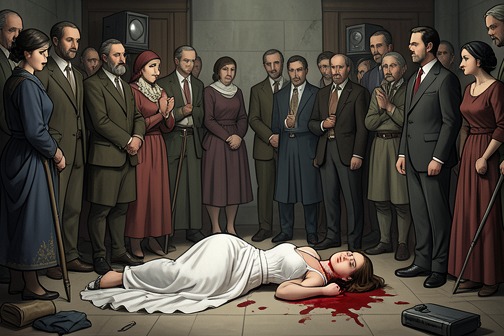
Maria Elena Torres’s murder takes place two days after she joins a public march protesting the killings of women and the climate of impunity in [Santa Teresa](entity:location-recall-location-fc0da48b1b60). She is found dead in her home, and the investigation produces suspects but no resolution, turning the proximity between protest and murder into a stark measure of the danger the marchers sought to confront.
## The March and the Killing
On November 23, women march from the university to city hall. The Women of [Sonora](entity:location-recall-location-sonora-c839a79bc3dc) for Democracy and Peace organizes the demonstration with several nongovernmental organizations, the Party of the Democratic Revolution, and student groups. Authorities estimate that no more than five thousand people took part; organizers claim that more than sixty thousand filled the streets. Torres is among the marchers.
Two days later, on November 25, Torres, thirty-two, is found in her house on Calle Sucre in [Colonia Ruben Dario](entity:location-recall-location-d945d78054ef). She has been stabbed through the neck and bleeds to death. She lives alone after separating from her husband not long before, has no children, and, according to neighbors, had argued with him that week. The account places this private killing immediately after a mass public protest, linking a single woman’s death to a crisis that the demonstration had brought into the streets.
## Investigation and Its Failure
The case was assigned to Inspector Luis Villasenor, who had recently arrived from [Hermosillo](entity:location-recall-location-4f7f0d63ba67). After a week of interrogations, he concluded that the killer was not Torres’s estranged husband but Augusto or Tito Escobar, a boyfriend she had been seeing for about a month. Escobar, who lived in [Colonia La Vistosa](entity:location-recall-location-39e6ca879a94) and had no known occupation, had disappeared by the time police went looking for him. Three men found at his home said they had seen him return one night with bloodstains on his shirt. Villasenor had them questioned, but the account also records him beating them with a length of hose and forcing them to wash before he became sick. A sketch was made from their descriptions and circulated to police stations around the country; the investigation nevertheless went nowhere. Torres’s husband and Escobar both vanished and were never heard from again.
## A Case in a City of Unresolved Deaths
Torres’s case belongs to a wider pattern in which deaths could be documented without producing sustained accountability. Earlier in the same year, radio reporter Isabel Urrea’s killing was publicly explained as a possible robbery or the act of a drug user, while the ballistic analysis was never made public and was eventually lost between the courts of Santa Teresa and Hermosillo. In the case of Emilia Mena Mena, police pursued her missing boyfriend, detained members of his family, and then left the case open; it was soon forgotten. These separate investigations do not establish a connection to Torres’s murder, but they show the institutional setting in which her own inquiry also ended without a resolution.
The pressures on police work are made explicit elsewhere in the city’s investigations. [Juan de Dios Martinez](entity:character-recall-character-a321f3f58023) was reassigned from the stalled Penitent case to a series of armed robberies because Santa Teresa had only a limited number of investigators and officers were expected to prioritize cases deemed more urgent for public security. The reassignment did not formally close the earlier inquiry, but it diverted the officers who had been watching the city’s churches. Such choices give the recurring language of stalled investigations a practical dimension: attention and personnel are limited, and cases can remain nominally open while investigative effort moves elsewhere.
The wider city is described as expanding across starkly unequal terrain: industrial parks and the horizon of maquiladoras stand beside slums, vacant lots, and a garbage-filled gully, while its infrastructure cannot support the pace of demographic growth. [Chucho Flores](entity:character-recall-character-chucho-flores-c7aa829c6aaf) names factories, cross-city migration, poverty, violence, and the desire for peace as parts of Santa Teresa’s urban reality, then identifies the missing resource as time. Torres’s case does not explain the city’s violence through any single cause; instead, its failed investigation sits within a setting where economic expansion, institutional limits, and repeated deaths coexist.
The murder therefore resonates beyond the question of which absent suspect was responsible. Torres had marched against the killings and the impunity surrounding them, yet her own death was followed by a week of questioning, a circulated sketch, and the disappearance of the two men considered suspects. The contrast is not a solution but an unresolved measure of the distance between collective protest and legal remedy.
## Significance
The murder’s place in the narrative is sharpened by its proximity to public protest: Torres joins a march against the killings and the impunity surrounding them, then is killed in her own home two days later. The investigation identifies a possible boyfriend as a suspect but never resolves the case, while both he and Torres’s estranged husband disappear. The sequence offers no proof that the murder was retaliation for the march, nor does it connect Torres’s case to the other killings. Instead, it leaves the reader with a stark contrast between collective demands for protection and an inquiry that ends without an accountable perpetrator or a known outcome.
Event 49
Kelly Rivera Parker's disappearance

[Kelly Rivera Parker](entity:character-recall-character-kelly-rivera-parker-7fc9ba0981c2)’s disappearance is a personal loss that exposes the difficulty of investigating violence in [Santa Teresa](entity:location-recall-location-fc0da48b1b60) when money, political connections, and official indifference obstruct the search. Kelly vanishes after a work trip involving a party at a ranch; her rented car reaches the airport, but she does not board her flight. Her friend, a congresswoman, presses the local authorities, hires a private investigator, and learns that Kelly’s event-planning work brought her into contact with powerful figures. The inquiries make the circumstances more alarming without resolving whether Kelly is alive or dead.
## The Disappearance
Kelly’s partner first alerts the congresswoman, explaining that Kelly should have returned from Santa Teresa two weeks earlier. The two had not spoken since Kelly called in distress, saying she had gotten herself into trouble, then retreating into uncertainty and insisting that nothing was wrong. Her partner had tried Kelly’s phone without success and contacted the people who had hired her. They said Kelly left a ranch the day after a party and was expected to travel from Santa Teresa to [Hermosillo](entity:location-recall-location-4f7f0d63ba67), then onward to [Mexico City](entity:location-recall-location-mexico-city-78f19f654410).
The account leaves an important gap between departure and destination. Kelly rented a car, and it was found in the airport parking lot, evidence that she reached the airport. But, her partner reported, Kelly never boarded the plane. She had already been missing for two weeks when the congresswoman heard this. At first, the congresswoman imagined that Kelly might have gone away with a lover, as she had done before; what seemed less plausible was that she would disappear without contacting her partner, who depended on her for business matters. When Kelly remained missing for another week, that ordinary explanation no longer reassured her.
## A Search Meets Official Silence
The congresswoman sought the people who had hired Kelly, the [Salazar Crespo](entity:character-recall-character-salazar-crespo-ee08ccbaba90) family, and received a telephone number from Kelly’s partner. A trusted friend then checked the name through private sources. He told the congresswoman that Salazar Crespo was a banker who, according to those sources, laundered money for the Santa Teresa cartel. He also reported that the banker owned several ranches outside the city, though his sources knew of no public party at one on the relevant dates. The banker, he added, had deep, longstanding ties to the [Institutional Revolutionary Party](entity:organization-recall-organization-institutional-re-6064a963ed62).
The congresswoman traveled to Santa Teresa and told Mayor [José Refugio de las Heras](entity:character-recall-character-jos-refugio-de-las-ab7e0760cd58) that Kelly was missing. She deliberately withheld the name Salazar Crespo, wanting to see what the officials would do without that information. The mayor summoned [Ortiz Rebolledo](entity:character-recall-character-ortiz-rebolledo-c92528cc1282), the head of the state judicial police, but the visit produced no evident progress. During two nights at the [Hotel Mexico](entity:location-recall-location-hotel-mexico-4cc750e47edf), officials insisted that nobody had reported Kelly missing, despite the partner’s report. They did not raise Salazar Crespo, and they did not connect Kelly’s disappearance to the killings of women already known publicly in the city.
The congresswoman responded by calling local reporters and holding a press conference at the hotel. She told Kelly’s story and pledged to pursue the truth as a politician, a feminist, and a friend. She also contacted two fellow deputies from the Institutional Revolutionary Party, who promised support. Her public intervention brought the disappearance into national coverage, but it did not by itself produce information from the local authorities. The disparity between the public record and what Kelly’s partner had already reported became one of the clearest signs that the official response could not be trusted.
## The Private Investigation
Back in Mexico City, the congresswoman asked a former colleague from the attorney general’s office to recommend a detective. He introduced her to [Luis Miguel Loya](entity:character-recall-character-luis-miguel-loya-47fffeeaa1f6), a former federal investigator who now worked privately. Loya heard her account, including the suspected connection between Salazar Crespo and drug traffickers, and promised an initial report within three days. The wait felt interminable to the congresswoman, whose concern had become inseparable from anger.
Loya’s first report reconstructed Kelly’s professional activity rather than locating her. It described her work arranging parties as a form of high-level prostitution, an assessment the congresswoman rejected and challenged. But the report also supplied a concrete pattern: Kelly had worked for Salazar Crespo four times, and between 1990 and [1994](entity:time-recall-time-1994-2c6f52c72808) had flown to Hermosillo at least ten times, continuing on to Santa Teresa on seven of those trips. Her meetings with Salazar Crespo were categorized as party planning. She usually spent no more than two nights in Santa Teresa. Early trips included four or five models; later trips involved fewer, and on her final visits she traveled alone.
Loya also identified [Conrado Padilla](entity:character-recall-character-conrado-padilla-59aba34c611e), a [Sonora](entity:location-recall-location-sonora-c839a79bc3dc) businessman with interests in maquiladoras, transport companies, and the Santa Teresa slaughterhouse. According to the report, Kelly had worked for Padilla three times. When the congresswoman demanded that Loya go to Santa Teresa and continue the investigation there, he warned that it could take months or years and that people might prevent him from doing his job. His response that Kelly might be “more or less” dead provoked her insistence on a clear distinction: either Kelly was alive and must be found, or she was dead and those responsible must be pursued. Loya accepted the work without promising a result.
## Parties, Power, and Uncertainty
Over the following two years, Loya sent reports to the congresswoman, who met with him every three months and kept their calls brief, using a secure line because he believed no telephone conversation was completely secure. His findings connected Kelly’s party-planning work to gatherings at narcorranchos, large desert properties owned by wealthy people and, in some cases, drug traffickers. A model who had worked for Kelly and later lived in San Diego told Loya that Salazar Crespo’s parties were held at one of his two ranches. The properties could remain empty for long periods and then be prepared for a gathering with workers, bodyguards, and guests arriving in separate stages.
According to that model’s account, Kelly initially brought a small number of models, but later stopped using them, possibly because their fees were high and her finances were strained. The parties also included young local women whom Kelly reportedly dressed for the occasion. Guests included businessmen and people connected to organized crime; Loya’s information placed [Sergio Muñoz Otero](entity:character-recall-character-sergio-mu-oz-otero-ebef8878a29c) and [Fabio Izquierdo](entity:character-recall-character-fabio-izquierdo-24665344265d), described as associates of [Estanislao Campuzano](entity:character-recall-character-estanislao-campuzan-6ffaa0b01e9c), at some of the gatherings. The evidence Loya assembled was largely testimonial—conversations and accounts from people in bars and brothels—not the kind of proof that would establish what happened to Kelly or who was responsible for her disappearance.
The testimony also limited one particularly ominous possibility: the model told Loya that, although guests sometimes watched pornography, she knew of no pornographic films made at the ranches. The account therefore links Kelly’s work to a setting shaped by wealth, cartel connections, and secrecy, but does not prove that she was killed there or explain how she vanished. The congresswoman’s search accumulates names, trips, and relationships without reaching the decisive fact it seeks.
## Aftermath and Significance
The investigation changes the congresswoman’s understanding of her friend’s disappearance and of the surrounding violence. At first, her response is driven by personal grief and the expectation that Kelly may simply reappear. As she learns about other cases and listens to accounts of victims, she describes her anger as becoming collective, an expression of the accumulated suffering of thousands. She says she is losing her mind and imagines herself in the desert with a knife, hearing voices but seeing no faces or forms. She begins taking medication for her nerves, while continuing to depend on Loya’s periodic reports.
The disappearance also becomes a test of what public institutions will acknowledge. Local officials fail to act transparently even after a friend reports Kelly missing, and the congresswoman’s investigation must proceed through private contacts, guarded conversations, and information gathered outside formal channels. Her press conference can make the case visible; it cannot compel the authorities to disclose what they know. Loya’s work can trace Kelly’s professional network; it cannot turn suspicion into a confirmed account of her fate.
The event consequently remains unresolved. Kelly’s car at the airport establishes that she reached the terminal, not what happened afterward. Her connection to parties attended by people linked to the cartel supplies a disturbing context, not proof of a crime. The novel leaves the disappearance suspended between the congresswoman’s insistence that Kelly must be found and the accumulating indications that the search may confront powerful resistance. That uncertainty is itself central: a person can vanish amid plentiful information, while no institution delivers an answer.
Event 50
Josué Hernández Mercado's disappearance
[Josué Hernández Mercado](entity:character-recall-character-josu-hern-ndez-merc-89b56dfd2a88)’s disappearance turns a reporter who had written about [Santa Teresa](entity:location-recall-location-fc0da48b1b60)’s killings into another person whose fate cannot be established. A brief notice in his own newspaper said that he had been missing for five days; [Mary-Sue Bravo](entity:character-recall-character-mary-sue-bravo-10036d7c8180)’s subsequent inquiries found no reliable account of his last movements, and the authorities treated an ordinary explanation as sufficient. The most telling counterevidence was not forensic but personal: a young colleague believed Hernández Mercado would never have left behind the books he had written.
## Identity and Work
Hernández Mercado was thirty-two, born in [Mexico City](entity:location-recall-location-mexico-city-78f19f654410), and had lived in the [United States](entity:location-recall-location-united-states-2f533bc8d0b9) since he was fifteen. He was an American citizen living alone in a small house in [Sonoita](entity:location-recall-location-1b1f073ea1fc). The notice about his disappearance described him as a reporter for [La Raza de Green Valley](entity:organization-recall-organization-la-raza-de-green-b81180bc3972), a newspaper whose modest resources were reflected in the fact that it paid its staff little.
His work joined journalism to literature. He had published two books of poetry in Spanish through a small [Hermosillo](entity:location-recall-location-4f7f0d63ba67) publisher, apparently at his own expense, and two plays written in Chicano or Spanglish in a Texas magazine. At La Raza he had written a long series of articles about farmworkers, a subject he knew from watching his parents and from doing that work himself. The paper’s account called him self-made, but Mary-Sue found that its profile read less like a life sketch than an obituary.
Hernández Mercado had also covered the Santa Teresa killings of women. His reporting included the widely noticed press conference held by [Klaus Haas](entity:character-recall-character-klaus-haas-a06ea2613d1a) in prison, where Haas asked how murders could continue while the man accused of them was behind bars. The disappearance notice identified Hernández Mercado as the reporter who had covered the killings, placing his absence within the same local story he had reported on, without establishing that the two were connected.
## The Notice and the Official Explanation
Mary-Sue learned of the disappearance while leafing through La Raza de Green Valley. The item said Hernández Mercado had disappeared five days earlier. It was vague and so local in scope that, apart from the newspaper’s own publishers, almost no one seemed interested. The notice gave basic biographical details, but did not explain where he had gone or what had happened to him.
When Mary-Sue asked her editor to let her investigate, he dismissed the possibility that the disappearance required serious attention. He speculated that Hernández Mercado had lost his mind and might be wandering in a state park, then allowed Mary-Sue to pursue the story. She went first to La Raza’s [Green Valley](entity:location-recall-location-3ee1da43611f) office, spoke with its editor and a young reporter, and then travelled with the younger man to Sonoita.
The sheriff’s working theory was that Hernández Mercado had gone to [California](entity:location-recall-location-california-fd5bbc3f2eb4) to escape his debts. He owed six months’ rent, his landlord planned to evict him, and his wages at La Raza barely covered food. The young reporter confirmed the paper’s low pay. The sheriff also said Hernández Mercado had no car and travelled by bus when he needed to leave Sonoita. At the bus stop, however, the ticket seller and the few people who rode regularly could not say whether he had boarded on the day he disappeared. Their accounts were confused and inconclusive.
## The House and the Missing Books
The young reporter let Mary-Sue into Hernández Mercado’s house with a key kept at La Raza. The rooms were orderly, with no apparent sign of violence, and dust was gathering on the few pieces of furniture. Mary-Sue asked whether the sheriff had examined the computer; he had not. She switched it on and searched its files, finding the beginning of a mystery novel in Spanglish, published articles, and sketches of seasonal and farmworkers’ daily lives in southern [Arizona](entity:location-recall-location-arizona-99fb276bcc30). She also found the articles about Klaus Haas, many of them sensationalistic, but nothing that explained the disappearance.
A week later, the young reporter called Mary-Sue to ask what progress she had made. She said she would not write anything because she believed Hernández Mercado had probably gone to California to live and work. The young man rejected that conclusion. In his view, Hernández Mercado would not have left voluntarily without taking the books he had written: they mattered to him as much as children. Mary-Sue remembered seeing books in the living room and bedroom, perhaps fewer than a hundred in all, but had not considered whether they included his own published work. She reasoned that books were heavy and could be replaced; the younger reporter insisted that these particular books could not simply be abandoned.
That disagreement leaves the inquiry suspended between an explanation supported by hardship and a refusal grounded in intimate knowledge of the missing man. The books are the story’s most concrete unresolved clue, but the evidence does not establish whether they were his, whether he took them, or where he went.
## Journalism, Evidence, and Aftermath
Mary-Sue’s investigation takes place amid other failures of information and accountability in Santa Teresa. The novel repeatedly shows cases being narrowed, delayed, or lost: an investigation into the killings can be set aside when the suspect has vanished and investigators are reassigned; an unidentified-body search can be conducted without producing an identification; and a ballistic analysis connected to another woman’s murder can disappear in transit between courts. These episodes do not prove that Hernández Mercado was harmed or that his disappearance was connected to the killings. They do establish a setting in which missing people and missing evidence can remain unresolved.
The press offers no dependable remedy. Mary-Sue later tries to contact a Mexico City reporter who had interviewed Daniel Uribe, but he refuses to share his source’s number, invoking source privacy; she receives no news of Hernández Mercado. When she revisits the reporter’s coverage of Haas’s press conference, she judges it to be full of inaccuracies, exaggerations, clichés, and sensational claims. Yet the flaws of that work do not settle the question of what happened to its author. Mary-Sue’s editor repeatedly suggests that he simply ran off, while the younger reporter argues that the books left in the house point the other way. Neither account is verified.
The disappearance therefore remains an open question rather than a solved episode. Its significance lies in the parallel between Hernández Mercado’s work and his fate: he had reported on a city where the deaths of women could surface as intermittent news, command attention for a time, and then recede from public concern. When he himself vanished, the story likewise contracted into a sparse local notice, a speculative explanation about debt, and an unanswered disagreement over the books he may have left behind.
Event 51
Hitler's rise to power

[Hitler's rise to power](entity:event-recall-event-hitler-s-rise-to-power-41405fa82915) is presented through a child’s disrupted education and the arrival of political propaganda in his town. In 1933, thirteen-year-old [Hans Reiter](entity:character-recall-character-hans-reiter-71edfa723a3e) left school: the headmaster judged him unfit for it and proposed that his mother apprentice him in a trade. The same year, a National Socialist committee visited the surrounding villages, carrying its promise of national revival into a community where Reiter’s family already stood at the margins.
## School and Exclusion
Reiter had begun attending school at twelve, but disliked it and routinely arrived late, distracted by an imaginative inner world. His walk to the [Town of Chattering Girls](entity:location-recall-location-faf81102a97c) became, in his mind, a descent beneath the sea, where familiar things turned into marine creatures and the sea spider’s tiny appendages seemed like undeveloped hands. This inward journey stands against the institution’s practical verdict: in 1933, the headmaster summoned Reiter’s parents, but only his mother came. After declaring the boy unsuited to school, he suggested vocational apprenticeship. The episode places Reiter’s idiosyncratic way of seeing against an authority that measures him by his capacity to fit an educational system.
## Propaganda in the Town
Before Hitler seized power, a propaganda committee passed through the area. It held a successful rally at a movie theater in the Town of Chattering Girls, then continued to [Pig Village](entity:location-recall-location-651b0ba4d900) and [Egg Village](entity:location-recall-location-88ab52fcbdf4) before reaching Reiter’s town. There, the committee members drank beer with farmers and fishermen and explained [National Socialism](entity:state-recall-state-national-socialism-a0044989293a) as a movement that would raise [Germany](entity:location-recall-location-a3c24dd56e42) and [Prussia](entity:location-recall-location-7974898c86b9) from their ashes. The account presents the campaign not as an abstract political announcement but as a local encounter, conducted in familiar social settings and directed at village inhabitants.
## The Reiter Family and Political Authority
The committee’s visit brings Reiter’s family into view through the townspeople’s conversation. His father, a one-legged veteran and the only man from the town said to have returned alive from the front, was remembered for telling stories of war that listeners regarded as true because he had experienced them. When a committee member asked why Reiter was not at the tavern among his National Socialist comrades, a townsman explained that he could not afford even a mug of beer. The committee offered to buy him one, and the member who carried himself with particular authority ordered a villager to fetch him.
Reiter refused to go. He said he was not properly dressed to meet the committee and was alone with his daughter, since his one-eyed wife was still at work. The exchange makes the limits of the committee’s friendly presentation visible: its members bring political promises into the town, but their interest in the veteran takes the form of an order delivered through a local intermediary. His refusal, grounded in his circumstances at home, interrupts that attempt to draw him into their gathering.
## Historical Echoes and Narrative Significance
The episode’s placement in the novel links the arrival of National Socialist persuasion to Reiter’s coming of age, without making his school troubles a direct consequence of the political campaign. Both are described as events of 1933, and their juxtaposition gives the year a double pressure: one institutional judgment narrows the boy’s educational future, while another movement claims to offer a national future. Reiter’s difficulty fitting school and his family’s precarious standing are distinct from the committee’s message, yet all appear within the same social landscape.
Elsewhere, the novel’s historical references place the rise of National Socialism alongside other episodes of political violence and state power. A later discussion contrasts the social visibility of individual murders with deaths that went largely unremarked, including mass deaths aboard slave ships and the thousands killed during the [Paris Commune](entity:event-recall-event-09d927942b3a). That broader reflection on whose suffering becomes legible complicates any simple separation between public history and private fate. The 1933 scene is therefore both a local account of political persuasion and part of a wider narrative concerned with how historical authority enters ordinary lives.
Event 52
World War II
[World War II](entity:event-recall-event-world-war-ii-6434f354548b) enters [2666](entity:time-recall-time-2666-76934e943b8e) not as one continuous campaign narrative but as a scattered historical pressure: [Hans Reiter](entity:character-recall-character-hans-reiter-71edfa723a3e)’s regiment advances into [Poland](entity:location-recall-location-8e143713a3f3), [Boris Abramovich Ansky](entity:character-recall-character-boris-abramovich-an-a17e275ff295)’s notebook places private thought against the widening conflict, and later characters read the war’s aftermath through exile, poverty, and a writer’s prolonged disappearance. The novel’s fragments connect military history to the lives and interpretations that survive it, without making those interpretations interchangeable with the historical events themselves.
## The Invasion of Poland
In September, after Reiter leaves with a few belongings and a copy of [Animals and Plants of the European Coastal Region](entity:object-recall-object-animals-and-plants-of-ae9a33b53e11), his division advances to the Polish border and crosses behind the Panzer and motorized infantry divisions. Reiter’s regiment travels by forced marches, initially without fighting and with few precautions. The men move in a festive atmosphere that resembles a pilgrimage more than a march toward a war in which some of them will die.
The advance passes through several towns in orderly fashion. The soldiers do not plunder them; they smile at children and young women, while motorcycle messengers carry orders between the road and the staffs. The regiment moves ahead of its artillery. From hilltops the men look east toward the imagined front and see only a landscape at the end of summer; to the west, dust marks the artillery’s effort to catch up. The gap between the apparently peaceful countryside and the war approaching behind the soldiers gives the march its uneasy character.
On the third day, Reiter’s regiment turns onto a dirt road and reaches a river shortly before nightfall. Beyond it lie woods and, according to what the soldiers have been told, a village where Poles have taken a stand. The regiment assembles machine guns and mortars and fires flares, but receives no response. Two assault companies cross the river after midnight, move through the woods, and approach the village. When the men rush toward its first houses, they discover that it is deserted. The episode records an advance into enemy territory, but its immediate encounter is with absence rather than combat; the regiment continues east the following day.
## [Ansky](entity:character-recall-character-2b3d034ca5c5)’s Notebook and the Expanding War
In the sequence of notes that Reiter reads, Ansky’s private reflections on suicide, memory, and the limits of knowledge unfold alongside the larger political catastrophe. Ansky leaves [Moscow](entity:location-recall-location-19aceb5ce281) without papers, travels through landscapes and unnamed stations, and eventually reaches [Kostekino](entity:location-recall-location-bc1adcf0187b), where his mother opens the door without recognizing him. After his father dies, Ansky spends nights reading beside his sleeping mother and thinks about chaos, the end of time and space, and the possibility of parallel universes. The notebook’s movement between intimate return and abstract speculation gives the war’s historical scale a personal, unsettled counterpoint.
The widening conflict supplies a stark chronological frame: Hitler invades Poland, [Warsaw](entity:location-recall-location-warsaw-0c6571460e56) falls, [Paris](entity:location-recall-location-657453741ed3) falls, and the [Soviet Union](entity:location-recall-location-67657886d3d4) is attacked. Ansky’s recurring thought that only in chaos can people be conceived is set against these events rather than offered as an explanation for them. One night he dreams that the sky is an ocean of blood; on the last page of the notebook, he draws a map intended to join the guerrillas. The sequence ends not with a resolution of his reflections but with a practical sign of commitment to resistance.
## The Postwar Encounter in [Friesland](entity:location-recall-location-friesland-11f1c9306c08)
The war’s end also shapes the circumstances in which [the Swabian cultural promoter](entity:character-recall-character-the-swabian-cultura-b17c028af2a1) meets the young [Benno von Archimboldi](entity:character-recall-character-benno-von-archimbol-b19f141ab3bf). The Swabian recalls a Frisian town still marked by social and economic wounds after the war, where visiting writers read for audiences and might sell self-published books at a table. Archimboldi, then twenty-nine or thirty, arrives without books to sell and reads two chapters of a novel in progress. The first novel he had published in [Hamburg](entity:location-recall-location-hamburg-83eba4856d4b) that year is present only as a small, worn copy carried in his pocket.
The encounter’s most enduring object in the Swabian’s recollection is not the book but Archimboldi’s loose black leather jacket, suited to cold and rain and suggestive, to the Swabian, of jackets worn by Gestapo officers. The recollection explicitly places that association within the clothing fashions of the time: people wore such jackets without necessarily considering what they evoked. In this postwar setting, clothing, literary ambition, and damaged civic life bring the recent past close without turning the reading itself into a scene of combat.
Later, the four critics interpret the meeting through the shared history of the two men. Morini imagines the Swabian and Archimboldi as grotesque doubles: both young during the years of terror and barbarism under Hitler, both World War II veterans, both writers, and both poor men in a bankrupt nation. The likeness is a critical metaphor, not proof that the Swabian is Archimboldi; Norton rejects that possibility on the basis of their different physical descriptions. Pelletier and Espinoza instead speculate that the Swabian was the widow’s lover. The disagreement makes the war’s afterimage part of a broader problem in the novel: a past event is recalled through competing conjectures, and the story does not collapse them into a single authoritative account.
## War Memory, Exile, and Political Analogy
The critics’ later search for Archimboldi likewise draws on his war record. He is discussed as an elderly veteran and deserter still on the run, a figure whose possible Nobel recognition might recall Europe’s past in troubled times. The account does not establish that his travel to [Mexico](entity:location-recall-location-mexico-6f79111cb935) is an escape from a particular danger. The critics consider several explanations—including a visit to a friend, research for a novel, tourism, and flight—without resolving the question. Their uncertainty links the war’s unfinished consequences to Archimboldi’s absence from public view, while preserving the difference between evidence and conjecture.
The book also places World War II within characters’ later political and historical comparisons. As a child, Amalfitano answers his father’s claims about Chilean boxers by invoking Italy’s conduct in the war; the exchange is a family argument shaped by national stereotypes, not a neutral account of the conflict. Elsewhere, a speaker discussing the legibility of death contrasts the mass deaths of the [Paris Commune](entity:event-recall-event-09d927942b3a) and the mortality of enslaved people transported by ship with individual murders that became widely reported stories. That comparison concerns how societies decide whose deaths count as narratable; it does not equate those historical situations or make war the sole subject of the speech.
Amalfitano’s own account of exile gives another distinct historical connection. He explains that he was in Argentina in 1974 because the coup in Chile forced him to leave. He subsequently describes exile as a natural movement that may help abolish what is usually understood as fate. His statement concerns the Chilean coup and its consequences, not World War II, but its presence beside the novel’s European wartime memories broadens the book’s concern with displacement under political violence.
## Narrative Significance
World War II appears through changes in narrative scale and viewpoint: a soldier’s march, a reader’s encounter with a notebook, a remembered literary evening, and later debates about what those memories mean. The transitions refuse the shape of a single authoritative chronicle. Reiter’s advance includes precise movements through roads, a river, woods, and an empty village; Ansky’s notes juxtapose the fall of cities with philosophical questions and a decision to seek the guerrillas; the Swabian’s memory attaches the postwar era to a writer, a reading, and a jacket whose associations remain qualified by the period’s ordinary fashions.
These fragments make the war both a historical event and a test of interpretation. Characters use it to understand national identity, political rupture, literary reputation, and the persistence of danger after fighting ends, but their analogies remain partial and sometimes plainly speculative. The novel’s structure preserves that distance: the war’s events are stated, while the meanings later assigned to them belong to particular speakers, memories, and conjectures. Through that separation, World War II becomes a recurring background against which 2666 examines what survives catastrophe—and how incompletely it can be known.
Event 53
German invasion of Poland
The [German invasion of Poland](entity:event-recall-event-7b0b1e74cfd4) enters the narrative through [Hans Reiter](entity:character-recall-character-hans-reiter-71edfa723a3e)’s experience as a soldier in an advancing division. Its opening movement is not presented as continuous battle: the troops march behind forces that have cleared the way, pass through towns without plundering, and proceed with little sense of imminent danger. The contrast between the division’s festive mood and the war’s impending human cost gives the episode its force, while its retrospective framing links Reiter’s military past to the later public image of [Benno von Archimboldi](entity:character-recall-character-benno-von-archimbol-b19f141ab3bf).
## Reiter’s departure and the advance
Before the war begins, Reiter leaves with a new kit bag containing a few items of clothing and a copy of *[Animals and Plants of the European Coastal Region](entity:object-recall-object-animals-and-plants-of-ae9a33b53e11)*. His departure is notably quiet: he says goodbye to his landlady, but no one sees him off at the station. He has not heard from [Hugo Halder](entity:character-recall-character-hugo-halder-c773786bddec) or [Noburo Nisamata](entity:character-recall-character-noburo-nisamata-7785fa38b866) since an earlier visit, and suspects that Halder has already gone to [Berlin](entity:location-recall-location-769cdeac2511) as if Reiter had left. The small, practical contents of the kit bag precede his entry into a conflict that will soon become a defining part of his life.
In September, Reiter’s division reaches the border and crosses into [Poland](entity:location-recall-location-8e143713a3f3) behind the Panzer and motorized infantry divisions that have opened the way. The troops make forced marches but see no combat at first and take few precautions. The three regiments advance almost as one, in what the narration describes as a general atmosphere of festivity—as though the men were on pilgrimage rather than marching toward a war in which some would be killed.
## An orderly march through uncertain country
The division passes through several towns without plundering them. The soldiers move in an orderly manner, smile at children and young women, and encounter dispatch riders on motorcycles carrying orders between the division and corps headquarters. They move ahead of the artillery, which trails behind in clouds of dust. From the tops of hills, the soldiers look east toward the front they imagine lies ahead, but see only a landscape in the last splendor of summer. The march’s apparent ease depends on this distance: the war is a destination imagined beyond the horizon, not yet an immediate exchange of fire.
On the third day, Reiter’s regiment turns onto a dirt road and reaches a river shortly before nightfall. Across it lies a forest of pines and poplars, beyond which, the soldiers are told, a group of Poles has taken a stand. The Germans assemble machine guns and mortars and fire flares, but receive no response. After midnight, two assault companies cross the river. They pass through the forest and approach a village in darkness; when they reach the houses, they discover that it is deserted. The regiment continues east the next day, divided across three roads parallel to the division’s main route.
## The bridge and the first brief clash
Reiter’s battalion later encounters a Polish detachment holding a bridge. The Germans demand that the Poles surrender; the Poles refuse and open fire. The battle lasts scarcely ten minutes. Its brevity contrasts with the uncertainty surrounding it: one of Reiter’s comrades returns with a broken nose and describes how, after crossing the bridge with ten soldiers, he reached the edge of the forest and was attacked by a Pole who dropped from a tree branch and struck him with his fists. The German had imagined possible attacks by knife, bayonet, or gunfire, but not this. His account emphasizes surprise as much as combat and makes the encounter’s abruptness part of Reiter’s early experience of the invasion.
## Historical memory and Archimboldi
The event acquires another frame through the later account of Archimboldi’s life. In discussion of his possible Nobel candidacy, he is described as a [World War II](entity:event-recall-event-world-war-ii-6434f354548b) deserter still on the run, a figure whose existence could remind Europe of its past. The invasion is therefore not only a military episode in Reiter’s chronology; it belongs to the history that the adult writer’s public identity seems to carry with him. The novel does not equate the wartime advance with later violence elsewhere, but it places the memory of war beside later reflections on authoritarian power, political fear, and the ways societies narrate or obscure violence.
The invasion’s presentation also depends on mediation. The march and the first clash are narrated through Reiter’s wartime experience, while the image of Archimboldi as a deserter comes from later discussion among critics. That shift between lived episode and retrospective reputation leaves the military past present but not fully resolved: the orderly march, the empty village, and the brief fight stand beside the later fact of a writer who remains publicly associated with flight from the war’s aftermath.
Event 54
Battle near Kutno
The [Battle near Kutno](entity:event-recall-event-419189a4660e) is [Hans Reiter](entity:character-recall-character-hans-reiter-71edfa723a3e)’s first actual combat, and its significance lies less in a military outcome than in the bewildering way he passes through danger. German casualties establish the assault’s cost; Reiter’s survival, and the sergeant’s inability to explain it, make him appear at once unchanged and inexplicable to those who fought beside him.
## Background and Deployment
Reiter’s 79th Division fought Polish forces on the outskirts of [Kutno](entity:location-recall-location-57e1fdfb0689). The Poles were few and poorly armed, but initially appeared unwilling to surrender; the clash was brief, and it ultimately became clear that they did want to surrender but did not know how. Reiter’s assault group was sent against a farm and a forest where the remaining Polish artillery had concentrated.
Before the group left, Captain Gercke expected Reiter to be killed. His extraordinary height seemed to make him an obvious target, and Gercke imagined him exposed among a pack of predators. That expectation frames the episode’s reversal: Reiter goes into the attack, but the danger anticipated for him falls instead on other members of the group.
## The Assault and Its Cost
The fighting took place in two attacks. At the farm, two German soldiers were killed and five wounded. In the attack on the forest, another German soldier was killed and three more wounded. Reiter emerged from both assaults unharmed. His survival is not presented as the result of a documented tactical maneuver; the account leaves the reason open, making the disparity between his apparent vulnerability and his outcome central to the scene.
That night, the sergeant who had commanded the group reported to Gercke that Reiter had somehow frightened the opposing soldiers. Gercke tested possible explanations—whether Reiter shouted, cursed, acted ruthlessly, or became a fearless warrior or hunter in combat. The sergeant rejected those possibilities. Reiter had remained the person everyone knew: he followed orders, neither disobeying nor failing to obey, and was not in a trance. Yet the enemy repeatedly fired at him without hitting him, becoming increasingly dismayed.
## Reiter’s Unexplained Composure
The sergeant’s account gives the battle its distinctive psychological force. Reiter did not seem to undergo a recognizable change into a different, merciless self. Instead, he entered combat as if he were not entering combat—as if he were absent, or the quarrel had nothing to do with him. The narration carefully distinguishes this state from paralysis or a trance, without replacing the uncertainty with a definite explanation.
The episode therefore makes Reiter’s survival a puzzle rather than a triumph. The others can describe what happened and what they saw, but their interpretations remain provisional. His apparent distance from the fighting does not mean that he disregards orders or escapes the battle’s consequences for his unit; it marks the gap between observable conduct and an explanation of that conduct.
## Aftermath and Narrative Significance
The 79th Division continued fighting near Kutno, but Reiter took no part in another skirmish there. Before the end of September, the division was moved by train to the western border to join the rest of the 10th Infantry Corps. From October 1939 until June 1940, the unit remained in place near the [Maginot Line](entity:location-recall-location-25e72ded22db), with the soldiers listening to the radio, eating, drinking beer, writing letters, and sleeping. The movement from the concentrated danger of Kutno to a long, uneventful wait gives the battle a contained place in Reiter’s military experience.
The event also establishes a recurrent tension in his portrayal: other people seek a legible account of him, but the evidence they possess resists a simple answer. Gercke’s expectation that Reiter would die and the sergeant’s report that the enemy could not hit him form opposing interpretations of the same tall, exposed figure. The battle offers no supernatural confirmation and no final account of why he survived; it leaves the reader with a witnessed event whose meaning remains unsettled.
Event 55
Battle of France
The [Battle of France](entity:event-recall-event-8f3bfbeefa3c) is presented as a brief military episode whose understated account contrasts with the novel’s broader record of war, political violence, and historical memory. The [79th Infantry Division](entity:organization-recall-organization-79-050cb2f59fe1) crosses the [Maginot Line](entity:location-recall-location-25e72ded22db) with few surprises, participates in the siege of French soldiers near [Nancy](entity:location-recall-location-37338751c833), and is subsequently quartered in [Normandy](entity:location-recall-location-88b4c1e61ca2). The narrative gives the campaign little epic grandeur; its significance emerges instead through the dislocation, uncertainty, and retrospective interpretations that surround war.
## The Division in [France](entity:location-recall-location-france-f5cafc8a8ad4)
The account follows the 79th Infantry Division on the western front. After the Somme offensive, in June, the division crosses the Maginot Line and takes part in the siege of a few thousand French soldiers near Nancy. It is then stationed in Normandy. The sequence is concise and matter-of-fact, and explicitly denies the campaign an epic character from the division’s point of view.
An anecdote told during a train journey extends this setting into a story of confusion beneath the front. A soldier becomes lost in the Maginot Line’s tunnels, passing through a succession of named sectors while imagining that he may never find his way back to the surface. When he finally recognizes the passageways’ unnaturally orderly, nearly immaculate condition, he concludes that they have no military use and may never have held soldiers at all. The tale unsettles the apparent solidity of the defensive system: the names and signs organize a route, but do not guarantee that the underground world corresponds to the soldier’s expectations.
## Memory and Historical Distance
The Battle of France is one element in a larger network of wartime recollection. In a later discussion, Archimboldi is imagined as a [World War II](entity:event-recall-event-world-war-ii-6434f354548b) deserter still on the run, a figure whose possible Nobel recognition would make Europe confront a past it might prefer to leave behind. This is speculation about his public image, not a factual account of his wartime service, but it shows how the war persists as a measure of reputation and political memory.
The novel also places European wartime history beside the experience of exile from Chile. Amalfitano explains that the coup in Chile compelled him to leave for Argentina in 1974, and he later describes exile as a movement that can help undo what is commonly taken to be fate. That testimony does not equate the coup with the Battle of France; rather, it brings distinct historical ruptures into a shared narrative of displacement, in which political events redirect individual lives.
## Violence, Visibility, and Political Analogy
The text’s reflections on historical violence are concerned not only with its scale but also with whose deaths become publicly legible. A speaker contrasts the mass deaths of enslaved people transported by ship and the thousands killed during the [Paris Commune](entity:event-recall-event-09d927942b3a) with individual murders that drew extensive attention. His argument is that social recognition determines what can enter public language: some deaths are recorded as crimes, while others remain outside the boundaries of what society acknowledges. This meditation broadens the novel’s historical frame beyond the military campaign without treating different forms of violence as interchangeable.
A separate, explicitly speculative reflection on a book published in Chile during military dictatorship imagines how political authority might inhabit literary language. Amalfitano considers whether its purported author might be fictional and whether the prose could stand for Pinochet or for politicians across opposing factions. The passage presents these as possibilities and questions, not established facts. Together with the novel’s attention to war and exile, it shows history being recalled through uncertain accounts, political interpretation, and the uneven visibility of suffering.
## Narrative Significance
The Battle of France is therefore not developed as a complete campaign chronicle. Its direct military outline is sparse, while its surrounding scenes emphasize the fragility of systems that claim to orient people: a line of defense becomes an empty labyrinth, and later accounts turn wartime experience into contested memory. The campaign’s restrained presentation also contrasts with the novel’s attention to violence that is either magnified into public history or rendered socially invisible. The result is a historical episode whose force lies less in spectacle than in the unresolved relation between events, testimony, and what societies choose to remember.
Event 56
German-Soviet War
The [German-Soviet War](entity:event-recall-event-b90d0cb5e54c) is presented through [Hans Reiter](entity:character-recall-character-hans-reiter-71edfa723a3e)’s experience as an infantryman in the German advance into Soviet territory. Its significance lies not only in the campaign’s movements across the landscape, but in the narrative’s persistent uncertainty over what the soldiers see and who is responsible for the destruction around them.
## The invasion and the 79th Division
The attack on the [Soviet Union](entity:location-recall-location-67657886d3d4) began on [June 22, 1941](entity:time-recall-time-1941-6-22-229a88bc9b59). The 79th Division was attached to the 11th German Army; a few days later, its advance troops crossed the Prut and entered combat alongside Romanian forces, whose fighting spirit exceeded German expectations. The 11th Army had fewer human and material resources than the major formations of Army Group South and faced difficult terrain and a scarcity of roads. It also lacked the element of surprise that had favored other army groups.
The division was light infantry, moving under its own power, with mules carrying heavy equipment while soldiers marched and fought. The account emphasizes the physical form of this advance: repeated marches and forced marches rather than a rapid, mechanized sweep. The campaign’s pace is measured through the division’s successive crossings and the exhaustion of its men.
## The advance across [Ukraine](entity:location-recall-location-579435a0d9f6)
Reiter’s division crossed the Prut, fought across the steppes and hills of [Bessarabia](entity:location-recall-location-94ea12b6730f), crossed the [Dniester](entity:location-recall-location-1a0d1219889f), and reached the outskirts of [Odessa](entity:location-recall-location-681f5d732390). It continued onward as Romanian troops halted, engaging retreating Soviet forces before crossing the Bug. The route of the advance is thus rendered as a chain of rivers, battles, and movement deeper into Ukrainian territory.
The soldiers passed burned villages and granaries, while woods in the surrounding fields suddenly caught fire. The account sets these dark, burning woods against the seemingly immense wheat fields, making the advance’s destruction part of the landscape through which the men move. The fires recur as a question the soldiers cannot answer, rather than as an explained military action.
## Uncertainty and the fires
Reiter asks who is setting the woods alight. [Wilke](entity:character-recall-character-wilke-11a8dc07967d), [Neitzke](entity:character-recall-character-neitzke-475acabb8c8e), [Kruse](entity:character-recall-character-kruse-c089e54328e5), and Sergeant Lemke have no explanation. The men deny that their unit set those fires, even as they acknowledge that they burned or bombed villages elsewhere. They speculate that another German battalion or a sapper unit may have encountered resistance, but none has seen German or Soviet soldiers in the area who could account for the blaze.
This uncertainty does not undo the surrounding evidence of destruction: villages have been burned, granaries destroyed, and the woods are visibly on fire. Instead, the scene separates what the soldiers can identify from what remains unknown. The division advances through a landscape altered by war while its men watch a fire whose cause they cannot establish.
## Narrative significance
The campaign is told as a sequence of military facts, but its emphasis falls as well on the limits of those facts. Reiter’s unit has a defined route and role; the fires beside that route resist attribution. The contrast makes the war legible as both organized movement and unresolved violence, without supplying a single explanation for every act of destruction.
Elsewhere in the novel, the memory of war appears in very different contexts. The Swabian cultural promoter recalls meeting the young [Benno von Archimboldi](entity:character-recall-character-benno-von-archimbol-b19f141ab3bf) in a Frisian town just after the war, and describes the social and economic wounds that remained. Later, Archimboldi is imagined as a [World War II](entity:event-recall-event-world-war-ii-6434f354548b) deserter still on the run, an image invoked during speculation about his possible Nobel candidacy. These references place the German-Soviet campaign within a longer afterlife of wartime experience and public memory, without making the novel’s other histories interchangeable with it.
Event 57
Battle of Perekop
The [Battle of Perekop](entity:event-recall-event-005589e6a432) is recalled as part of the German advance into the Crimean peninsula after the crossing of the [Dnieper](entity:location-recall-location-88475c4fa23e). For [Hans Reiter](entity:character-recall-character-hans-reiter-71edfa723a3e), the fighting meant not only combat but also the grim work of clearing corpses and controlling the movement of civilians; his conspicuous bravery carried a private, self-destructive purpose.
## Advance into the [Crimea](entity:location-recall-location-14f700c5d2bf)
After crossing the Dnieper, the division pressed into the Crimean peninsula. Reiter fought at [Perekop](entity:location-recall-location-8b3f9f237af3) and in several nearby villages, whose names he never learned even as he walked their dirt streets. His experience of the advance is thus recorded through the places traversed and the tasks imposed on him, rather than through a complete itinerary of named settlements.
## Combat and civilian life
In Perekop and the surrounding villages, Reiter helped clear away corpses. He also ordered elderly people, women, and children to go inside and stay there. The scenes place military occupation alongside the exposed lives of civilians, whose movement was restricted even as the battle continued. The account does not specify their identities or what became of them, leaving the commands themselves as a measure of how war entered ordinary streets.
## Reiter’s recklessness
The physical strain of the fighting appears in Reiter’s spells of dizziness. When he stood abruptly, a black fog sometimes rose before his eyes, filled with grain-like dots that he likened to meteors; strangely, these seemed motionless. At other times he threw himself into attacks on enemy positions alongside his companions without taking precautions. Others interpreted this as daring and bravery, but the narration discloses a darker explanation: Reiter was seeking a bullet that might bring peace to his heart.
## Suicide and the battle’s aftermath
One night, Reiter unexpectedly discussed suicide with [Wilke](entity:character-recall-character-wilke-11a8dc07967d). Wilke answered with a joke about good Christians masturbating but not committing suicide; before sleeping, Reiter wondered whether the joke concealed a truth. The exchange does not resolve his suicidal intent. Instead, it sharpens the contrast between the humor of his companion and Reiter’s persistent desire for death, which continued to shape his conduct in battle.
Event 58
Battle of Chornomorske
The [Battle of Chornomorske](entity:event-recall-event-baa80077f39e) is a campaign episode in which [Hans Reiter](entity:character-recall-character-hans-reiter-71edfa723a3e) repeatedly approaches death without taking the precautions that might keep him alive. His conduct earns him a reputation for daring, but the account gives that bravery a darker explanation: he is seeking a bullet that might quiet his heart. The battle’s decisive scenes therefore hold two kinds of action together—the military advance and Reiter’s private, persistent desire to disappear.
## The Assault on the Fort
During the battle, the [310th Regiment](entity:organization-recall-organization-310-56e7fd52eb7f), and especially Reiter’s battalion, plays an important role. At a junction near Kirovske and Chornomorske, the company confronts a brick fortification. Reiter is struck by its poverty and apparent innocence; it seems to him almost as if children had built and manned it. With no mortar rounds available, the company decides to take the position by storm and calls for volunteers. Reiter steps forward first. Voss joins him, along with three other soldiers.
The attack splits across the fort’s flanks. When the men are about twenty yards away, rifle fire comes from inside. The three soldiers on the right drop to the ground, and Voss hesitates, but Reiter keeps running. A bullet passes close to his head; another brushes his right arm. Voss knocks him down, pulling him out of the immediate line of fire. Reiter watches as Voss crawls toward the fort, noticing the stones, weeds, wildflowers, and nails in the soles of his companion’s boots, as well as the small cloud of dust he raises. Then Reiter gets up and fires over Voss’s body while walking forward, as if the danger around him were not real. The fort is finally hit by a series of grenades from the soldiers on the right flank and explodes.
## The Advance into Chornomorske
The capture of Chornomorske is Reiter’s second near-death in the battle. After the first attack is repulsed, his reserve battalion advances in a second wave, crossing barbed wire as artillery fires on Soviet machine-gun positions. Reiter begins to sweat and feels suddenly ill. The sea’s nearness strengthens his conviction that he is about to die. The advancing troops cross a field, pass through a garden where an old, white-bearded man watches from a small window, and kill five Soviet soldiers dragging a field gun.
In a pine grove, Reiter finds a statue that he takes for a Greek goddess. He touches its cold surface, unable to tell whether it is marble or another kind of stone. Its presence in that hidden place seems absurd; for a moment he feels he ought to ask it something, but no question comes to him. The brief encounter gives way to the battle’s next view: from a ravine, the sea and harbor appear below, with people crowding onto a ship, houses burning in the hills, and soldiers moving toward the city. Some Russian soldiers flee or surrender, emerging from fish sheds with blackened walls. The calm, nearly flat sea stands in stark contrast to the violence on shore.
## Entry into the City and the Battle’s Ending
From the ravine, Reiter’s men descend toward a square dominated by two newly built, five-story white buildings. Gunfire comes from several windows. The other soldiers take cover behind trees, but Reiter continues toward one of the buildings as though he has not heard the shots. Outside, a mural shows an old sailor reading a letter; some lines are legible, but they are written in Cyrillic, which Reiter cannot understand. He climbs the stairs in a building without an elevator. A shot wounds his right arm on the first landing; another follows as he climbs. The wound bleeds little and the pain remains bearable, leading him to wonder whether he is already dead and to decide he should not faint before taking a bullet in the head.
Reiter kicks open the door of a flat and finds a young woman and two little boys. He tells her he will not hurt them and tries to smile as he backs away. In another flat, two closely cropped militiamen raise their hands in surrender; Reiter does not even look at them. Residents emerge from other apartments, appearing to him hungry or like pupils at a reform school. In one room he finds two old rifles beside an open window, throws them into the street, and signals his comrades to stop firing. Amid the capture, this small intervention marks a change in his conduct: the soldier who has repeatedly advanced into fire turns his attention to civilians and to ending the shooting around them.
The battle’s wider sequence continues beyond this encounter. Weeks later, during the attack on [Sevastopol](entity:location-recall-location-1ff0e8513108), the German advance is driven back; artillery repeatedly breaks up attempts to establish a defensive line, and the fighting becomes hand to hand in the trenches. Reiter’s Chornomorske episode thus belongs to a campaign in which survival is never secured by apparent forward movement. His earlier visions of dying near the sea return in the later assault, where he imagines sinking beneath the Baltic, Atlantic, or [Black Sea](entity:location-recall-location-ffc291f5a74a) into a forest of seaweed—or simply disappearing. The sea links these battles in his mind, turning military danger into an image of obliteration.
## Narrative Significance
The battle’s action is inseparable from Reiter’s private orientation toward death. Before the assault, he has already risked himself in combat, not because he expects a military reward but because he hopes a bullet will bring peace to his heart. At Chornomorske, that impulse becomes visible in repeated decisions: he runs toward the fort despite the rifle fire, keeps advancing through the city despite being shot, and behaves as though a fatal outcome is already settled. The sequence makes battlefield courage unstable as a description. To his companions it looks like bravery; to the reader, it is also a form of self-erasure.
Yet the episode does not reduce Reiter to that wish. Voss pulls him down when the attack exposes him to fire, and Reiter later acts to protect civilians, telling a terrified woman he will not hurt her and signaling his comrades to stop shooting after throwing two rifles into the street. These gestures interrupt the forward drive of the assault. He can move toward danger with apparent indifference, but he can also recognize vulnerable people within the occupied city and alter what happens around them.
The battle’s imagery holds these contrary movements together. Reiter encounters a statue of a goddess in a hidden pine grove and cannot think of what to ask it; from a ravine he sees burning houses, people crowding onto a ship, and a sea that appears calm. The contrast between the still water and the violence on land prepares the sea to become more than a feature of the battlefield. In his later thoughts during the assault on Sevastopol, the sea is the place where he imagines sinking and vanishing, while a forest of seaweed waits below. Chornomorske thus joins military conquest to a recurring image of disappearance, without resolving whether Reiter’s advance expresses courage, despair, or both.
## Narrative Significance
The battle’s action is inseparable from Reiter’s private orientation toward death. His earlier willingness to risk himself in combat is driven not by an expectation of military reward but by the hope that a bullet will bring peace to his heart. At Chornomorske, that impulse becomes visible in repeated decisions: he runs toward the fort despite rifle fire, continues through the city after being shot, and acts as though a fatal outcome has already been settled. What his companions might call bravery is thus also a form of self-erasure.
Yet the episode does not reduce Reiter to that desire. Voss pulls him down when the attack exposes him to fire, and Reiter later turns his attention to civilians: he tells a terrified young woman he will not hurt her, throws two old rifles into the street, and signals his comrades to stop shooting. These gestures interrupt the assault’s forward momentum. Reiter can move toward danger with apparent indifference, but he can also recognize vulnerable people in the occupied city and alter what happens around them.
The battle’s images hold those contrary movements together. In a hidden pine grove, Reiter finds a statue he takes for a Greek goddess and reaches toward its cold surface, yet cannot think of what to ask. From a ravine, he sees houses burning, people crowding onto a ship, and a sea that looks nearly flat. The calm water stands against the violence on shore; in the later attack on Sevastopol, the sea returns in Reiter’s thoughts as the place where he might sink beneath the Baltic, Atlantic, or Black Sea, with a forest of seaweed waiting below—or simply disappear. Chornomorske consequently binds military conquest to an image of obliteration, leaving the meaning of Reiter’s advance unresolved between courage and despair.
Event 59
Siege of Sevastopol
The [Siege of Sevastopol](entity:event-recall-event-bbbc82df8017) is presented as a brutal and unresolved ordeal in [Hans Reiter](entity:character-recall-character-hans-reiter-71edfa723a3e)’s wartime life, one that leaves him gravely wounded, unable to speak, and separated from his division. Rather than recounting the battle as a continuous military history, the narrative follows Reiter through repeated attacks and near-death, placing the confusion of combat beside his private expectation of vanishing into the sea.
## The Assault and Its Reversals
Weeks after an earlier brush with death, Reiter takes part in the attack on [Sevastopol](entity:location-recall-location-1ff0e8513108). The German advance is driven back, and attempts to establish defensive lines are met by the city’s artillery. Outside the city, near the Russian trenches, mutilated German and Romanian soldiers lie in heaps. The fighting repeatedly becomes hand-to-hand: assault troops reach a trench held by Russian sailors, fight for several minutes, and retreat, only for more sailors to appear and the struggle to begin again.
The account offers no clean forward movement or decisive victory. The attackers’ advance is checked, renewed, and checked again, while death accumulates around them. [Neitzke](entity:character-recall-character-neitzke-475acabb8c8e) and several other members of Reiter’s company are killed in one of the attacks. Reiter’s survival does not make the battle feel mastered; each pause remains vulnerable to another assault, and the siege continues to govern the soldiers’ lives.
## Reiter’s Wound and Its Consequences
During a night in the trenches, Reiter rises to his full height and looks toward the stars, but his attention turns back to Sevastopol, a dark mass in the distance. When Sergeant Lemke orders him down, Reiter removes his helmet and scratches his head; before he can put the helmet back on, a bullet strikes him, followed by another in the chest. He falls, seeing Lemke dimly as the sergeant seems to grow larger. The episode turns a brief, exposed gesture into another near-death, without suggesting that Reiter’s survival has brought him any control over the battle.
Two weeks later, in a field hospital at Novoselivske, Reiter receives the Iron Cross. A colonel cites reports of his actions at Chornomorske and Mykolaivka, shakes his hand, and leaves. The decoration and the wound are presented together: Reiter is recognized for his service, yet a bullet has pierced his throat and he cannot speak. After his chest wound heals, he is transferred to a larger hospital at Krivoy Rog, where his throat is operated on again. He can eat normally and move his neck as before, but his speech does not return.
His injuries leave his military status unresolved. The doctors cannot decide whether he should be given leave to return to [Germany](entity:location-recall-location-a3c24dd56e42) or sent back to his division, which is still engaged in the siege of Sevastopol and Kerch. Winter arrives, and a Soviet counterattack overruns parts of the German line; these developments postpone the decision. In the end, Reiter is neither sent home nor returned to his unit, while remaining in hospital is also no longer an option. The siege thus continues to shape his fate beyond the immediate fighting, redirecting him into convalescence and displacement rather than a clear return to civilian life or the front.
## The Sea and the Limits of Recounting
The battlefield also becomes the setting for Reiter’s recurring image of disappearance. Amid the dusty trenches, the presence of Russian sailors strikes him as charged with both terror and exhilaration. He imagines that one of them will kill him, after which he will sink into the depths of the Baltic, the Atlantic, or the [Black Sea](entity:location-recall-location-ffc291f5a74a): in his thought, every sea is ultimately the same, and a forest of seaweed awaits below. Death is imagined less as a conclusion than as a passage out of the visible world. The prospect that he might simply disappear gives the siege a private, inward dimension alongside its military reversals.
[Wilke](entity:character-recall-character-wilke-11a8dc07967d), speaking only to Reiter, finds the sailors’ presence inexplicable: they are miles from the sea and ships, and he speculates that perhaps the Stukas have sunk the Russian fleet or the Black Sea has dried up, though he does not believe the latter. The others, by contrast, do not question what they see or what happens to them. That contrast makes the siege’s strangeness part of its narrative texture: an impossible-seeming detail is noticed, privately tested against reason, and left unresolved rather than explained away.
Reiter’s wound finally removes him from the immediate conflict without resolving its meaning. The bullet through his throat leaves him mute even after surgery restores his ability to eat and move his neck, turning survival into an enduring loss of speech. The account does not conclude with a victory or a return to the front: winter and the Soviet counterattack interrupt the doctors’ decision, and Reiter is eventually sent to [Kostekino](entity:location-recall-location-bc1adcf0187b) instead of home or back to his division. The siege therefore persists in the story through its consequences—wounds, silence, and displacement—after Reiter has left the battlefield.
## Aftermath and Lasting Silence
The wound removes Reiter from the fighting without bringing the siege to a decisive close. The doctors cannot determine whether he should return to Germany or rejoin his division, still engaged at Sevastopol and Kerch. Winter and a Soviet counterattack that overruns part of the German line delay their decision; eventually, Reiter is sent neither home nor back to his unit. Unable to remain in the hospital, he is transferred to Kostekino with three other wounded men. The siege’s consequence is therefore not a return to ordinary life but an unsettled passage into another place, where his wartime experience continues to shape what he encounters.
The episode also links military recognition to a lasting impairment. Reiter receives the Iron Cross for reported actions at Chornomorske and Mykolaivka, yet the bullet through his throat leaves him unable to speak even after surgery. The wound heals sufficiently for him to eat normally and move his neck, but his voice does not return. In the larger arc of the novel, the siege is one of the moments through which Reiter’s silence becomes a physical condition, while the battle’s repeated reversals and his imagined disappearance beneath the sea resist the closure of a conventional victory narrative.
Event 60
October Revolution
The [October Revolution](entity:event-recall-event-e4be4913f923) becomes both a historical turning point and a test of literary faith in the account of Boris [Ansky](entity:character-recall-character-2b3d034ca5c5) and [Efraim Ivanov](entity:character-recall-character-efraim-ivanov-dae3efe6e72e). Ansky invests revolution with the hope of abolishing death; Ivanov’s sudden success as a science-fiction writer gives readers an imaginative picture of socialist possibility, before the later suppression of his novels exposes the widening distance between that promise and political reality.
## Revolutionary Hope and the Abolition of Death
Ansky and Ivanov meet at a [Moscow](entity:location-recall-location-19aceb5ce281) literary cafe, where the two writers become friends through their shared interest in ideas and literature. Ansky rejects the official and popular classification of Ivanov as a fantasy writer, accepting instead Ivanov’s preferred description of his work as science writing. Their friendship gives Ansky an interlocutor for his expansive political hopes: he believes revolution will spread throughout the world and bring progress and happiness.
When Ivanov insists that death cannot be abolished, Ansky treats that impossibility as the very problem revolution must confront. He imagines humanity immersing itself in the unknown until it finds something beyond death. The repeated insistence on abolition makes his political hope more than a program for social change: it becomes a demand to overcome the most fundamental limit of human life.
## Ivanov’s Work Before and After the Revolution
Ivanov’s literary career has already been shaped by failure and adaptation. After attempts to imitate celebrated nineteenth-century writers, he turns to the less-remembered Odoevsky and Lazhechnikov; for a time, this combination brings success. By 1910, however, the old models have been exhausted, his writing has stalled, and his finances and self-regard suffer. He supports himself through intermittent work, including jobs for scientific and agricultural journals, while continuing party duties ranging from writing pamphlets to procuring paper and serving as a liaison. The Revolution does not ease these burdens: his labor increases, but he continues without complaint.
Ivanov’s breakthrough arrives in an unlikely form. Asked to write about life in Russia in 1940, he produces his first science-fiction story, “The Train Through the Urals,” in three hours. Its young narrator travels at an average speed of 125 miles per hour through factories, cultivated fields, and new model villages, encountering foreign delegations who study the advances for use in their own countries. At the journey’s destination, the boy visits his grandfather, a former [Red Army](entity:organization-recall-organization-55b1ed5837e7) soldier who has earned a university degree later in life and now leads a secretive research laboratory. The grandfather wants to describe recent discoveries, but the boy asks instead for stories of the Revolution, the war against the Whites, and foreign intervention. The story’s reception astonishes both Ivanov and its editor; letters from across the country praise its faith in the future, and readers identify with the grandfather.
## Utopian Fiction and Political Reversal
The success of Ivanov’s first science-fiction story establishes a potent connection between revolutionary memory and imagined futurity. Its fast train, factories, villages, and international visitors make a transformed society visible through the eyes of a child. Yet the framing conversation between grandson and grandfather turns that future back toward the Revolution and war that produced it: technological advancement does not displace political history but carries it forward as a story to be remembered.
That imaginative confidence eventually collides with political disappointment. By 1930, Ansky’s notebooks register Trotsky’s expulsion from the [Soviet Union](entity:location-recall-location-67657886d3d4)—dated there as 1930, though the account notes that it actually occurred in 1929—and Vladimir Mayakovsky’s suicide. Ansky’s spirits decline, and the notebooks record his conclusion that the October Revolution has failed. The contrast is sharp: the Revolution once seemed to promise a worldwide advance toward happiness and even the abolition of death, but the later record measures that hope against events that diminish it.
## Ivanov’s Expulsion and the Revolution’s Legacy
Ivanov’s later novels, *Midday* and *Dawn*, extend his speculative world through extraterrestrials, interplanetary journeys, fractured time, competing civilizations, and characters on the move. In 1935, the novels are withdrawn from bookstores, and an official notice expels him from the party. According to Ansky, Ivanov spends three days unable to rise from bed, rereading his three novels and searching them for a reason for his expulsion. His books, once instruments for imagining a future and welcomed by readers who found hope in them, become the objects through which he tries to understand his political rejection.
In 1936, at the beginning of the first great purge, Ivanov is arrested and spends four months in prison before signing the documents placed before him. After his release, former literary friends avoid him. He writes to Maxim Gorky seeking intervention, but the gravely ill Gorky does not answer before he dies. At Gorky’s burial, two members of his circle challenge Ivanov’s presence. The sequence closes the arc of revolutionary literary promise with exclusion: a writer whose work had inspired readers’ faith in the future is left isolated by the political and literary world that once received him. The Revolution remains, in Ansky’s recollection, at once the source of an almost absolute hope and the historical measure by which that hope is judged.
Event 61
苏波战争

The [Polish–Soviet War](entity:time-recall-time-579ca2123000) appears in *[2666](entity:time-recall-time-2666-76934e943b8e)* as the absent center of a brief but formative episode in [Boris Abramovich Ansky](entity:character-recall-character-boris-abramovich-an-a17e275ff295)’s youth. At fourteen, [Ansky](entity:character-recall-character-2b3d034ca5c5) leaves his village to join the [Red Army](entity:organization-recall-organization-55b1ed5837e7), only to find in [Moscow](entity:location-recall-location-19aceb5ce281) that the campaigns he hopes to enter are already over. A veteran’s account of two comrades who died near [Warsaw](entity:location-recall-location-warsaw-0c6571460e56) suddenly gives the distant war human meaning: Ansky imagines their lives and deaths with extraordinary intensity and resolves that he does not want to be a soldier. Yet the recruitment process has already made the choice for him. The episode turns a history of battles into a story of belated knowledge, imaginative witnessing, and constrained agency.
## The war as belated news
Ansky’s journey to Moscow is his first departure from [Kostekino](entity:location-recall-location-bc1adcf0187b) beyond two earlier trips with his father to sell shirts in the region. Along the way, he is struck by unfamiliar faces, conversations, speeches, and proclamations promising a new paradise. He arrives eager to enlist, but the war he wants to join has receded into news that reaches his village too late.
At the recruitment office, Ansky asks to fight Wrangel and is told that Wrangel has already been defeated. He then names the Poles, only to hear that they, too, have already been defeated. He continues proposing other opponents, among them Krasnov, Denikin, the White Cossacks, the Czechs, Kolchak, Yudenich, and Allied troops; each time the answer is that the fighting is over. The repeated mismatch between his eagerness and the completed campaigns makes the war’s chronology feel almost absurd: Ansky has arrived ready for action, but history has already passed him by.
## A veteran’s testimony
An old, smoking soldier asks where Ansky comes from and whether he is Jewish. The boy answers that he is from Kostekino, near the [Dnieper](entity:location-recall-location-88475c4fa23e), and says that he is Jewish. The veteran replies that he once had a Jewish comrade during the campaign against the Poles. When Ansky asks the man’s name, the veteran challenges the assumption behind the question: Ansky cannot know every Jew in the Soviet republic.
The comrade was Dmitri Verbitsky, the veteran says, and he died fifty miles from Warsaw. The veteran adds that their commander, Korolenko, died the same day. These names and deaths are all the testimony supplies. The novel does not reconstruct the fighting or explain the circumstances of either man’s death; instead, the sparse account becomes the point from which Ansky’s imagination expands.
## Imagination, refusal, and enlistment
On hearing of Verbitsky and Korolenko, Ansky imagines the two men at extraordinary speed. He enters the shifting field of their relations, thoughts, dreams, convictions, and movements through forests and flooded lands. His vision carries them across landscapes and through the sounds and conversations of military life to the gray day on which both die. The imagined scene lasts scarcely a second, but it changes the meaning of the war for him: the abstract enemies he had hoped to fight give way to particular people whose lives and deaths he has just tried to apprehend.
At that instant, Ansky decides that he does not want to be a soldier. The refusal is immediate but ineffective. In the same moment, an officer gives him a paper to sign, and Ansky becomes a soldier. The sequence makes his decision neither a successful escape nor a simple change of heart: recognition arrives at the very point when institutional procedure has already placed him inside the army.
## Memory and narrative significance
The war reaches the reader through Ansky’s recalled encounter in a recruitment office, with the veteran’s brief oral account nested inside that memory. Its presentation foregrounds how little can be recovered from an event through a fragment of testimony: the names, the approximate place of death, and the fact that both men died on the same day. Ansky’s imaginative passage fills out the moment emotionally without turning it into a verified account of the campaign.
The episode also sets official momentum against the singular act of attention. Ansky first approaches war through its public language of enemies, victories, and proclamations; the veteran’s story redirects him toward the lives caught within that history. But this recognition cannot undo the enlistment already under way. The Polish–Soviet War therefore matters less as a chronicle of military operations than as the historical pressure behind a scene in which another person’s testimony briefly opens a way to refuse, while the machinery of recruitment closes it.
## Event classification
The event belongs to a remembered past, framed through Ansky’s recollection of his youth rather than narrated as an ongoing present-day scene. It is a wartime recruitment episode shaped by the aftermath of the fighting against [Poland](entity:location-recall-location-8e143713a3f3) and by a veteran’s account of comrades killed near Warsaw.
Event 62
Great Purge
The [Great Purge](entity:event-recall-event-8455c8ed6d2c) is rendered through the destruction of the Soviet writer [Efraim Ivanov](entity:character-recall-character-efraim-ivanov-dae3efe6e72e), whose career, persecution, and death survive in the notes of his friend [Boris Abramovich Ansky](entity:character-recall-character-boris-abramovich-an-a17e275ff295). Rather than presenting the purge as a single public event, the narrative traces its pressure through concrete changes in Ivanov’s life: his books disappear from shops, he is expelled from the party, arrested, isolated from former friends, and ultimately killed. [Ansky](entity:character-recall-character-2b3d034ca5c5)’s record makes the political violence legible as both a personal catastrophe and part of a wider disappearance of revolutionary writers.
## From Literary Success to Expulsion
Ivanov’s novels of the early 1930s combined extraterrestrials, interplanetary journeys, fractured time, and encounters between advanced civilizations. The narrative does not establish that these subjects caused his persecution. It does show the abrupt reversal: in 1935 his books were withdrawn from bookstores, and an official notice soon informed him that he had been expelled from the party. According to Ansky, Ivanov then spent three days unable to get out of bed. His three novels lay with him as he reread them, searching for a reason that might explain the decision.
The account keeps the consequences intimate rather than abstract. Ivanov tried to take refuge in memories of childhood, stroked the spines of his books, and sometimes stood for hours at the window. The books that had marked his literary life became the objects through which he confronted an unexplained political judgment. The purge first reaches him not as a public spectacle but as the sudden severing of a writer from his work, his institution, and the literary circle that had once recognized him.
## Arrest and Social Abandonment
At the beginning of the first great purge in 1936, Ivanov was arrested. He spent four months in prison and signed the documents placed before him. After his release, his former literary friends treated him as if he had the plague. His attempt to appeal to Maxim Gorky, who had praised one of his novels, met only silence: Gorky was gravely ill and did not answer. When Gorky died, Ivanov attended the burial, where two young members of Gorky’s circle challenged his presence and urged him to kill himself.
Ivanov answered by invoking Gorky’s earlier response to his writing and by presenting his attendance as the least he could do for him. The episode places social exclusion beside official repression: even at a funeral, Ivanov’s former standing offers no protection, and the literary community’s judgment compounds the consequences of arrest. His brief appeal to a surviving literary bond cannot restore the recognition he has lost.
## The 1937 Arrest and Execution
In 1937 Ivanov was arrested again. After a long interrogation, he was left in a dark cell and forgotten; the interrogator, the account notes, knew nothing about literature and was principally interested in whether Ivanov had met members of the Trotskyist opposition. The mismatch between Ivanov’s literary life and the investigation’s political demand makes clear how little his work matters to the machinery holding him.
During his confinement, Ivanov spoke with a rat he called Nikita. Their conversations concerned childhood and family rather than literature or politics. A week after he was locked up, Ivanov was interrogated again. He signed further papers without being beaten, was taken directly to a courtyard, shot, and placed on a truck. The account marks his death plainly, without making his final moments into a scene of heroism or a political explanation. What remains is the sequence of arrest, isolation, coerced paperwork, and execution.
## Ansky’s Notes and the Record of the Purge
Ivanov’s death alters the form of Ansky’s surviving notes. They grow chaotic and apparently haphazard, though [Hans Reiter](entity:character-recall-character-hans-reiter-71edfa723a3e), reading them later, discerns a structure beneath their disorder. The notes move among writers, sex, illness, political figures, and the people swept away by revolution. Their repeated names become a counter-record: Ansky returns to people whom the political upheaval has removed, as though writing them down might resist their disappearance.
Among those names is Yuri Piatakov, identified as assassinated in 1937 after the second [Moscow](entity:location-recall-location-19aceb5ce281) Trial. Ansky recalls young Russian Jews who had made the revolution and were now dying in large numbers, and describes the revolution’s aftermath as a nightmare concealed behind the dream. The notes do not turn Ivanov’s fate into a complete account of the purge or claim that every case followed the same course. Instead, they connect his individual death to a wider pattern of revolutionary participants being consumed by the order that had once claimed them.
## Historical Violence and the Novel’s Design
The novel presents the purge through nested acts of remembrance: Ansky records Ivanov, and Reiter later reads Ansky’s papers and finds an order within their apparent disorder. That structure gives the events a fragile afterlife. The official acts against Ivanov—withdrawal of books, expulsion, arrest, interrogation—are paired with private traces such as the reread novels, the unreturned letter to Gorky, and the names preserved in a notebook.
The wider historical references keep the account from collapsing into a biography alone. [Ivanov’s execution](entity:event-recall-event-ffee1d1456e2) appears amid Ansky’s recollections of writers and revolutionaries killed or forgotten, while the repeated names register the difference between political history as an abstract sequence and the lives it removes. The Great Purge is therefore significant not only as the setting for Ivanov’s persecution and death, but as a force that damages literary communities and leaves incomplete, disordered records for later readers to reconstruct.
Event 63
Ivanov’s execution
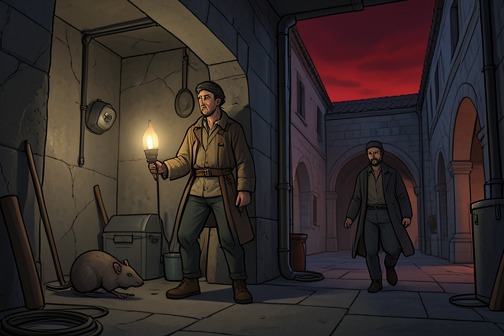
[Ivanov’s execution](entity:event-recall-event-ffee1d1456e2) in 1937 is the abrupt end of a sequence of arrest, interrogation, and isolation, and a turning point in the surviving account of [Boris Ansky’s notes](entity:object-recall-object-d7a595264b8e). The narrative dwells not on a political confession or a public trial but on Ivanov’s private conversations with a rat in a dark cell; after he signs documents, he is taken directly to a courtyard and shot. His death is followed by a formal change in [Ansky](entity:character-recall-character-2b3d034ca5c5)’s writing: the notes grow chaotic, though [Hans Reiter](entity:character-recall-character-hans-reiter-71edfa723a3e) can still discern an underlying order.
## Arrest and imprisonment
In 1937 Ivanov was arrested and subjected to a long interrogation. His interrogator knew nothing about literature; the investigation focused instead on whether Ivanov had met members of the Trotskyist opposition. Afterward, Ivanov was left in a dark cell and, in the account’s stark phrasing, forgotten there. The contrast between the interrogator’s political question and Ivanov’s literary life establishes the terms of his confinement: the state treats him as a suspected political connection, while the concerns that occupy his cell are intimate and personal.
## Nikita in the cell
During his imprisonment, Ivanov befriended a rat he called Nikita. At night, when she emerged, the two spoke about their childhoods. Ivanov told her about his mother, who often occupied his thoughts, and his siblings, while avoiding his father. Nikita, in turn, described the [Moscow](entity:location-recall-location-19aceb5ce281) sewers and their imagined sky, where stars appeared among debris through an unexplained phosphorescence; she also recalled her mother’s warmth and her sisters’ antics. The conversations do not supply a political defense or a route to freedom. Instead, they give the confinement a fragile domestic dimension, built from memories each companion can offer the other.
The exchange also changes the scale of the scene. Ivanov’s world has narrowed to a cell, but Nikita’s account opens an unlikely image of stars beneath Moscow. When despair overtakes him, he rests his cheek on his palm and asks what will become of them. Nikita looks back with sadness and perplexity, and her expression seems to tell him that she is even more innocent than he is. Their companionship offers no escape from the cell; it makes his isolation legible by setting one vulnerable creature beside another.
## Execution
A week after Ivanov was locked up—a duration that felt to him more like a year—he was interrogated again. No one had to hit him to make him sign several papers and documents. The account does not identify what the papers said or describe the contents of the interrogation, so the signature cannot be treated as a revelation of guilt, a confession, or a change in Ivanov’s political position. What follows is stated without delay: he was not returned to his cell but taken straight to a courtyard, shot in the back of the head, and placed on the bed of a truck. The transition from paperwork to execution makes the administrative procedure and the killing part of one continuous sequence, without explaining the decision behind it.
## Aftermath in Ansky’s notes
After Ivanov’s death, Ansky’s notes become chaotic and apparently haphazard. Reiter nevertheless discerns a structure and a kind of order amid the disorder. The entries continue to move among writers and literary viability, sex, parents, sickness, and political violence, but the reported shift in their form registers the death as a break in the notes’ texture rather than as a conclusion to their subjects. Ivanov’s execution is therefore both a terminal event in his life and a point after which Ansky’s writing carries on in altered, unstable form.
## Narrative significance
The scene gives the execution its force through postponement and contrast. Its central stretch is not the interrogation itself but the nocturnal conversations with Nikita: recollections of family, the rat’s account of the sewers, and Ivanov’s question about what will become of them. The return to interrogation and the sudden movement into the courtyard end that small, shared world. The account then turns from the individual death to the changing shape of Ansky’s notes, connecting political violence to a literary record that persists but no longer proceeds in the same manner.
Event 64
Yevgenia Bosch’s suicide

[Yevgenia Bosch’s suicide](entity:event-recall-event-284bbd03e87d) enters the novel through the literary work of [Boris Abramovich Ansky](entity:character-recall-character-boris-abramovich-an-a17e275ff295): in 1929, he wrote aphorisms titled *Reflections on the Death of Evgenia Bosch*, identifying the death as a gesture of protest. The reference is brief, but it links a specific life and political history to the novel’s wider concern with how death becomes a story—and whose deaths are allowed to matter.
## [Ansky](entity:character-recall-character-2b3d034ca5c5)’s 1929 Writing
Ansky’s reflections on Bosch appear amid an account of his intense literary and political activity in 1929. He was writing in several forms and languages, reading widely, and composing work connected to revolutionary figures and political history. His aphorisms on Bosch were one element in this crowded record, rather than a separately narrated scene of her death.
The passage identifies Bosch as a Bolshevik leader who used a pseudonym and gives a compressed account of her revolutionary career: party membership, arrest and deportation, escape, political activity abroad, return after the February Revolution, and a leading role in the Kiev uprising and civil war. It then describes her 1924 suicide as a gesture of protest. The narrative does not specify the circumstances of her death beyond that characterization.
## Death, Protest, and Political Memory
By naming Bosch’s suicide as protest, the passage frames it as an action with political significance, not merely as a private ending. Yet that meaning reaches the reader indirectly, through Ansky’s later writing and a biographical summary quoted within the account of his life. Bosch is not given a speaking scene; her history is mediated by other texts and by the narrator’s compressed recital of her political record.
The distinction between event and remembrance matters. Bosch’s death occurred in 1924; Ansky’s aphorisms about it belong to his 1929 work. The five-year interval places the suicide within the continuing afterlife of revolutionary struggle, where a death can be recalled and interpreted as an act of protest. The passage establishes that interpretation without elaborating Bosch’s own words or inner experience.
## The Novel’s Wider Account of Legible Death
Elsewhere, a speaker considers how societies filter death through language and decide which losses become publicly visible. He contrasts mass deaths that pass without public alarm with individual murders that generate extensive reporting and enduring stories, arguing that social membership shapes whose deaths can be made legible. His examples range from deaths aboard slave ships to the victims of the [Paris Commune](entity:event-recall-event-09d927942b3a) and crimes that newspapers across Europe reported.
That broader meditation does not directly explain Bosch’s suicide, but it sharpens the significance of its textual appearance. Her death survives here through a political and literary record: Ansky makes it the subject of aphorisms, and the novel preserves that act of remembrance within an account of his own intellectual life. The episode therefore connects personal death, political protest, and the forms of writing through which the past remains available to readers.
## Historical Echoes and Limits of Comparison
The novel places Bosch’s revolutionary history alongside other references to political violence and authoritarian rule, but it does not equate these histories. In another scene, [Oscar Amalfitano](entity:character-recall-character-oscar-amalfitano-1ba3b4a6beaa) recalls that the coup in Chile compelled him to go into exile; his account presents political upheaval as a force that redirects an individual life. A separate reflection on Chile imagines how political authority and literary language can become entangled, while remaining speculative in its claims.
These passages create a field of historical echoes rather than a single explanation for Bosch’s death. The text identifies her suicide as protest and records the political circumstances that frame her life, but it does not supply a fuller account of her motives or circumstances. Its emphasis falls instead on the transmission of political memory: a death enters literature, is shaped by the language that records it, and becomes part of a larger inquiry into how histories of violence are remembered.
Event 65
Revolutions of 1848
The [Revolutions of 1848](entity:event-recall-event-1848-c0c7e499ab8e) appear in *[2666](entity:time-recall-time-2666-76934e943b8e)* not as a standalone battle scene but as part of a historical reflection on artists and political responsibility. Through Boris [Ansky](entity:character-recall-character-2b3d034ca5c5)’s account, the revolutions become a point of reference for understanding Gustave Courbet’s later participation in the [Paris Commune](entity:event-recall-event-09d927942b3a): a history in which artistic engagement brings the state’s punishment, while most writers and artists remain conspicuous by their absence.
## Historical Context and Narrative Frame
The event is invoked in a passage transmitted through Boris Ansky’s writings, which [Hans Reiter](entity:character-recall-character-hans-reiter-71edfa723a3e) reads. Ansky imagines Courbet first amid the Revolutions of 1848 and later in the Paris Commune, linking two moments of revolutionary upheaval without narrating the 1848 events themselves in detail. The focus is therefore less on a chronology of revolt than on what political action means for an artist—and on how the record of such action is shaped by later memory.
This recollection is nested within the novel’s broader history of violence, political power, and cultural memory. Its account comes through Ansky and Reiter rather than through an impersonal historical survey, and the passage itself signals uncertainty about some details of Courbet’s later prosecution. The revolutions function as a historical point of departure for a meditation on commitment, repression, and the stories that survive them.
## Courbet and the Artist’s Choice
Ansky’s account distinguishes Courbet from the vast majority of artists and men of letters, who, in his telling, were notable for their absence during the Paris Commune. Courbet instead takes an active role. That contrast gives the reference to 1848 its force: political upheaval is not merely scenery around artistic life but a situation in which the artist’s position becomes legible through action or withdrawal.
The passage presents Courbet’s later fate as consequential. After the Commune’s suppression, he is arrested and imprisoned in Sainte-Pelagie, where he occupies himself by drawing still lifes. Ansky recounts that the state charges him with inciting the crowds to destroy the Vendome column, while openly acknowledging that he is unsure about the charge or may be relying on hearsay. The account thus preserves both the political stakes and the limits of what its narrator can confidently establish.
## Repression, Exile, and Historical Irony
Courbet had held public office after the fall of Napoleon III, with responsibility for protecting [Paris](entity:location-recall-location-657453741ed3)’s monuments. Ansky treats this responsibility as grimly ironic in light of the later charge concerning the Vendome column. The state seizes Courbet’s assets, and he leaves [France](entity:location-recall-location-france-f5cafc8a8ad4) for Switzerland, where he dies in 1877 at the age of fifty-eight. These consequences belong to the aftermath of his Commune involvement, while the Revolutions of 1848 provide the earlier revolutionary setting through which Ansky frames his political trajectory.
The passage resists turning this history into a cleanly settled account. Ansky’s qualification about the charge exposes how political memory travels through uncertain recollection and hearsay, even as the larger sequence—participation, arrest, imprisonment, confiscation, and exile—makes the costs of dissent plain. The episode’s significance lies in that tension: revolutionary history is remembered through imperfect testimony, but its consequences for an artist remain sharply visible.
Event 66
The duel between Konrad Halder and Baron von Zumpe
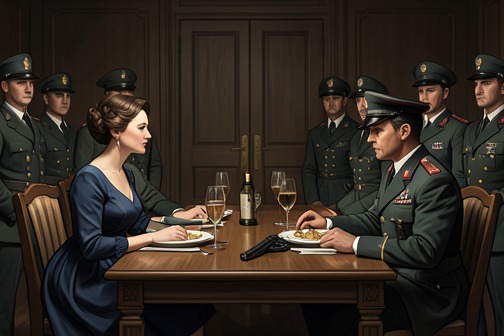
[The duel between Konrad Halder and Baron von Zumpe](entity:event-recall-event-9f38eea2d552) is a story told years later by [Baroness Von Zumpe](entity:character-recall-character-baroness-von-zumpe-c8d14720d126) at a dinner where officers and guests are discussing murder. Its decisive reversal is that Halder, having accepted the challenge and survived the Baron’s shot, turns his weapon on himself rather than firing at his opponent. The duel does not settle the lovers’ conflict: Halder soon runs away with the Baron’s sister, and the story’s aftermath moves from public spectacle to marriage, illness, death, and an arrangement over the couple’s child.
## The story at the dinner table
The Baroness introduces Halder as a criminal—or perhaps not quite one—whose mysterious aura made him attractive to women. Her aunt, the Baron’s only sister, fell in love with him. The attachment so angered her father that he challenged Halder to a duel. The tale is therefore not offered as a direct account by a participant but as family history narrated by a woman who was not born when the confrontation occurred. She later visited its setting herself, but what she knows of the duel comes through recollection and inherited report.
The story enters a discussion already preoccupied with how murder is named. An [SS](entity:organization-recall-organization-bbcdb0ea06e2) officer has called the word ambiguous and imprecise; [General Von Berenberg](entity:character-recall-character-general-von-berenbe-91b2e8b40066) insists that a court’s judgment determines whether an act counts as murder. Against that legal and institutional conversation, the Baroness’s account supplies a past in which a pistol duel, an apparent act of self-injury, and a family scandal are narrated as overlapping questions of crime, courage, and social standing. Her anecdote does not resolve those categories; its force comes from leaving them unsettled.
## The duel in the forest
The confrontation takes place in the Heart of Autumn forest outside Potsdam, in a clearing on sloping ground. The Baron arrives with aristocratic seconds, including the Baron of X and the Count of Y. Halder arrives at seven in the morning with two beggars, both drunk, rather than conventional seconds. The contrast makes the encounter look unequal in social form before either man fires: the Baron brings the recognizable apparatus of rank, while Halder arrives with companions who appear to violate its decorum.
Both men use pistols. The Baron’s bullet passes close to Halder’s left shoulder. At first, the onlookers assume Halder has fired and missed, and they expect the more accomplished marksman to prevail. The apparent end of the exchange is reversed when they realize that Halder is still aiming and has not yet shot at the Baron. He fires point-blank at his own body, apparently his left arm, rather than at his opponent. The Baroness remembers this as the duel’s most surprising turn: Halder accepts the ritual’s lethal possibility but redirects the shot away from the man who challenged him.
The immediate outcome is left uncertain. The Baroness does not know whether Halder was taken to a doctor or went to seek one himself with his beggar-seconds. She imagines the Baron standing motionless in the clearing, furious or stunned, while his own seconds gather around him. This gap matters: the anecdote preserves the act that altered the encounter but not a confirmed medical aftermath, and it does not say that either participant was formally declared victor.
## From scandal to family arrangement
Shortly after the duel, Halder runs away with the Baron’s sister. They live for a time in [Paris](entity:location-recall-location-657453741ed3) and then in the south of [France](entity:location-recall-location-france-f5cafc8a8ad4), where Halder, a painter, spends long stretches. They eventually marry and settle in [Berlin](entity:location-recall-location-769cdeac2511), though the Baroness qualifies that account as something she heard rather than witnessed. The elopement turns the duel’s apparent contest between two men into part of a longer conflict shaped by the aunt’s choice and the family’s response.
The Baron’s sister falls gravely ill. On the day she dies, a telegram informs her brother, and that night he sees Halder again. Halder is drunk and half-naked; their three-year-old son wanders through the house, which also serves as Halder’s studio, naked and daubed with paint. The Baroness cannot say what the men discussed or whether they reached an agreement, but she reports the practical consequences: the Baron takes charge of his nephew, while Halder leaves Berlin forever. The earlier challenge gives way to an arrangement made in the wake of bereavement, and the child becomes the link that remains after the couple’s life together ends.
## Memory, murder, and legibility
The Baroness’s account is conspicuously incomplete. She was not present at the duel, cannot reconstruct its rules, does not know what became of Halder’s wound, and marks the later history with qualifications such as what she heard. Even the Baron, who nods when she invokes the episode, apparently does not understand what she is referring to. The story reaches the dinner table as a vivid family legend whose details are vivid precisely where its witness’s knowledge is limited.
That uncertainty resonates with the novel’s wider meditation on the social legibility of death. A white-haired man argues that words can filter violence, making some crimes appear consequential and others scarcely count as public events. He contrasts the deaths of thousands in the [Paris Commune](entity:event-recall-event-09d927942b3a) with the extensive publicity given to a smaller domestic crime, explaining that some victims were treated as belonging to society and others were not. The duel story does not make that comparison directly, but its own survival as a family anecdote shows how violence can be preserved through selective narration: the pistol exchange, the lover’s defiance, and the Baron’s family history endure, while the wound’s treatment and the duel’s formal resolution remain unknown.
The surrounding conversation also resists treating murder as the exclusive mark of a remote monster. One speaker observes that murderers and heroes can resemble one another in their solitude and in the public’s initial failure to understand their actions. Halder’s self-directed shot is not presented as proof that he is either a hero or a murderer. Instead, it unsettles the distinction: he refuses the expected target, yet remains inside a ritual built around armed confrontation. The story’s lasting significance lies in that redirection and in the aftermath the anecdote can report—love, loss, a child placed in the Baron’s care, and a painter who disappears from Berlin—without ever making the duel’s meaning final.
Event 67
Kostekino massacre
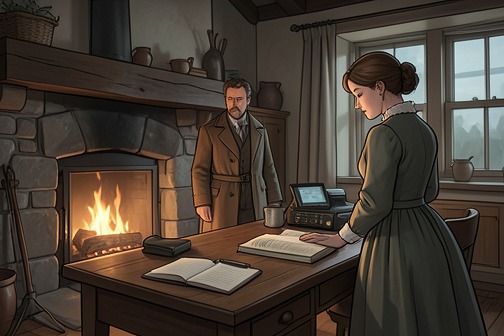
The [Kostekino massacre](entity:event-recall-event-kostekino-massacre-44f69ac11a41) is recalled not as a fully witnessed scene but through [Hans Reiter](entity:character-recall-character-hans-reiter-71edfa723a3e)’s troubled reconstruction of the killing of [Boris Abramovich Ansky](entity:character-recall-character-boris-abramovich-an-a17e275ff295) and the Jews of [Kostekino](entity:location-recall-location-bc1adcf0187b). Its significance lies in the way mass violence enters the present indirectly: through a notebook, an unused hiding place, and Reiter’s dreams, which blur the boundary between what he knows and what he fears he did.
## The hiding place and the imagined escape
Reiter considers who built a hiding place for one person behind the farmhouse fireplace. He decides it was probably [Ansky](entity:character-recall-character-2b3d034ca5c5)’s father, though he cannot settle whether it was made before Ansky returned to the village or after his parents learned that their son was an enemy of the state. Reiter imagines its construction as careful and unhurried, an impression that gives Ansky’s father the aura of either a seer or a madman. He also concludes that nobody used it.
The possibility that Ansky hid there during earlier visits by party officials remains open to Reiter. But in his reconstruction of the decisive moment, when [Einsatzgruppe C](entity:organization-recall-organization-einsatzgruppe-c-e999105bdb31) arrived, no one took refuge in the hiding place—not even Ansky’s mother. Instead, Reiter imagines her securing her son’s notebook before going with the other Jews of Kostekino toward their deaths. The shelter’s survival as an empty space makes escape imaginable while marking the moment when it did not occur.
## Reiter’s dreams and sense of guilt
Reiter dreams of Ansky walking westward at night as a nameless person, then falling under gunfire. For several days, he believes that he was the one who shot him. The massacre is thus bound to a personal fear of culpability, although the account presents this as Reiter’s belief and nightmare, not as confirmation that he killed Ansky.
These dreams disrupt Reiter’s life after the killing. He wakes in distress, reads [Ansky’s notebook](entity:object-recall-object-ansky-s-notebook-29a130b06d3a) at random, and withdraws from the communal routine of the village, preferring the snowy forest and the farmhouse to the building where his comrades gather around food and warmth. At the hearth, he sometimes imagines a shadowy, timid, benevolent figure looking out from the fireplace. He even climbs into the hiding place and remains there until morning, turning a shelter that no one used during the massacre into a place he inhabits in its aftermath.
## The massacre in historical perspective
Elsewhere, the novel places the social recognition of killing beside the selective attention given to it. A speaker contrasts the many deaths during the [Paris Commune](entity:event-recall-event-09d927942b3a) with widely reported individual murders, arguing that some victims were treated as outside society and that their deaths could not readily be made legible in public language. This reflection does not describe the events at Kostekino directly, but it sharpens the novel’s concern with how mass death can be obscured, even while its traces endure in private memory.
The account of Kostekino likewise reaches the reader through what survives and what can only be imagined: Ansky’s notebook, the unused hiding place, and Reiter’s recurring dreams. Its narrative form withholds a complete eyewitness perspective. Rather than resolving that absence, it makes the uncertainty part of the event’s lasting consequence.
Event 68
Mutiny of the Romanian Third Legion and the crucifixion of General Entrescu
The mutiny of the Romanian Third Army Corps and the crucifixion of [General Entrescu](entity:character-recall-character-d0d085598988) turn a retreating army’s collapse into a stark encounter with the consequences of hunger, fear, and failed command. Seen by [Hans Reiter](entity:character-recall-character-hans-reiter-71edfa723a3e) as his German unit flees the advancing Soviets, the episode shifts from a tense standoff between armed groups to an impromptu gathering around the dead general, whose former authority has been reduced to a cross in the courtyard of his own deserted estate.
## Retreat and discovery
In 1944, Reiter and the remnants of his division were retreating toward Jassy with a Russian motorized brigade close behind. From a lookout, the soldiers saw a cloud of blue dust, heard shouting and faint singing, and watched Romanian soldiers cross a field. Though the immediate danger of the Soviet advance made any detour risky, Reiter and several comrades left their lookout in an armored vehicle to investigate.
They reached a deserted Romanian castle, its windows closed and its courtyard extending toward the stables. Beyond it, soldiers were playing dice or loading paintings and furniture onto carts they would have to pull themselves. The scene joined military flight to the stripping of an estate: the retreating men were not simply passing through but carrying away what they could from a place whose ordinary household life had already disappeared.
At the far end of the open space stood a large wooden cross, assembled from dark-varnished pieces that may have come from the castle’s great hall. General Entrescu was nailed to it. The discovery connected Reiter’s present encounter to an earlier episode: he recognized the general as the man who had been with the [Baroness Von Zumpe](entity:character-recall-character-baroness-von-zumpe-c8d14720d126) at the castle in the [Carpathians](entity:location-recall-location-carpathians-f73fa02197c6), where Reiter and [Wilke](entity:character-recall-character-wilke-11a8dc07967d) had watched them from a secret passageway.
## Mutiny and confrontation
When the Germans asked what had happened, the Romanians said that the Third Army Corps had decided to desert the previous night. Their explanation placed the cross within a collective break from military obedience rather than presenting the killing as an isolated act. The Germans, themselves fleeing the Soviets, exchanged uncertain looks: for a moment they seemed unsure whether to shoot at the Romanians or join them in desertion.
The uncertainty sharpened when the Romanians said they would kill anyone who stood in their way. Most picked up their rifles, and some aimed them openly at the Germans; for an instant, the two groups seemed close to exchanging fire. Reiter then got out of the vehicle and walked toward the cross, disregarding the armed standoff. His movement changed the scene’s focus: the possibility of a firefight receded as the soldiers, one by one, turned their attention to Entrescu.
The Romanians explained that the Third Army Corps had reached Litacz station three days earlier. Instead of seeking safety farther west, Entrescu had gone to his castle, which they found deserted. There were no servants and no animals to slaughter for food. He shut himself in his room for two days while the soldiers searched the house, found the cellar, and broke in. Although some officers had reservations, the men began drinking; that night, half the corps deserted. Those who stayed, the account stresses, were not held there by force. They remained because they loved the general, or something like that—a qualification that makes the professed loyalty uncertain rather than resolving the contradiction between devotion and revolt.
## Entrescu’s death and its explanation
The soldiers’ account traces the killing to a collapse that gathered over several days. Some men went to loot neighboring villages and did not return. Others called to Entrescu from the courtyard, asking him to resume command and decide what they should do, but he remained locked in his room and admitted no one. One drunken night, the soldiers broke down the door and found him sitting in an armchair, surrounded by candelabras and tapers, looking through a photo album.
The general initially defended himself with his riding crop. The soldiers, described as driven by hunger and fear, killed him and nailed him to the cross they had made beforehand. When Reiter remarked on the effort required to construct it, a Romanian replied that they had built it before killing Entrescu and did not know why. The cross therefore precedes the decisive act without receiving a clear explanation: it is both the setting chosen for the killing and an unanswered sign of what the mutineers intended their revolt to mean.
## From armed standoff to vigil
The crucifixion does not end in a renewed attack. As the men gather near the cross, their rifles cease to be aimed at one another and are held like ordinary tools. The Soviet advance remains close, and the soldiers remain afraid, yet none can resist one last visit to the general. Their immediate military danger is not removed; rather, the discovery temporarily displaces it, drawing Germans and Romanians into a common pause.
The soldiers stand lost in thought, some with bowed heads and others staring at Entrescu. No one asks how he was killed, and no one proposes taking him down. A young Romanian, no more than fifteen and wearing an oversized uniform, prays nearby. When a German asks what kind of man Entrescu was, a Romanian answers that he was not a bad sort. The brief judgment sits beside the account of his abandonment and death: neither the general’s former authority nor the soldiers’ claim of affection can undo what they have done.
## Narrative significance
The episode’s central reversal is not simply that a general is killed by his own soldiers. Entrescu’s return to his castle, apparently a place of refuge, puts him among men who have lost food, direction, and confidence in his command; his withdrawal into his room leaves their requests unanswered. The revolt culminates in violence, but its aftermath is marked by hesitation, recollection, and an unexplained decision to make a cross before the killing.
Reiter’s choice to approach the body while armed men face one another also alters the encounter’s scale. A potential clash between Germans and Romanians gives way to a shared vigil under the pressure of the Soviet advance. The scene offers no reconciliation or account of what becomes of the deserters; its ending remains with the gathered soldiers and the cross they do not remove, making the abandoned estate a temporary point of stillness within a retreat that otherwise continues toward destruction.
Event 69
Sommer’s massacre of Greek Jews
[Leo Sammer](entity:character-recall-character-777ae01f1aa0)’s account of the massacre of Greek Jews presents organized murder as a sequence of administrative choices: a train arrives, local officials debate what to do, and repeated groups are sent from an abandoned tannery to a hollow outside the village. The episode is not told as an impersonal chronicle. Sammer recounts it to [Hans Reiter](entity:character-recall-character-hans-reiter-71edfa723a3e), insisting that he was a fair administrator and that killing the Jews himself was contrary to his nature, even as his story records his decisions to supervise their deaths and finally abandon the survivors. The gap between the bureaucratic language of his account and the violence it describes is central to the event’s meaning.
## The order and the first decisions
Sammer says that a sudden order placed five hundred Jews from Greece under his authority. He is uncertain whether they were Greek, Hungarian, Croatian, or Serbian, but settles on calling them Greek. He stresses that he ran a civilian operation, not a military or [SS](entity:organization-recall-organization-bbcdb0ea06e2) one, and that he had no specialists for the task. These qualifications establish the terms of his defense, but they do not alter what he does: he signs the papers confirming the train’s delivery and takes charge of the people on it.
At the station, Sammer refuses to have the railcars opened at first, claiming concern about disease. He contacts an acquaintance connected to a camp near [Chelmno](entity:location-recall-location-chelmno-3bdd66b0179d), but receives no immediate solution. When railway personnel insist that the train must leave that night, he agrees to unload it. Once the cars are opened, eight people are already dead. Sammer orders the survivors taken to an abandoned tannery and bread bought for them, while he returns to what he calls urgent business. The small act of providing bread sits beside his decision to confine the group and seek a way to dispose of them.
A secretary suggests putting some of the Jews to work locally. Sammer assigns around fifty of them to sweep the village in brigades of ten, then resumes arranging labor for factories elsewhere. When he calls Chelmno again, he is still trying to find an institution to take the group. The account does not present these arrangements as protection: the tannery, the work brigades, and the calls to other camps are steps in managing people Sammer knows are in danger.
## A killing operation assembled locally
Sammer says he understands, after a telephone conversation, that he is expected to eliminate the Greek Jews himself and bear the risk. He asks the mayor, fire chief, police chief, and head of the War Veterans Association to meet at a club. Over coffee and bread, the local officials consider other camps and possible contacts. Sammer lets them discuss alternatives before telling them that the order is unequivocal and asking how to carry it out. The scene places the planned killing among ordinary municipal business and conversation, rather than in a distant command center.
After surveying possible sites, Sammer chooses a remote hollow roughly ten miles from town. He assembles policemen, office staff, his driver, and volunteer farmers, and sends them out before sunrise. The first groups take Jews from the tannery to the hollow; those returning report that the operation went according to plan. Sammer’s questions about whether chaos prevailed reveal that he is monitoring the process, though he chooses not to press for details. The next day the operation is repeated with changes to the personnel, and the killing continues in rotating groups.
By the end of the week, eight brigades of sweepers—eighty people—have disappeared. Sammer describes the strain on those carrying out the work: farmers withdraw, police complain that their nerves are frayed, and office staff refuse or fall ill. He himself says his health is failing. Instead of stopping the killings, he recruits fifteen young soccer players from the village. He offers them wine, bread, sausages, and provisions for their families, then sends them to the hollow with armed police. He also orders that no Jew be allowed to leave the tannery. The operation thus draws in boys through food and drink while Sammer maintains control over the imprisoned group.
## Concealment, exhaustion, and interruption
As the mass grave fills, Sammer tells his men to cover anything they find and dig elsewhere: the aim, he says, is not to find things but not to find them. Eventually he directs them to dig a deeper, wider pit. The work continues in snow and bad weather. Some of the boys become too drunk to stand; five fall ill with pneumonia, and two later die. Sammer sends food to their mothers as condolence, while the Jewish prisoners remain subject to the operation. His account sets these gestures of local care beside his continued use of the boys and the police to carry out the killings.
A tally gives Sammer a total of more than one hundred Jews still alive, after accounting for those who died on the journey, in the tannery, or in the hollow. He halts the work temporarily because the police, volunteers, and boys are exhausted. The boys return to playing soccer; the police return to their duties; the farmers go back to their farms. With no outside authority showing interest in the prisoners, Sammer restarts the sweeping brigades and sends a group of no more than twenty to farmwork under the farmers’ responsibility. The pause is therefore a response to the limits of the perpetrators’ endurance, not a decision to release or protect the Jews.
A new order to evacuate Germans from the region changes Sammer’s priorities. He asks what should be done with the Jews, but receives no answer. He organizes the westward departure of local people and remains in the village after the others have left. With artillery audible in the distance, he visits the Jews and tells them to leave; then he collects the two policemen guarding them and abandons them in the tannery. He calls this freedom, a word that exposes the distance between his chosen description and the perilous situation he leaves them in. The account gives no further outcome for the abandoned survivors.
## The account’s self-defense and its significance
Sammer tells Reiter that he was a fair administrator, that instinct sometimes led him to do good things, and that the vicissitudes of war drove him to do bad ones. He anticipates that the Polish boys will accuse him of ruining their childhoods, then blames liquor, soccer, and their mothers instead. Finally, he claims that anyone else in his position would have killed all the Jews with his own hands, whereas he did not because it was not in his nature. The claim is contradicted by the story he has just told: he did not personally perform every killing, but he selected the site, assembled the participants, issued orders, kept the Jews confined, and continued the operation until wartime evacuation forced a change of course.
The novel’s framing makes Sammer’s testimony more than a report of events. His recollection supplies concrete detail while repeatedly cushioning responsibility with uncertainty, administrative language, and assertions of personal temperament. The operation depends not only on an order from elsewhere but on local choices, including the use of police, employees, farmers, and village boys. His closing defense tries to distinguish his own actions from direct killing; the account instead shows how mass murder can be organized through delegation, routine, and a narrator’s persistent effort to make complicity sound like reluctant management.
Event 70
Sommer’s murder at the Ansbach prisoner-of-war camp
[Sommer’s murder at the Ansbach prisoner-of-war camp](entity:event-recall-event-00eeaf4593c1) is a concealed wartime killing that [Hans Reiter](entity:character-recall-character-hans-reiter-71edfa723a3e) recounts only later, while explaining why he thought authorities might be looking for him. The camp’s sparse investigation never identifies the murderer in the evidence presented, but Reiter admits that he had done away with Sommer. The interval between the death and that admission makes the episode both a crime within the story and a belated, guarded act of testimony about guilt, fear, and postwar justice.
## The Camp and Sommer’s Fear
After the war, Reiter was held at the prisoner-of-war camp at [Ansbach](entity:location-recall-location-ansbach-416092daf1d6), where he watched Sommer from a distance. Sommer watched him too, with visible unease and mistrust. Their exchanges took place under the eyes of the former police chief and fire chief, who had once served alongside Sommer and now kept several feet away, as though unwilling to interfere in their former superior’s affairs.
Sommer spoke of the actions and words people later regret. He also anticipated that the American police would return to question him and said he expected arrest and public disgrace. His apprehension gives the killing an immediate context: he believed an inquiry was coming, while Reiter knew him as a man implicated in the murder of Jews. The account establishes Sommer’s fear and his past, but does not claim that the anticipated interrogation directly caused his death.
## The Killing and Its Immediate Aftermath
One morning Sommer was found dead halfway between his tent and the latrines. He had been strangled. The discovery is reported without an identified witness or an account of the killing itself; the narrative supplies the location and cause of death, not a reconstruction of who acted or how the event unfolded.
American personnel questioned perhaps ten prisoners, Reiter among them. He told them he had heard nothing unusual during the night. They took Sommer’s body away and buried him in the common grave at the Ansbach cemetery. The inquiry, as described, produces no disclosed culprit or public resolution. The common grave fixes Sommer’s physical fate while leaving the circumstances of his death unsettled.
## Reiter’s Later Account
The murder returns when Reiter tells [Ingeborg](entity:character-recall-character-a7ab11af18c4) that American and German police might be searching for him, or that his name might appear on a list of suspects. He says he had done away with Sommer and identifies him as a killer of Jews. Ingeborg tries to reassure Reiter that killing such a man was no crime, but Reiter does not accept her interruption and continues with the explanation.
In Reiter’s account, Sommer had concealed his identity under the name Zeller. Reiter says he does not know whom Sommer thought he was, but that Sommer kept telling him things. He also distinguishes what Sommer feared from what the Americans were actually investigating: he believes they were pursuing prominent war criminals, such as people from the death camps, [SS](entity:organization-recall-organization-bbcdb0ea06e2) officials, and senior party figures, not a relatively minor civil servant like Sommer. The gap between Sommer’s anticipated disgrace and the authorities’ priorities leaves his fear intact without confirming that the Americans were close to exposing him.
The policemen questioned Reiter about Sommer, including whether Sommer had mentioned enemies among the prisoners. Reiter says he denied knowing anything of that kind and reported that Sommer spoke only about his son, who had died at [Kursk](entity:location-recall-location-kursk-8ec85e4486c2), and his wife’s migraines. Reiter recalls that the young policemen looked at his hands, wrote down his name, and questioned him again about his political membership, acquaintances, family, and home. He says he answered honestly and asked for help finding his parents. These details place the murder inside a wider postwar search for people responsible for Nazi crimes, while showing how little the questioning resolves about Sommer’s death.
## Escape, Silence, and Narrative Significance
As the camp began to empty and new groups of prisoners arrived, Reiter was not released. A fellow prisoner told him the guards were only for show and were distracted; during a transfer, Reiter slipped away. He then wandered between cities, worked in reopening mines in Koblenz, and felt pursued by the memory of Sommer. After reaching [Cologne](entity:location-recall-location-cologne-ffb64b091f90), he concluded that what could happen to him had already happened. Once arrested after a bar scuffle, he was released when officials could not find his name in their files.
The account leaves a telling asymmetry. Sommer, who feared public disgrace, is buried in a common grave; Reiter, questioned but not convicted in the episode, survives by escaping detention and moving through a damaged postwar landscape. The novel does not supply an independent investigation or a fuller account of the killing. Instead, the murder emerges retrospectively through Reiter’s own words, in a confession framed by his fear of being sought and his insistence that Sommer was a killer of Jews. That delayed disclosure makes the episode central to the ambiguity of his postwar identity: he presents the killing as an act against a perpetrator, yet remains conscious of the possibility that authorities may treat him as a suspect.
Event 71
Reiter and Ingeborg reunite in Cologne
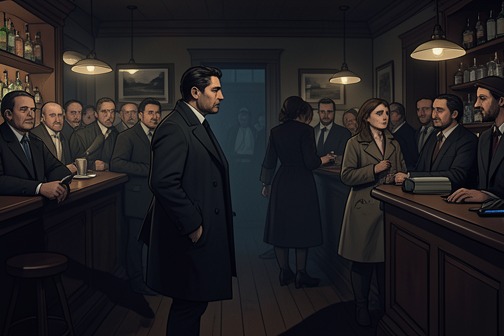
[Reiter and Ingeborg reunite in Cologne](entity:event-recall-event-2862bdb29310) through a delayed act of recognition. Reiter initially cannot place the woman who calls to him outside a bar, and later cannot remember her name even after recognizing where he knows her from. Their renewed connection leads to a life together, but the account presents that intimacy alongside [Ingeborg](entity:character-recall-character-a7ab11af18c4)’s precarious health and the damaged buildings around them.
## The Call and the First Recognition
One night, while Reiter is guarding the entrance to a bar on Spengler-strasse, a woman calls his name from the darkness. He looks around and sees no one. At first he supposes that one of the women who frequent the bar is playing a joke, but the voice calls again; he then understands that it belongs to someone else and asks what she wants.
Reiter examines the woman and cannot remember who she is. The uncertainty persists as she speaks: he feels that he knows her, but cannot identify where or under what circumstances they met. Rather than press her, he keeps the encounter calm and offers her a drink. She looks toward the bar before accepting, and they sit near the entrance with tea. When the woman serving them asks who the newcomer is, Reiter calls her his girlfriend. The casual answer gives their uncertain reunion a provisional intimacy before he has recovered even her name.
## A Name Returned
Later, while working, Reiter watches the entrance of the house across the street. At times he thinks he sees a pair of eyes in the dark. During a lull he goes to the doorway, intending to speak to the woman, then realizes that he does not know her name. Using a match, he finds her asleep in a corner. As he kneels beside her, he remembers who she is.
When she wakes, the doorway has become a room with photographs of performers on the walls and dolls and stuffed bears on a chest of drawers. Cases of whiskey and wine are stacked on the floor. Ingeborg is under a green quilt, with her shoes removed. Reiter identifies her as the girl who lived in [Hugo Halder](entity:character-recall-character-hugo-halder-c773786bddec)’s old flat. She confirms this without opening her eyes, but when he admits that he still cannot remember her name, she corrects him: she is [Ingeborg Bauer](entity:character-recall-character-ingeborg-bauer-527eac274f32). Reiter repeats the name as though it contained his fate. The sequence turns recognition into more than simple recollection: he retrieves both her connection to Hugo Halder and the name that makes their reunion definite.
## From Encounter to Shared Life
The narrative looks back to the kiss in the park, when Reiter was searching for Hugo Halder and Ingeborg told him the story of the Aztecs. In retrospect, Reiter understands that she had gone mad, or may already have been mad when they first met. He also recognizes that she was ill, or perhaps hungry. Their reunion therefore does not begin from secure knowledge of one another. It restores a connection whose earlier circumstances had been obscured by Reiter’s failures of memory and by Ingeborg’s unstable situation.
Reiter brings Ingeborg to live with him in his cellar. Her persistent coughing and apparent lung trouble prompt him to look for different accommodation, and he finds a garret in a partly ruined building. The stairs are unsafe: some steps sink under a climber’s weight, while gaps open onto the building’s interior and the damage left by bomb shrapnel. Ingeborg weighs 110 pounds, and Reiter, though very tall, is thin and bony; their light frames make the stairs manageable for them. A small, amiable Brandenburger employed by the occupation troops is not so fortunate: he falls through a gap between the second and third floors and breaks his neck. The account sets the couple’s fragile domestic arrangement within a structure whose dangers are not merely metaphorical, but part of everyday life.
## The Meaning of the Reunion
The episode binds personal recognition to material vulnerability. Reiter’s memory returns in stages: first a feeling that he knows the woman, then the recollection of Hugo Halder’s former flat, and finally Ingeborg’s name. Each recovery brings the relationship into clearer focus, while leaving its future uncertain. His declaration at the bar that she is his girlfriend precedes that knowledge, making the reunion feel less like a settled romantic resolution than an improvised beginning.
The move from cellar to garret further defines that beginning. Reiter responds to Ingeborg’s coughing by seeking another place to live, but the accommodation he finds is itself precarious, scarred by wartime destruction and unsafe for other tenants. Their shared life takes shape not in a secure home but in compromised rooms and unstable passageways. The reunion thus joins affection and care to the novel’s persistent attention to damaged places and vulnerable lives, without offering a clean separation between private intimacy and the historical environment around them.
Event 72
The birth of the pen name Benno von Archimboldi
[The birth of the pen name Benno von Archimboldi](entity:event-recall-event-20589c8a0bc8) is a small, decisive act of self-invention: while completing his first novel in [Cologne](entity:location-recall-location-cologne-ffb64b091f90), [Hans Reiter](entity:character-recall-character-hans-reiter-71edfa723a3e) supplies a stranger with a name that begins as an expedient and becomes the identity under which his work will enter the literary world. The name is born not in a public ceremony or a declaration of ambition, but beside an old French typewriter, in an encounter shaped by anonymity, money, and an old writer’s uncompromising account of [Germany](entity:location-recall-location-a3c24dd56e42)’s moral evasions.
## The name at the typewriter
Reiter finishes his first novel, titled Lüdiche, and needs a typewriter. He deliberately searches the backstreets of Cologne rather than borrowing or renting one from anyone who knows him as Hans Reiter. The separation matters: he wants to write without bringing his familiar name into the transaction. His search ends with an old man who owns a French typewriter in perfect condition and, though he does not usually rent it out, sometimes makes an exception for writers.
The price is high. Reiter initially considers looking elsewhere, but the clean, carefully maintained machine changes his mind: every key seems ready to make its mark. The owner requires payment in advance, so Reiter borrows money from several girls at a bar. When he returns the next day, the old man opens an accounting book and asks for his name. Reiter has come seeking anonymity, but the demand for a name turns that absence into a choice.
His first answer is immediate: he says that his name is [Benno von Archimboldi](entity:character-recall-character-benno-von-archimbol-b19f141ab3bf). The old man does not accept it, asking him to stop playing games and give his real name. Reiter repeats the invented identity, now addressing the man respectfully and making clear that he will leave if it is treated as a joke. The brief exchange gives the pseudonym its first force: it is no longer a passing answer, but a name Reiter is willing to stand behind, even when challenged.
## The old writer’s rebuke
The pause after Reiter repeats the name gives the encounter a charged stillness. In the old man’s dim study, his dark eyes seem black; Archimboldi’s blue eyes appear to him tired and reddened, yet young, and in a certain sense pure. That judgment leads into a bitter reversal. The old man says the country has tried to topple other countries into the abyss in the name of purity and will, and he rejects both as empty ideals. In his account, those ideals have helped turn people into cowards and thugs, only for them afterward to claim ignorance and blame the Nazis.
The rebuke makes the naming scene more than a playful first step toward literary authorship. It places the new name beside a critique of the very language that might make a name seem noble: purity, will, innocence, and the wish to be forgiven. The old man’s accusation does not explain why Reiter chooses this particular name, and the scene does not supply a hidden origin for it. Instead, it gives the naming a moral setting. Reiter listens, answers that he understands, and the old man then reveals that he, too, was a writer.
The narrator marks the moment cautiously: that afternoon, Reiter may have become Archimboldi. The qualification preserves the gap between speaking a name once and inhabiting it. Yet the scene’s practical facts—the borrowed money, the rented machine, the name entered into an account—give the transformation a material beginning. Authorship here starts not as pure inspiration but as a transaction, and the name offered in that transaction carries the weight of the old writer’s warning.
## From private alias to literary identity
The name soon reaches beyond the room where Reiter first speaks it. After Mr. [Bubis](entity:character-recall-character-921e7ac9dc0e) writes about his publishing house and the books it is preparing to release, Archimboldi shows the letter to [Ingeborg](entity:character-recall-character-a7ab11af18c4). She is surprised because she does not know who Benno von Archimboldi is. He answers that it is him, and she asks why he changed his name. The exchange makes visible a divide that had been useful to Reiter: the person closest to him knows Hans Reiter, while a publisher’s correspondence addresses a writer under another identity.
Archimboldi explains the change in terms of safety. When Ingeborg questions his account, he says that it is safest for him if Reiter is forgotten. The explanation follows the earlier insistence on remaining unknown to the typewriter owner, but now the separation has a sharper consequence: the name may protect him if the police pursue him over Sammer’s murder. The narrative leaves open whether safety was the original reason for taking the name or whether it has become a reason afterward. Ingeborg initially calls him a liar, then believes him; before he leaves for work, she smiles and predicts that he will be famous.
That prediction introduces a possibility Archimboldi says he had never considered. He distinguishes fame from the people and writers who matter to him: Döblin is his consolation, [Ansky](entity:character-recall-character-2b3d034ca5c5) his strength, Ingeborg his joy, the missing [Hugo Halder](entity:character-recall-character-hugo-halder-c773786bddec) his lightheartedness and fun, and his sister, from whom he has had no news, his innocence. These attachments answer particular needs; fame, by contrast, seems to him rooted in delusion and lies, or perhaps ambition. He considers it reductive, a force that diminishes both what leads to it and what follows from it. In his formulation, fame and literature are irreconcilable enemies.
## An origin that remains unsettled
The name’s meaning is not resolved when it is first spoken. Archimboldi spends the day turning over possible explanations. At the bar and among his acquaintances in Cologne, people know him as Hans Reiter; the police, should they pursue him over Sammer’s murder, could find clues. Perhaps Ingeborg is right that he expects fame and is arranging protection for a future public life. Perhaps the change means something else. The thought ends not with an answer but with repeated uncertainty, keeping the name between concealment and emergence.
That tension also shapes what follows. The day after receiving Mr. Bubis’s letter, Archimboldi writes that the novel is not promised to another publisher and that the proposed advance is acceptable. The name that began as an answer to a typewriter owner now appears in the correspondence of a prospective publishing partnership. Its birth is therefore not a single clean break between Hans Reiter and a finished literary persona. It is a staged passage: first uttered under pressure, then explained as protection, recognized by Ingeborg, and carried into a negotiation over the novel.
The episode’s central irony is that the name may be intended to keep Reiter forgotten, yet it is precisely the name through which his writing becomes recognizable. Archimboldi himself distrusts fame because it compresses a life into a public label; the narrative, meanwhile, shows that a label can both conceal and enable. The pseudonym begins as a refusal to be known by the wrong person, and its literary future grows out of that refusal without settling whether the motive is fear, ambition, or something Reiter cannot yet name.
Event 73
Archimboldi and Bubis begin their publishing partnership

[Archimboldi and Bubis begin their publishing partnership](entity:event-recall-event-feb95aa561c8) when [Benno von Archimboldi](entity:character-recall-character-benno-von-archimbol-b19f141ab3bf) accepts the [Hamburg](entity:location-recall-location-hamburg-83eba4856d4b) editor’s offer for Lüdicke and travels to meet him. The arrangement grows out of a modest advance and a promise of serious editorial care, but its decisive force lies in [Bubis](entity:character-recall-character-921e7ac9dc0e)’s willingness to stand behind books that find little public favor: when Archimboldi’s first two novels sell only a few hundred copies, Bubis still means to publish every book that follows.
## The offer and the journey
A letter from Hamburg reaches Archimboldi while he is working at a bar. Signed by Mr. Bubis, a prominent editor, it praises Lüdicke in guarded but unmistakable terms. Bubis asks whether the novel has already been promised elsewhere; if not, he would like to publish it. He admits that the advance he can offer is laughably small by the standards of fifteen years earlier, but promises the book the finest treatment and distribution through respected bookshops in [Germany](entity:location-recall-location-a3c24dd56e42), Austria, and Switzerland. A leaflet enclosed with the letter advertises forthcoming books by Döblin and Heinrich Mann, placing Bubis’s proposal in the context of a publishing house trying to re-establish a literary life after the war.
The letter is not merely an offer of money. Bubis presents his firm as an independent and high-quality publisher, and his promise of care answers the economic weakness of the offer with cultural standing and professional attention. Archimboldi writes back the next day to say that Lüdicke is uncommitted and that the proposed advance is acceptable. Bubis then invites him to Hamburg to sign in person, explaining his distrust of the German post and his new habit, acquired after returning from England, of meeting his authors face to face.
Archimboldi takes leave from work and travels by train to Hamburg. The publisher’s building remains where it stood before 1933, but neighboring buildings and others across the street have been flattened by bombs. Employees privately joke that Bubis directed the raids himself, an absurd rumor set against the visible destruction surrounding the house. The firm’s small staff includes a copy editor, a bookkeeper who also handles press relations, a secretary, and a storeroom attendant; the cellar stock is repeatedly threatened by rainwater and groundwater. Its cramped and precarious circumstances make Bubis’s claims for literary seriousness all the more tangible: this is a working enterprise struggling to keep books in circulation amid the physical and institutional damage of the postwar years.
## Meeting Bubis
At seventy-four, Bubis can seem ill, bad-tempered, mistrustful, and miserly, but the impression is misleading. He is healthy, ready to smile, and trusting, though not generous in what he pays his employees. Before Archimboldi reaches him, the young writer sees the publisher’s office: shelves packed tight, books and manuscripts piled on the floor in precarious towers, and first editions, works of so-called degenerate art, French and English books, American paperbacks, and magazines that seem like treasure to an impecunious author. The room’s disorder, abundance, and international range embody a literary world that persists despite war and injustice.
After the usual introductions, Bubis immediately asks for Archimboldi’s real name, certain that the name in the letter cannot be genuine. Archimboldi answers that it is his name. The exchange turns the pseudonym into the partnership’s first test: the publisher questions the identity on which his offer rests, while the writer holds to it directly. Once Archimboldi identifies himself as Benno von Archimboldi, Bubis gestures as if applauding, then sends him to [Mrs. Bubis](entity:character-recall-character-mrs-bubis-ad40de826c52)’s office.
There, Archimboldi recognizes [Anna Bubis](entity:character-recall-character-a21d1eef090f) as the [Baroness Von Zumpe](entity:character-recall-character-baroness-von-zumpe-c8d14720d126), a woman from his past. She has changed, and he initially says nothing; she, too, takes time to confirm who he is. As they leave the building’s dark stairs for a walk and perhaps coffee, she tells him that she recognized him and was sure he had recognized her. Archimboldi replies that he recognized her instantly. The publisher meeting thus opens onto a personal history neither of them can treat as new, even as their immediate purpose is to establish a professional relationship.
## Bubis as publisher and reader
Bubis’s invitation carries a painful account of his own publishing history. Before 1933, he published promising young German writers. In 1940, alone in a [London](entity:location-recall-location-london-420923d4a60a) hotel, he tried to calculate how many of those writers had joined the [Nazi Party](entity:organization-recall-organization-bddabb00303b) or the [SS](entity:organization-recall-organization-bbcdb0ea06e2), contributed to antisemitic newspapers, or advanced through the Nazi bureaucracy. He writes that the result nearly drove him to suicide. Instead, he struck himself, opened the hotel window, and watched the bombing of London: the bombs seemed to fall close to the hotel, searchlights crossed the sky, and explosions flashed over the barrage balloons. His self-reproach takes place inside the spectacle of war, joining the moral failure of literary culture to the destruction unfolding around him.
That history gives the face-to-face meeting a particular weight. Bubis does not present publishing as an innocent business untouched by political complicity. His earlier authors’ careers have become part of his own reckoning, and the new partnership begins with a publisher who has returned to Germany carrying that burden. The office full of books is therefore more than a sign of taste or wealth: it is the working setting for a renewed commitment to literary judgment after a past in which writers and institutions were implicated in the regime.
## Early books and continued commitment
Archimboldi goes on to write The Endless Rose in less than three months. Before Lüdicke has even come off the presses, Bubis receives the new manuscript, reads it in two nights, and wakes his wife to say that they must publish it. His response distinguishes the editor’s judgment from ordinary commercial calculation: he is deeply shaken by the book and considers it better than good.
The sales record supplies a sharp measure of how little that conviction is rewarded. Lüdicke receives two positive notices and one negative one, yet only 300 copies of its first edition sell. The Endless Rose appears five months later, receives one positive review and three negative reviews, and sells 205 copies. Archimboldi’s finances improve only slightly. At readings arranged through the [Cologne](entity:location-recall-location-cologne-ffb64b091f90) Cultural Center, the audience is small: fifteen people, including [Ingeborg](entity:character-recall-character-a7ab11af18c4), attend the Lüdicke reading, and just three buy the book; nine, again including Ingeborg, attend the reading from The Endless Rose, and only three remain at the end. Even Ingeborg later admits that she had considered leaving.
Despite these results, Bubis is prepared to publish not just a third Archimboldi book but the fourth, the fifth, and every book that comes afterward. The contrast between meager sales and expansive commitment defines the partnership. Bubis offers the writer neither instant fame nor financial security; what he offers is continuity, a publisher willing to keep reading, judging, and bringing the work into print when the market gives little reason to do so.
## Significance of the partnership
The alliance is formed through a sequence of acts of recognition: Bubis identifies promise in a book by an unknown writer, Archimboldi accepts an offer whose advance is small, and the two meet in a damaged city inside a publishing house still occupying its pre-1933 premises. The encounter with Anna Bubis, formerly the Baroness Von Zumpe, adds a private past to that professional beginning, while Bubis’s account of his former authors makes the ethical stakes of literary work explicit.
The partnership’s strength becomes clearest when success fails to arrive. Critical notices remain mixed, readership stays small, and Archimboldi’s livelihood improves only marginally, yet Bubis continues to choose his books. That persistence turns the editor’s initial promise of good treatment into a long-term relationship of trust and literary advocacy. In the wider story of Archimboldi’s emergence under a pen name, the Hamburg meeting is the point at which a concealed identity begins to acquire a public literary career.
Event 74
Crucifixion of General Entrescu
The [Crucifixion of General Entrescu](entity:event-recall-event-crucifixion-of-general-968c1acf6e8a) is a wartime episode recalled years later through the testimony of a crippled former officer. As the Romanian [Fourth Army Corps](entity:organization-recall-organization-9b210fcc8372) disintegrates during the German retreat from the Romanian border in 1944, Entrescu is crucified by mutinous men; the witness later confirms that he saw the general’s body on the cross. The account links military collapse with a landscape already marked by human remains, while its broken, secondhand transmission leaves the event’s meaning unresolved.
## Background and Retelling
The episode enters the narrative when [Benno von Archimboldi](entity:character-recall-character-benno-von-archimbol-b19f141ab3bf), searching the Internet, recognizes [Hermes Popescu](entity:character-recall-character-0328abbe4174) as the former secretary of [General Entrescu](entity:character-recall-character-d0d085598988). Archimboldi had seen Entrescu’s crucified body in 1944, but the fuller account comes through Popescu’s later encounter with a crippled captain from the Romanian Fourth Army Corps. The captain says that he witnessed events around the general’s final days, though he heard more than he saw.
The story is therefore layered: Archimboldi finds Popescu’s life story, and Popescu listens to the captain reconstruct the army’s collapse. Rather than presenting the crucifixion as a direct scene, the novel makes it an act of belated testimony, assembled from remembered fragments and gaps in what the witness could personally observe.
## Collapse at the Palace
The captain recalls officers of the Fourth Army Corps as dazed and divided, some grieving and others struggling to contain their distress. General Danilescu had already departed north with eight men, while the captain was away from the palace preparing defenses that were never used. In trenches dug near the grounds, soldiers uncovered bones. They disagreed about what the remains were, but the captain ordered them to keep digging; more bones appeared, and the trench work stopped.
Meanwhile, a group of mutinous men left the granary and began building a cross. The captain did not see the crucifixion as it happened. He and the soldiers heard a commotion but, exhausted, did not go to investigate. They guessed that their comrades might have found food or wine. When the captain later saw a huge cross being carried through the palace courtyard, the cellar had been emptied and the crisis was already over.
## The Witness and the Cross
Popescu presses the captain to clarify what he knows, asking whether he witnessed the events and whether he saw the general on the cross. The captain distinguishes what he heard from what he saw, then gives a direct confirmation: he saw Entrescu’s body, and the others saw it too. This confirmation anchors the account despite the witness’s absence from the palace at the moment of the killing.
After the crucifixion, the men began to leave as though Entrescu might return and punish them. A German patrol arrived while retreating and warned that the Russians were only two villages away and were taking no prisoners. The Germans moved on, and the Romanian officers and soldiers soon left as well. Popescu says nothing in response to the captain’s account, leaving the testimony without an explicit judgment or resolution.
## Bones and Historical Uncertainty
The captain returns to the bones in a final question: why had Entrescu brought his men to a palace whose grounds were riddled with them? Popescu offers a possibility, not a confirmed explanation: perhaps the general knew he would die and wanted to die at home. The exchange connects the unexplained remains with Entrescu’s death, but does not establish who the buried people were or what the general knew about them.
The cross and the bones thus frame the episode with two distinct uncertainties: the captain did not witness the act of crucifixion itself, and the palace’s history remains unreadable even to those who encountered its remains. The narrative preserves the event through testimony without turning its unanswered questions into facts. Its historical force lies in that tension between a confirmed death, a remembered act of collective violence, and the silence surrounding the ground on which it occurred.
Event 75
Bubis’s death
[Bubis’s death](entity:event-recall-event-fe86ebc3def5) is a sudden interruption in the life of his publishing house: laughter carries through its rooms, stops at eleven twenty-five, and gives way to the discovery of [Bubis](entity:character-recall-character-921e7ac9dc0e) dead at his desk. The episode joins an intimate, almost joyful final moment to the practical succession of the business and to [Benno von Archimboldi](entity:character-recall-character-benno-von-archimbol-b19f141ab3bf)’s private, unresolved response from far away.
## The last morning in [Hamburg](entity:location-recall-location-hamburg-83eba4856d4b)
Bubis is in his office reading a book by a young writer from Dresden, a work described as viciously funny and already troubled by censorship in the Democratic Republic. He laughs so hard that the publicity chief can hear him across the publishing house: in the lobby, the bookkeeper’s and copy editors’ offices, the meeting room, the reading room, the bathroom, the kitchen and pantry, and even the office of Bubis’s wife, the farthest away.
Then the laughter stops. Everyone remembers the time: eleven twenty-five in the morning. Bubis’s secretary first knocks and waits, reluctant to disturb him. When an urgent call comes through and no one answers, she knocks several times more and opens the door. He is slumped over among books artfully scattered across the floor. He is dead, but his face retains a happy expression. The contrast is stark: the sound that had animated the whole building disappears, while the room preserves the signs of his reading and the unexpected serenity of his final expression.
## Succession and farewell
Bubis’s body is burned, and his ashes are scattered over the waters of the Alster. His widow, the baroness, takes the helm of the publishing house and declares that she has no intention of selling it. The company thus continues under her direction, while the death closes Bubis’s own part in the business without ending its institutional life.
The young writer’s book remains an unresolved detail in the aftermath. No one says anything about the manuscript, despite the writer’s difficulties with censorship in the Democratic Republic. Its appearance in Bubis’s final reading links his death to the publisher’s work, but the scene does not explain what will happen to the manuscript.
## Archimboldi learns of the death
After moving back to the Continent, Archimboldi is reading a German newspaper on a terrace in Missolonghi when he learns that Bubis has died. He reads the story again, then a third time, and gets up shaking before walking around the town. The news reaches him not in Hamburg but at a distance, through print; his repeated reading and physical agitation register the impact without supplying an explanation of what Bubis meant to him in that moment.
Missolonghi is presented through its memorials to Byron, which seem to make the English poet appear to have done nothing there but stroll between inns, taverns, backstreets, and squares. The narrative corrects that misleading picture: Byron was too ill to move, while [Thanatos](entity:character-recall-character-9baf95b2ec63), personified as a tourist who walks, looks, and takes note, moves through the landscape. This meditation follows Archimboldi’s news of Bubis’s death, enlarging the episode’s concern with death beyond the office while preserving the distinction between the actual report and the literary reflection it prompts.
## The unsent condolence
Archimboldi wonders whether to send a card to the publishing house and even imagines the words he might write. He then decides that none of it makes sense and sends nothing. The episode ends not with a message or a journey back to Hamburg, but with the abandonment of an imagined gesture. Bubis’s death produces a concrete succession at the publishing house and an inward response in Archimboldi; the condolence that could have connected them remains unwritten.
Event 76
Ingeborg’s death
[Ingeborg’s death](entity:event-recall-event-d7160e98c58e) reaches the [Baroness Von Zumpe](entity:character-recall-character-baroness-von-zumpe-c8d14720d126) as a brief telegram from [Bubis](entity:character-recall-character-921e7ac9dc0e), but its effects unfold through travel, testimony, and absence. The baroness learns that Archimboldi’s wife has died in a remote village on the [Adriatic coast](entity:location-recall-location-813068d85fc6); when she arrives, villagers say [Ingeborg](entity:character-recall-character-a7ab11af18c4) drowned, her body was never found, and her husband had already left alone. The death thus becomes both a personal loss and an unresolved disappearance, with neither a grave nor an account of where Archimboldi went.
## The Telegram and the Departure
The news interrupts the baroness’s stay in Milan, where she has been visiting editors, meeting Italian writers whose books might be translated, and moving through a cycle of parties. She receives Bubis’s telegram without warning. Though she cannot explain why, she begins to weep as if she had lost a sister. That bodily grief precedes any investigation or confirmed detail: before she knows how Ingeborg died, the news has already made the loss intimate.
The baroness tells her hosts that she is leaving for the village, although she does not know whether the journey will require a train, bus, or taxi. The place is so remote that it does not appear in her travel guide. A young Leftist editor from [Turin](entity:location-recall-location-turin-7d5a70373e49) offers to drive her. The baroness has had a few dalliances with him, and her gratitude takes him aback; their personal history briefly intersects with the journey, but the journey’s purpose is to reach the site of a death whose circumstances remain unknown.
## The Journey and the News in the Village
The drive becomes a threnody or an epicede, its character changing with the countryside. The baroness and the editor recite an increasingly exaggerated, infectious Italian litany of dead family members and lost friends, including some who have died without their knowledge. Their talk gives the journey the form of a mourning ritual before they have confirmed what happened to Ingeborg. By the time they reach the village, both are exhausted, yet they still ask after the German man whose wife has died.
The villagers confirm that a German couple arrived a few days earlier. Shortly afterward, the man left alone because the woman had drowned. Asked where he went, they cannot say. The baroness and the editor question the village priest, who knows nothing more; the gravedigger repeats what they have already heard. Ingeborg was not buried in the cemetery because she drowned and her body was never recovered. Each witness confirms the loss while leaving its central facts unresolved: there is no body, no burial, and no trace of the husband’s destination.
## The Unburied Dead and the Vanishing Husband
The baroness’s search yields no discovery that can close the account. Ingeborg’s death is reported by the telegram and repeated by the villagers, but the missing body prevents the ordinary material confirmation of a grave. The husband’s departure is equally unexplained. The village can establish that he left alone after the drowning, not where he went or what followed. The scene therefore ties death to disappearance without converting uncertainty into a solution.
Before leaving, the baroness insists on driving up a mountain to see the whole area. From above, she sees winding yellow paths disappearing among small, rain-swollen-looking clusters of leaden-colored trees, hills covered in olive trees, and tiny moving specks. The landscape offers a view of the region but not access to the missing people or the missing body. The closing image holds the search at a distance: the terrain can be surveyed, while Ingeborg’s fate and Archimboldi’s whereabouts remain beyond the witnesses’ knowledge.
Event 77
Santa Teresa murders
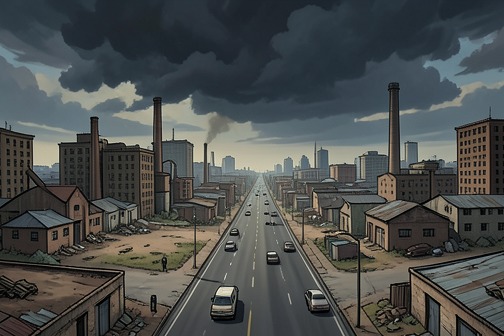
The [Santa Teresa murders](entity:event-recall-event-900707b53c09) are an ongoing series of killings of women that the novel places within the city’s expanding border landscape and its failures of investigation, public attention, and accountability. Their scale is uncertain from the beginning: one account puts the deaths at more than two hundred since [1993](entity:time-recall-time-1993-d7b93468ef23) or [1994](entity:time-recall-time-1994-2c6f52c72808), while allowing that the true total may be considerably higher. The uncertainty is not incidental. It is part of how the murders persist, accumulating across individual cases that institutions repeatedly fail to resolve.
## Background and Scale
[Santa Teresa](entity:location-recall-location-fc0da48b1b60) appears as a city without a stable edge. Its industrial warehouses and maquiladoras stand near slums, abandoned factories, vacant lots, and unpaved streets; highways lead out toward the border, while the city’s neighborhoods spread around industrial parks and dry terrain. The critics driving through it see a place growing by the second. The city’s geography supplies no simple boundary between work, residence, transit, and sites where people can disappear.
The killings also cross the practical boundaries of the border economy. The city has factories and maquiladoras, a steady flow of workers from elsewhere, Central American migrants, and an infrastructure unable to keep pace with demographic growth. Its residents and visitors move between Santa Teresa and the [United States](entity:location-recall-location-united-states-2f533bc8d0b9), while merchandise from maquiladoras crosses the border in trucks belonging to powerful regional families. The murders occur within this dense system of labor and circulation, but the agencies responsible for investigating them do not produce a correspondingly coherent account.
The reported number first reaches the European critics indirectly, through a boy who says that more than two hundred women have been killed. [Jean-Claude Pelletier](entity:character-recall-character-jean-claude-pelleti-ee4823274bfc) and [Manuel Espinoza](entity:character-recall-character-manuel-espinoza-5c3d56673a24) initially cannot take in the figure. Espinoza later reflects that disbelief can function as a kind of exaggeration: listeners signal astonishment even while accepting what they have heard. He revises the scale upward in his own thoughts, considering totals of 250 or 300 and concluding that no one will ever know. The scene makes uncertainty itself a feature of the crisis: the number is repeated, doubted, and enlarged, yet never securely established.
## Investigations and Institutional Failure
The individual cases repeatedly demonstrate how official explanations and procedures narrow what can be known. After radio reporter Isabel Urrea is murdered, the initial coverage offers competing possibilities, including robbery, an impulsive attack, or a perpetrator seeking money to reach the United States. No autopsy is conducted, at the family’s request, and the ballistic analysis is never made public; it is eventually lost while being transferred between the courts of Santa Teresa and [Hermosillo](entity:location-recall-location-4f7f0d63ba67). The case’s unresolved evidence becomes a concrete measure of institutional failure, not merely a gap in public knowledge.
The investigation into Emilia Mena Mena’s death likewise fails to secure its leading suspect. Her boyfriend has disappeared before police reach his family home. Relatives are detained briefly, and officers follow an address in Ciudad Guzman, but the suspect is not found. The case remains open and is soon forgotten. Five days after Emilia’s body is discovered, another woman is found on the grounds of Morelos Preparatory School, where the janitor first notices vultures over a field used by students for soccer and baseball. The next death arrives while the previous investigation is still unfinished.
The pressure of limited personnel further displaces the cases. [Juan de Dios Martinez](entity:character-recall-character-a321f3f58023) is ordered to leave the Penitent investigation and pursue armed robberies in two neighborhoods. He is told that the earlier investigation is not officially closed, but that the suspect appears to have vanished, the inquiry has stalled, and the city has too few investigators to keep officers assigned to watching churches around the clock. The decision turns an ostensibly continuing investigation into a lower priority: other demands for public security take its personnel, while the unresolved case remains nominally active.
The search for the [Huntsville](entity:location-recall-location-f2a55c927b94) sheriff shows how cross-border cooperation can be permitted without becoming a substantive inquiry. The American consul and Santa Teresa’s police chief authorize a review of photographs of unidentified bodies found since November 1994, but none is identified by the sheriff’s assistant. The search produces no resolution. Meanwhile, official attention is shaped by the judgment that it is better not to stir up trouble, and the possibility that the sheriff simply disappeared into the desert is treated as plausible speculation.
## Public Attention and Political Pressure
The murders move in and out of the news according to a recurring cycle. [Chucho Flores](entity:character-recall-character-chucho-flores-c7aa829c6aaf) tells [Oscar Fate](entity:character-recall-character-oscar-fate-3ff30603f701) that each rise in the number of killings briefly revives reporting and public conversation; the story grows until attention subsides and people return to work. Flores compares the killings to a brutal strike, an image that links the recurring deaths to the city’s labor order while emphasizing the rhythm of interruption and normalization. His explanation is starkly answered by his own account of Santa Teresa: a wealthy and poor city of factories, drug trafficking, migration, violence, and an urban infrastructure overwhelmed by growth, with no time to become something else.
Public responses seek to interrupt that cycle but struggle to attract sustained attention. In July, after two women are killed, Women of [Sonora](entity:location-recall-location-sonora-c839a79bc3dc) for Democracy and Peace stages its first protests in Santa Teresa. The organization has only three members in the city, and its effort begins amid a sequence of cases that remains under investigation. By January 1996, its local branch has grown to twenty activists and supporters. At a press conference, members describe the degrading treatment of victims’ families and present letters intended for the state governor and the attorney general. The letters go unanswered. Only two local reporters attend.
The press itself is part of this uneven visibility. When [Klaus Haas](entity:character-recall-character-klaus-haas-a06ea2613d1a) calls reporters to the prison in January 1996, he asks how killings can continue if the accused killer is already behind bars. He points to similarities in the ropes used in two cases and to the fact that one victim had direct contact with him. Yet a newspaper sends a novice crime reporter to cover his claims, while [Sergio Gonzalez](entity:character-recall-character-3f3e38d17323), an experienced journalist who had written about the case, stays in [Mexico City](entity:location-recall-location-mexico-city-78f19f654410) to work on an article about fiction. The episode sets the continuing killings against the limits of both official explanations and editorial attention.
## Suspects, Verdicts, and Continuing Uncertainty
A later press conference produces a much more forceful accusation. Klaus Haas identifies two sons of wealthy families, Antonio and Daniel Uribe, as the serial killers. He describes their family connections, business networks, and association with the narco [Fabio Izquierdo](entity:character-recall-character-fabio-izquierdo-24665344265d), who works for [Estanislao Campuzano](entity:character-recall-character-estanislao-campuzan-6ffaa0b01e9c). The accusation gives the reporters a name and a social structure to investigate: the Uribes are linked to major transport and hotel interests, while their circle includes police officers and narcos. But the force of the claim does not, in itself, settle the wider series or establish that every death belongs to one perpetrator or group.
The later trial of Klaus Haas provides a verdict but not a conclusive end to the uncertainty. In [1997](entity:time-recall-time-1997-83fe85347f22), Lotte Reiter returns to [Mexico](entity:location-recall-location-mexico-6f79111cb935) alone to follow the proceedings. The trial lasts twenty days, and Haas is found guilty of four murders. His lawyer, [Isabel Santolaya](entity:character-recall-character-isabel-santolaya-9f5ef78c729c), tells Lotte that the trial was marred by irregularities and would probably be declared a mistrial; she promises to appeal. Lotte observes that the verdict appears not to affect Haas, who remains distant and cold. The judgment resolves four charges at the trial’s end, but the prospect of appeal and the continuing killings prevent it from serving as an answer to the larger crisis.
## Narrative Significance
The murders are presented not as one self-contained crime with a settled explanation, but as an accumulating field of cases, reports, missing evidence, competing suspicions, and interrupted inquiries. The narrative moves between individual deaths and broader institutional patterns, showing how a case can be briefly prominent, then neglected, while another woman is found before the previous investigation is complete. That structure makes the failure to know—how many were killed, who was responsible, and which institutions could be trusted—part of the event’s meaning.
The border city’s rapid expansion and the murders’ intermittent visibility reinforce one another. Santa Teresa’s industries, crowded movement, poverty, and overloaded infrastructure are described alongside the institutional decisions that leave investigations understaffed or unresolved. The killings persist through that gap between the scale of the violence and the limited, episodic responses to it. When Lotte later tells [Benno von Archimboldi](entity:character-recall-character-benno-von-archimbol-b19f141ab3bf) about Klaus and the murders, the crisis has become inseparable from her family’s immediate uncertainty; the distant public catastrophe enters a private conversation without becoming any more intelligible.
Event 78
Trial of Klaus
The [Trial of Klaus](entity:event-recall-event-0e94f732f33c) is a twenty-day proceeding in [Santa Teresa](entity:location-recall-location-fc0da48b1b60) that ends with [Klaus Haas](entity:character-recall-character-klaus-haas-a06ea2613d1a) convicted of four murders, while continuing killings and reported irregularities unsettle the meaning of the judgment. Told chiefly through Lotte Reiter’s experience, the episode links a courtroom verdict to the unresolved violence around it and to the intimate relationship between Haas and his lawyer, [Isabel Santolaya](entity:character-recall-character-isabel-santolaya-9f5ef78c729c).
## Background and the Case
The trial takes place against a long-running series of murders of women in Santa Teresa. The first officially counted killing described in the record dates to January [1993](entity:time-recall-time-1993-d7b93468ef23): thirteen-year-old Esperanza Gomez Saldana was found in a vacant lot in [Colonia Las Flores](entity:location-recall-location-b67a0a40c0af). Even that starting point is uncertain, since the narrative allows that earlier deaths may have gone unrecorded or that victims were never found. The uncertainty surrounding the count is part of the case’s larger problem: violence is repeatedly converted into partial files, isolated suspects, and incomplete public knowledge.
The handling of individual cases compounds that uncertainty. After radio reporter Isabel Urrea was murdered, authorities circulated explanations including a botched robbery, but no autopsy was performed and the ballistic analysis was eventually lost in transit between the courts of Santa Teresa and [Hermosillo](entity:location-recall-location-4f7f0d63ba67). In another case, after the boyfriend of Emilia Mena Mena disappeared, the investigation remained open but was soon forgotten. These examples establish a setting in which formal proceedings do not necessarily produce reliable resolution.
The broader crisis also competes for attention. [Chucho Flores](entity:character-recall-character-chucho-flores-c7aa829c6aaf) describes a recurring cycle in which rising numbers briefly revive public and press discussion, only for the killings to recede from view as people return to work. He likens the murders to a brutal strike: an image that makes the violence visible as a disruption of ordinary labor, even as the surrounding society resumes its routine. The court case therefore unfolds within an atmosphere of repeated alarm and repeated forgetting.
## Proceedings and Verdict
In January 1996, Haas called another press conference from prison and challenged the logic of treating him as the killer while murders continued. He drew attention to the identical knots in the ropes used to bind Michelle Requejo and [Estrella Ruiz Sandoval](entity:character-recall-character-estrella-ruiz-sando-81faf5c46b7c), and stressed that Estrella was the only dead woman who had had direct contact with him, because of her interest in computers. His intervention put the unresolved pattern of the killings directly against the accusation that his imprisonment had settled the matter.
The trial itself came later. In [1997](entity:time-recall-time-1997-83fe85347f22), Lotte returned to [Mexico](entity:location-recall-location-mexico-6f79111cb935) alone; her Spanish had improved enough for her to speak by telephone with Santolaya. The twenty-day trial passed for her as if in a dream, and Haas was found guilty of four murders. The judgment gave the case a decisive formal outcome, but the account does not present that outcome as an uncomplicated closure.
That night, Santolaya drove Lotte back to her hotel and stayed. Over a drink beside a large window overlooking a tree-lined avenue, the lawyer began to cry. Lotte understood that Santolaya was in love with her son. Before Lotte left Santa Teresa, Santolaya said that the trial had been plagued with irregularities and would probably be declared a mistrial; she promised to appeal. Lotte, meanwhile, thought Haas had not been affected by the verdict and that, in a strange but natural way, he and Santolaya made a good couple.
## Lotte and Santolaya
Lotte’s experience of the trial is shaped by the people waiting outside the legal process as much as by the verdict. On an earlier visit, she learned simple Spanish phrases for greeting the children and older women who accompanied prisoners’ visitors. She bought a shawl and sometimes used it to cover her face when she wept behind Santolaya and the lawyer. The gesture marks the strain of visiting Haas without turning her distress into an explanation of the case itself.
In 1998, after the first verdict was set aside and a second trial scheduled, Lotte asked Santolaya directly whether there was something between her and Haas. Santolaya confirmed it. When Lotte asked whether the relationship was hard for her, the lawyer replied that it was no harder than for Lotte. Lotte distinguished a mother’s bond from Santolaya’s freedom to choose, but Santolaya answered that no one is free to choose in love. She then made clear that she was the one who slept with Haas. Lotte recalled that prisoners were entitled to conjugal visits and understood how the relationship could continue despite his imprisonment.
Lotte told Santolaya that what she was doing for Haas was admirable. Santolaya answered that what Haas gave her was priceless. Before sleeping, Lotte imagined the two of them together in Europe and pictured Santolaya pregnant with Haas’s child. The imagined future is Lotte’s, not a confirmed event; it shows how she accommodates a relationship she had only gradually recognized.
## Retrial and Unresolved Outcome
In 1998, a mistrial was declared and a second trial was scheduled. Lotte traveled to Mexico twice that year and spent forty-five days in Santa Teresa, but the retrial was postponed until 1999. The legal process thus moves from conviction to mistrial without settling the question of Haas’s guilt in the evidence presented here.
The story’s uncertainty is reinforced by the institutions and public narratives surrounding the case. When Santa Teresa’s branch of Women of [Sonora](entity:location-recall-location-sonora-c839a79bc3dc) for Democracy and Peace held a press conference in January 1996, it had only two local reporters in attendance. Its members described the degrading treatment suffered by victims’ families and showed letters they intended to send to the state governor and the attorney general; the letters received no answer. The branch later grew from three members to twenty activists and supporters, but this growth did not itself secure an institutional response.
The trial’s significance lies in the gap between legal finality and evidentiary or social resolution. Haas’s conviction names four murders, while his prison press conference points to killings continuing behind bars; Santolaya’s appeal and the later mistrial reopen the proceeding; and the women’s organization’s unanswered letters expose a wider failure of response. The case is therefore not a self-contained conclusion to Santa Teresa’s violence, but one contested stage in a continuing crisis.
Event 79
Lotte and Archimboldi reunite
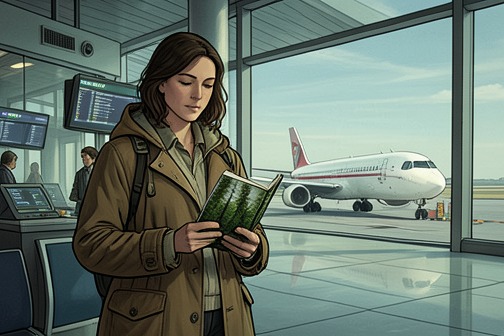
[Lotte and Archimboldi reunite](entity:event-recall-event-2788f77eb93d) after she recognizes her own family in [The King of the Forest](entity:object-recall-object-the-king-of-the-forest-ea8f52f4cb1e), a novel by the brother she has long been unable to find. Her discovery connects his public identity as a celebrated, absent writer to the private history he has transformed into fiction; when he finally appears at her home, the siblings speak through the night about Klaus and the killings in [Santa Teresa](entity:location-recall-location-fc0da48b1b60), without reaching a solution to Lotte’s distress.
## The book on the flight
In 2001, Lotte travels to [Mexico](entity:location-recall-location-mexico-6f79111cb935) to follow the case of her son, Klaus, who is detained in connection with the killings of women in Santa Teresa. At Frankfurt airport, while waiting for her flight to Los Angeles, she buys a book and several magazines. She is not ordinarily a committed reader, and the books she tends to buy are celebrity biographies or accounts by actors and television personalities. This time, by mistake or in her haste, she chooses The King of the Forest, by [Benno von Archimboldi](entity:character-recall-character-benno-von-archimbol-b19f141ab3bf).
The book is fewer than 150 pages long. It describes a one-legged father, a one-eyed mother, and their two children: a boy who likes to swim and a girl who follows her brother to the cliffs. As the plane crosses the Atlantic, Lotte realizes that she is reading part of her childhood. The recognition turns an airport purchase into an encounter with family history, and the flight becomes the point at which Archimboldi’s published work reaches her more directly than any message from its author.
## Recognition and the author’s identity
Lotte finds the novel’s style strange despite its clear, sometimes transparent writing. Its successive stories seem not to lead anywhere; the people and places recede until nature itself appears to dissolve and disappear. During the flight, she reads the book a second time, skipping passages that do not concern her family, house, neighbors, or garden. By the end, she has no doubt that its author is her brother. She briefly considers whether Archimboldi might have spoken with him, then rejects the possibility because the book contains things she believes her brother would never have told anyone. She does not pause over the contradiction that publishing those details has made them available to the world.
The cover offers no author photograph, but it gives a birth year: 1920, the year her brother was born. It also lists numerous books published by the same house and notes that Archimboldi has been translated into twelve languages and has been mentioned for several years as a possible Nobel recipient. In Los Angeles, while waiting for her connection to [Tucson](entity:location-recall-location-tucson-01e85518a44a), Lotte searches airport bookstores for more of his work but finds no other Archimboldi titles. His public literary reputation and his lack of a visible face sharpen the difference between the recognized author and the brother she knows through the details embedded in this one book.
## A call to the publisher
That night in her hotel, Lotte calls the [Bubis](entity:character-recall-character-921e7ac9dc0e) offices in [Hamburg](entity:location-recall-location-hamburg-83eba4856d4b) and asks for the publisher. The secretary says that [Mrs. Bubis](entity:character-recall-character-mrs-bubis-ad40de826c52) is not yet in. Lotte asks that the publisher be told that Lotte Haas, Archimboldi’s sister—or [Hans Reiter](entity:character-recall-character-hans-reiter-71edfa723a3e)’s sister—has called. She later calls back and identifies herself directly to Mrs. Bubis as the sister of both Benno von Archimboldi and Hans Reiter. The two names bring his public literary identity and his family identity into a single conversation, but Lotte is so uncertain what to say that she falls quiet. She is on the verge of tears as she confirms that she is calling from Mexico.
In their conversation, Mrs. Bubis recalls that Lotte was a very blond, pale child and that her mother sometimes brought her to work at the house. Lotte initially cannot place the reference. She then remembers accompanying her mother to the country estate of [Baron Von Zumpe](entity:character-recall-character-baron-von-zumpe-066161f34e2a), where she helped dust, sweep, polish candlesticks, and wax floors. Before Lotte can respond, Mrs. Bubis says she hopes she will hear from her brother soon and ends the call. Lotte remains seated with the phone pressed to her ear, unable to turn this contact with someone from the past into an answer about Archimboldi’s whereabouts.
## The reunion in [Germany](entity:location-recall-location-a3c24dd56e42)
Three months after returning to Germany, Lotte is at home in her nightdress and about to go to bed when the doorbell rings. Asked over the intercom who is there, the visitor answers that it is her brother. Archimboldi has appeared in person, reversing the absence that had led Lotte to seek him through his book and his publisher.
The siblings talk until dawn. Lotte tells him about Klaus and the killings of women in Santa Teresa. She also recounts Klaus’s dreams, in which a giant will rescue him from prison, and remarks that Archimboldi no longer looks like a giant. Archimboldi answers that he never was one. The exchange sets Klaus’s imagined rescuer against the brother who has actually arrived: the dream’s giant promises rescue, while the real reunion offers Lotte someone to tell, but no stated means of changing Klaus’s situation.
## An encounter without resolution
After a long silence, Lotte says that she no longer knows what to do. She feels she lacks strength, understands little, and is frightened by what she does understand; nothing, she says, makes sense. The novel does not present the reunion as a cure for her uncertainty. Archimboldi’s arrival closes the immediate distance between brother and sister, but their conversation leaves the central pressures intact: Klaus remains caught up in the Santa Teresa case, and the killings continue to occupy Lotte’s attention.
The sequence also binds recognition to absence. Lotte first encounters her brother through a fictional account of childhood details she thought private; only afterward does he come to her door. His book provides enough knowledge for her to identify him, but not enough to explain the years of separation or to resolve her present fears. Their nighttime conversation therefore functions as a reunion and a disclosure, while its ending preserves the uncertainty that brought Lotte to seek him.
Event 80
Archimboldi’s departure for Mexico
[Archimboldi’s departure for Mexico](entity:event-recall-event-8722a0de9c3c) begins after an intimate visit with Lotte and takes shape in a pause between family grief and travel: a night in a [Hamburg](entity:location-recall-location-hamburg-83eba4856d4b) park, a paid-for ice cream, and a brief exchange with a stranger who calls the dessert a mysterious legacy. By the next morning, Archimboldi is on his way to [Mexico](entity:location-recall-location-mexico-6f79111cb935), where the novel’s final movement carries him toward his imprisoned nephew, [Klaus Haas](entity:character-recall-character-klaus-haas-a06ea2613d1a).
## The parting from Lotte
Lotte’s questions give the departure its emotional weight. She admits that many things have slipped from her memory, but says she does not forget kind people; she recalls a woman who had treated her well even while her son was rotting in a Mexican prison. Her attention turns from that kindness to the fear that Klaus has no children, no friends, and no one to remember or care for him after she dies. As dawn approaches, she offers Archimboldi tea, coffee, or water and asks whether he will take care of everything. He asks for a beer, which she does not have. The request does not resolve her plea, but it leaves the practical and familial question hanging over his departure.
Archimboldi sits down and stretches his legs; his bones crack. The gesture makes the distance between the siblings’ ages and the journey ahead bodily present, while the conversation has already placed Klaus’s fate between them. The scene ends not with an explicit promise, but with the unresolved question of care that Archimboldi carries away from his sister’s home.
## The night in Hamburg
After leaving Lotte, Archimboldi goes to Hamburg, planning to take a direct flight to Mexico. Because the flight will not leave until the following morning, he walks through an unfamiliar park. Its trees and small paved paths form a temporary stopping place populated by women walking with children, young people skating, and students cycling. He sits on a terrace far from the bar itself, nearly in the woods, and reads while eating and drinking.
The terrace has a particular rule: customers must pay immediately for everything they order. Archimboldi pays for a sandwich and a beer, then orders a Fürst Pückler and pays for that as well. The dessert is defined by its precise combination of chocolate, vanilla, and strawberry—not simply any three flavors. This small, exact routine of ordering and settling the bill gives the pause a self-contained quality: he is already in transit, yet for one evening his attention rests on a book, a meal, and the details of an unfamiliar place.
## A conversation about inheritance
The only other person at the terrace is an elderly gentleman, seated three tables away at a heavy wrought-iron table. He reads a magazine and sips a cappuccino. As Archimboldi is finishing his ice cream, the man asks whether he liked it. Archimboldi says that he did and smiles. The stranger then describes the dessert’s legacy as mysterious. Archimboldi agrees and takes his leave of him, identified in the narration as a descendant of Fürst Pückler.
The encounter is modest, but its placement gives the word “legacy” an echo beyond the dessert. Lotte has just worried about who will remember Klaus when she is gone, while Archimboldi is leaving her to travel toward the country where Klaus is imprisoned. Against that family anxiety, the stranger’s remark links inheritance to a name preserved in a familiar three-flavor confection. The text does not turn the conversation into an explanation or a revelation; it lets the small exchange resonate alongside the unanswered question of remembrance.
## Departure and narrative significance
Soon after the conversation, Archimboldi leaves the park. The next morning, he is on his way to Mexico. The departure is therefore both a concrete journey—with Hamburg as the point of departure and a direct flight planned—and the culmination of the preceding encounter with Lotte. Her appeal about Klaus gives the trip a personal stake, while the quiet park scene delays its onward movement long enough to place family memory beside cultural inheritance.
The ending preserves the uncertainty that has shaped the exchange: Archimboldi has left his sister, Lotte’s question has not received a clear answer, and Klaus remains in a Mexican prison. Rather than supplying a settled resolution, the narrative closes this episode with movement toward Mexico. Its final transition makes departure itself the answer the scene can establish: Archimboldi goes, carrying the unresolved family concern into the journey.