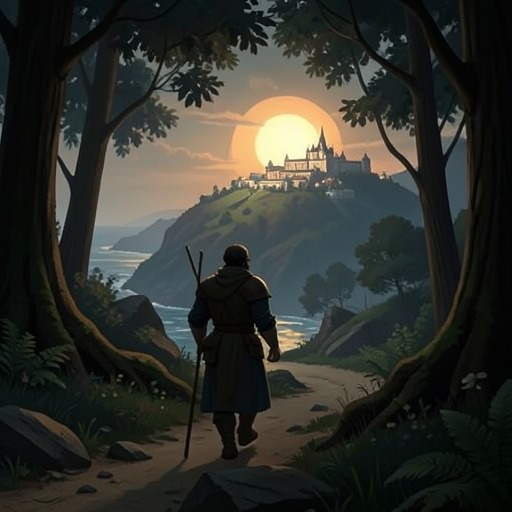
Aeneas mistakenly resides in Crete
AeneidAeneas’s mistaken settlement in Crete is a decisive episode in the Trojan migration because it turns an apparently fulfilled prophecy into a painful recognition of error. The Trojans reach Crete, begin to build a new society, and suffer disease and environmental corruption; only after divine messengers correct their interpretation does Aeneas understand that the promised ancestral land is not Crete but Italy. The episode therefore joins failed colonization, religious interpretation, communal suffering, and renewed obedience to destiny.
The Oracle and the Misreading
The crisis begins with a divine instruction to seek the “mother earth” from which the ancestors derive their birth. The command is deliberately broad enough to invite interpretation, and the Trojans take it to mean Crete. The island is presented as a fertile and famous place, sacred from ancient times to Jupiter, and as a plausible origin for the Trojan race. Its religious prestige gives the error an appearance of legitimacy: Crete is not chosen randomly, but because its sacred history seems to answer the oracle’s language.
The Trojans therefore treat the island as the destination promised by heaven. Their mistake is not simple disobedience. Aeneas and his companions act in good faith, relying on inherited genealogical traditions and on the authority of prophecy. The episode’s dramatic force comes from the gap between sincere obedience and correct understanding. Divine will is present, but it must still be interpreted, and a community can suffer even while trying to follow it.
Arrival and the Founding Attempt
When the fleet finally reaches the promised shore, the Trojans land with joy. Aeneas immediately converts arrival into settlement: he begins to frame a rising town, promotes new marriages among his people, gives laws, and distributes dwellings by lot. These acts establish the principal elements of civic order. Marriage creates continuity, law creates authority, and the allotment of homes turns displaced followers into a structured community with claims upon the land.
The settlement thus briefly appears to offer an end to Trojan exile. Aeneas is no longer merely guiding ships from one coast to another; he is acting as founder and lawgiver. His work also reveals the practical burden of destiny. The future of the Trojan people depends not only on military courage or divine promises, but on the organization of households, property, and public rule. Yet the very completeness of this foundation intensifies the reversal that follows: the town is carefully ordered, but it is built in the wrong place.
Disease and the Failure of the Colony
The settlement’s apparent success collapses under a spreading affliction. Vapors choke the wholesome air, noisome winds corrupt the season, and caterpillars consume the trees. The damage is both environmental and bodily. The land’s air becomes unhealthy, its vegetation is attacked, and the Trojan population is divided between those who die and those who remain burning with fever. The colony’s failure is therefore not caused by a single battle or an enemy assault. Its vulnerability is exposed through the ecology of the place itself.
The disaster also tests Aeneas’s authority. He has supplied laws and homes, but civic arrangements cannot by themselves secure the community against a hostile environment or an incorrectly understood divine command. In response, his father Anchises directs him to return to the shore of sacred Delos and consult the god about the end of their sufferings. Religious inquiry becomes the community’s instrument for diagnosing a crisis that ordinary administration cannot resolve.
Divine Correction and the Road to Italy
At Delos, the Trojans receive a second revelation. Divine figures appear before Aeneas and declare that the answer he sought from the Delian god is being delivered there. They instruct him to change his seat: neither the Delian god nor the messengers has given Crete to the Trojans as their abode. This correction directly overturns the foundation of the Cretan settlement and makes the preceding labor part of a larger pilgrimage rather than a final achievement.
The messengers identify Hesperia, the ancient name for Italy, as the land that must receive the Trojans. They explain that Jasius and Dardanus were born there, and that the Trojans came from that land and must return to it. The revelation transforms the meaning of ancestry. Crete had seemed to be the ancestral source because its sacred reputation matched the oracle; Italy is now shown to be the deeper homeland, the place from which the relevant lineage truly emerged. Aeneas is commanded to rise and bring the glad news to Anchises, then to search for Italy because Jupiter denies Crete to him.
This is the episode’s recognition scene. Aeneas discovers that the obstacle was not the absence of a divine plan but the human misreading of that plan. The failed colony becomes a necessary reversal: its sickness forces a renewed consultation, and the renewed consultation restores the larger route. In the logic of the poem, error does not abolish destiny; it reveals how destiny works through correction, delay, and the painful abandonment of settled hopes.
Significance of the Misplaced Foundation
The Cretan episode gives physical form to the instability of Trojan exile. A community can carry laws, marriages, sacred traditions, and collective memory across the sea, but none of these guarantees that the first habitable land is the destined homeland. Aeneas’s founding activity is genuine and impressive, yet it remains provisional because political order requires more than successful construction: it requires legitimate relation to the land appointed by divine and ancestral history.
The episode also establishes a recurring pattern in Aeneas’s journey. Sacred signs authorize movement, but their meaning emerges only through testing. Settlement is interrupted by plague; confidence gives way to consultation; and apparent arrival becomes another departure. The contrast between Crete and Italy joins the poem’s sacred and political dimensions: divine command determines geography, geography determines the future of the people, and the future depends upon accepting that even a well-governed city may have to be abandoned.
Crete consequently functions as both mistake and instruction. It teaches Aeneas that founding is not merely the act of building walls or distributing homes, and that ancestry cannot be inferred from a superficially suitable tradition. The Trojans must leave the island so that their migration can continue toward Italy, where their wandering will be aligned with the land from which their forefathers came and with the historical destiny awaiting their descendants.