Death of Ankeses
AeneidThe death of Anchises is the central bereavement of Aeneas’s exile, ending the physical presence of the father who has guided the Trojan survivors through catastrophe and wandering. At Drepanum, after storms have driven the fleet across hostile coasts and after “endless labours,” Anchises dies from age and exhaustion. His death is not presented as a single isolated calamity but as the terrible culmination of a journey that has repeatedly saved him only to bring him at last to an irreparable loss.
Causes and Background
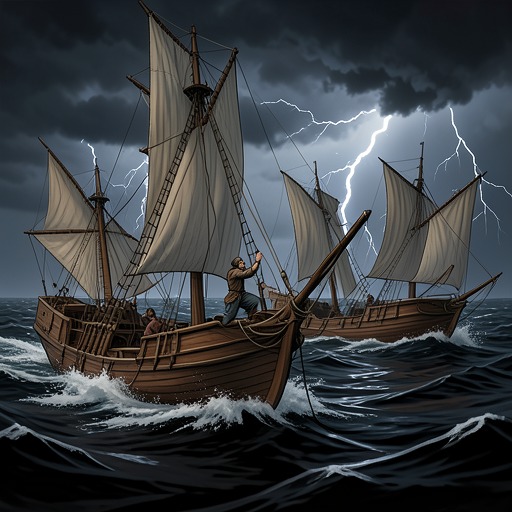
Anchises reaches Drepanum after the fleet has been forced to avoid the Lilybaean shore, whose hidden rocks and shifting sands make it unsafe. The Trojans have already been tossed by raging storms and driven from coast to coast; the arrival at Drepanum therefore offers a brief landing after prolonged maritime danger. The port receives a fleet worn down by travel, while Anchises, described as aged and exhausted, has endured the same succession of ordeals as the rest of the exiles.
The death also carries a prophetic dimension. A prophet had disclosed Aeneas’s future sufferings, yet had concealed this calamity, “the greatest and the worst.” The withholding makes Anchises’s death a revelation through experience rather than foreknowledge: even a journey shaped by prophecy contains a grief that prophecy has not prepared Aeneas to meet. The event exposes the limit of human and prophetic knowledge at the precise moment when the survivors believe endurance may still preserve what they have carried from Troy.
What Happens at Drepanum
The fleet finally reaches the unhappy port of Drepanum after its long exposure to the sea. There Anchises dies of age, and Aeneas records the loss as both the end of his father’s suffering and the destruction of his own chief consolation. Anchises had been saved through a thousand toils, but that preservation proves temporary. The journey has protected him through danger without making him secure against mortality.
Aeneas’s language makes the relationship between them inseparable from the burden of exile. Anchises is not merely a member of the fleet who dies at a stopping place; he is the “dear, dear father” whose presence has eased Aeneas’s cares and offered solace amid pain. His death therefore removes an emotional refuge as well as a family elder. The son remains responsible for the surviving Trojans and for the future represented by Ascanius, but he must now carry those obligations without the father whose endurance had made the wandering bearable.
Immediate Consequences
The death changes the meaning of every later stage of Aeneas’s voyage. Until Drepanum, the fleet’s movement can still be understood as a collective escape in which the old Trojan household travels together. After the loss, Aeneas’s mission becomes marked by absence. The father who had been carried out of the ruins of Troy can no longer accompany the fleet toward Italy, and Aeneas’s survival is now inseparable from mourning.
The bereavement also foreshadows the repeated deaths that surround the Trojan migration. At Cumae, the company soon encounters Misenus lying dead on the shore; in the Underworld, Aeneas meets Palinurus among the newly arrived spirits; later, the narrative presents Pallas’s corpse under the watch of Acoetes and describes the Latins crying out over a fallen chief. These later scenes do not duplicate Anchises’s death, but they return the poem to the problem introduced at Drepanum: voyages, wars, and heroic purposes continually convert living companions into bodies, memories, and names that the survivors must carry.
Later Memory and Narrative Function
Although Anchises dies before the descent into the Underworld, his absence prepares the poem’s most important encounter between Aeneas and the dead. At Cumae, Aeneas reaches the shore and moors the vessels before entering the realm of the dead; the stated purpose of the episode is that the Sibyl will conduct him to his father, who will instruct him in the mysteries of the soul, transmigration, and the glorious line descending from him and his posterity. The physical loss at Drepanum thus becomes the condition of a later meeting in which Anchises returns as a dead father whose knowledge directs the living son.
Their reunion is emotionally charged rather than merely doctrinal. When Anchises sees Aeneas, he welcomes him as the long-expected child of the gods and embraces him with tears. The recognition cannot undo the death at Drepanum, but it changes its final meaning. Anchises is no longer only the aged man whom the sea and years overcame; he becomes a guide to the future that Aeneas must found. The father’s authority survives in another form, passing from physical protection to prophetic interpretation and instruction.
Significance
The event joins private grief to the larger destiny of the Trojan people. Aeneas loses the person who had been his comfort, yet the loss eventually clears the narrative space for Anchises to reveal the future of the race and the imperial order descended from it. The poem therefore refuses to treat destiny as compensation that makes death harmless. The promised future does not preserve the family intact; it advances through separation, delayed recognition, and the conversion of a beloved father into an ancestor.
Anchises’s death is consequently a decisive reversal in the quest plot. Aeneas has survived storms, hostile shores, and repeated displacement, but endurance no longer guarantees preservation. The value of companionship shifts into irrevocable absence, and the hero’s onward movement acquires the discipline of mourning. The later underworld encounter offers not restoration but a sacred continuation of the father-son bond: Anchises can no longer share the voyage, yet his dead voice becomes essential to understanding why the voyage must continue.