Charybdis
AeneidCharybdis is the monstrous whirlpool that guards one side of the dangerous passage shared with Scylla. It embodies the sea as an active, devouring power: not merely a difficult current, but a force that seizes the tides, draws them into its depths, and throws them back with enough violence to make the waves seem to wash the face of heaven. Its presence turns navigation into a matter of disciplined choice, since survival depends on avoiding the nearer monster and accepting a longer course instead.
Identity and Setting
Charybdis presides on the left of the passage, while Scylla lies concealed on the right. The two dangers are presented as opposed but complementary forms of maritime terror. Scylla is associated with a hidden den, open jaws, and monstrous dogs; Charybdis is defined by motion, sound, and appetite. It roars, sucks in the tides, and then expels them from below. The landscape is therefore not passive scenery. Its rocks, currents, and creatures form a single lethal mechanism through which the fleet must pass.
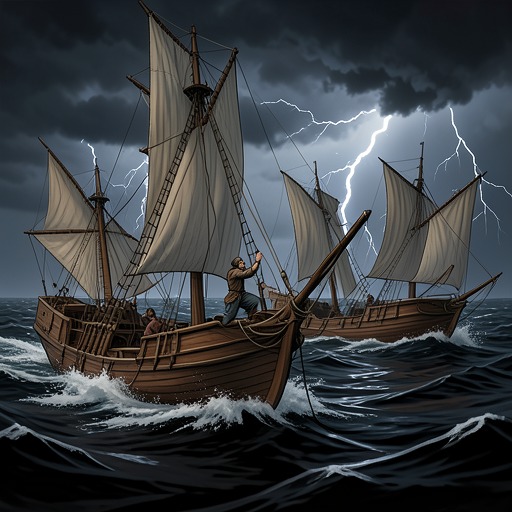
The danger appears after the Trojan galleys have lost sight of land. Around them are only sea and sky, and the threat is intensified by weather: a burst of rain descends, night covers the main with black clouds, and rough winds raise foaming waves. In this setting Charybdis is more than a named obstacle. It becomes the concentrated image of a voyage in which ordinary points of orientation disappear and the travelers must read signs, warnings, and changing waters under conditions of near-total exposure.
Power and Appearance
Charybdis’s defining action is consumption. The whirlpool greedily sucks in the tides, then spouts them upward from beneath the surface. This repeated inrush and eruption creates a vertical violence that overturns the normal hierarchy of sea and sky: water is dragged downward toward an unseen depth and then driven upward until the waves appear to reach heaven. The image joins subterranean force to celestial scale, making the hazard seem capable of disturbing the whole order of nature.
The description also gives Charybdis a voice. Its roaring announces a danger that may be sensed before it can be safely understood, while the surrounding darkness and storm obscure the route by which the fleet might escape. The creature’s horror comes from this combination of appetite and instability. It does not simply block the sailors’ path; it alters the sea around them, making every movement part of a larger suction and recoil.
Encounter with the Trojan Fleet
The fleet’s passage is governed by a practical judgment: it is safer to keep far out at sea and coast Pachynus, even though this causes greater delay, than to approach misshapen Scylla. The route is consequently shaped by comparison rather than by the possibility of complete safety. Charybdis and Scylla create a narrow field of risk in which the sailors must choose the danger that can be given the widest berth.
When the fleet reaches the predicted rocks, Anchises recognizes Charybdis as the whirlpool foretold by the seer and identifies the surrounding dangers. His warning directs the helmsman to bear away toward the open sea. Palinurus turns the fleet to larboard first, and the other ships follow his example. The response is collective and ordered: prophecy supplies recognition, Anchises supplies experienced interpretation, and Palinurus converts that knowledge into navigation.
The maneuver does not make the passage harmless. The galleys ride upward on ridged waves and then plunge downward when the waters divide; three times they strike the stony ground. The fleet survives, but survival is marked by impact and instability rather than by a clean escape. Charybdis therefore functions as a trial of seamanship in which correct obedience reduces danger without abolishing it.
Narrative Significance
Charybdis gives physical form to the recurring vulnerability of the Trojan exiles at sea. Storm, darkness, and hostile waters repeatedly threaten to erase the distinction between forward movement and destruction, while the fleet’s discipline provides the fragile means of continuing toward its destination. The whirlpool’s danger is external to the sailors, but the outcome depends on whether they can recognize the warning, accept delay, and coordinate their actions.
Its contrast with Scylla also establishes a pattern of tragic choice. The Trojans are not offered a route free from loss; they must select a course that postpones danger and limits exposure. The longer passage is preferable because it preserves distance from the visible monster, yet the later grounding of the ships shows that prudence has a cost. In this balance between foresight and unavoidable suffering, Charybdis becomes an emblem of the voyage’s larger logic: destiny may offer a direction, but every advance still passes through hazards that demand judgment, endurance, and sacrifice.