Scylla
AeneidScylla is a monstrous marine guardian of a lethal passage, defined by concealment, hybrid form, and the destruction of ships. In the voyage of Aeneas, she is not merely a fabulous ornament of the seascape: she converts navigation into a severe calculation of risk. To approach her is to place a vessel and its human cargo within the reach of an appetite that the poem presents as both physically violent and grotesquely unnatural.
Lair and Monstrous Form
Scylla hides far to the right of the passage, in a den associated with foul dogs. Her danger begins before any attack is visible: the creature is concealed, while the surrounding waters already threaten to draw a ship from its course. Her body violates ordinary categories. Above the waves appears a human face and a virgin breast, but below the water her form descends into an obscene tail enclosed by dogs, ending in a dolphin. The contrast between the attractive or recognizably human upper body and the bestial lower form makes Scylla a figure of unstable boundaries, in which the familiar becomes the surface of a predator.
Her physical design also makes the sea itself difficult to separate from the creature. Scylla is hidden in a den, yet her attack operates through an eddy that takes hold of a vessel; the monster is therefore both an inhabiting body and a force of the environment. The ship does not encounter a single visible opponent in open combat. It is drawn into a space where rock, whirlpool, animal mouths, and distorted anatomy cooperate in destruction.
The Passage and Its Double Peril
Scylla occupies one side of a maritime danger paired with Charybdis. Charybdis roars on the left, greedily sucking in the tides and then spouting them upward until the waves seem to wash the face of heaven. Scylla answers this vertical violence with a more targeted assault: she draws the sinking vessel into her eddy and then dashes it against the rocks. One threat swallows and expels the sea; the other captures a ship and breaks it. Together they make the passage a structural opposition between vast natural upheaval and monstrous predation.
The poem’s practical judgment is unequivocal. It is safer to keep out to sea and coast Pachynus, even though that route causes more delay, than to come near Scylla. The advice gives the monster a concrete navigational consequence. Scylla is not defeated, appeased, or confronted; survival consists in accepting inconvenience and distance. Her power is thus measured by the route she forces travelers to abandon.
Helenus’s Warning and the Trojan Voyage
The danger remains active after the first description because Helenus has warned the Trojans about it. Forewarned, they labor at every oar and raise every sail to take advantage of a friendly wind, specifically striving to avoid Charybdis’s gulf and refusing to run toward Scylla. The warning transforms mythic knowledge into collective seamanship. The Trojans respond not with a heroic contest against the creature but with disciplined movement, using speed, wind, and altered course to pass beyond the reach of both perils.
This episode gives Scylla a recurring place in the logic of the voyage. Even when she does not appear again in an attack, her remembered presence governs action. The crew’s route is shaped by what she could do, and the possibility of an equal fate on either side makes every decision provisional and anxious. The monster therefore acts through anticipation as much as through direct violence.
Narrative and Symbolic Significance
Scylla represents a form of nonhuman power that cannot be absorbed into human intention. She is not presented as a companion, ally, or moral interlocutor, and the evidence does not grant her a human voice or an independent account of her motives. Her narrative agency lies instead in her capacity to alter the behavior of those who pass near her: sailors must recognize her territory, interpret the signs of danger, and choose a longer route. The episode consequently places human survival within limits imposed by an inhuman environment.
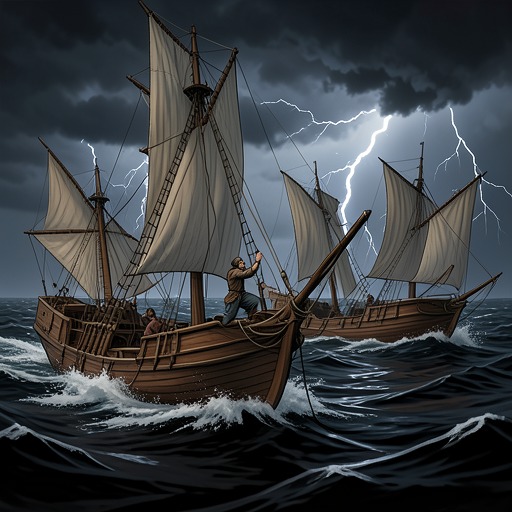
Her hybrid body intensifies the poem’s broader concern with unstable borders. The sea is neither a neutral road nor a simple obstacle; it contains forces that blur the distinction between landscape and living predator. Scylla’s human face and virgin breast promise recognizability only to expose the violence beneath it, while the dogs enclosed in her lower form turn the creature into a moving threshold between woman, beast, and sea. In contrast with the storm that surrounds the galleys elsewhere, Scylla gives catastrophe a body, a den, and a direction.
Memory, Fear, and the Discipline of Escape
Scylla’s lasting importance comes from the fact that she makes avoidance itself an achievement. The Trojans’ progress depends on heeding Helenus rather than treating danger as an occasion for reckless proof of courage. Their success is therefore practical and communal: knowledge is received, the ship is worked, and the dangerous alternatives are left behind. The creature remains undefeated, but the voyage continues because her power has been correctly understood.
In this sense, Scylla marks the boundary between exploration and survival. The traveler who approaches her seeks no revelation that the poem can safely provide; the proper response is to keep away. Her legend gives visible shape to the costs of misjudgment, while her continued place in the sailors’ calculations shows how an unseen threat can govern a journey as effectively as a visible enemy. Scylla’s defeat is not her destruction but the preservation of those who learn to pass beyond her reach.