Shield of Aeneas
AeneidThe Shield of Aeneas is the central artifact of divine craftsmanship and historical prophecy in the epic. Forged by Vulcan at Venus’s request, it is made to sustain Aeneas in war, yet its deeper power lies in the images worked across its surface: Roman triumphs, the Julian line, and the decisive naval conflict led by Young Caesar. The shield therefore makes future history present to its bearer, converting a weapon into a portable vision of Roman destiny.
Divine Forging and Physical Function
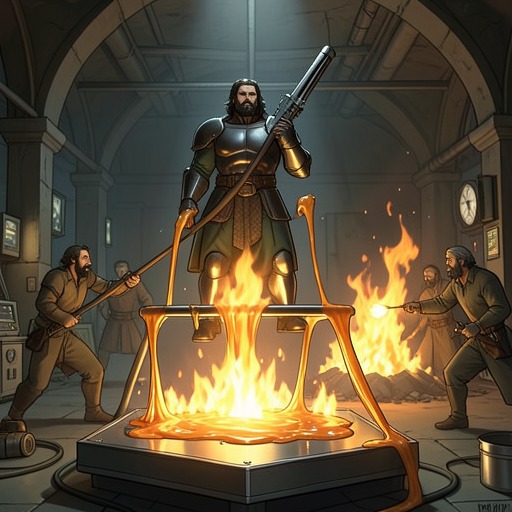
Vulcan interrupts his smiths’ ordinary labor when he commands them to set their tasks aside and prepare arms for a hero. The order demands their strength, speed, and “forming fire,” and the forge responds with a flood of molten silver, brass, gold, and deadly steel. From this mixture the craftsmen produce a shield “Alone sufficient to sustain the war,” establishing its practical role as armor capable of preserving Aeneas amid the violence that awaits him.
The shield’s construction is presented on an unusually grand scale. Its inner design contains seven orbs enclosed within a spacious round, suggesting that the object is not merely a flat defense but an ordered cosmos of concentric images. Vulcan’s workmanship gives material form to events beyond the ordinary human horizon: the smith has been taught the sequence of future wars and the divine race of warriors who will issue from the Julian line. The object thus possesses both bodily and temporal architecture, protecting Aeneas while also enclosing the history his mission will bring forth.
The Historical Vision Embossed in Gold
When Aeneas receives the shield, he admires above all its mysterious design and the Roman triumphs rising upon the gold. The emphasis falls not on decoration but on revelation. The images are arranged as wars in order, and they trace the succession of warriors descended from the Julian line. History appears here as a divinely organized sequence rather than as an accidental accumulation of battles; the shield gives visible shape to a future that Aeneas cannot yet fully understand.
The scenes draw together several layers of heroic and sacred memory. Elsewhere in the epic, the poem recalls Ripheus and Iph’itas fighting beside the defenders of Troy, the ancient heroic race of Teucer, and the first inhabitants of Grecian blood who dedicated a forest to Silvanus. Set against those earlier figures and sanctified origins, the shield’s Roman imagery places Aeneas within a long genealogy of warriors, founders, and ritual communities. Its historical vision does not erase the older heroic world; it absorbs and reorders that inheritance toward Rome.
The shield’s most prominent historical scene is the naval battle in which two mighty fleets meet with equal fury, their bronze beaks opposed across the waters of Actium and Leucate. Young Caesar stands upon the stern, armed brightly and leading the Romans and their gods into combat. His radiant temples and naval crown associate military command with auspicious fortune, while the crown itself foreshadows victory. Opposite him, Antonius brings barbarian auxiliaries and troops of Eastern kings, including Arabians and Bactrians from distant regions. The image therefore presents the conflict as more than a contest between individual commanders: it opposes Roman order, divine support, and imperial succession to a coalition marked by foreign distance and heterogeneous power.
Vulcan’s workmanship is joined to Venus’s purpose. The shield is forged by Vulcan and brought to Aeneas by Venus, making maternal protection and divine manufacture part of the same act. Its scenes exceed what Aeneas can know from personal experience, but the poem grants the artifact an authority unavailable to ordinary memory. The future has already been shaped in metal before it is enacted in the world.
Aeneas’s Encounter with the Object
Aeneas receives the shield with joy and wonder. His response is emotional as well as intellectual: the artifact fills him with astonishment because it displays a history whose full meaning lies beyond his immediate life. He does not read it as a detached historian; he encounters it as the man who must carry its promise into the uncertain struggle of Latium.
That encounter changes the meaning of armor. The spear and greaves answer the body’s need for combat, and Aeneas eagerly tests the pointed spear and the plated armor upon his thigh. The shield, however, commands the greatest admiration because it contains the mysterious pattern of Roman triumphs. His martial readiness is therefore inseparable from a historical image. He goes toward battle not simply as a survivor of Troy or an exile seeking settlement, but as the bearer of a future already represented as victorious.
The artifact also compresses time. Troy’s threatened walls, the remembered heroism of figures such as Ripheus and Iph’itas, the ancient lines of Teucer and Assaracus, and the later Roman victory at Actium occupy one imaginative continuum. The shield allows the poem to place the remote past, Aeneas’s present, and Rome’s future into a single visual field. Its wonder comes from that simultaneity: the hero holds in his hands scenes that the narrative world has not yet reached.
Destiny, Victory, and Historical Meaning
The Shield of Aeneas embodies the epic’s movement from Trojan ruin to Roman foundation. Its material contains destructive metals, and its images are filled with war, yet the object is not presented as an emblem of violence alone. It is a vessel for ordered succession. The wars are arranged, the Julian line continues, and Roman triumph emerges as the culmination toward which the shield’s imagery directs attention.
The Actium scene gives this destiny a particularly political form. Young Caesar leads Romans and their gods, while Antonius commands eastern and barbarian forces. The contrast makes victory signify the consolidation of Roman authority, not merely success in battle. The shield turns that later triumph into part of Aeneas’s inherited mission, linking the hero’s struggle in Latium with the imperial future that will arise from his line.
Its significance is heightened by the fact that Aeneas cannot possess complete interpretive mastery over what he carries. The images are divinely wrought and “not in the rolls of future fate untaught,” but their knowledge belongs first to the gods and the poet. Aeneas’s wonder marks the distance between human action and providential design. He can bear the shield, fight beneath its images, and become the ancestor of the future it portrays without seeing the whole historical meaning at once.
The shield consequently serves as both protection and proclamation. It protects the hero in the immediate war, while proclaiming that his struggle belongs to a larger Roman imperial destiny. Its gold does not simply shine; it makes political history visible as sacred inheritance. By carrying it, Aeneas carries the poem’s answer to the problem of exile: the shattered past is not restored, but transformed into a future whose triumph has already been imagined, forged, and placed in his hands.