¿Lo hice yo
Amadeus¿Lo hice yo? is the question at the heart of Antonio Salieri’s staged confession: whether he caused Wolfgang Amadeus Mozart’s death, and what it means to claim responsibility for destroying a rival’s art. Presented as the subtitle of Salieri’s supposed final composition, La Muerte de Mozart o ¿Lo hice yo?, it turns an apparent confession into a problem of authorship, performance, and self-fashioning. The play’s answer remains deliberately unstable: Salieri calls himself Mozart’s assassin, but also declares that he has made the murder story up to secure a lasting place in history.
Title and Confession
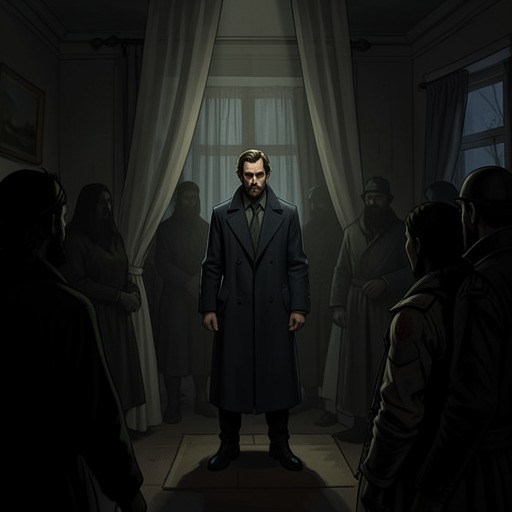
Salieri introduces the work as a one-night performance dedicated to posterity on the last night of his life. Its title supplies the question before the story of his rivalry has been staged, inviting the audience to hear what follows as testimony while reminding them that testimony is also theatre. At the frame’s opening, after thirty-two years, Salieri addresses Mozart by name and asks forgiveness as the man who killed him. The pause that follows leaves the onstage citizens looking at Salieri, then at one another; the confession produces attention, but not an unambiguous verdict.
The question’s force comes from the discrepancy between that public posture and Salieri’s later explanation. At dawn, back in his apartment, he says he has spent the week crying out his crime and has arranged for his servants to carry the news into the street. As the murmurs of his name grow louder, he announces that the world will believe the lie forever. In his design, every future loving mention of Mozart will be accompanied by Salieri’s name in hatred. The title therefore does not simply ask the audience to solve a murder; it asks how much of Salieri’s apparent guilt is an act devised to make his name inseparable from Mozart’s.
A Pact and a Rival
The subtitle also echoes the origin story Salieri gives for his ambition. At sixteen, he says, he knelt before an image of God and bargained to become a famous composer in return for a virtuous life, service to humanity, and music offered in God’s honor. The next day a family friend took him to Vienna and paid for his musical studies; soon afterward, the Austrian emperor became his protector. Salieri interprets this rapid advancement as evidence that his pact has been accepted. In the same year he left Italy, he recalls, the ten-year-old Mozart was touring Europe as a virtuoso. The title’s question thus grows out of a conflict Salieri understands as both personal rivalry and a dispute over the meaning of his own success.
Salieri distinguishes the thought of killing Mozart physically from the attempt to defeat him in art. After Mozart leaves with the score of Salieri’s welcome march, Salieri wonders whether that was the moment he began to think of murder, then answers that physical death was not yet what he meant. Artistically, however, he had already imagined composing a great tragic opera on the legend of Danaius, a man chained to a rock for eternity and repeatedly struck by lightning. Salieri maliciously pictured Mozart in that position, while emphasizing that Mozart was not then in physical danger. The distinction makes the subtitle more than a question about a single act: in Salieri’s account, harm can mean an imagined artistic defeat, a real career obstruction, or the literal killing suggested by his confession.
Art, Institutions, and Agency
The episodes Salieri recounts place artistic achievement inside court decisions about language, genre, and performance. At Schönbrunn Palace, Johann von Strack conveys Joseph II’s request that Mozart be commissioned to write a comic opera in German. Count Orsini-Rosemberg objects that Italian is the only proper language for opera, while Gottfried van Swieten questions whether music should be comic at all. The disagreement makes Mozart’s work a test of who has authority to define opera: the emperor’s wish for a national German-language work, the director’s preference for Italian, or the composer’s own creative choices.
A related conflict surrounds The Marriage of Figaro. Van Swieten condemns Mozart’s chosen subject, the play by Beaumarchais, as an unworthy use of his talent; Mozart answers that he wants an opera about real people in a real place, describing the boudoir and its intimate everyday objects as dramatically compelling. Later, when the dance music has been cut, Joseph II arrives just as the dancers perform in silence. After asking whether the music is modern, he orders Count Orsini-Rosemberg to restore it and insists on hearing Mozart’s music complete. The episode shows that the power to make or unmake an artwork is distributed among composer, court, and theatre officials. It gives the title’s question a practical dimension: Salieri’s story is set amid repeated struggles over who gets to shape Mozart’s work and how fully it can reach an audience.
Infamy and the Final Meaning
In the final scene, Salieri’s strategy becomes explicit. He believes that a horrible death and a widely repeated accusation will make him immortal, not through fame equal to Mozart’s, but through infamy attached to Mozart’s name. He presents this as defiance of a God who has denied him the absolute artistic possession he desired. He says that he knew God only when listening to music and could worship only by composing it; because that surrender was denied him, he claims, life lost its meaning. His proposed identity as the patron saint of mediocrities turns private disappointment into a public role he hopes others will invoke.
The last gesture binds the title’s uncertainty to the theatrical frame. Salieri takes a razor and cuts his throat, while servants and a cook enter and the murmurs of his name swell. His suicide attempt is real within the scene; the murder story, by his own account, is deliberately fashioned. The audience is left to distinguish the death it has witnessed from the killing he has claimed, and to recognize that even a confessed crime can be used as a performance. ¿Lo hice yo? remains both accusation and strategy: Salieri seeks forgiveness from Mozart, but he also wants posterity to remember him whenever Mozart is remembered.